
§ 41 — Use-case analysis
Why ChatGPT Fails for Supply Chain Planning — and the Fix
General-purpose LLMs like ChatGPT struggle with quantitative supply chain tasks such as demand forecasting and inventory optimization. This article explains the architectural reasons behind that failure and outlines the capabilities of purpose-built AI platforms that deliver reliable, data-driven planning outcomes.
- Function
- demand-forecasting, inventory-optimization
- AI technique
- generative-ai
- Failure pattern
- quantitative-reasoning-failure
- Evidence source
- Blue Yonder (2024), Omnifold (2025)
If ChatGPT is not working for supply chain AI, the first thing to check is not the prompt. It is the job being handed to the model. A tool can write a clean explanation of safety stock and still fail when asked to calculate it, defend the assumptions, absorb a promotion calendar, or adjust a forecast after actual demand arrives.
That mismatch showed up clearly in a Blue Yonder benchmark published in December 2024. In vendor-conducted research, Blue Yonder tested large language models against APICS Certified Supply Chain Professional-style material. With no additional context, the models scored 48.30%; with retrieval-augmented generation, the score rose to 79.71%. The improvement matters, but so does the failure pattern: the models struggled most with mathematical reasoning and domain-specific supply chain logic, and even adding code-writing capability improved math accuracy by only about 28%.[1]

Blue Yonder sells supply chain software, so the benchmark should not be treated as neutral academic evidence. Still, the result is useful because the weak spots are familiar to anyone who has watched a planning demo turn into manual cleanup. The model can sound fluent on service levels, buffers, lead times, and demand variability. Then the planner has to decide whether the number can survive a Monday operations review.
The Failure Is Polished, Which Makes It Worse
The problem is not that ChatGPT always returns obvious nonsense. Obvious nonsense is easy to reject. The operational risk is the confident answer that looks finished enough to circulate.
Steve Banker described this in Forbes after testing ChatGPT on supply chain prompts. The output was “well written but fluff,” and some claims “could not be verified” through web search.[2] That is a small phrase with a large planning consequence. A shallow paragraph in a slide deck wastes time. A shallow paragraph attached to a replenishment recommendation creates reconciliation work for someone who now has to prove why the model’s answer should not be trusted.
John Galt reported a similar pattern in an expert evaluation of ChatGPT’s supply chain planning answers. The assessment was that the responses were “basic — the responses you’d expect” and sometimes “off the mark but delivered in a convincing way.”[3] That is not a harmless limitation in planning. A basic answer can be worse than no answer when it arrives with the tone of a system that appears to know what it is doing.
This is where many ChatGPT experiments in supply chain stall. The model can draft a training note, summarize a policy, explain a term, or help a planner turn rough notes into a cleaner email. Those are legitimate uses. They are also text tasks. Demand forecasting, inventory optimization, allocation, and safety stock design are not text tasks just because the user typed the request into a chat box.
| ChatGPT can help with | ChatGPT should not own |
|---|---|
| Drafting training materials | Generating the official demand forecast |
| Summarizing planning policies | Calculating safety stock for execution |
| Creating first-pass documentation | Optimizing inventory across locations |
| Answering basic terminology questions | Detecting demand anomalies from live operational data |
| Rewriting meeting notes or exception explanations | Closing the feedback loop after actuals arrive |
Next-Word Prediction Is Not Demand Forecasting
A large language model predicts likely text. It learns patterns in language and generates a plausible continuation. That architecture is powerful for explanation, summarization, translation, and drafting. It is not the same thing as estimating future demand distributions, optimizing inventory under constraints, or learning from forecast error by SKU, location, channel, season, and promotion state.
Omnifold, which markets AI forecasting technology and therefore has its own commercial interest, makes the architectural critique plainly: LLMs are designed for next-word prediction, not numerical optimization. Its analysis also points out that chat interfaces are reactive, waiting for a user to ask a question, while supply chains need systems that proactively detect anomalies and trigger decisions before a planner notices the miss.[4]
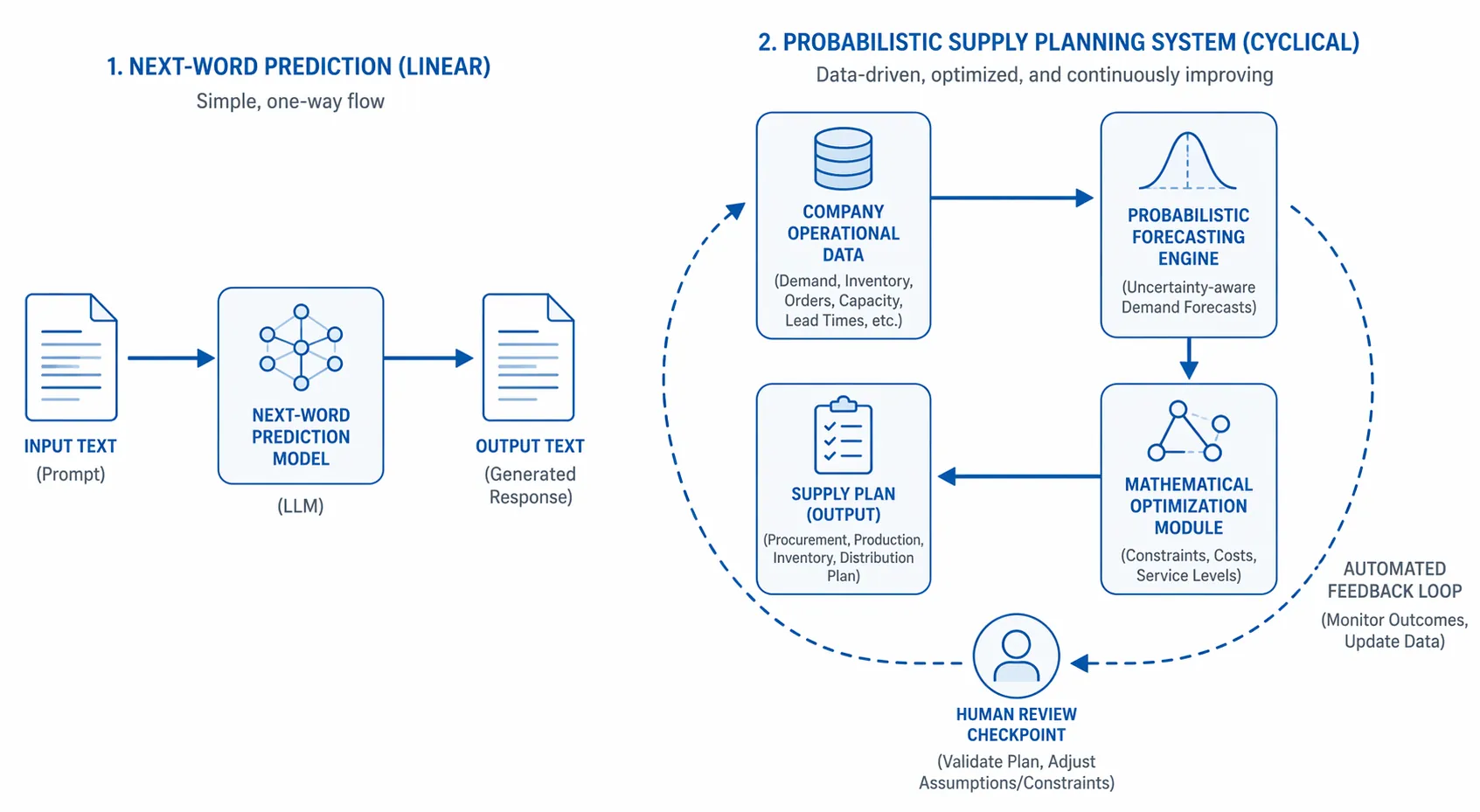
The distinction sounds technical until it lands in a planning meeting. A language model may infer from wording that a higher service level usually requires more inventory. A planning system has to calculate how much inventory, where it should sit, how demand variability changes the buffer, what supplier lead-time uncertainty does to the reorder point, and whether the working-capital tradeoff is acceptable. The former produces an answer-shaped object. The latter produces a decision that can be audited.
Better prompting can reduce ambiguity. It can force the model to show assumptions, ask for missing inputs, or structure the answer. It cannot turn a general-purpose language model into a probabilistic forecasting engine. If the model is not connected to clean operational history, not trained on the company’s demand behavior, not optimizing under constraints, and not comparing its prior forecast with actual results, the prompt is only improving the packaging.
The Fix Is a Different System, Not a Better Chat Window
A supply chain AI platform that can be trusted for planning work has to do several things ChatGPT is not built to do by default. It needs access to company-specific operational data: order history, shipments, inventory positions, lead times, lost sales signals, promotions, substitutions, constraints, and master data quality problems. It also needs to know when those inputs are stale, incomplete, or contradictory.
It then needs probabilistic forecasting, not a single polished sentence about what demand “will” be. Planners do not only need a point estimate. They need a range, a confidence level, and visibility into the drivers that make the forecast fragile. A launch, a weather-sensitive category, a supplier delay, or a one-off customer order should not be flattened into the same kind of narrative.
Optimization is the next dividing line. Planning is full of constrained choices: service level versus working capital, capacity versus expedite cost, store availability versus warehouse inventory, forecast accuracy versus forecast bias. A useful system has to evaluate tradeoffs mathematically and show the consequence of changing the target. A chat answer that says “increase safety stock for volatile items” does not solve the allocation problem.
Integration matters just as much as the model. If the AI sits beside the ERP, APS, WMS, or demand planning system as a separate chat window, someone still has to copy, reconcile, approve, and explain the result. That person usually becomes the hidden control layer. The work may look automated in a demo while remaining manual in the actual planning cycle.
What the replacement path has to include
- Company-specific data pipelines that connect to operational systems rather than relying on pasted excerpts.
- Probabilistic forecasting that exposes uncertainty instead of hiding it behind a single confident answer.
- Mathematical optimization for inventory, replenishment, allocation, and service-level tradeoffs.
- Automated feedback loops that compare forecasts and recommendations with actual demand, inventory movement, and service outcomes.
- Workflow integration so planners review exceptions, approve critical decisions, and understand why the system changed its recommendation.
That last point is not a concession to old habits. It is how accountability survives automation. RELEX’s State of Supply Chain 2026 research found that only 10% of supply chain leaders trust AI to make critical decisions without human review, while 54% prefer a human-in-the-loop model.[5] That statistic should not be read as resistance to AI. It is a fairly sober statement about where operational trust is in 2026.
Human review also has to be placed carefully. If every recommendation needs manual checking, the system has not reduced planning load; it has changed the shape of the queue. If no critical recommendation needs review, the organization may have removed the very control that catches bad master data, unusual demand, supplier exceptions, and commercial context the model cannot see. The useful middle is exception-based governance: automate routine decisions where the system has earned trust, escalate material changes, and keep assumptions visible enough that planners can challenge them.
Purpose-Built Does Not Mean Automatically Reliable
Switching from ChatGPT to a supply chain AI platform addresses the architecture problem. It does not fix weak data ownership, inconsistent item-location history, promotion calendars that live outside the planning system, or governance that cannot decide who approves an override. A purpose-built platform can forecast, optimize, integrate, and learn only to the extent that the operating environment lets it.
That is why the better vendor question is not “Do you use AI?” It is “What data does the model train on, what uncertainty does it expose, what constraints does it optimize against, how does it learn from misses, and where does the planner intervene?” The answers separate planning software from a fluent interface wrapped around the same manual process.
A credible implementation also needs a test design that planning teams can defend. Run the system against historical periods with known disruptions. Compare forecast bias and service outcomes, not only forecast accuracy. Check whether recommendations remain stable when master data is corrected. Track how many exceptions planners review and how many they override. If the pilot only measures whether users liked the explanation, it is evaluating the chat layer, not the planning capability.
Where ChatGPT Still Belongs
There is no need to ban general-purpose LLMs from supply chain work. They can help planners document exception rationales, draft training content, translate SOPs, summarize meeting notes, clean up supplier communications, and explain planning concepts to new team members. They can also help analysts explore questions before the actual quantitative work begins.
The boundary should be explicit. ChatGPT can help write about the forecast. It should not be the forecast. It can help explain why safety stock exists. It should not be the system of record for safety stock. It can help a planner prepare a narrative for a demand review. It should not replace the model that calculates the demand plan being reviewed.
For teams trying to fix a failed ChatGPT supply chain AI experiment, the practical answer is therefore narrower than the hype and less glamorous than the demo. Keep the language model where language is the work. Move planning decisions into systems designed to forecast, optimize, integrate with operational workflows, learn from actual outcomes, and keep humans in control where the decision is material.
References
- Can ChatGPT Pass the Supply Chain Test?, Blue Yonder, December 2024.
- The Potential (And Peril) Of ChatGPT In Supply Chain Applications, Forbes, June 2023.
- How Much Does ChatGPT Know About Supply Chain Planning Technology?, John Galt Solutions.
- Why ChatGPT Won’t Fix Your Demand Forecasting Problems, Omnifold, June 2025.
- Supply chain AI in 2026: The numbers behind the hype, RELEX Solutions.
§ 42 — Cited evidence
Flag an inaccuracy or submit a comparable account — Contribute or read how claims are verified in Methodology.