
§ 41 — Use-case analysis
Parts Shortages, Not Defects, Drive Ford Bronco Recall Delays
Ford's 2026 Bronco recall portfolio reveals that replacement part shortages — not defect identification — are the primary cause of long remedy wait times. This use-case analysis examines how multi-tier supplier visibility gaps create inventory bottlenecks that undermine even well-engineered recall campaigns.
- Function
- inventory-optimization
- AI technique
- optimization
- Failure pattern
- supplier-visibility-gap
- Evidence source
- Hearn Law Firm Ford Recall Statistics, AMS/ABB Automotive Manufacturing Outlook Survey 2025
The July 2025 Ford Bronco fuel pump recall is the case that makes the phrase “recall announced” feel unfinished. The campaign, identified as NHTSA 25V455, covered about 110,000 Broncos. More than 12 months later, as of July 2026, the remedy was still listed as unavailable in Hearn Law Firm’s analysis of NHTSA recall data.[1] Owners were not waiting because the defect had been missed. They were waiting because the repair could not yet move through the parts channel.
That distinction matters for anyone looking at Bronco recall delays as an operating problem rather than a headline count. A safety issue can be found, a campaign number can be assigned, and an owner notification can be sent while the replacement pump, sensor, harness, shock, or software package still has no practical path to the dealer bay. The recall exists on paper before the remedy exists at scale.
Bronco Nation forum discussions around the low-pressure fuel pump campaign give the owner-side version of the same gap: open recalls, no parts, and no useful date.[2] Forum threads are anecdotal, not a completion-rate dataset. Still, they line up with the more important operational fact: the largest Bronco case in this set was old enough by July 2026 to show that announcement timing and fulfillment timing had separated.

The Bronco Cases Point to a Parts Workflow, Not Just a Recall List
The fuel pump case is not the only Bronco-related campaign where the waiting point sits downstream of defect identification. The April 2026 occupant classification system sensor recall, listed as NHTSA 26V201, affected 3,170 Ford Bronco Sports and Mavericks. The remedy parts were anticipated for November 2026, creating an expected lead time of about seven months from the April recall notice to parts availability.[3]
The rear shock absorber recall shows the same operating discomfort in a shorter phrase: no ETA for parts. Available reports identify it as affecting specific 2021–2024 Bronco trims. Without a dated parts release, the dealer cannot schedule work with confidence, and the owner cannot distinguish a temporary supply delay from an open-ended campaign.
The July 23, 2026 rear camera and wiring harness campaign needs more care. Bronco6G identifies the campaign as 26S55 for 2021–2026 model-year Broncos and describes an engine-compartment wiring harness repair.[4] Motor1 separately reported a Bronco fire-risk recall involving 566,000 vehicles and 15 fires before the recall was issued.[5] Wiring harness and camera issues can involve remedy-design complexity as well as parts logistics, so it would be too neat to call every day of delay a supply-chain failure. But once a harness repair is defined, the same question returns: can the network produce, allocate, and install the fix fast enough?
| Bronco-related recall | What was known | Where the delay shows up |
|---|---|---|
| Fuel pump recall, NHTSA 25V455 | About 110,000 Broncos affected; July 2025 campaign | No remedy available more than 12 months later as of July 2026, according to Hearn Law Firm analysis of NHTSA data[1] |
| OCS sensor recall, NHTSA 26V201 | 3,170 Bronco Sports and Mavericks affected; April 2026 notice | Parts remedy anticipated for November 2026, about seven months later[3] |
| Rear shock absorber recall | Specific 2021–2024 Bronco trims affected | No ETA for parts in available reports |
| Rear camera / wiring harness campaign, 26S55 | July 23, 2026 campaign for 2021–2026 Broncos | Software and harness repair path pending, with both design and fulfillment uncertainty[4] |
The Bottleneck Chain Is Boring Until It Is Expensive
A recall-parts workflow has a sequence that is easy to compress in public language and difficult to execute in a service network. First, a defect or safety issue is identified. Then the recall is announced. Engineering defines or anticipates a remedy. Procurement and suppliers have to make the replacement component real at volume. Parts distribution has to put it in the right places. Dealers have to schedule the work. Only then does the completion rate move.
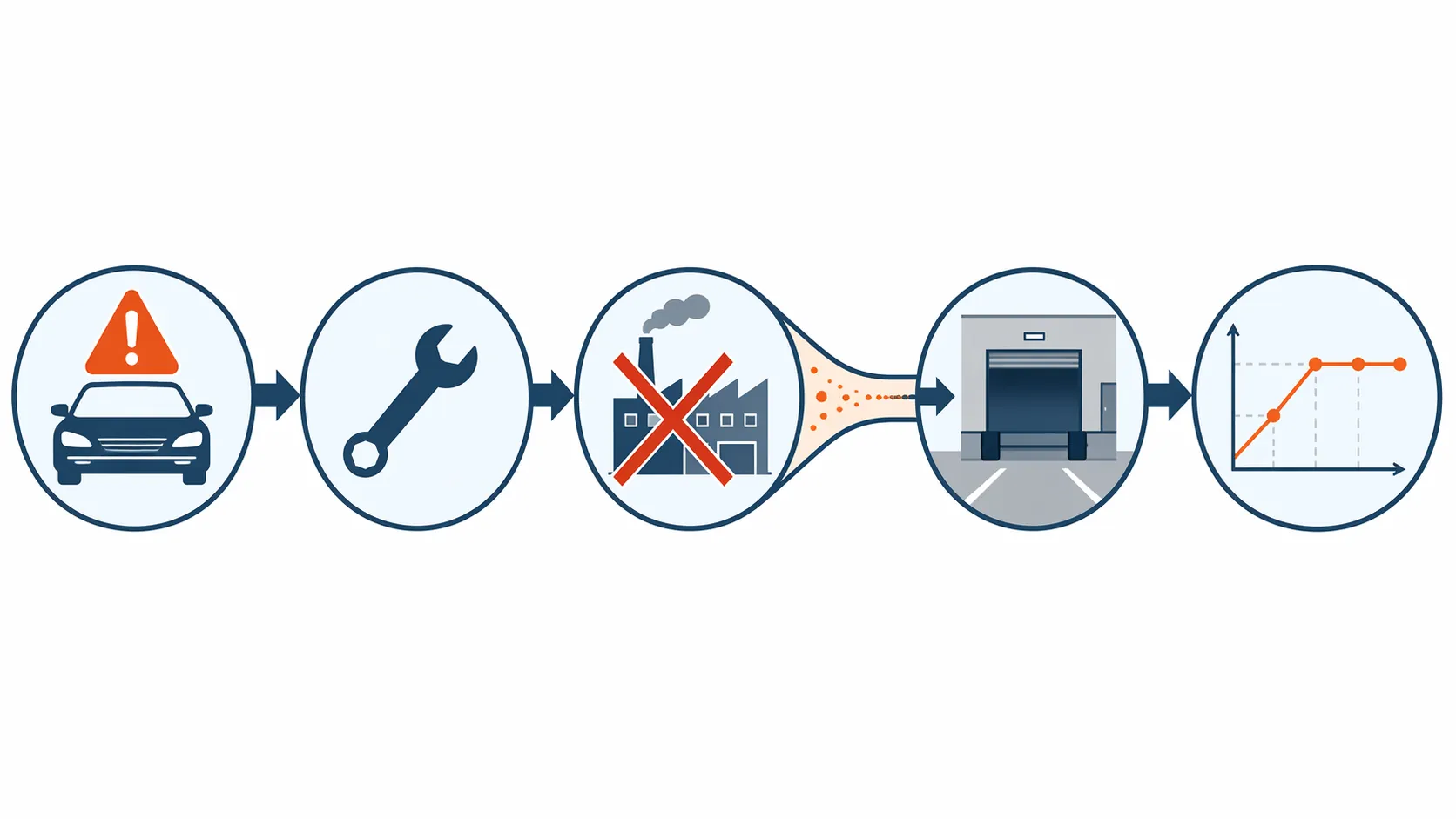
The public notice usually appears near the front of that chain. The burden lands later. A dealer cannot repair a fuel pump recall with an explanatory letter. A service adviser cannot close an OCS sensor campaign with a future parts month. A regional parts manager cannot allocate a wiring harness that has not been released, validated, produced, and shipped in enough volume.
That is why the Ford Bronco cases are useful beyond Ford. They expose the handoff between engineering intent and service execution. Once a remedy is known, the limiting constraint often becomes mundane: supplier capacity, tooling, validation, packaging, distribution, dealer ordering rules, or prioritization among regions and vehicles. If those constraints are not visible early, the recall team inherits a demand spike that was never planned as a real scenario.
The broader recall-completion data supports that concern without proving every Bronco delay came from the same root cause. Recall Masters’ review of NHTSA recall compliance data states that completion rates plateau at 75% to 87% over ten years. The same 2025 discussion quotes NHTSA directly: “Parts delays and shortages can affect the availability of a recall remedy, particularly when a manufacturer first launches a remedy program.”[6] That sentence is doing more work than a generic complaint about slow recalls. It names the launch period, when demand is highest, owner attention is fresh, and the parts pipeline is least likely to have recovered.
Hearn Law Firm’s 2022–2026 compilation adds a useful but narrower signal. For Ford recalls with no immediate fix, the firm calculated an average wait of 198 days and a maximum of 514 days.[1] Those are the law firm’s calculations from NHTSA data, not NHTSA-published averages. The caveat is important. So is the pattern: for a subset of recalls where the remedy is not ready at launch, the wait can become long enough to reshape customer behavior, dealer workload, and parts planning assumptions.
Regulatory Pressure Does Not Manufacture Pumps
Ford already faces regulatory pressure around recall timeliness. In November 2024, NHTSA issued a $165 million civil penalty, described as the second-largest in the agency’s history, over failures to recall vehicles in a timely manner.[7] That belongs in the story, but not as a legal detour. A consent order can force process discipline, reporting, and escalation. It cannot, by itself, create a constrained component, qualify a supplier, or place finished parts on dealer shelves.
This is where recall operations split into two kinds of lateness. One is late recognition: the company should have found or acted on the defect sooner. The other is late fulfillment: the company has recognized the issue, but the repair cannot be deployed at scale. The Bronco fuel pump case sits squarely in the second conversation as presented in the available materials. The OCS sensor case does too, because the lead time is attached to anticipated remedy parts rather than uncertainty over whether a fix exists.
The distinction is not a defense of the manufacturer. It is a more useful diagnosis. If the real constraint is parts availability, then the solution set is not only better defect analytics or faster legal review. It is earlier supplier visibility, a more realistic recall-demand model, and inventory policy that treats a service campaign as a possible demand event rather than an exception to be handled after the fact.
Why Lean Inventory Breaks Differently During a Recall
Normal service-parts demand is uneven but somewhat observable. Warranty history, vehicle population, mileage, climate, geography, and failure rates give planners a starting point. Recall demand is different. A campaign can convert a low-volume part into a high-urgency requirement almost overnight, and the installed base is not the same as ordinary replacement demand. If a component has to be replaced across a large population, the parts system is suddenly asked to behave like a launch operation after the vehicles are already in customer hands.
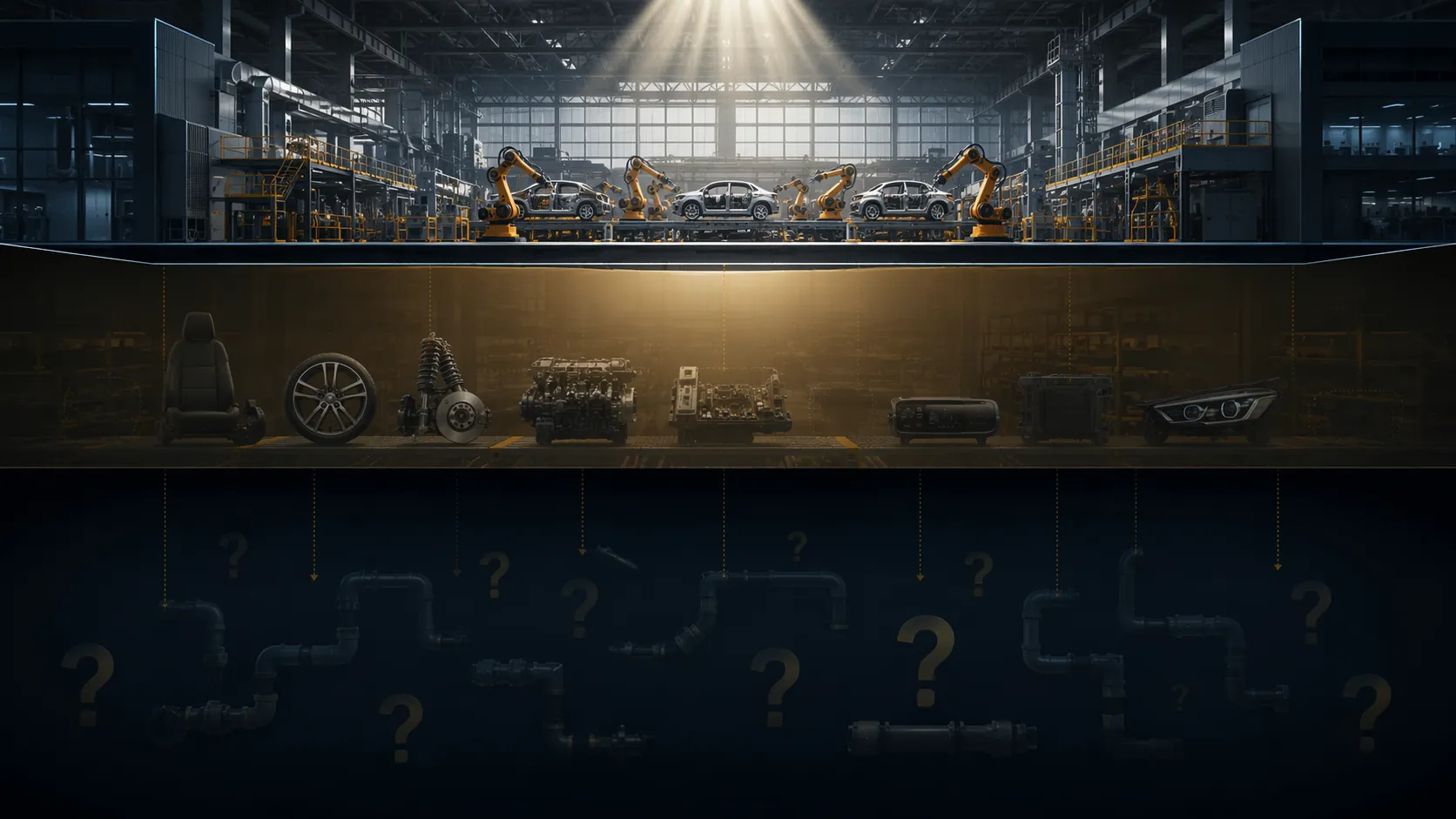
Just-in-time assumptions make that harder. They reduce working capital in normal conditions, but they also remove the buffer that would absorb an abnormal service campaign. A planner can know the top-tier supplier. The harder question is whether the sub-tier supplier for a pump component, sensor element, connector, clip, circuit, seal, or harness material has enough capacity once the recall remedy is released.
The automotive sector’s own survey data makes that constraint believable at an industry level, though not Ford-specific. The AMS/ABB Automotive Manufacturing Outlook Survey 2025, with 473 respondents, found that 45% ranked supply-chain disruption and parts shortages as their top challenge, a position the issue had held since 2022.[8] That does not prove the Bronco fuel pump delay came from the same cause. It does show that parts shortages are not an exotic explanation in the current manufacturing environment.
A multi-tier visibility gap becomes visible only when the schedule breaks. A Tier 1 supplier may report a recovery plan. The OEM may see purchase orders, shipment dates, and supplier commitments. What can remain poorly understood is the fragile part of the chain below that: a single sub-tier process, a constrained material, a tooling bottleneck, a supplier quality hold, or a capacity reservation already committed to production vehicles. Recall demand competes with all of that.
Recall Volume Raises the Stakes, but Volume Is Not the Whole Diagnosis
Ford’s 2026 recall volume gives the Bronco cases a harsher backdrop. Hearn Law Firm counted more than 60 Ford recalls affecting more than 11.2 million vehicles by July 25, 2026, and identified the Bronco as the third-most-recalled Ford model over the prior 18 months, with 27 recalls and 46 total across 2022–2026.[1] Motor1 also reported that Ford had recalled 11.2 million vehicles in 2026 by late July.[9]
Those figures should not be used lazily. A high recall count does not automatically explain why a specific pump, shock, sensor, camera, or harness is unavailable. Nor does it make every Bronco campaign operationally identical. But recall volume changes the planning environment. Each open campaign competes for engineering attention, supplier escalation, dealer capacity, owner communications, and parts-distribution bandwidth. An owner with four or five open recalls is an anecdote, not a statistical average, but the operating condition behind that anecdote is real enough: multiple remedies can stack up before the parts network is ready to clear them.
For the dealer, that stack becomes a scheduling problem. For the regional parts team, it becomes an allocation problem. For procurement, it becomes a supplier-capacity problem. For the owner, it is simpler and more frustrating: the vehicle has an open safety campaign, and no one can say when the repair will actually happen.
What Planning Tools Can and Cannot Fix
AI planning tools cannot make unavailable components appear. They do not remove the need for engineering validation, supplier qualification, regulatory reporting, or dealer execution. They also cannot turn a still-uncertain harness redesign into a finished repair package. The useful question is narrower: can planning systems see the constraint earlier and allocate scarce remedy parts more intelligently once they exist?
For recall-parts planning, the practical mechanisms are specific. Demand sensing can model the difference between ordinary service demand and a sudden recall surge. Supplier risk scoring can flag components with single-source exposure, weak sub-tier visibility, long validation loops, or poor recovery confidence. Inventory optimization can stop treating recall demand as an exception and instead test scenarios where a campaign pulls months of replacement demand into a compressed window.
The output should not be a prettier dashboard that confirms the obvious after owners start calling. It should answer harder questions before launch: which remedy components are capacity constrained, which suppliers need escalation, which regions should receive first allocation, which dealer orders are safety-critical, and how completion rates will behave if the first production batch covers only part of the affected population.
In a Bronco-style recall portfolio, that visibility would not guarantee a fast remedy. It would, however, make the gap between announcement and repair harder to hide inside the word “pending.” The fuel pump recall shows the cost of discovering that gap after the campaign is already public. The OCS sensor lead time shows why anticipated remedy dates need supply-chain confidence behind them. The shock and harness cases show why an ETA is not a courtesy detail; it is part of the operating plan.
The lesson is not that Ford’s Bronco delays would have disappeared if a planning platform had been better configured. That would give software too much credit and supply chains too little respect. The better lesson is that recall readiness depends on multi-tier visibility before the remedy is announced, not after the first owner asks why the dealer still has no parts.
References
- Ford Recall Statistics and Fast Facts 2026, Hearn Law Firm
- Low Pressure Fuel Pump Recall, Bronco Nation
- Recall Alert: 2025-2026 Ford Bronco Sport, Maverick, The Truth About Cars, April 2026
- Recall 26S55: 2021-2026 Model Year Broncos Engine Compartment Wiring Harness Repair, July 23, 2026, Bronco6G, July 23, 2026
- Ford Bronco Recall Over Engine Compartment Fire Risk, Motor1
- NHTSA Recall Compliance 2015 to 2025, Recall Masters
- Turning Vehicle Recalls into a Test of Supply Chain Resilience: Lessons from 2025, Supply Chain Management Review
- Automotive supply chains fundamentally redesigned amid a confluence of disruptions, Automotive Logistics, 2025
- Ford Has Recalled 11.2 Million Vehicles In 2026, Motor1
§ 42 — Cited evidence
Flag an inaccuracy or submit a comparable account — Contribute or read how claims are verified in Methodology.