
§ 41 — Use-case analysis
Greg Brockman's Philanthropy Flags Vendor Risk for Supply Chain AI
Greg Brockman's $30B OpenAI stake and $75M+ political donations have triggered governance friction and a 67% two-year engineer retention rate at OpenAI. This article explains why supply-chain procurement leads should treat these signals as a factor when evaluating AI-dependent SCM platforms and demand documented model-diversification strategies from vendors.
- Function
- procurement
- AI technique
- generative-ai
- Failure pattern
- model-concentration-risk
- Evidence source
- SignalFire 2025 State of Talent Report
A supply-chain director evaluating an AI-dependent planning platform has a familiar problem with a newer edge: the demo looks useful, the workflow is plausible, and the vendor says its generative-AI layer is “model-agnostic.” The harder question is what happens in year two of the rollout if the model supplier behind those features becomes noisy, loses critical engineers, changes access terms, or forces the application vendor to rework prompts, APIs, and fallback logic while planners are already relying on the tool.
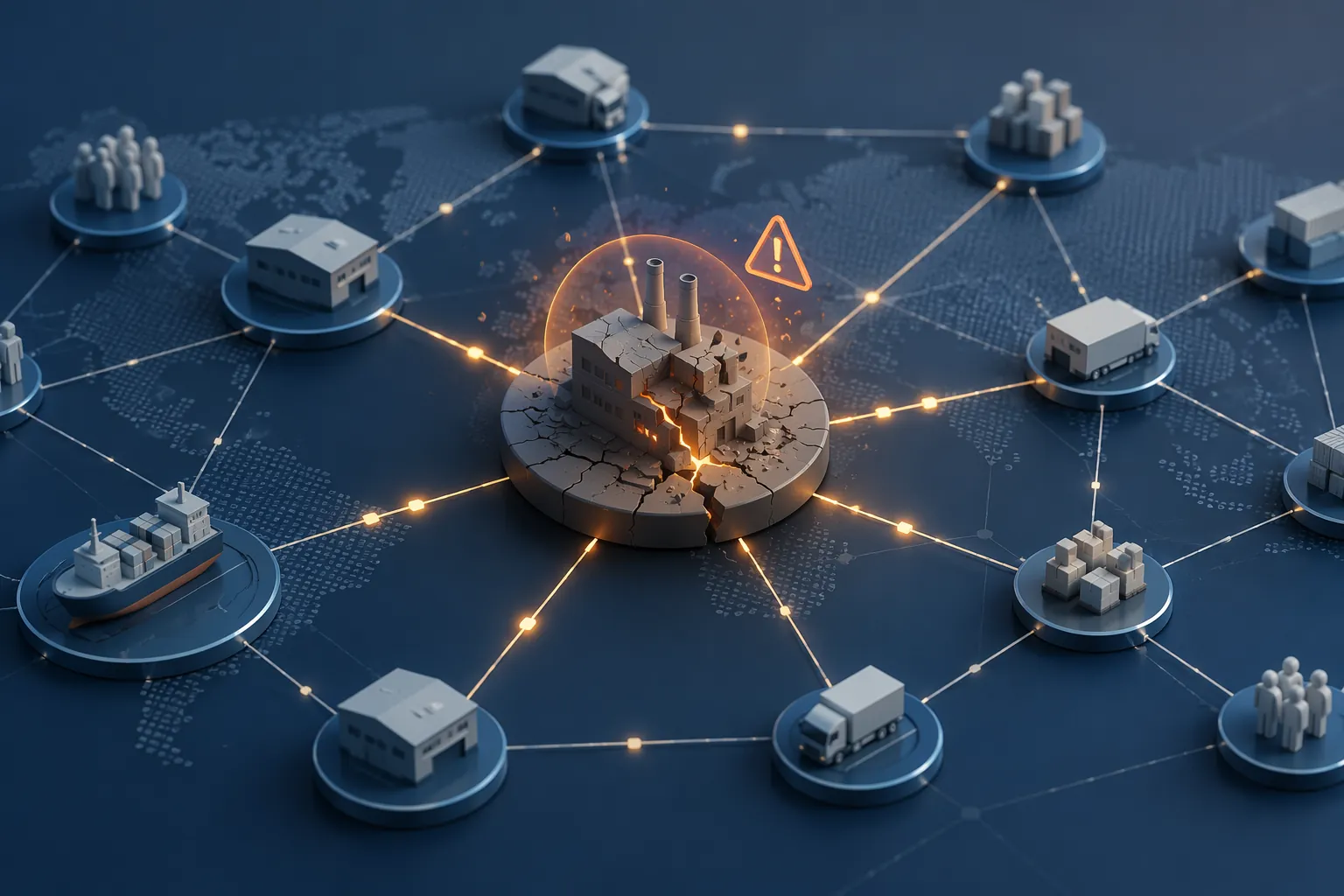
That is where Greg Brockman, OpenAI, philanthropy, and AI talent stop being a founder-profile story and become a procurement issue. Not because a supply-chain buyer needs to adjudicate a founder’s politics, and not because every application vendor using OpenAI is suddenly unsafe. The issue is narrower: if an SCM platform depends materially on OpenAI’s model pipeline or OpenAI-trained engineering talent, recent governance friction and measurable retention gaps belong in the vendor-stability file.
Why Frontier-Lab Governance Belongs In An SCM Evaluation
Most enterprise scorecards were built for software suppliers, implementation partners, data processors, and hosting providers. They ask sensible questions about uptime, security, implementation references, integration effort, and contractual remedies. They are less good at examining the model layer when the software vendor’s most impressive AI features depend on a frontier lab that sits outside the buyer’s direct contract.
In a planning deployment, that gap matters. Forecast explanations, exception triage, supplier-risk summaries, scenario narratives, and natural-language interfaces can become embedded in daily work. If the underlying model access changes, the problem is not just a degraded chatbot. It can mean retesting workflows, rewriting guardrails, retraining users, changing data-routing approvals, or explaining to finance why a promised automation lane has been paused after go-live.
The buyer does not need to know every personality dispute inside an AI lab. The buyer does need to know whether the application vendor can keep serving the contracted capability if the lab supplying the model experiences governance turbulence, executive distraction, or staff movement that affects product continuity.
The Brockman Signal Is Not The Dollar Amount Alone
Brockman’s personal OpenAI stake became more than background wealth when he disclosed under oath in May 2026 that it was worth about $30 billion; Bloomberg separately estimated the stake at $25.5 billion, according to Business Insider’s account of the trial disclosure.[1] SiliconAngle reported that the Musk v. Altman case was later decided for OpenAI on statute-of-limitations grounds on May 18, 2026.[2]
The donations then made the story organizationally louder. Business Insider reported that Brockman gave $25 million to MAGA Inc. in September 2025, more than $50 million to Leading the Future with another $25 million pledged for 2026, and $5.5 million to Moon Camp; the same report said OpenAI publicly distanced itself from his political donations on June 2, 2026.[3] Wired also reported on Brockman’s multimillion-dollar political giving.[4]
For an enterprise buyer, the important point is not the ideological content of those donations. It is that OpenAI found it necessary to create public distance between the company and a cofounder’s personal giving, while an employee petition platform called QuitGPT reportedly drew more than 700,000 signatures calling for formal governance separation between Brockman’s personal giving and OpenAI’s mission.[5]
That combination changes the procurement reading. Personal wealth concentration, high-profile donations, public distancing, and employee organizing do not prove operational weakness. They do show that the governance atmosphere around a key model supplier has become visible enough to deserve questions from buyers whose vendors are building on top of that supplier.
The Retention Numbers Are The Stronger Evidence
The most useful signal is not the size of the stake or the color of the donations. It is talent movement. Fortune, citing SignalFire’s 2025 State of Talent Report, reported that OpenAI’s two-year engineer retention rate was 67%, compared with Anthropic’s 80% and DeepMind’s 78%; the same reporting said OpenAI engineers were eight times more likely to leave for Anthropic than Anthropic engineers were to leave for OpenAI.[6]
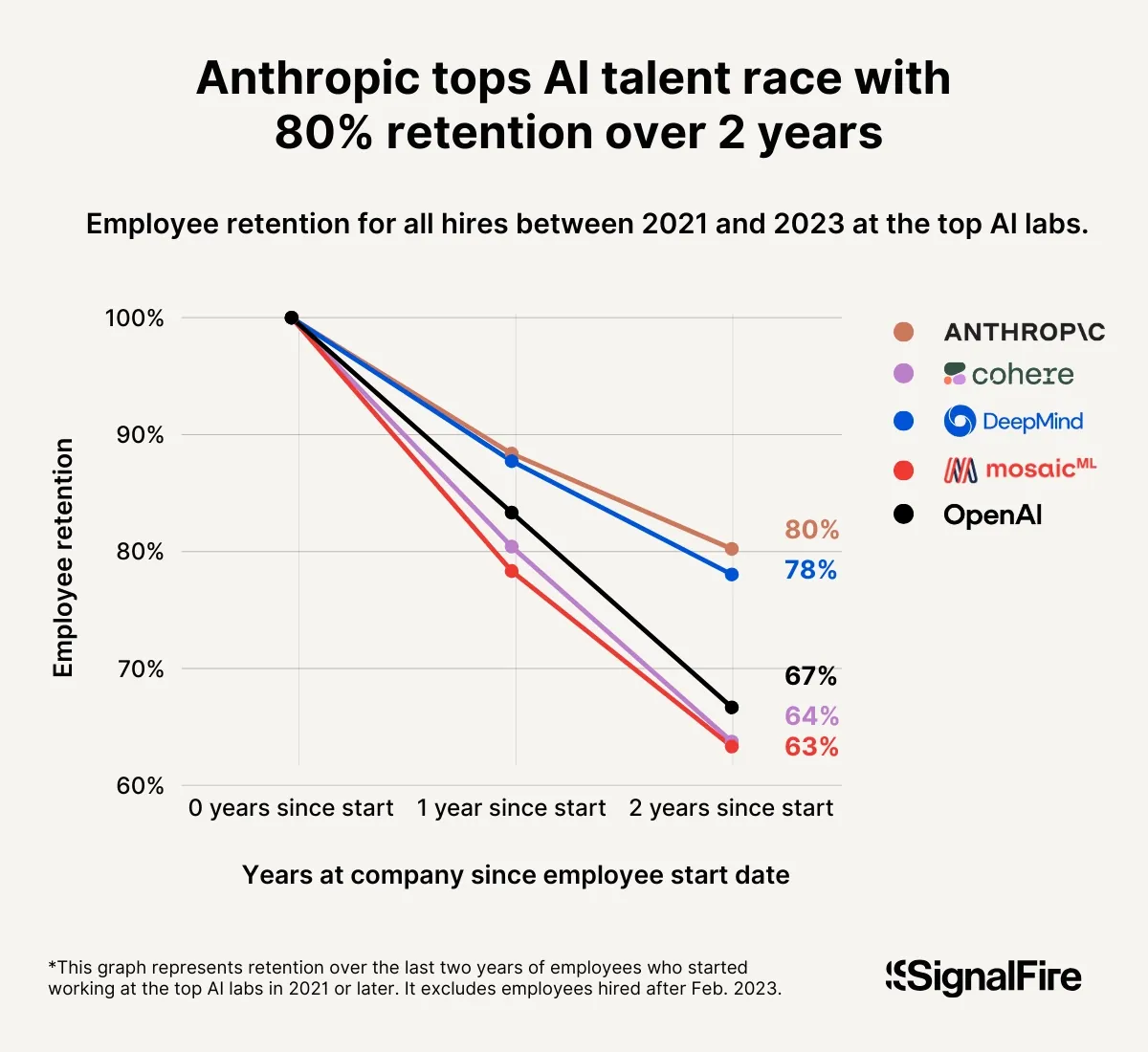
Those figures still need discipline in interpretation. They do not say Brockman’s philanthropy caused engineers to leave. They do not identify the motives of individual employees. They also do not prove that OpenAI cannot maintain models, APIs, or enterprise support. What they do provide is a vendor-stability signal: the lab at the center of many enterprise AI roadmaps is retaining engineers at a lower measured rate than a direct rival, while movement between the two firms appears materially one-sided.
For supply-chain systems, that distinction is enough. A planning vendor may expose AI features through its own interface, but the underlying quality often depends on a chain of people and systems the buyer cannot see: model researchers, safety and eval teams, API product managers, infrastructure engineers, solution architects, and the application vendor’s own AI engineers who translate model capability into planning workflows. Attrition at the frontier layer can show up downstream as roadmap slippage, changed model behavior, delayed feature hardening, or a need to rebuild integrations around a different model family.
The talent market around that layer is hot enough that no single retention number should be read in isolation. Sam Altman said in June 2025 that Meta was offering $100 million-plus packages to poach OpenAI staff, though the most careful reading treats that as directional evidence of bidding pressure rather than a granular compensation benchmark for ordinary hires.[7] Reuters reported in May 2025 that top OpenAI researchers earned more than $10 million a year, with retention bonuses above $2 million and equity increases above $20 million also in the compensation context.[8]
Enterprise buyers are competing for adjacent talent as well. Gartner reported that AI-skilled supply-chain roles rose 387% from the first quarter of 2023 to the first quarter of 2026, and that 58% of those roles were mid-senior level.[9] That matters because a vendor that says it can swap models easily still needs people who understand planning data, AI behavior, integration constraints, and customer-specific controls. Model optionality without engineering capacity is just a slide.
Do Not Turn Correlation Into A Procurement Myth
There is a tempting but lazy story available here: founder makes controversial donations, employees leave, enterprise buyers should run. The available material does not support that conclusion. The SignalFire retention figures measure overall retention and movement; they do not isolate exits tied to Brockman’s political giving. QuitGPT suggests employee concern around governance separation, but it is not an attrition study.
The more defensible reading is also more useful. Brockman-related governance friction belongs in the same risk file as the measured retention gap, not as a proven cause of that gap. The buyer’s task is not to score personal virtue. It is to decide whether an AI-dependent SCM vendor can document continuity, redundancy, and escalation paths when its model supplier is under organizational pressure.
The OpenAI Foundation belongs in this file, but only as context. OpenAI’s own foundation materials describe a scale-up from $7.5 million in 2024 to more than $1 billion committed for 2026, including life-sciences commitments and a People-First AI Fund.[10] Reuters separately reported a $250 million commitment to help workers navigate AI-related change.[11] Those commitments may matter to governance observers, but the unresolved scope and timing questions around some figures make them poor substitutes for the harder operational questions: who maintains the model-dependent feature, what happens if access changes, and how quickly can the vendor move to an alternative?
What To Ask An AI-Dependent SCM Vendor
The right procurement response is not to ban OpenAI-dependent products. It is to stop accepting “model-agnostic” as an answer. In an evaluation of o9, Blue Yonder, Kinaxis, RELEX, Anaplan, or any other AI-heavy planning platform, the buyer should force the vendor to describe its dependency posture in operational terms.

| Procurement Question | Why It Matters |
|---|---|
| Is OpenAI a core dependency, a preferred option, or one model provider among several? | The answer separates architectural resilience from vendor language. |
| Which contracted features degrade if OpenAI access, pricing, latency, or model behavior changes? | Planning teams need to know which workflows are exposed before go-live. |
| What models have been tested in production-like conditions for the same use case? | A fallback plan is weaker if alternatives have only been used in demos. |
| Who inside the vendor owns model evaluation, prompt governance, integration changes, and customer escalation? | Continuity depends on the vendor’s own AI bench, not only the frontier lab’s roadmap. |
| What review dates trigger reassessment of model dependency during the contract term? | A multi-year rollout needs scheduled risk review, not a one-time AI appendix. |
The vendor should be able to produce a model-diversification document that names supported model providers, explains selection criteria by use case, and identifies where switching models would require customer retesting. A vague statement that the platform can connect to multiple large language models is not the same thing as evidence that the vendor has already validated alternatives for demand sensing, exception narratives, supplier-risk summarization, or planning-assistant workflows.
Dependency disclosure should be feature-level, not brand-level. A vendor may use OpenAI for one workflow, a different model for another, and its own smaller models or rules-based logic elsewhere. Buyers need a map of which capabilities depend on which external model services, which data is sent where, which controls govern retrieval and grounding, and which service-level commitments are truly under the application vendor’s control.
Fallback planning should be written in the language of degradation, not aspiration. If model access changes, does the feature switch to a less capable model, pause only generative explanations, revert to deterministic alerts, or require a professional-services change order? Who approves that switch? How are planners notified? Which validation tests must be rerun before the feature is restored?
The vendor’s own AI-engineering bench deserves particular attention. A supplier that depends heavily on frontier-lab expertise but has thin internal capacity may struggle to absorb model changes. A supplier with a credible internal team can evaluate model drift, rework prompts, adjust retrieval, update guardrails, and explain tradeoffs to the customer without waiting for the model provider to solve the application-level problem.
Contract Language Should Match The Risk
Once the dependency is visible, the contract can deal with it. The buyer can require notice of material model-provider changes, documented regression testing before model substitution, named escalation contacts for AI incidents, and periodic reviews of model concentration. These are not exotic demands. They are the model-layer equivalent of asking a cloud-dependent vendor about hosting regions, subcontractors, and disaster recovery.
- Require a current inventory of external model providers by feature.
- Attach tested fallback behavior to critical planning workflows.
- Define what counts as a material change in model access, model behavior, pricing, data handling, or provider availability.
- Set review dates during implementation and after go-live, especially before expanding AI features to more planners or regions.
- Ask for evidence of the vendor’s internal AI governance and engineering capacity, not only partner logos.
This is also where the retention data becomes practical. A 67% two-year retention rate at OpenAI versus 80% at Anthropic does not tell a buyer which model will perform better in a planning workflow.[6] It does tell the buyer to ask whether the application vendor has built its roadmap around a concentrated external talent base, and whether it can keep contractual promises if the people and priorities behind that external model layer shift.
Anthropic’s own hiring momentum can reinforce the point without turning the discussion into a rival-company profile. TechFundingNews reported that Anthropic’s top 10 hires of 2026 included transfers from OpenAI, Google, xAI, and Microsoft.[12] The procurement implication is not that one lab has won. It is that scarce AI talent is mobile, expensive, and strategically important enough that application vendors should be asked how their customer commitments survive movement at the model layer.
The Risk Register Entry
The current facts do not support a prediction that OpenAI is failing. They do not support a claim that Brockman’s philanthropy directly caused attrition. They do support a procurement finding: when a supply-chain AI platform depends on OpenAI talent, OpenAI model access, or OpenAI-shaped roadmap assumptions, the buyer should treat Brockman-related governance friction and the measured retention gap as a vendor-stability signal.
That signal is strong enough to require documented model diversification, feature-level dependency disclosure, fallback plans, escalation paths, and scheduled review dates. It is not a verdict on a founder. It is the kind of evidence that keeps remedial integration work from arriving after the contract is already signed.
References
- Greg Brockman's OpenAI Stake Is Worth $30B, He Says at Trial — Business Insider
- OpenAI President Greg Brockman grilled about his $30B personal stake — SiliconAngle, May 18, 2026
- OpenAI Distances Itself From Cofounder Brockman's Political Donations — Business Insider, June 2, 2026
- OpenAI's President Gave Millions to Trump — Wired
- OpenAI President Greg Brockman grilled over embarrassing diary entries — NY Post
- OpenAI and DeepMind are losing engineers to Anthropic in a one-sided talent war — Fortune
- OpenAI boss: Meta offering $100m plus to poach my staff — BBC, June 2025
- Reuters reporting on OpenAI researcher compensation — Reuters, May 2025
- Gartner Says There is an Outsized Need for AI Talent in Supply Chain — Gartner, June 15, 2026
- OpenAI Foundation update page — OpenAI Foundation
- OpenAI Foundation commits $250 million to help workers — Reuters
- Anthropic's top 10 hires of 2026 — TechFundingNews
§ 42 — Cited evidence
Flag an inaccuracy or submit a comparable account — Contribute or read how claims are verified in Methodology.