
§ 41 — Use-case analysis
Four AI detection modalities screen banana cargo for cocaine
Banana shipments account for 35% of containerized drug concealments. This survey examines four AI detection modalities—X-ray computer vision, muon tomography, behavioral analytics, and fleet risk AI—with published accuracy data and documented failure modes, providing port security evaluators a grounded comparison of each technology's real-world readiness.
- Function
- cargo screening
- AI technique
- machine learning
- Failure pattern
- insufficient standalone reliability
- Evidence source
- Windward MIOC, DHS S&T, arXiv 2505.18851
Banana cargo has become too specific a smuggling lane to treat as just another refrigerated import. Windward’s July 2026 MIOC analysis cites World Customs Organization data attributing 35% of global containerized drug concealments to banana cargo, a figure large enough to change how inspection teams should think about perishable shipments that cannot sit indefinitely in a hold queue.[1] The pressure around the lane is not easing: UNODC’s 2026 reporting, as summarized by bne IntelliNews, puts global cocaine production at a record 4,100 tonnes in 2024 and identifies Ecuador as a primary transit corridor.[2]
That is the practical frame for using AI in supply-chain security to detect cocaine in banana shipments. The question is not whether an algorithm can spot something suspicious in a slide deck. It is whether the tool narrows the right uncertainty before a reefer loses time, a broker starts chasing holds, and an officer has to decide which boxes get opened.
Recent seizures keep the problem concrete. The Maritime Executive reported cocaine hidden in banana shipments intercepted in Italy and the United Kingdom in 2025, while Windward’s MIOC case work describes a record 1,515 kg banana seizure in August 2025 and a repeated incident pattern around one Ecuador–Russia reefer operator.[1][3] Those cases do not prove that every banana shipment is risky. They do show why this commodity now draws a screening question of its own.
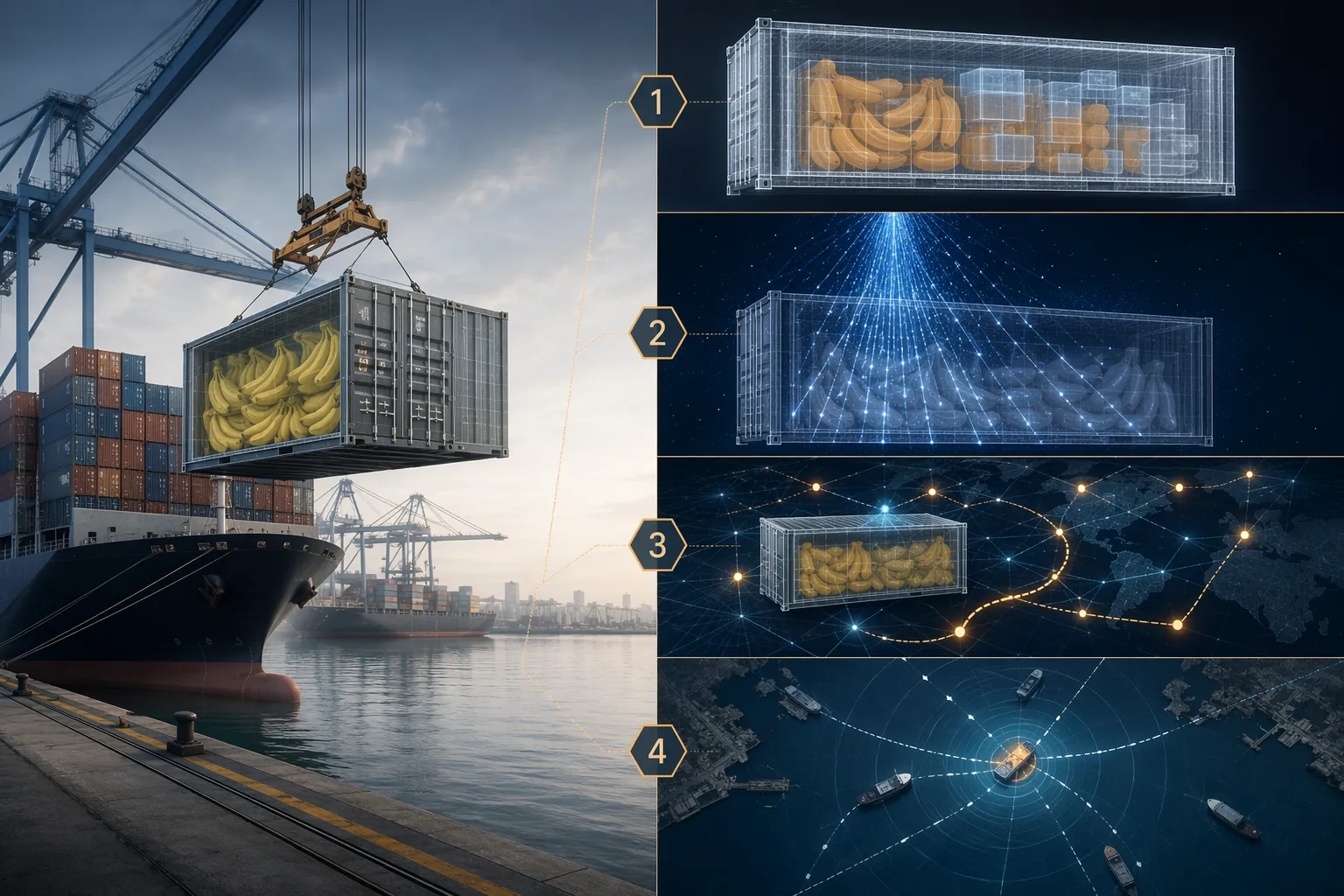
Four AI modalities now matter on this vector: X-ray computer vision, muon tomography, behavioral analytics, and fleet-level risk AI. They operate at different layers of the same decision chain. Comparing them as if they compete for one procurement slot misses the operational point.
| Modality | Evidence source | Status in cited material | Published metric or disclosure | Operational layer | Primary failure mode |
|---|---|---|---|---|---|
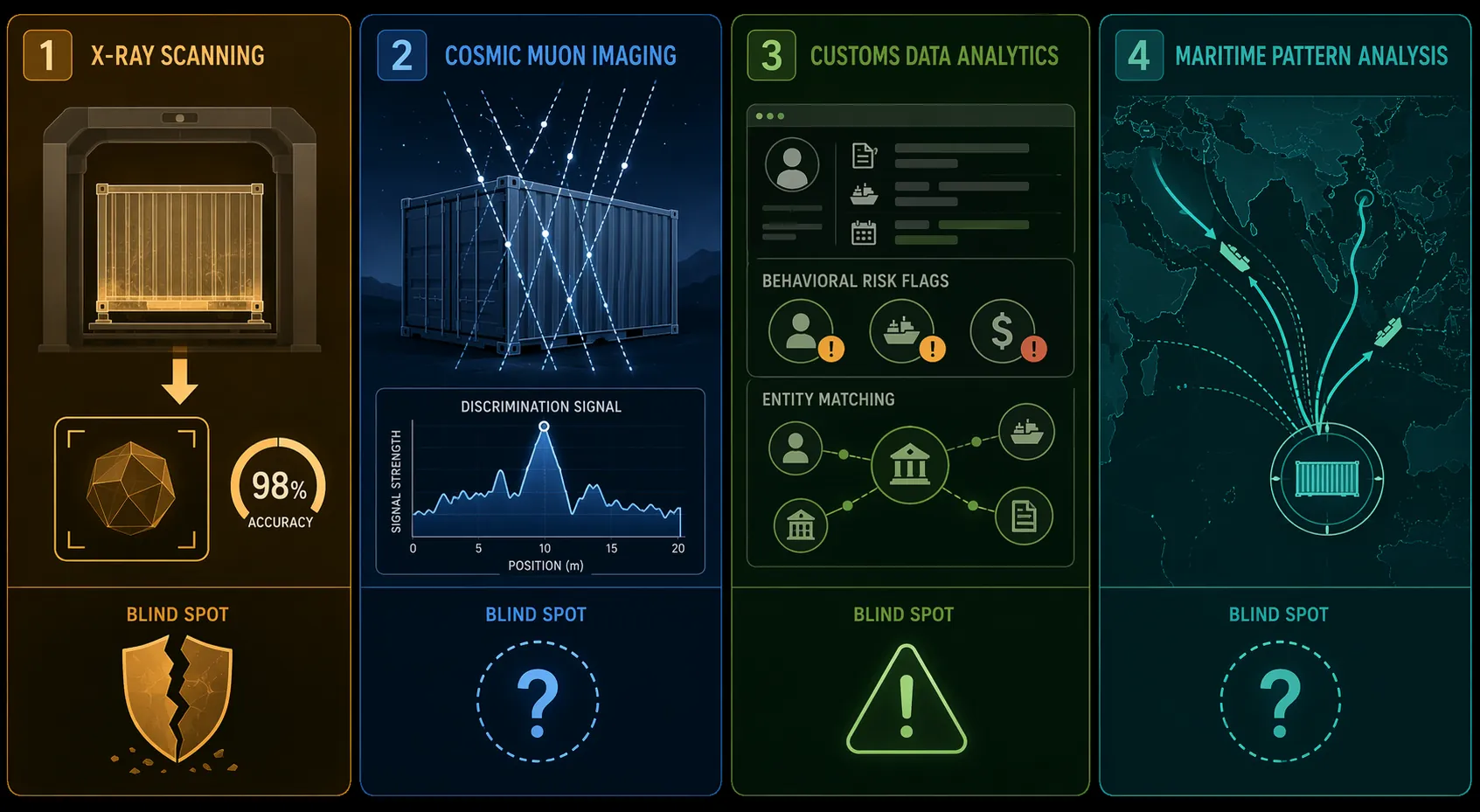
| X-ray computer vision | Tufts/DHS research summarized by Orange Hello Future | Research publication summarized publicly | 98% accuracy on synthetic X-ray anomalies | Image inspection of container scans | Known concealment geometries can perform well; novel shapes remain a blind spot |
| Muon tomography with machine learning | arXiv 2505.18851 | Simulation-only GEANT4 study; no field deployment data in cited source | Random Forest AUC 0.9969 for cocaine-vs-benign discrimination; 3-sigma detection in 60-second rapid scans | Material discrimination inside cargo | Promising physics and modeling, but validation has not crossed into live port conditions |
| Behavioral and cargo-data analytics | DHS AI Use Case Inventory for CBP | Multiple deployed systems and additional pre-deployment systems | Inventory discloses use cases, high-impact designation, and risks; no audited public accuracy rates | Entity, shipment, cargo, and trade-risk scoring | Historical-risk models can create unnecessary inspections and delays for legitimate importers |
| Fleet-level maritime risk AI | Windward MIOC case analysis | Commercial intelligence analysis documented through incident patterns | Six cocaine incidents on one Ecuador–Russia reefer operator since 2023 | Vessel, operator, route, and commodity-pattern monitoring | Adversaries can shift operators, routes, and commodities once targeting logic tightens |
X-ray AI Is the Most Familiar Temptation
X-ray image analysis fits naturally into port inspection because scanners already produce the visual material. DHS Science and Technology has described the inspection burden at ports of entry as involving thousands of scans, with multi-energy systems intended to help officers distinguish materials in dense cargo.[4] The appeal is obvious: if a model can mark the part of the image that looks wrong, the officer spends less time hunting across a cluttered container scan.
The Tufts/DHS work summarized by Orange Hello Future reports 98% accuracy for an AI framework detecting synthetic anomalies in X-ray images of shipping containers.[5] That is a strong number, but the word “synthetic” carries weight. It means the test condition was not a full live inventory of banana containers moving through a port under changing packing practices, box densities, scanner settings, and concealment tactics.
Synthetic anomaly testing is still useful. It can expose whether a model has learned the underlying structure of a clean container well enough to notice disruptions. For bananas, that matters because concealments may sit among repetitive organic shapes, cardboard, pallets, liners, and cooling materials. A bored human screener can miss a small irregularity after hours of near-identical reefer images.
The operational weakness is also straightforward. A model trained around known concealment geometries can be very good at flagging things that resemble those geometries and much less dependable when packaging changes. If cocaine bricks are arranged in a shape the model has not seen, hidden in a different void, or distributed to look less like a compact mass, the metric from synthetic anomalies does not automatically transfer.
For a port evaluator, the missing questions are as important as the 98%. How many containers per hour can the system process without slowing the lane? How many legitimate banana loads does it flag? Does it explain the suspicious region clearly enough for an officer to open the right boxes rather than unload half a reefer? The public metric answers image anomaly detection under a described research condition. It does not answer the full inspection-lane problem.
Muon Tomography Has Better Physics Than Deployment Evidence
Muon tomography is interesting because it does not merely ask whether a scan looks odd. It uses naturally occurring cosmic-ray muons passing through cargo to infer material properties. For dense or shielded concealments, that is a more ambitious promise than another image classifier layered on top of an X-ray.
The strongest cited metric comes from “Muon Imaging for Illicit Cargo Detection: A Simulation-Based Study,” posted to arXiv in May 2025. In that GEANT4 simulation, a Random Forest classifier achieved an AUC of 0.9969 for cocaine-versus-benign discrimination, and the study reported 3-sigma detection in 60-second rapid scans.[6]
Those numbers deserve attention. A 60-second scan window, if it survived real hardware and port workflow constraints, would be far easier to imagine near a high-risk secondary inspection process than a long research scan. The same study also describes DBSCAN visualization of cocaine inside banana boxes during a 30-minute extended scan, which helps explain why the method attracts interest for this commodity rather than only for generic contraband detection.[6]
But simulation-only evidence is not deployment evidence. GEANT4 can model particle interactions with care, yet it cannot by itself prove detector uptime, calibration behavior, maintenance burden, yard placement, operator training, integration with customs case systems, or the rate at which legitimate cargo would be held for follow-up. It also does not show how a muon system performs across the normal mess of refrigerated cargo: variable moisture, mixed packaging, inconsistent palletization, and partially loaded containers.
Muon tomography may eventually fill a valuable gap between visual anomaly detection and physical unloading. Its best role, on the cited evidence, is still conditional: a possible material-discrimination layer for selected containers, not a proven replacement for X-ray, canine inspection, manual examination, or intelligence-led targeting.
CBP’s Data-Layer AI Is Real, but Its Accuracy Is Not Publicly Audited
The most operationally real AI in this comparison is not the most visually dramatic. CBP’s public AI Use Case Inventory, updated in July 2026, lists deployed cargo-related systems including Entity Resolution DHS-24, Cargo Security Assessment Model DHS-2390, Empty Container Detection DHS-68, and Trade Entity Risk Model DHS-95; it also lists Advanced Analytics for X-ray Images, DHS-313, as a high-impact use case.[7]
That inventory matters because CBP faces a scale problem before it faces a model-choice problem. GDIT’s account of CBP operations describes technology-enabled screening across more than 100,000 containers daily and seizures of more than 2,300 pounds of drugs per day.[8] At that volume, a risk model does not need to be glamorous to matter. It can change which containers reach the inspection lane, which importer histories receive attention, and which entity relationships look suspicious.
The limitation is that the public inventory is a disclosure document, not an audited performance report. It confirms use-case status and identifies risks; it does not give a port operator a false-positive rate for banana shipments, a missed-detection rate for cocaine, or a measured delay cost for legitimate importers. The inventory’s own risk language acknowledges that models trained on historical seizure patterns can create “unnecessary inspections and delays” for lawful trade.[7]
That risk is not an abstract civil-liberties footnote for refrigerated cargo. A false positive on a dry-goods container is inconvenient. A false positive on bananas can become a product-quality problem, a demurrage problem, a missed retail window, and a relationship problem among the exporter, carrier, broker, importer, and inspection agency. The model may be doing exactly what it was designed to do—prioritize risk from historical patterns—while still pushing costs onto a legitimate lane.
The fair reading is narrow. CBP’s behavioral and cargo-data AI is available and operational in ways the inspection-layer tools are not always shown to be. It is also opaque from the outside. Without public validation by commodity, route, importer type, and inspection outcome, it should be treated as a targeting layer that requires human review, not as a transparent detector of cocaine in bananas.
Fleet Risk AI Sees Patterns Before the Container Arrives
Fleet-level risk AI moves the screen earlier. Instead of starting with a container image or a customs entry, it looks at vessel behavior, operator history, port calls, routes, ownership and management signals, commodity flows, and incident patterns. For banana shipments, that matters because the risk can be attached to a service pattern before a particular reefer is scanned.
Windward’s MIOC analysis of the 500 kg St. Petersburg cocaine seizure is useful because it does not stop at a single spectacular find. It documents six cocaine incidents on one Ecuador–Russia reefer operator since 2023, and it connects that pattern to broader banana-cargo concealment risk.[1] A single seizure can be luck. Repeated incidents around an operator and route begin to look like targeting material.
This is where AI can help enforcement teams avoid staring only at the box in front of them. If a fleet-risk system notices that a reefer operator, origin corridor, commodity, and destination cluster resemble prior seizure patterns, it can raise the container’s priority before an X-ray image exists. That is not detection in the chemical or imaging sense. It is investigative triage.
The same case material also shows the weakness. Windward reported a shift to frozen-tuna concealment in July 2026 after banana-linked scrutiny intensified.[1] That is adversary-aware adaptation in plain operational language. If targeting logic makes one commodity lane more expensive for traffickers, they can test another commodity, another operator, another port pair, or another concealment geometry.
Fleet-risk AI therefore has a different failure mode from X-ray AI. It may see the pattern correctly and still be outpaced by a network willing to move. Its value depends on refresh speed, analyst feedback, case closure, and the willingness to retire stale indicators before they punish yesterday’s legitimate lookalikes.
Readiness Depends on the Layer
The word “ready” gets slippery in this market. X-ray computer vision is ready enough to merit serious inspection-lane testing, but the cited 98% result belongs to synthetic anomalies, not a published operational trial across banana reefer traffic. Muon tomography is technically promising, but the cited evidence is simulation-only. CBP’s data-layer systems are deployed, but their public documentation does not expose commodity-specific accuracy or delay rates. Fleet-risk AI has documented case patterns, but those patterns are not the same as proof that a specific container contains cocaine.
A cleaner way to evaluate these systems is to ask what uncertainty each one narrows:
- X-ray AI narrows where an officer should look inside the scanned load.
- Muon tomography narrows what kind of material may be present, if the simulated performance holds in field hardware.
- Behavioral analytics narrows which shipment, entity, or trade pattern deserves more attention.
- Fleet-risk AI narrows which vessels, operators, routes, and commodity flows should be watched before arrival.
Those layers can reinforce one another. A suspicious operator history can justify a closer look at a banana container. An X-ray anomaly can tell the officer where to open. A future field-validated muon system could help decide whether a dense or ambiguous region is worth escalation. A behavioral model can connect the shipment to prior entity risk. None of those steps removes the need for someone to review the evidence, make a proportional intervention, and account for the cost of being wrong.
The Practical 2026 Judgment
Banana-cargo cocaine detection in 2026 is best understood as layered screening. X-ray AI can flag visual anomalies that resemble known concealment patterns, but novel shapes can defeat that comfort. Muon tomography may offer material-level discrimination, but the cited rapid-scan and AUC results remain pre-deployment evidence from simulation. CBP’s behavioral analytics are operational at a scale that matters, but they carry disclosed false-positive and delay risks for legitimate importers. Fleet-risk AI can surface suspicious patterns before arrival, but adversaries can shift commodities, routes, and operators.
The useful standard is not whether one modality can be declared the answer. It is whether each layer is validated against its own test condition, monitored for its own false positives, and recalibrated when traffickers change tactics. In banana shipments, that means treating high accuracy claims as starting points for operational testing, not as permission to forget throughput, perishability, staffing, and the person who has to open the box.
References
- Inside the 500 kg St. Petersburg Cocaine Seizure — Windward MIOC
- Ecuador ports and bananas fuel record global cocaine trade, UN finds — bne IntelliNews
- Italy and UK Each Find Cocaine Hidden in Shipments of Bananas — The Maritime Executive
- Feature Article: Securing Our Ports of Entry, One Scan (or Thousands) at a Time — DHS Science and Technology, October 26, 2023
- Contraband: AI efficiently detects anomalies in shipping containers — Orange Hello Future
- Muon Imaging for Illicit Cargo Detection: A Simulation-Based Study — arXiv, May 2025
- United States Customs and Border Protection – AI Use Cases — DHS AI Use Case Inventory, July 2026
- Border Security: Technology Enabled Intelligence Accelerates Screening of 100K Containers Daily — GDIT
§ 42 — Cited evidence
Flag an inaccuracy or submit a comparable account — Contribute or read how claims are verified in Methodology.