
§ 41 — Use-case analysis
How the AWS Outage Impacted Logistics Supply-Chain AI
The October 2025 AWS US-EAST-1 outage caused cascading failures across logistics AI platforms, from real-time visibility to warehouse execution. This post-mortem examines what broke and why AI-dependent systems face a structural vulnerability that traditional cloud apps don't.
- Function
- Logistics Operations
- AI technique
- Real-time data pipeline AI
- Failure pattern
- Lack of graceful degradation
- Evidence source
- Logistics Viewpoints (Oct 2025)
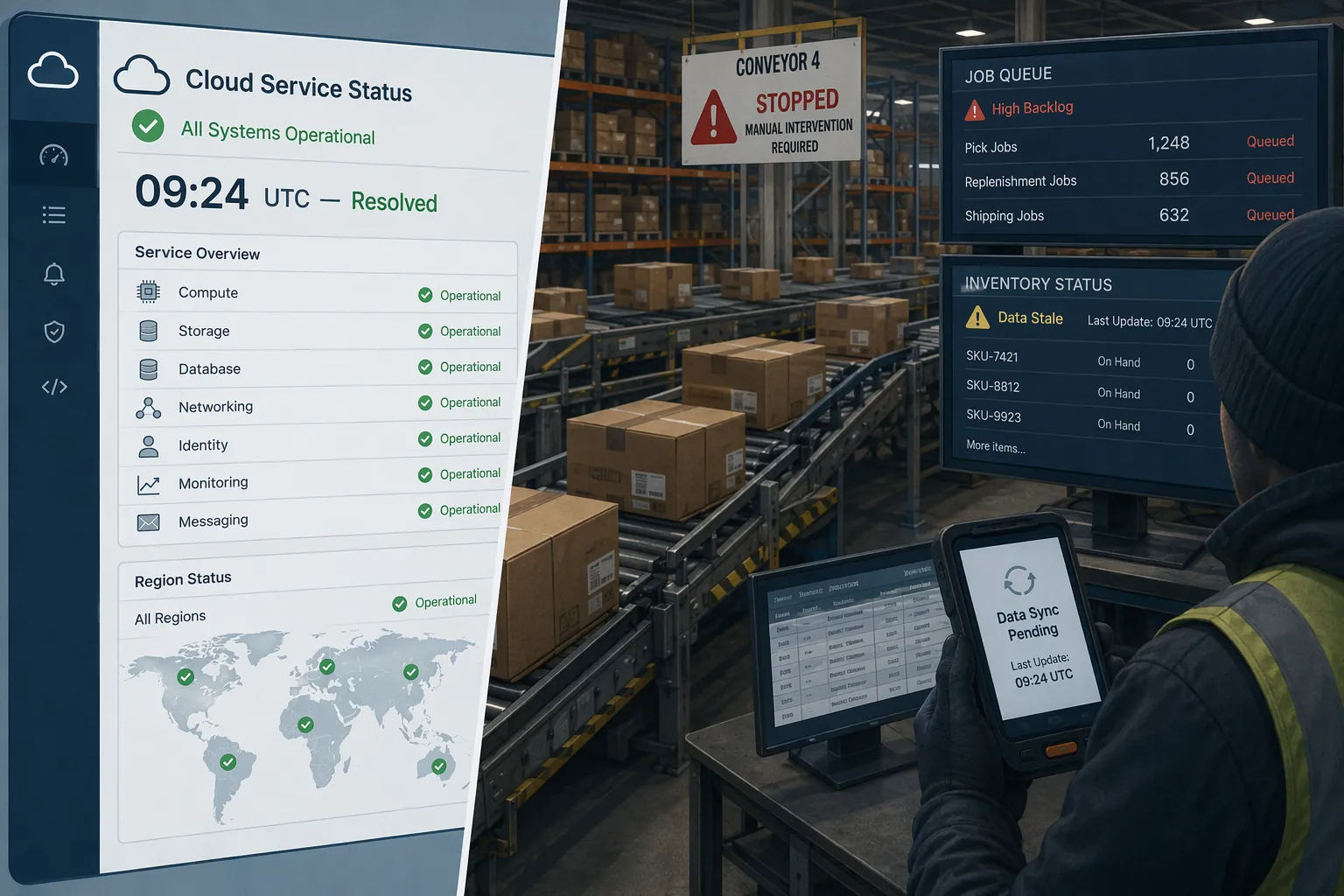
The uncomfortable part of the October 20, 2025 AWS outage is not that a cloud region failed. It is that AWS marked the core DynamoDB DNS issue resolved at 09:24 UTC, while logistics operators were still waiting for the practical recovery: labels to generate, warehouse jobs to clear, shipment visibility to return, inventory feeds to catch up, and order-routing dashboards to stop lying by omission.[1]
That gap is the real AWS outage impact on logistics supply chain AI. A status page can turn green while the floor is still working through stale state and queued transactions. For a conventional hosted application, restoration often means users can log back in and resume. For AI-dependent logistics systems, restoration is more like reopening a highway after a pileup: the road exists again, but the accumulated traffic still has to move.
What Actually Stopped Moving
The failures that matter most were not abstract dependency-chain diagrams. They showed up in the places where logistics systems have to produce an operational answer right now: where is the shipment, can this carton be labeled, is this inventory available, which order should this warehouse release next?
The sharpest visibility failure came through project44. Ti Insight reported that project44 Last Mile APIs were rendered inoperative during the outage, cutting off real-time shipment visibility rather than leaving users with a clearly bounded degraded view.[2] For a shipper or 3PL, that is not a cosmetic dashboard problem. It means the system that normally absorbs carrier events, location updates, delivery milestones, and exception signals stopped being able to answer the basic customer-service question: what is happening to this freight?
Shipping and warehouse execution were hit in a more physical way. ShipStation and ShipHero both publicly reported AWS-dependent disruptions, with Logistics Viewpoints tying the outage to failures in shipping label generation and warehouse execution workflows such as picking and packing.[1] Those are the kinds of failures that quickly turn from IT incidents into labor-planning incidents. A picker with no executable task, a pack station waiting on a label, and a supervisor watching a wave stall are all experiencing the same architectural fact from different ends of the building.
Amazon’s own fulfillment network was not insulated from the incident. SCW Magazine reported slower response times in Amazon fulfillment-center pick, pack, and ship operations, while Fulfillment by Amazon users saw delivery delays.[3] That matters because the affected process was not merely a customer-facing storefront. The slowdown reached the execution layer where system latency changes how quickly goods leave a building.
The wider 3PL layer saw the same pattern in smaller pieces: delayed inventory updates, slower API responses in freight management systems, and intermittent order-routing dashboard failures were reported across logistics operations dependent on the affected AWS services.[1][2] None of those symptoms needs to sound dramatic on its own. Together, they describe a logistics stack losing its sense of current state.
| Operational Area | Documented Failure | Practical Consequence |
|---|---|---|
| Shipment visibility | project44 Last Mile APIs inoperative | In-transit freight could not be reliably tracked in real time |
| Shipping execution | ShipStation AWS-dependent disruption | Label generation and shipment processing were interrupted |
| Warehouse execution | ShipHero AWS-dependent disruption | Picking, packing, and related WMS workflows were affected |
| Fulfillment operations | Amazon fulfillment centers saw slower pick, pack, and ship response times | Outbound execution slowed and some FBA users saw delivery delays |
| 3PL operations | Delayed inventory updates, slower freight-management APIs, intermittent order-routing dashboard failures | Operators had to work around stale stock positions and unreliable routing views |
The Blast Radius Was Large, But Size Is Not the Lesson
The outage’s ecosystem footprint was substantial. IncidentHub counted more than 197 downstream SaaS outages explicitly acknowledged as tied to the AWS event, while noting that the real number was likely higher because its count depended on public attribution.[4] Ookla reported more than 17 million Downdetector reports across more than 3,500 companies in more than 60 countries, about 970% above baseline.[5]
Those figures are useful context, but they can also flatten the incident into a familiar story: big cloud outage, many apps down, vendors apologize, service resumes. Logistics does not recover that cleanly. The important evidence is not just the number of affected services; it is the type of operational output that disappeared. Tracking did not merely refresh more slowly in the documented project44 case. Last Mile APIs were inoperative.[2] Warehouse execution and label generation did not simply lose some convenience features. They were disrupted in workflows that decide whether labor can keep processing orders.[1]
This is where the language of “cloud dependency” is too blunt. The problem is not only that logistics vendors ran workloads in AWS US-EAST-1. The deeper problem is that modern logistics AI and automation layers are built around continuous freshness: current shipment events, current inventory balances, current warehouse task state, current freight API responses, current exception signals. When those streams stop, many systems cannot produce a bounded stale answer. They produce no usable answer, or worse, an answer whose age and completeness are not obvious enough for operators to trust.
Why AI-Dependent Logistics Fails Differently
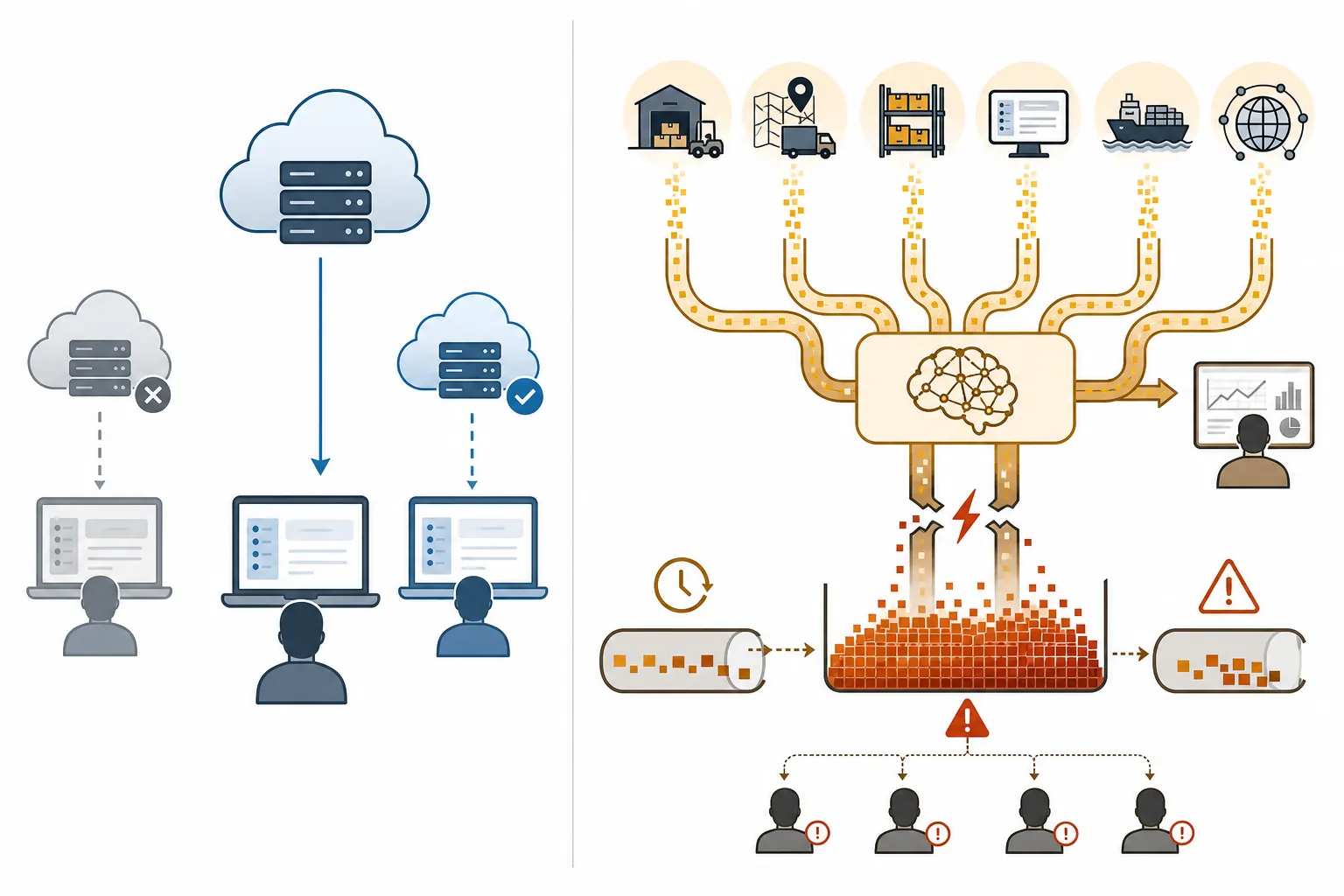
A traditional hosted app can fail hard and still have a relatively simple recovery shape. The application is unavailable; users wait; the service returns; users resume. There may be lost sessions or some manual reconciliation, but the application’s main job is often to present stored information and accept new transactions once the backend is reachable again.
A logistics AI system has a messier job. It is usually not just serving a screen. It is ingesting events, ranking exceptions, predicting arrivals, allocating labor, selecting routes, releasing tasks, mapping orders to carriers, or deciding which cases deserve human attention. These functions depend on data that ages quickly. A shipment location from hours ago may still be informative if it is clearly labeled as stale. An unlabeled stale location can trigger the wrong customer message, the wrong dock plan, or the wrong escalation.
That is why recovery lag matters. Logistics Viewpoints reported that even after AWS resolved the core issue, dependent logistics systems needed additional time to drain accumulated data backlogs before returning to normal operation.[1] During that period, the cloud substrate may be alive, but the business process is not yet healthy. Messages are replaying. Queues are draining. Integrations are retrying. Dashboards are catching up. Operators are trying to determine which screen reflects the present and which screen is a delayed echo.
The failure mode is especially punishing because logistics execution creates work while the system is down. Trucks keep moving. Workers keep arriving for shifts. Customer promises keep aging. Orders keep entering the commercial system even if warehouse release is impaired. Carriers still need labels and manifests. Inventory changes still happen physically, even if the digital record is delayed. By the time the platform can accept traffic again, it is not returning to a paused world.
The Queue Is Part of the Incident
Backlog handling is often treated as cleanup. In logistics, it is part of the outage. If a WMS loses task execution for a period, the restart is not complete when users can log in. Someone has to know whether waves were partially released, whether pick confirmations were captured locally or lost, whether labels were requested twice, whether carton status agrees with physical location, and whether inventory updates arrived in order.
The same applies to visibility platforms. If carrier events fail to ingest for a window of time, the recovery question is not simply whether the API now responds. It is whether missing events are replayed, whether late events overwrite newer status, whether estimated arrival models mark the data gap, and whether users can see the difference between “no exception” and “no fresh data.”
That distinction is where many green dashboards become operationally dishonest. They report service availability, not decision readiness. A platform can be technically available while its users are still sorting through stale state and delayed jobs.
The Cost Figures Are Directional, Not a Verdict
Warehouse downtime is expensive, but the available cost figures should be handled carefully. A Synergy Logistics report cited by Yahoo Finance placed warehouse downtime at roughly $5,000 to $100,000 per hour, depending on the operation.[6] That range is plausible as a directional warning, especially for high-throughput facilities, but it comes from a vendor-commissioned source with limited publicly visible methodology. It should not be treated as a precise industry constant.
The same caution applies to broader economic-impact warnings. SCW Magazine cited ParcelHero’s warning that the October 2025 outage could have billions in economic impact, but that is a forward-looking estimate, not a settled post-event accounting.[3] It is enough to say the operational exposure was material. The documented failures in labels, WMS execution, fulfillment response times, freight APIs, and inventory updates already make that case without pretending the total loss is knowable from the available public record.
What Resilience Would Have Looked Like
The useful question after this outage is not whether every logistics platform should abandon AWS. That conclusion is too easy and not supported by the evidence. The question is whether the system can keep producing bounded, degraded, clearly labeled output when fresh cloud data stops arriving.
CloudFactory’s post-outage lessons for AI resilience map closely to the logistics failure pattern: AI systems need fallback states that can produce partial output, human-in-the-loop override paths when models lack fresh data, and inference pipelines designed with offline-capable caching.[7] Those are not abstract AI governance points. In logistics, they translate into specific operating behaviors.
- A visibility platform should show the last confirmed event with an obvious freshness marker, not silently imply that tracking is current.
- A shipping system should have a controlled label fallback for eligible shipments, with later reconciliation, rather than forcing a full stop at every pack station.
- A WMS should define which tasks can continue locally, which tasks must pause, and how confirmations rejoin the system after connectivity returns.
- An order-routing dashboard should separate stale recommendations from unavailable recommendations, because those require different human decisions.
- An inventory feed should make delay and sequence risk visible, especially when late updates may arrive after newer physical activity.
None of these fallbacks makes an outage painless. They change who is blind. During the October outage, the worst affected operators were not the people writing retrospectives about region concentration. They were the integration leads and warehouse supervisors trying to decide whether to wait, work around, rekey, release, hold, relabel, or reconcile. A resilient system gives those people a bounded degraded state and a safe override path. An unresilient one gives them a spinner, a stale dashboard, and a cleanup queue.
What the Evidence Does Not Show
The documented record is strongest for visibility, WMS, shipping, fulfillment execution, freight-management APIs, inventory updates, and order-routing dashboards. It does not prove that every supply-chain AI category failed in the same way. The available sources do not document direct outage impact on planning suites such as Blue Yonder, Kinaxis, or o9, so they should not be pulled into the incident by association.
It also does not prove that executives are unaware of cloud risk in any simple sense. SCW Magazine, citing ParcelHero, reported that only 3.9% of transport and storage firms ranked cloud outages among their top concerns.[3] That is a strikingly low share given the operational exposure shown by the outage, but without the original survey method in view, it should be treated as a signal of an awareness gap rather than a definitive measurement of boardroom negligence.
The narrower conclusion is still strong enough. The October 2025 AWS US-EAST-1 outage showed that logistics AI is not merely hosted in the cloud. It is dependent on real-time data continuity. When that continuity breaks, recovery is not finished when infrastructure recovers. It is finished when the system has drained backlogs, exposed stale state, restored trusted execution, and given operators a safe way to reconcile what happened while the data was missing.
The resilience test is simple to ask and hard to pass: if fresh data stops, can the system still show a bounded stale state, accept human override, and restart without hours of backlog-induced paralysis?
References
- AWS Outage Highlights Cloud Dependency Risks in Supply Chains, Logistics Viewpoints, October 21, 2025
- AWS outage disrupts logistics platforms, Ti Insight
- AWS outage exposes global supply chain vulnerabilities, SCW Magazine
- Definitive AWS Outage Report 2025 Reliability, IncidentHub
- AWS Outage Q4 2025, Ookla
- Warehouses Face $100K/Hour Downtime, Yahoo Finance
- AI Resilience: Lessons from the AWS Outage, CloudFactory
§ 42 — Cited evidence
Flag an inaccuracy or submit a comparable account — Contribute or read how claims are verified in Methodology.