
§ 41 — Use-case analysis
Mapping AI Supply Chain Optimization's Impact on EV Affordability
This analysis aggregates independently reported cost savings from AI supply chain deployments across the EV value chain—covering battery materials procurement, gigafactory manufacturing, logistics, and disruption prediction—giving procurement directors and IT/ERP leads verifiable, peer-reviewed figures to support AI investment business cases.
- Function
- procurement, manufacturing, logistics
- AI technique
- forecasting, optimization, deep learning
- Evidence source
- McKinsey (2018), Caresoft Global (2026), Star.global/Toyota (2025), arXiv/Ford (2024)
The practical question behind AI supply chain optimization for electric vehicle affordability is not whether a planning algorithm sounds sophisticated. It is where the cost stack actually moves. For an EV OEM or Tier-1 supplier, that means purchased materials, plant labor, rework, expedited freight, stock buffers, forecast error, and the time lost when a supplier disruption arrives before the organization can see it.
The evidence is now strong enough to map those cost locations, but not clean enough to turn them into one blended ROI percentage. The largest absolute-dollar estimates sit in procurement and manufacturing. Logistics, demand forecasting, inventory, and disruption prediction have more familiar optimization narratives and useful numbers, but they usually work on narrower baselines.
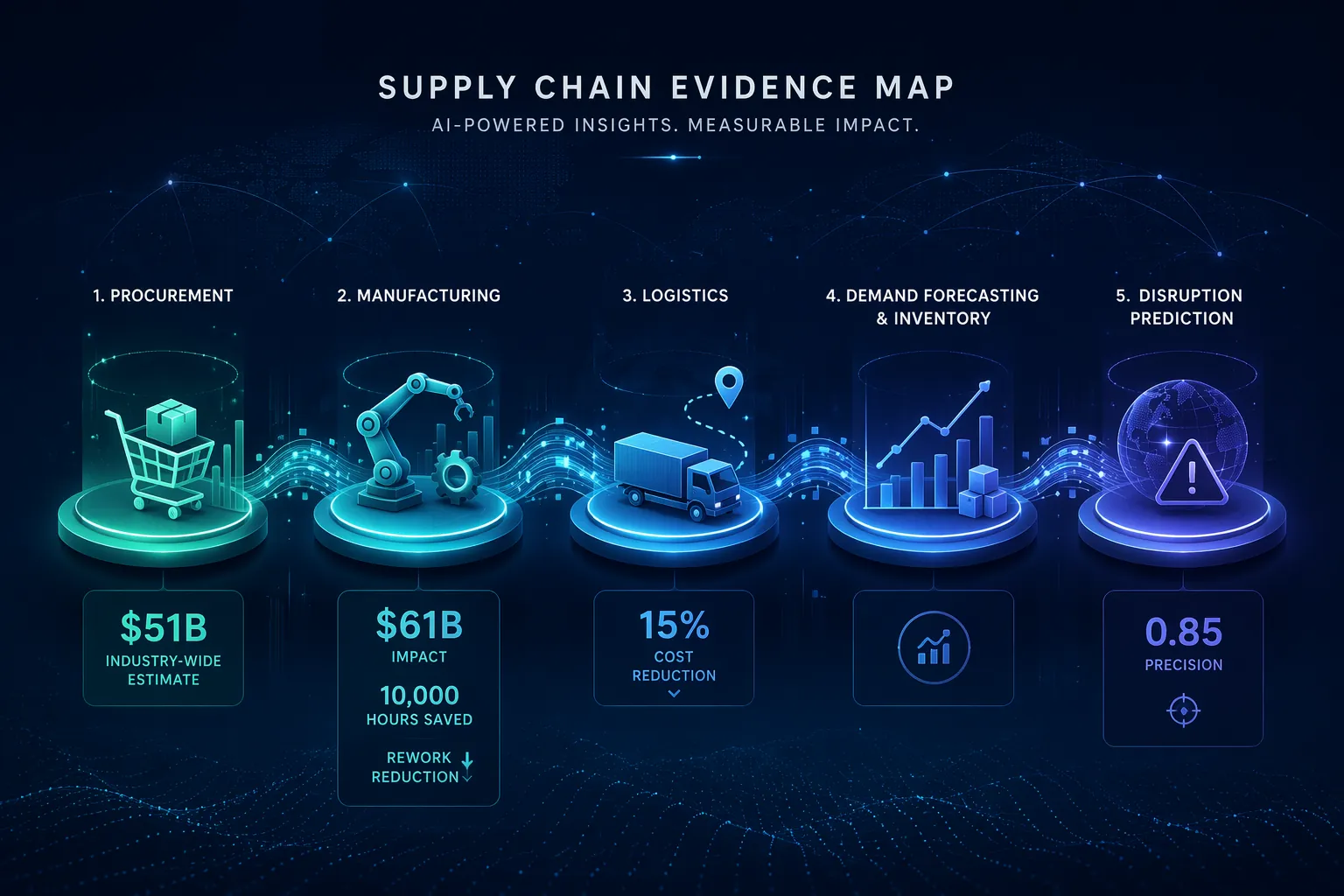
| Supply-chain node | Best quantified signal | What the number measures | Evidence type |
|---|---|---|---|
| Procurement | $51B annual value estimate for automotive OEMs | AI-enabled procurement efficiency opportunity within a broader $215B automotive AI value estimate | Consulting estimate, Jan. 2018 |
| Materials and purchased parts | $1.1T-$1.23T of a $2.6T OEM annual cost base | Cost base where a 1% materials-cost improvement equals roughly $11B-$12B annually | Industry cost-base analysis, Apr. 2026 |
| Manufacturing | $61B annual value estimate; up to 10,000 hours saved annually in Toyota manufacturing workflows | Industry-wide manufacturing AI value estimate and OEM-level workflow savings | Consulting estimate plus reported OEM platform case |
| Quality and rework | About 9% rework reduction from AI in-line quality control | Manufacturing cost leakage reduced before defects move downstream | Industry reporting, 2024 |
| Logistics | Up to 15% logistics cost reduction; 5.76% average monthly savings in one manufacturer case | Transportation and delivery optimization effects | Consulting estimate and vendor case study |
| Demand forecasting and inventory | 17% lead-time reduction, 22% excess-stock reduction, 35% inventory reduction estimate, up to 50% forecasting-error reduction | Planning accuracy, inventory buffers, and delivery timing | Reported Toyota figures and consulting/analyst estimates |
| Disruption prediction | 0.85 precision and 0.8 recall across 500K+ correlated time series | Model performance in predicting supply-chain disruptions across Ford’s North American plants | Academic preprint using OEM data |
That table is deliberately uneven. A dollar-value estimate from a 2018 consulting report, a 2026 purchased-parts cost base, a Toyota workflow metric, a self-reported survey, and an arXiv model-performance paper do not belong in the same authority bucket. They are still useful together because they point to where an AI business case deserves serious modeling, and where it should remain directional.
Procurement is where small percentages become CFO-sized numbers
McKinsey’s widely cited automotive AI estimate put total annual value potential for OEMs at about $215 billion, including $51 billion in procurement, $22 billion in supply chain management, and $61 billion in manufacturing.[1] The date matters: January 2018 is before the most recent EV affordability pressure, before post-2022 battery cost volatility entered many board-level conversations, and before today’s software-defined supply-chain platform market looked the way it does.
That age weakens the number as a forecast. It does not make procurement irrelevant. If anything, the cost base has become harder to ignore. Caresoft Global’s April 2026 analysis places materials and purchased parts at $1.1 trillion to $1.23 trillion of a $2.6 trillion annual OEM cost base, and translates a 1% materials-cost improvement into roughly $11 billion to $12 billion annually.[2]
For EV affordability, this is the first place to be careful with language. AI does not make lithium, cathode active material, semiconductors, castings, thermal systems, or power electronics cheap by declaration. The business-case question is narrower: can better supplier risk scoring, should-cost modeling, sourcing event analytics, demand-supply matching, and contract intelligence reduce the purchased-cost line or prevent avoidable premium buys?
The procurement case should therefore be built from exposure first, not from software capability lists. If an OEM has a multi-billion-dollar annual purchased-parts base, even low-single-digit impact assumptions change the affordability discussion. But the evidence brief does not justify lifting McKinsey’s $51 billion and treating it as an EV-specific, 2026-ready savings promise. It is better used as a signpost that procurement is one of the highest-leverage nodes, then tested against the company’s own bill-of-material concentration, supplier fragmentation, contract coverage, and ERP data quality.
The uncomfortable part for procurement leaders is that the most strategic number is also one of the least directly deployable. A CFO can understand the $11 billion to $12 billion implication of a 1% materials improvement across the industry. What still has to be defended is whether the proposed AI system can reach the spend categories that matter, whether it can see the right cost drivers, and whether buyers will actually use its recommendations before the next sourcing wave closes.
Manufacturing evidence is messier, but closer to work
Manufacturing deserves almost equal weight because its evidence includes both broad value estimates and operationally concrete outcomes. McKinsey’s same 2018 automotive AI estimate put manufacturing value potential at about $61 billion annually.[1] That is a large, dated, industry-wide number. Toyota’s reported factory AI figures are smaller in scope but easier to translate into work removed from the system.
Star.global, citing Toyota’s Google Cloud-based factory AI platform, reported savings of up to 10,000 hours of manual work annually across Toyota’s manufacturing network.[3] For an operations or IT team, that kind of metric is useful because it can be challenged. Which manual checks disappeared? Which engineering or production teams no longer wait for the same information? Which tasks moved from spreadsheet reconciliation to exception review?
Those are better business-case questions than asking whether the platform is “AI-driven.” Hours saved do not automatically become margin. They become margin only if they reduce overtime, compress launch work, speed issue resolution, raise throughput, or let skilled people stop performing avoidable coordination work. Still, a manufacturing-network figure is materially different from a demo-room proof of concept.
Quality and rework are the other manufacturing line items worth isolating. Supply Chain Dive reported that AI in-line quality control reduced rework by about 9%, and separately cited survey findings in which 64% of organizations said they saw manufacturing cost reduction from AI and 61% said they saw reduced supply-chain planning costs.[4] The rework figure is closer to process economics; the survey figures are adoption-experience signals, not audited savings.
In EV manufacturing, rework has an affordability consequence beyond the rework station itself. Defects can consume constrained battery-pack capacity, delay vehicle completion, trigger extra inspection loops, and complicate already tight launch curves. The research brief does not provide an EV-specific audited rework-dollar figure, so the correct conclusion is not that AI quality systems reduce EV unit cost by a known percentage. The defensible conclusion is that manufacturing AI has multiple quantified cost signals: industry-wide value estimates, reported OEM workflow savings, rework reduction evidence, and self-reported cost-reduction experience.
Logistics is quantified, but usually on a narrower base
Logistics gets a lot of attention because routing, load planning, delivery promises, and network optimization are easier to visualize than procurement leverage. The numbers are also respectable. McKinsey has been cited for estimates that AI can reduce automotive logistics costs by up to 15%.[5] ELEKS documented 5.76% average monthly cost savings and a 50% delivery-time reduction for some customer clusters using AI plus integer programming optimization.[6]
The ELEKS case is useful, but its boundary should stay visible: the brief identifies the customer as a U.S. manufacturer, not an explicitly named EV OEM.[6] That means it can support a logistics-optimization argument for manufacturing environments, but it should not be treated as direct proof of EV vehicle-program economics.
For an EV operator, logistics savings still matter. Battery packs, modules, power electronics, and specialized components can create expensive handling constraints and schedule sensitivity. A 15% logistics-cost reduction, where achievable, can protect margin. It is just unlikely to carry the same absolute affordability leverage as purchased materials or plant economics unless the company’s logistics baseline is unusually distressed.
Forecasting and inventory evidence belongs in the working-capital case
Demand forecasting and inventory are where AI benefits can look dramatic while still being hard to convert into unit-cost claims. Star.global reported that Toyota’s LLM-powered delivery optimization cut lead times by 17% and that AI-enabled inventory forecasting reduced excess stock by 22%.[3] Separately, McKinsey has been cited for a 35% inventory reduction estimate from AI, while Gartner has been cited for up to a 50% cut in forecasting errors.[5][3]
Lead-time reduction is not the same as cost reduction, but it can release cost. Shorter lead times reduce the amount of buffer a planner has to defend. Lower excess stock reduces cash tied up in the wrong parts. Better forecast accuracy can cut the gap between what purchasing commits to and what production actually needs.
The EV-specific angle is mix volatility. Trim, battery size, chemistry, regional incentives, and charging-related options can all shift demand signals. The brief does not quantify those EV mix effects, so they should not be invented. What can be said is that forecast and inventory AI has reported effects on lead time, excess stock, inventory levels, and forecast error, which makes it a credible working-capital and service-level lever rather than only a planning-team productivity tool.
Ford’s disruption model shows a different kind of evidence
Disruption prediction is not a cost-savings percentage. That is why Ford’s published model results are valuable in a different way. A July 2024 arXiv paper reported that Ford’s attention-based deep learning model achieved 0.85 precision and 0.8 recall in predicting supply-chain disruptions across its North American plants, processing more than 500,000 correlated time series.[7]
Precision and recall are not budget lines, but they tell an operations team whether the model is merely noisy or potentially usable. Precision of 0.85 means that, within the model setup reported, predicted disruptions were correct often enough to deserve attention. Recall of 0.8 means the model captured a substantial share of actual disruptions. Those are not guarantees of avoided shutdowns, but they are stronger than a generic claim that AI can “improve resilience.”[7]
The business value depends on what happens after the alert. If planners can qualify an alternate supplier, expedite before capacity disappears, move inventory to the right plant, or resequence production, the model may prevent real cost. If alerts arrive in a workflow no one owns, the model becomes another dashboard. This is where softer change management stops being soft: ownership determines whether predictive accuracy converts into avoided premium freight, downtime, or missed shipments.
How much confidence each source should get
The evidence base is strong enough to support AI investment expectations, but only if the source types are kept separate. Flattening them into one authority level makes the business case look cleaner and less credible.
| Evidence type | Examples in this evidence map | How to use it in an investment case |
|---|---|---|
| Industry-wide consulting estimate | McKinsey’s $215B total automotive AI value, including $51B procurement and $61B manufacturing | Use for opportunity sizing and executive prioritization, not as a guaranteed savings baseline |
| Current cost-base analysis | Caresoft’s $1.1T-$1.23T materials and purchased-parts base | Use to test the financial sensitivity of small procurement improvements |
| Reported OEM platform result | Toyota’s 10,000 hours saved, 17% lead-time reduction, and 22% excess-stock reduction as reported by Star.global | Use as operational comparables, while checking whether the original operating context matches your plants and systems |
| Industry reporting and self-reported survey data | 9% rework reduction; 64% manufacturing cost reduction; 61% supply-chain planning cost reduction | Use as supporting evidence, not as audited ROI |
| Vendor or consultant case study | ELEKS 5.76% average monthly cost savings and 50% delivery-time reduction for some customer clusters | Use to frame a pilot hypothesis, with explicit limits around customer identity and sector fit |
| Academic preprint using OEM data | Ford’s 0.85 precision and 0.8 recall disruption model | Use to support technical feasibility and model-performance expectations, not direct dollar savings |
This separation is not academic housekeeping. It changes vendor evaluation. A procurement platform promising category savings should be tested against spend under management, supplier data completeness, and sourcing-cycle timing. A manufacturing AI platform should be tested against labor-hour removal, scrap, rework, throughput, and engineering response time. A logistics tool should be tested against freight baseline, delivery constraints, and whether the optimizer can actually execute through the transportation management system. A disruption model should be tested against alert ownership and decision latency.
The weakest business cases will add the figures together: 15% logistics reduction plus 35% inventory reduction plus $61 billion manufacturing value plus $51 billion procurement value. That arithmetic is not valid. The baselines overlap, the dates differ, the methodologies differ, and the implementation contexts differ. A serious case uses the map to choose where to model first.
A disciplined investment takeaway
There is now enough quantified evidence to treat AI supply chain optimization as a serious EV affordability lever across procurement, manufacturing, logistics, inventory, forecasting, and disruption response. The procurement and manufacturing nodes deserve the first pass because the cost pools are largest and the strategic consequence is highest. Logistics and inventory improvements are still material, especially when they reduce buffers, premium freight, or delivery delay. Disruption prediction adds a model-performance layer that can protect operations before cost shows up in the ledger.
What the evidence does not support is a universal ROI calculator. The figures are too heterogeneous for that. A procurement director or ERP integration lead can use them to build a quantified business-case map, set credible ranges, and decide which data integrations deserve funding. They should not use them as additive guaranteed savings. That distinction is the difference between an AI proposal that survives CFO review and one that collapses the first time someone asks what the percentage is actually applied to.
References
- Artificial intelligence as auto companies’ new engine of value, McKinsey & Company, January 2018
- Materials Cost Reduction: The $1 Trillion Opportunity for OEMs, Caresoft Global, April 2026
- AI in automotive supply chain: use cases and examples, Star.global, August 2025
- How AI can reduce manufacturing costs and improve supply chain planning, Supply Chain Dive, 2024
- How AI is transforming automotive supply chains, Forbes Technology Council, February 2026
- AI-powered route optimization for a U.S. manufacturer, ELEKS, March 2024
- Attention-based Deep Learning for Supply Chain Disruption Prediction, arXiv, July 2024
§ 42 — Cited evidence
Flag an inaccuracy or submit a comparable account — Contribute or read how claims are verified in Methodology.