
§ 41 — Use-case analysis
What AI Planning Platforms Deliver for Texas Solar Procurement
Texas solar equipment buyers face overlapping tariff uncertainty and project-driven demand that manual planning cannot efficiently model. This analysis evaluates documented outcomes from comparable energy-sector AI deployments to assess whether tools like o9, Kinaxis, and Blue Yonder can meaningfully reduce procurement volatility.
- Function
- procurement
- AI technique
- forecasting
- Evidence source
- First Solar Kinaxis 2013-2014 case study
A Texas solar buyer does not buy modules against a smooth demand curve. The purchase decision sits between a project schedule that can move, an interconnection milestone that can slip, a supplier base still exposed to Asian wafer and cell sourcing, and a tariff picture that can change the landed-cost answer after the first procurement model has already been circulated. That is the practical question behind AI supply-chain planning for Texas solar: whether planning platforms can keep procurement decisions current when the project plan, the trade-policy case, and the inventory exposure all move at once.
The tariff calendar is not background noise. The DOE's solar manufacturing trade-policy overview identifies the February 2026 endpoint for Section 201 tariffs on solar cells and modules, AD/CVD exposure tied to Southeast Asian imports including Vietnam, Malaysia, Thailand, and Cambodia, and Section 301 tariffs on Chinese polysilicon and wafers at 50%.[1] For a buyer holding capacity for a Texas project, those facts do not translate into one clean assumption. They translate into scenario files: import now or later, module versus cell exposure, Southeast Asian supplier versus alternative supply, domestic option versus higher apparent price, and the working-capital consequence of being early.

That is why the useful conversation is not whether AI sounds modern enough for solar. The useful conversation is whether o9, Kinaxis, Blue Yonder, or a comparable planning layer can make a buyer faster and less wrong on five jobs: demand forecasting, tariff and landed-cost scenario modeling, inventory optimization, supplier and lead-time response, and delivery-risk visibility. These are planning jobs before they are software features.
The procurement problem is lumpy before it is digital
Retail demand forecasting can hide behind large numbers. Utility-scale solar procurement usually cannot. A single project shift can move a meaningful volume of modules from one month to another. A developer may still need supplier commitments before a grid milestone is fully settled. Finance may want lower working capital, construction may want guaranteed availability, and procurement is left holding the tradeoff.
Manual planning can model one or two versions of that problem. It struggles when every version has to be refreshed: one tariff case, one supplier substitution case, one delayed-project case, one accelerated-project case, one inventory-hold case, and one finance case showing what happens when modules arrive before the site can use them. The spreadsheet is not useless. It is just slow at the exact moment the buyer needs to compare consequences.
Texas adds a particular planning shape. ERCOT timing can matter to when equipment is actually needed. Port of Houston logistics can matter to where imported equipment is staged. Onshoring can matter to the supplier decision. The cited sources do not support a detailed claim about exact port lead times or domestic capacity by manufacturer, so those should be treated as planning variables, not as proven savings levers.
What AI planning platforms are being asked to do
The strongest use case is not one magic forecast. It is a planning loop that keeps demand, supply, tariff exposure, and inventory decisions connected. A Texas module buyer needs to know whether a purchase order should be placed now, delayed, split across suppliers, or tied to a substitute bill of materials. That requires more than a dashboard.
| Planning job | What the buyer needs to compare | Why it matters in Texas solar procurement |
|---|---|---|
| Demand forecasting | Project demand by date, site, module type, and confidence level | Project-driven demand can move in large blocks rather than stable monthly patterns |
| Tariff and landed-cost scenarios | Supplier, country-of-origin, cell/module, and timing assumptions | Section 201, AD/CVD, and Section 301 exposure can change cost rankings across sourcing options |
| Inventory optimization | Availability protection versus working-capital cost | Early inventory can protect construction but create finance exposure if project timing slips |
| Supplier and lead-time response | Substitution options, allocation risk, and replenishment timing | Supplier concentration and import exposure can make a late switch expensive |
| Delivery-risk visibility | On-time delivery probability and exception ownership | Procurement, logistics, construction, and finance need the same exception view |
o9, Kinaxis, and Blue Yonder fit into this conversation because they are built around connected planning, scenario modeling, forecasting, procurement operations, or supply-chain response. The distinction that matters is not brand vocabulary. It is whether the platform can represent the buyer's real constraints: tariff cases, project slippage, supplier substitution, lead-time variability, inventory policy, and cash exposure.
The evidence ladder is useful, but it is still a ladder
The available outcome evidence does not land evenly. Some of it is broad, recent, and directional. Some is specific to large industrial procurement or energy inventory. The closest solar case is older and vendor-adjacent. That does not make the evidence worthless. It means a Texas buyer should not treat every percentage as if it came from a current module-procurement deployment.
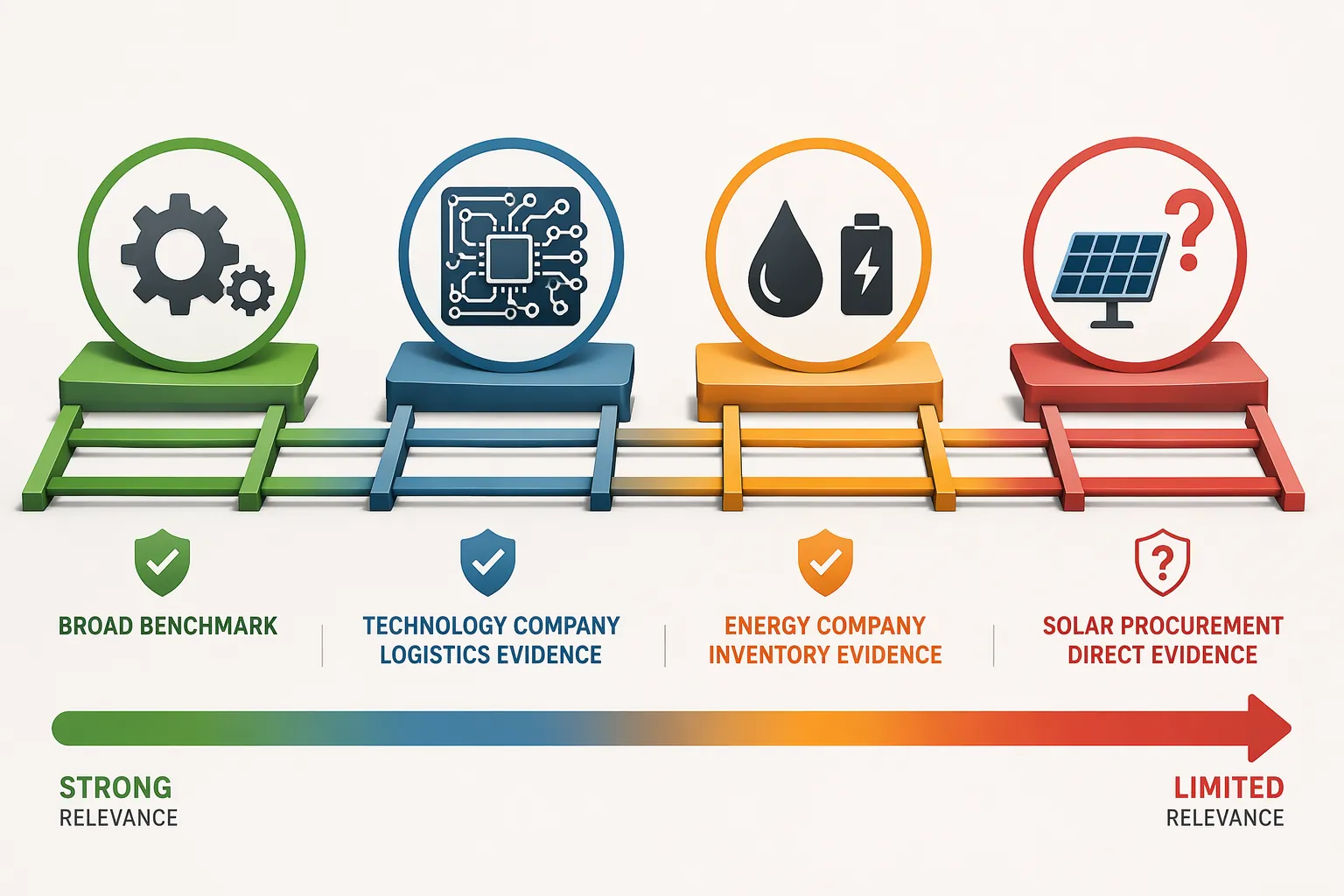
| Evidence source | Documented result | Usefulness for Texas solar procurement | Main weakness |
|---|---|---|---|
| Energies Media, April 2025 | AI-driven forecasting reduces forecast errors 20-50%, product unavailability up to 65%, and inventory costs 10-15% [2] | Good directional benchmark for what planning systems can improve in volatile energy supply chains | Aggregated industry benchmarks; not direct Texas solar module procurement proof |
| Lenovo and Blue Yonder, May 2026 | 5% forecast accuracy boost, 4% on-time delivery improvement, and 10% higher delivery accuracy [3] | Useful logistics and procurement proxy for a complex equipment network | Industrial technology case, not solar-specific |
| bp inventory optimization, April 2025 | 22% working-capital reduction and about $2 billion improved operational cash flow [2] | Strong signal that AI inventory decisions can affect energy-sector cash exposure | Energy inventory at scale, not module purchasing for Texas projects |
| First Solar and Kinaxis, 2013-2014 | 76-90% improvement in supply-chain response rates and improved on-time delivery [4] | Closest solar-sector pattern showing response-speed gains from integrated planning | Historical, vendor-sourced case-study evidence; current relationship not established |
Broad benchmarks show the possible range, not the buyer's result
The broadest benchmark is also the easiest to overuse. Energies Media reported that AI-driven forecasting can reduce forecast errors by 20-50%, lower product unavailability by up to 65%, and cut inventory costs by 10-15% in energy supply chains.[2] Those numbers are attractive because they map directly to solar procurement pain: bad forecasts, stockouts or unavailable product, and too much capital tied up in inventory.
But the benchmark is aggregated. It is not a measured result from a Texas solar buyer comparing module forecast error before and after implementation. It should be used as a range to test against, not as a promise to build into a capital request. If a vendor claims a 30% forecast-error reduction for solar procurement, the right response is not disbelief by default. It is to ask what demand signal was forecast, over what time window, against what baseline, and whether project slippage was included.
Lenovo is a logistics proxy, not a solar answer
Procurement Magazine reported in May 2026 that Lenovo's use of Blue Yonder produced a 5% boost in forecast accuracy, a 4% improvement in on-time delivery, and a 10% increase in delivery accuracy.[3] For a procurement lead, those are more believable than heroic claims because they are modest enough to survive contact with operations. A 4% on-time delivery gain can matter if the constrained material is holding a construction sequence.
The analogy to solar is partial. Lenovo's network is a complex technology and logistics environment, so the case is relevant to equipment flows, forecast accuracy, and delivery performance. It does not prove that the same platform will resolve tariff exposure on solar cells, model AD/CVD uncertainty, or decide when a Texas project should hold modules ahead of an ERCOT-related timing risk. It proves that planning technology can move measurable procurement and delivery metrics in a large operating environment. That is useful evidence, but it is one rung away from the specific solar problem.
bp matters because working capital is not a side metric
The bp example is important for a different reason. Energies Media reported that bp's AI-powered inventory optimization reduced working capital by 22% and improved operational cash flow by about $2 billion.[2] The direct connection to solar module procurement is not product similarity. It is the inventory tradeoff: how much material to hold, where to hold it, and how to avoid turning availability protection into unnecessary cash drag.
That is exactly where Texas solar buyers can get trapped. If a project may move, buying early protects availability but can strand capital. If procurement waits, the buyer may face supplier allocation, tariff changes, or delivery risk. A planning platform that can show the working-capital consequence of each scenario gives finance and procurement a shared decision surface. The bp result does not prove a 22% reduction is available in solar procurement. It does show that inventory optimization can be large enough to matter at the cash-flow level.
First Solar is the closest case, and the age matters
The First Solar and Kinaxis material is the closest solar-sector evidence in the cited material. SupplyChainBrain described First Solar's adoption of Kinaxis RapidResponse to consolidate module manufacturing and systems-business planning into one demand-driven planning tool, with reported supply-chain response-rate improvements of 76-90% and improved on-time delivery.[4] A related SupplyChainBrain piece described how First Solar used supply-chain technology to keep pace with demand.[5]
This is the kind of evidence that should get attention, but not a free pass. It is a historical 2013-2014 case, and the cited reporting frames the metrics through a vendor case-study description.[4] The current state of the First Solar-Kinaxis relationship is not established by the cited sources. The value of the case is therefore pattern evidence: integrated planning improved response speed and on-time delivery in a solar manufacturing context. It is not current proof that Kinaxis, or any other platform, will deliver the same improvement for a Texas buyer facing 2026 tariff and project-timing volatility.
Where the proxy cases translate to Texas solar
The useful overlap is operational. Lenovo's reported improvements speak to forecast and delivery performance in a complex equipment network.[3] bp's reported gains speak to working-capital discipline in energy-sector inventory.[2] First Solar's historical case speaks to response speed when demand planning and supply planning are connected in a solar business.[4] A Texas solar procurement team needs all three capabilities, just in a more tariff-sensitive package.
The first translation point is demand shape. Solar procurement demand is often tied to named projects rather than recurring customer consumption. That does not make forecasting impossible, but it changes the unit of prediction. The platform should not only forecast monthly module volume. It should preserve the project, milestone, probability, required-on-site date, and substitute-material options behind that volume.
The second translation point is tariff modeling. The DOE trade-policy overview gives the buyer enough reason to avoid a single landed-cost assumption: Section 201 timing, AD/CVD exposure on Southeast Asian sources, and 50% Section 301 tariffs on Chinese polysilicon and wafers all belong in the scenario model.[1] If the planning tool treats cost as a static supplier field, it is not solving the Texas solar problem. It is only automating a cleaner version of an incomplete model.
The third translation point is inventory. A conventional optimization run may recommend lower inventory because it sees carrying cost. A solar procurement run has to know which shortages stop construction, which early receipts create storage or cash pressure, and which supplier substitutions are actually approved. This is where the 10-15% inventory-cost benchmark is relevant but not sufficient.[2] The buyer still has to define what service level means when the missing item is not a generic SKU but a module package tied to a project schedule.
The fourth translation point is response ownership. A faster alert is only useful if someone can act on it. If a tariff case changes, procurement needs a supplier decision. If an interconnection or construction milestone moves, planning needs a demand-date change. If a delivery exception appears, logistics needs an owner. First Solar's historical response-rate gains are meaningful because response speed is a real operating metric, not because response speed alone proves economic value.[4]
Where the analogy breaks
The analogy breaks when a vendor turns adjacent outcomes into a solar-specific ROI claim without measurement. A 5% forecast-accuracy gain in an industrial technology network is not automatically a 5% module forecast gain in Texas.[3] A 22% working-capital reduction at bp is not automatically available to a developer or EPC holding solar equipment for a project portfolio.[2] A 76-90% response-rate improvement from an older First Solar case does not automatically describe current Kinaxis performance in solar procurement.[4]
The biggest difference is that tariff exposure can change the preferred action even when the demand forecast is right. A planner may correctly predict the project need and still make the wrong buy if the landed-cost case shifts. The platform therefore has to connect forecast accuracy to sourcing economics. Otherwise, procurement gets a better demand signal and still has to rebuild the tariff analysis somewhere else.
The second difference is that project slippage is not the same as ordinary demand variability. If a project moves, demand may not disappear; it may move as a block. That affects storage, payment timing, supplier allocation, and contract terms. Forecast-error metrics should separate volume error from timing error. A platform can look accurate on annual volume while still failing the buyer who needed the right modules in the right quarter.
The third difference is supplier substitution. In a spreadsheet, substitute supply can look like a price comparison. In procurement, it may involve technical approval, bankability, country-of-origin exposure, delivery slot availability, warranty acceptance, and contract risk. The cited sources support the need to treat solar trade exposure as a planning issue, but they do not support a blanket claim that any platform can solve all supplier qualification constraints out of the box.[1]
What a credible pilot should measure
A credible evaluation should start with the buyer's own historical data and open project pipeline, not a generic demo dataset. The platform should ingest project demand, approved suppliers, country-of-origin assumptions, tariff scenarios, lead-time distributions, inventory positions, purchase commitments, and delivery milestones. If any of those fields are missing or manually maintained outside the planning workflow, the pilot should say so.
- Forecast error: measure demand accuracy by project timing and module requirement, not only annual volume.
- Inventory cost: compare carrying cost, storage exposure, and excess or early receipts against the prior planning process.
- Availability: track whether required equipment is available when the project actually needs it.
- On-time delivery: measure delivery performance against required-on-site dates, not only supplier promise dates.
- Response speed: track how long it takes to replan after a tariff, supplier, project, or logistics exception.
- Working capital: quantify cash tied up under each buy-now, wait, split-buy, or substitute-supplier scenario.
This is also where governance becomes part of the software evaluation. AI-generated scenarios are only useful if the organization agrees which assumptions are controlled, who can change them, and when an exception forces a new decision. Tariff assumptions should not live in one analyst's workbook while supplier lead times live in procurement email and project dates live in a construction tracker. The point of connected planning is not to remove judgment. It is to make the judgment visible before the purchase order locks in the exposure.
The bounded answer
AI planning platforms plausibly reduce volatility in Texas solar procurement. The better evidence shows measurable gains in forecast accuracy, inventory cost, working capital, delivery performance, and response speed across adjacent energy and industrial settings.[2][3][4] The direct solar-procurement-specific outcome record is still limited. That distinction matters because the Texas buyer is not purchasing a benchmark. The buyer is committing capital, supplier capacity, and delivery risk against a project portfolio that may move.
Before accepting a vendor claim, ask whether the platform can model tariff scenarios, project slippage, supplier substitution, lead-time variability, and working-capital tradeoffs using the buyer's own data. Then measure the result against forecast error, inventory cost, availability, and on-time delivery. The case is promising enough to evaluate seriously, but not proven enough to underwrite a solar procurement business case without a scoped pilot and dated outcome tracking.
References
- Overview of Trade and Policy Measures for U.S. Solar Manufacturing, DOE Office of Manufacturing and Energy Supply Chains, 2025.
- AI in Supply Chain Management: Real Results from Top Energy Companies in 2025, Energies Media, April 2025.
- o9, BlueYonder and Kinaxis: Extending Procurement Operations, Procurement Magazine, May 2026.
- How an Integrated Supply Chain Enables First Solar's Top Business Goals, SupplyChainBrain, 2013-2014.
- How First Solar Keeps Pace With Demand, SupplyChainBrain.
§ 42 — Cited evidence
Flag an inaccuracy or submit a comparable account — Contribute or read how claims are verified in Methodology.