
§ 41 — Use-case analysis
How AI Planning Platforms Fared During the 2026 Oil Shock
The Q1 2026 oil price surge provided a real-world stress test for AI-driven supply chain planning platforms. This analysis maps what each major platform's architecture should do against the shock's characteristics, identifies which capabilities have independent evidence, and highlights critical gaps such as the lack of vendor post-mortems and shortage-modeling limitations.
- Function
- demand-forecasting
- AI technique
- forecasting
- Failure pattern
- batch reforecasting
- Evidence source
- BCG, 2026
The Q1 2026 oil shock was the kind of event that makes an AI supply chain planning demo either useful or embarrassing. Brent crude moved above $119 per barrel, the Strait of Hormuz closure affected roughly 20% of global oil supply, fertilizer prices rose 100–150% in parts of Asia, the New York Fed’s Global Supply Chain Pressure Index reached +1.3 standard deviations above its historical average, and the WTO cut its trade-growth forecast from 4.6% to 1.9%.[1][2] That is not a single-variable cost increase. It is a simultaneous hit to transport rates, petrochemical feedstocks, inventory economics, consumer demand, working capital, and service commitments.
For buyers evaluating how AI supply chain planning platforms performed during the oil price surge, the uncomfortable answer is that the shock was real, but public platform evidence is still thin. As of July 2026, the major planning vendors have not published verifiable post-event case studies showing how Blue Yonder, o9, Kinaxis, RELEX, or Anaplan performed during the disruption. There are documented architectures, analyst frameworks, surveys, and adjacent quantitative evidence. There is not yet a dated, customer-level record showing decision latency, forecast changes, service outcomes, cost outcomes, and what failed under shortage conditions.
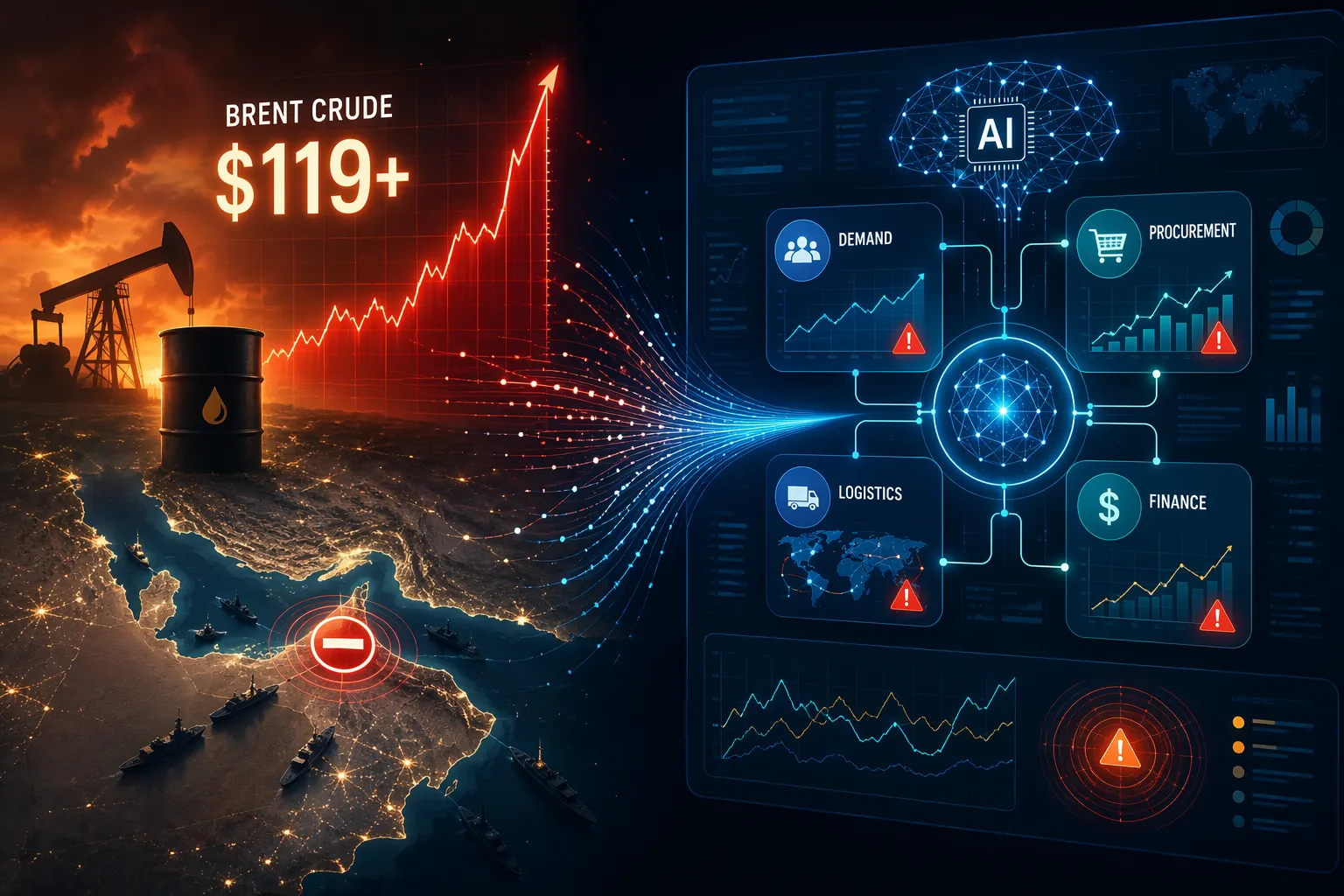
So the right exercise is narrower than a vendor ranking and more useful than a capability brochure. The question is what each architecture should have been able to do when oil, freight, raw materials, demand, and margins moved together, and where independent evidence supports the mechanism rather than the marketing.
Why This Shock Was Harder Than a Fuel Surcharge
A fuel surcharge is annoying. A synchronized commodity and logistics shock is different. It moves through the planning model in several directions at once: inbound freight rates rise, outbound delivery economics change, petrochemical inputs reprice, suppliers revise commitments, consumers respond to inflation, and finance asks whether margin guidance still holds.
The Strait of Hormuz dimension matters because it introduced availability risk, not just price volatility. The same New York Fed analysis noted that ASEAN countries held only one to three months of petroleum stockpiles, while U.S. imports from ASEAN had grown 46% since 2024, including components relevant to AI infrastructure.[1] It also noted that roughly one-third of global helium supply passes through the Strait, with helium critical for semiconductor manufacturing.[1] A planning system that can reprice freight lanes is not necessarily equipped to decide who gets constrained supply when allocation replaces normal purchasing.
That distinction is where many planning conversations get too comfortable. Price volatility can be modeled as a changed input. Physical shortage changes the decision problem. Procurement is no longer just asking when to buy; sales wants to know which customer commitments should be protected, logistics wants to know which lanes are still viable, manufacturing wants to know which SKUs deserve scarce inputs, and finance wants to know which margin hit is defensible. The planning platform either brings those questions into one decision space or it leaves each function to optimize its own corner.
The Evidence Split: Mechanisms Are Visible, Outcomes Are Not
The strongest public evidence does not say, “Platform X outperformed Platform Y in March 2026.” It says something more limited: certain capability categories are better suited to this kind of shock. Continuous sensing is better positioned than slow batch reforecasting when costs and demand move together. Concurrent scenario comparison is better than sequential spreadsheet negotiation when service, cost, inventory, and margin are all under pressure. Cross-functional AI agents may compress the argument cycle if they evaluate revenue, service, and cost tradeoffs in one pass.
BCG’s 2026 supply chain AI work is useful here because it focuses on the organizational decision loop, not just the forecast. It argues that AI agents can evaluate revenue impact, service level, and cost tradeoffs in a single pass rather than forcing sequential team negotiations. It also reports that only 44% of companies deploy AI in supply chain management, with many still using narrow copilot tools that deliver marginal productivity gains rather than integrated decision automation.[3]
That adoption number should temper any claim about platform performance. A company can own a capable platform and still respond slowly if the implementation only covers a narrow planning process, if master data is late, if finance works outside the model, or if procurement overrides system recommendations through a separate escalation chain. Architecture matters, but it is not the only binding constraint.
Real-Time Sensing Is Not the Same as Reforecasting Faster
The oil shock exposed the difference between a planning platform that continuously refreshes assumptions and one that simply runs the old forecast cycle more often. SDCExec’s June 2026 analysis argued that fuel costs now pass through transport, raw materials, and consumer demand simultaneously, making older ERP-centric batch reforecast cycles poorly suited to oil shocks.[4] That is the cleanest way to state the problem: the forecast is not stale because a planner forgot to update it; it is stale because the world changed in multiple linked places before the next cycle began.
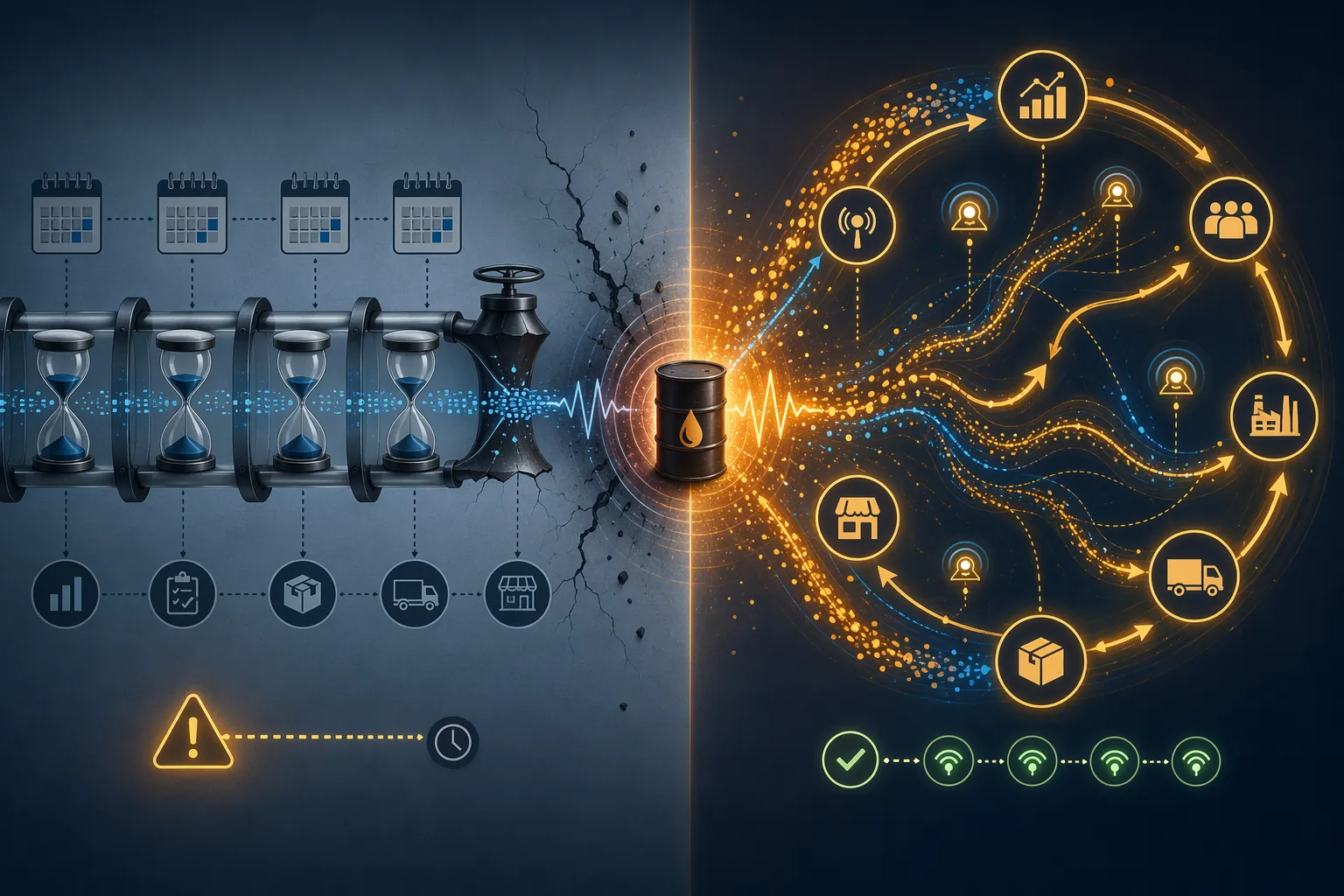
In a batch process, demand planning may update demand assumptions, procurement may update commodity costs, logistics may update transport constraints, and finance may update margin exposure on different clocks. Even if each team works quickly, the combined answer arrives late because the handoffs are sequential. By the time the new demand plan reaches procurement, the supplier allocation view may already be different. By the time procurement responds, transport economics may have moved again.
Continuous demand sensing is structurally better suited to this situation because it treats new signals as planning inputs rather than as exceptions waiting for the next review. In the documented vendor mechanism map, Blue Yonder’s probabilistic forecasting and demand-sensing architecture should be better positioned where the issue is a daily refresh of demand and cost signals. o9’s integrated business planning and digital-twin orientation should be better positioned where the planner needs to simulate changes across demand, supply, and network configuration. Those are architectural expectations, not public proof of Q1 2026 execution.
The important practical point is not whether a dashboard can display an oil-price feed. The issue is whether that feed changes downstream assumptions quickly enough to alter a decision: which orders to expedite, which SKUs to protect, which suppliers to renegotiate with, which freight modes to avoid, and which margin commitments finance should revisit. A real-time signal that still waits for a weekly consensus meeting is a faster warning light, not a faster response.
Where the Main Platforms Appear Structurally Stronger
The platform map below separates documented mechanism from proven shock performance. The first column describes the architectural fit implied by vendor materials and capability frameworks. The second column states the oil-shock stressor it should address. The third column is the evidence boundary.
| Platform | Oil-shock stressor it should address | Evidence boundary |
|---|---|---|
| Blue Yonder | Frequent demand and cost signal changes; daily reforecasting pressure; probabilistic demand shifts | Strong structural fit for real-time demand sensing, but no public Q1 2026 platform post-mortem |
| o9 | Network reconfiguration, integrated business planning, longer-horizon commodity scenario modeling | Strong structural fit where demand, supply, and finance need one model; no public Q1 2026 outcome record |
| Kinaxis Maestro | Concurrent comparison of service, cost, and inventory scenarios under fast-changing constraints | Strong structural fit where scenario-cycle time is the bottleneck; no public Q1 2026 outcome record |
| RELEX | Retail and CPG inventory response when transport costs and demand patterns shift together | Strong fit for inventory and demand-sensing use cases; no public Q1 2026 shock-specific case |
| Anaplan | Finance and operations alignment when fuel and input costs compress margin | Strong fit for connected margin planning; no public Q1 2026 supply-chain execution proof |
Blue Yonder and o9 look most relevant when the shock is interpreted as a sensing and integrated-planning problem. Blue Yonder’s documented strength is the ability to absorb demand signals probabilistically and refresh planning assumptions at a higher cadence. o9’s strength is the connected model: a digital-twin-style planning environment where network, demand, supply, and financial assumptions can be evaluated together. In an oil shock, those two orientations matter because the planner is not choosing between five versions of the same demand forecast. The planner is trying to understand how a fuel-cost change becomes a freight-rate change, then a landed-cost change, then a price or margin decision, then a demand response.
Kinaxis matters most where the bottleneck is scenario comparison. Its concurrent planning orientation is well matched to the 7 a.m. problem: procurement has one answer, logistics has another, finance has a third, and sales wants to know what can still be promised. The value is not that the platform can produce a scenario. Most planning tools can. The value is whether several materially different scenarios can be compared without waiting for each function to rebuild its portion of the plan in sequence.
RELEX is more specific. Its strongest fit is retail and CPG inventory response, where transport-cost pass-through, store or channel demand shifts, and replenishment decisions move quickly. It is less obviously the central tool for petrochemical allocation or semiconductor-input shortage modeling. That does not make it weaker in its lane; it makes the lane clearer.
Anaplan’s relevance is different again. Oil shocks become finance problems quickly because margin compression forces choices that operations cannot settle alone. If the company needs a shared view of margin exposure, cost absorption, pricing, and operating tradeoffs, connected planning can matter more than another demand-sensing layer. Anaplan is not the obvious answer to physical allocation under shortage. It is more relevant when the question is whether finance and operations can agree on the economic consequence of the response.
The Hardest Capability Is Cross-Functional Tradeoff Design
BCG’s cross-functional agent framing deserves more attention than most feature lists because oil shocks punish organizational sequence. A typical planning response still moves through a familiar loop: demand planning revises volume, procurement revises cost and supply, logistics revises lane assumptions, finance revises margin, sales revises commitments, and then the group negotiates. That loop can be disciplined and still be too slow.
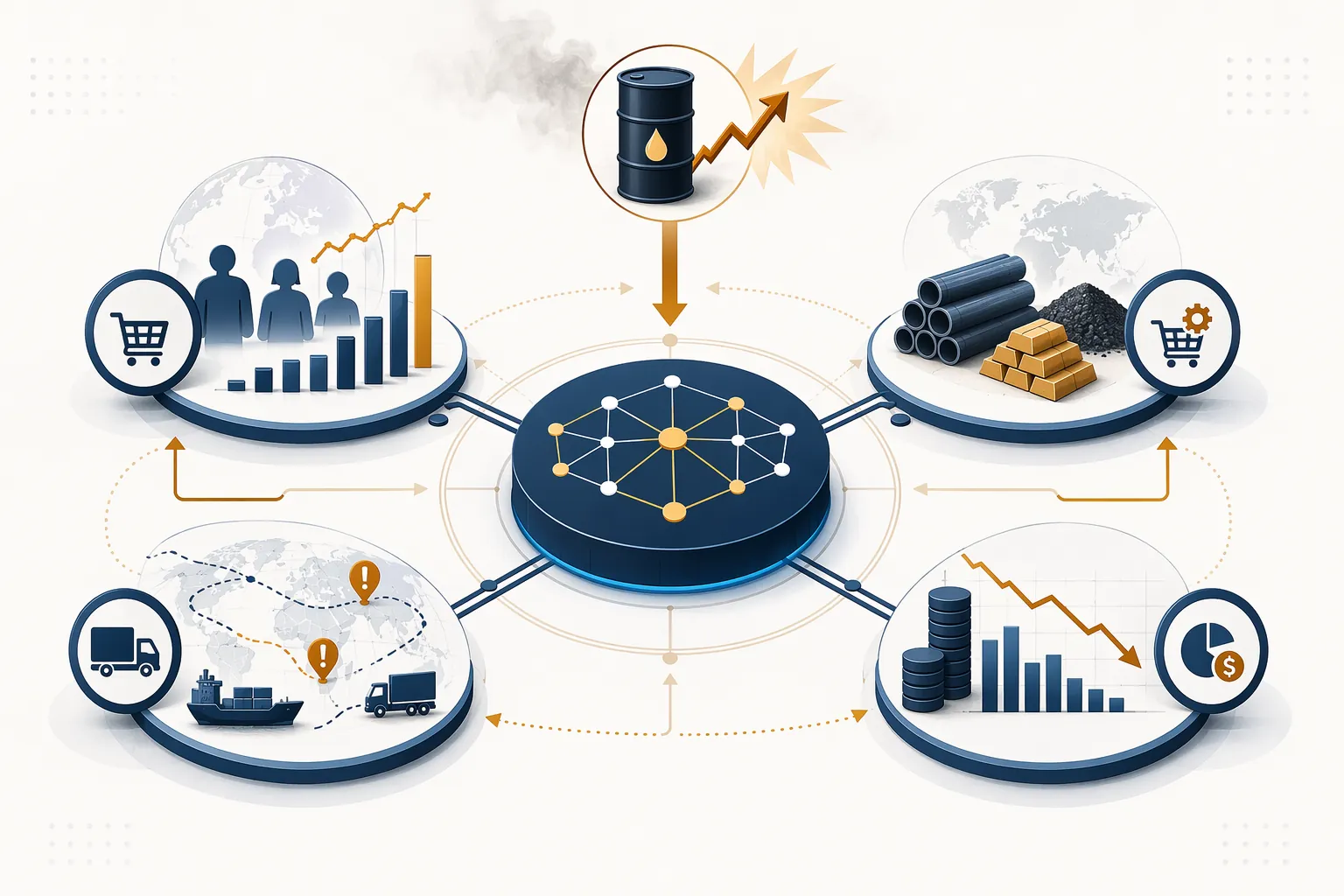
A better architecture does not merely automate each function’s existing step. It evaluates the tradeoff in a shared model. If procurement secures a higher-cost input, what happens to margin? If logistics shifts to a more expensive route to protect service, which customers or SKUs justify it? If sales protects volume with price concessions, does finance accept the margin effect? If inventory is repositioned, what service risk appears elsewhere? These are not independent questions. During a commodity shock, they are one decision wearing five departmental labels.
This is where Kinaxis, o9, Blue Yonder, Anaplan, and RELEX should be evaluated less by demo vocabulary and more by decision architecture. A platform that lets each team run its own AI assistant may improve productivity without changing the quality of the joint decision. A platform that exposes service, cost, revenue, and margin consequences in the same planning workflow has a stronger claim to shock response, because it attacks the negotiation delay directly.
The evidence still stops short of live-shock validation. BCG’s point is a capability framework and adoption diagnosis, not a platform-specific audit of March 2026 decisions.[3] But it identifies the right evaluation criterion: how quickly a company can move from signal to defensible tradeoff, not how elegantly the tool renders the signal.
Trust Latency Can Cancel Speed
The speed story has a human constraint. RELEX’s 2026 survey of 514 supply chain leaders found that only 10% trust AI to make fully autonomous decisions, while 54% prefer AI recommendations with humans making the final call.[5] During a stable cycle, that preference is easy to accommodate. During an oil shock, it creates verification latency: the time between the system recommending a better tradeoff and the organization being willing to act on it.
Verification latency is not irrational. A planner who accepts an AI recommendation may have to defend it to finance, procurement, sales, and an executive who remembers the last system-generated answer that failed. The fix is not to remove the human. The fix is to design the workflow so the human can see why the recommendation changed, which assumptions moved, what alternatives were rejected, and who bears the consequence.
This is why explainability and scenario traceability matter more in a shock than in a polished demo. If a platform senses demand faster but cannot show why it recommends protecting one customer segment over another, the decision will move to email, spreadsheets, and a call. Once that happens, the platform may still be right, but it is no longer controlling the response cycle.
Commodity Optimization Evidence Helps, but Only to a Point
Roland Berger’s commodity price optimization work is the strongest adjacent quantitative evidence in the public materials. Its AI-driven purchase timing optimization showed 3–5% raw material procurement savings in back-tested historical data across commodities including aluminum, copper, nickel, natural gas, crude oil, methanol, polyethylene, corn, and soybeans.[6]
That is meaningful evidence that AI can improve commodity timing decisions under historical volatility. It is not evidence that a planning platform improved live decisions during the Q1 2026 oil shock. Back-testing can show that a model would have made better historical buy/sell timing calls. It cannot prove that an organization had the data plumbing, governance, supplier access, and approval speed to act when Brent crossed $119 and physical flows through Hormuz were disrupted.
The boundary matters because procurement savings and supply continuity are different outcomes. A model may be very good at predicting favorable purchase timing and still be less useful when suppliers allocate constrained product, when substitute materials require qualification, or when transport availability becomes the gating issue. The Q1 shock did not only ask, “What will the price be?” It also asked, “Can we get the material, and who should receive it if we cannot get enough?”
The Shortage Gap Is the One Buyers Should Press On
Many planning models are more mature at price volatility than allocation under shortage. That is not a small gap. The Hormuz closure exposed a situation where oil prices, petroleum stockpile limits, petrochemical feedstocks, and helium supply could all matter to downstream production and AI infrastructure exposure.[1] A platform that treats the event mainly as a cost shock may miss the operating reality that some supply is not available at any price within the required window.
Buyers should therefore ask vendors for evidence in shortage language, not just scenario language. Can the model represent supplier allocation rules? Can it distinguish constrained supply from expensive supply? Can it prioritize customers, SKUs, plants, or channels under a binding input constraint? Can finance see the margin and revenue effect of those allocation choices before sales commits externally? Can the workflow preserve the rationale for later review?
Those questions are more revealing than asking whether the platform has a digital twin, demand sensing, or generative AI. The demo terms are now table stakes. The shortage behavior is where the architecture either becomes a decision system or remains an analytics layer.
What a Real Post-Mortem Would Need to Show
The missing public evidence is not hard to define. A useful post-mortem from any major platform or customer would need dates, affected functions, decision latency, forecast changes, scenario assumptions, service outcomes, cost outcomes, and a candid account of what broke. It would need to separate price decisions from shortage decisions. It would need to show whether the platform changed the decision or merely documented the decision after planners made it elsewhere.
The most useful evidence would be operational rather than promotional: how long it took to refresh demand and supply assumptions; whether procurement, logistics, finance, and sales worked from one scenario set; which recommendations humans rejected; which recommendations they accepted; and whether service, cost, inventory, or margin outcomes improved compared with the company’s normal disruption process.
Until that evidence exists, the disciplined conclusion is a theoretical capability ranking, not a performance ranking. Blue Yonder and o9 appear structurally better positioned where real-time sensing and integrated planning matter most. Kinaxis appears strongest where concurrent scenario comparison is the constraint. RELEX is strongest in retail and CPG inventory response. Anaplan is most relevant where finance and operations need a shared margin view. None of those statements proves that a customer using the platform responded better in Q1 2026.
The 2026 oil shock supports a clear evaluation standard: favor architectures that update assumptions continuously, compare cross-functional tradeoffs concurrently, expose recommendation logic, and model shortage separately from price. Do not treat those capabilities as proven shock performance until vendors or customers publish verifiable post-mortems with the operating details planners actually needed while the situation was still moving.
References
- Will Mounting Supply Chain Strains Hamstring the AI Investment Boom?, NY Fed Liberty Street Economics, May 2026
- Oil Price Surge: What It Means for Supply Chains, Logistics and Procurement in 2026, Bramwith Consulting, March 2026
- How AI Agents Are Transforming Supply Chains, BCG, 2026
- War, Oil Shock and the End of Predictable Supply Chains, Supply & Demand Chain Executive, June 2026
- RELEX Report: AI Moves Into Core Supply Chain Decisions as Volatility Persists, RELEX, 2026
- AI-driven commodity price optimization, Roland Berger, 2023
§ 42 — Cited evidence
Flag an inaccuracy or submit a comparable account — Contribute or read how claims are verified in Methodology.