
§ 41 — Use-case analysis
Why AI Supply Chain Models Miss Physical Warehouse Destruction
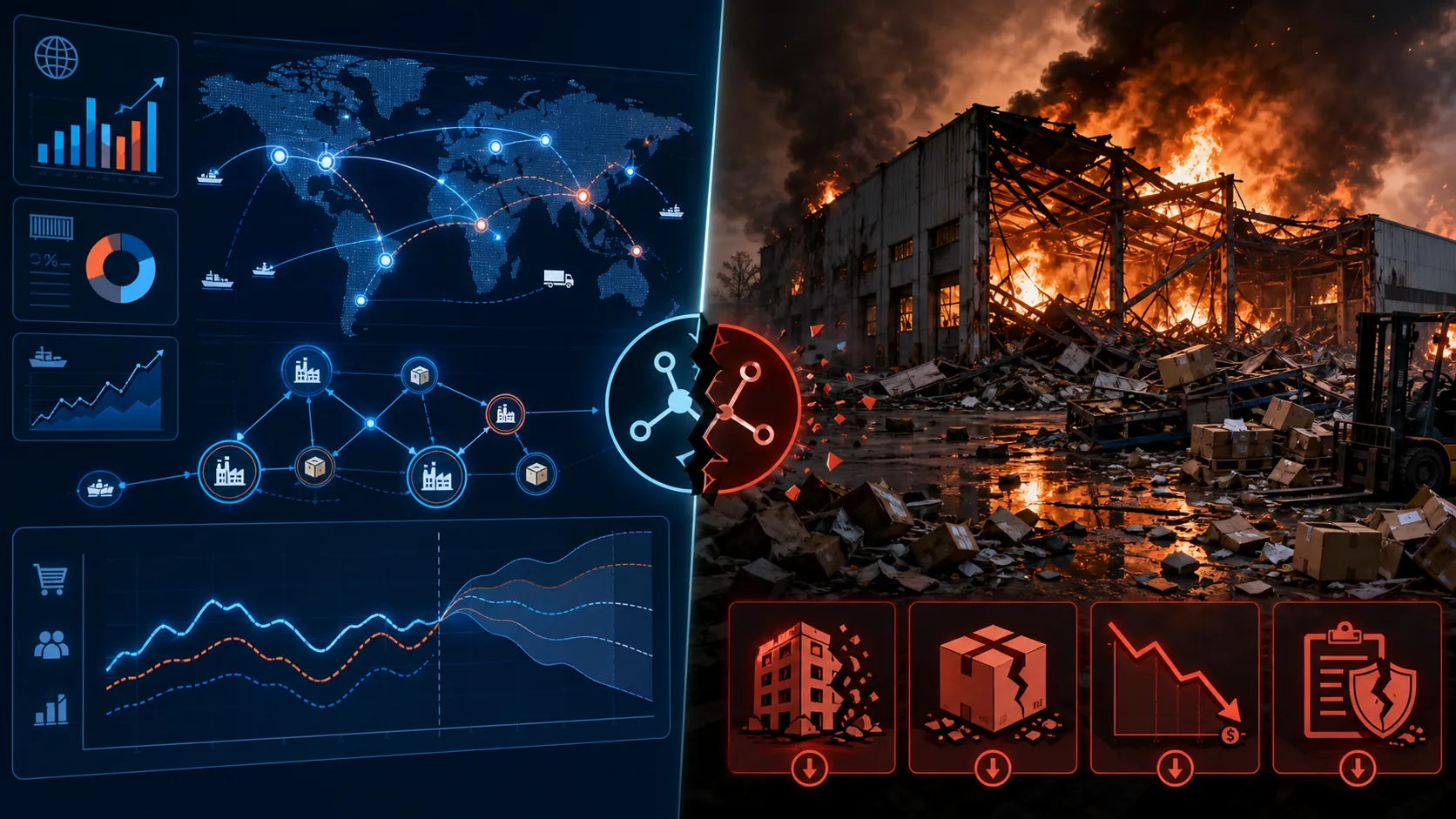
The 2026 Wildberries warehouse attacks show that major AI supply chain planning platforms advertise geopolitical scenario modeling but do not include total physical destruction of a logistics node from a kinetic attack. This article examines the gap and what buyers should demand in RFPs.
The useful question in AI supply chain disruption planning after the Wildberries attacks is not whether a platform can draw a new route around a closed lane. It is whether the model can remove a logistics node from the network, erase inventory that physically no longer exists, recognize that most sellers may not recover through insurance, and then sequence the recovery while legal liability is moving on a different clock.
Between July 18 and July 23, 2026, multiple Wildberries warehouses were struck, with at least five facilities reported hit across the period. Public reporting as of July 22-23 described the Elektrostal facility as a major loss: a warehouse complex reported at roughly 250,000 to 360,000 square meters, burning for three days, with eight deaths reported in the incident coverage.[1] Across the reported strikes, total destroyed warehouse area was estimated at about 552,000 square meters, roughly 10% of Wildberries logistics capacity.[2]

The financial numbers were already difficult to compare by July 24 because they described different scopes. Forbes cited about $2 billion for Elektrostal alone.[3] CNBC put the total across all strikes at about $2.3 billion.[4] Meduza cited seller inventory losses of 150 billion to 235 billion rubles, or roughly $1.9 billion to $3 billion.[5] Kommersant and Moscow Times reporting cited about 100 billion rubles, or about $1.3 billion, for the initial two strikes, while Kommersant also noted that a full inventory would take 30 days.[2][6]
Insurance did not look like a simple recovery variable either. Meduza and Intellinews reported that only 5% to 7% of sellers carried any insurance, and only 10% to 20% of those policies covered sabotage.[5][7] That matters because an AI plan that treats inventory as delayed, rerouted, or financially recoverable is not modeling the same event as one in which inventory is gone and most affected sellers may have no insurance path back to working capital.
Then there is the clause timing. Wildberries added drone and sabotage language to its force majeure clause on July 7, 2026, 11 days before the first reported strikes, according to Moscow Times, Washington Post, and Meduza coverage.[2][5][8] That fact does not prove intent, and it should not be used as if it does. It does show why physical risk, contractual risk, and planning risk cannot be treated as one generic disruption label. They activate on different dates, affect different parties, and change which losses the model should assign to the platform, sellers, carriers, insurers, or nobody at all.
What a warehouse strike does to a planning model
A tariff scenario changes landed cost. A route closure changes feasible paths and lead times. A supplier default changes supply availability. A demand shock changes what the network is trying to satisfy. A warehouse strike can do all of that indirectly, but its first-order effect is harsher: a physical node disappears.
That node is not just a dot on a map. It contains capacity, labor assumptions, sortation logic, handling constraints, inventory ownership records, inbound appointments, outbound promises, exception queues, safety-stock policies, insurance assumptions, and contractual obligations. Removing it from the model should not be equivalent to making it expensive or slow. It should make some actions impossible.
| Planning object | What changes in a node-destruction scenario |
|---|---|
| Warehouse capacity | The facility is removed from available network capacity rather than penalized with a higher cost or longer lead time. |
| Inventory | Stock at the node is written off or quarantined by ownership class instead of being treated as delayed supply. |
| Seller exposure | Small sellers with concentrated inventory face cash-flow and insolvency risk, not just late fulfillment. |
| Insurance recovery | Recovery cannot be assumed where policies are absent or sabotage exclusions apply. |
| Contractual liability | Force majeure language can shift who bears loss independently of the physical recovery plan. |
| Recovery sequence | The model must decide what capacity returns first: receiving, storage, picking, sortation, outbound dispatch, or seller onboarding. |
The Wildberries case is especially uncomfortable for planning systems because it combines marketplace ownership complexity with logistics capacity loss. In a conventional enterprise model, damaged inventory may sit on the balance sheet of the company running the warehouse. In a marketplace, inventory ownership and operating control can be split. The platform operates the logistics infrastructure; sellers may own the goods; carriers and service providers may be scheduled around a facility that no longer functions; customers see a fulfillment failure without caring which legal entity owns the item.
Seller bankruptcy contagion is the part most likely to be abstracted away. Available reporting described 88,000-plus small sellers facing bankruptcy contagion in the Wildberries case. That is not the same as 88,000 confirmed bankruptcies. It is a population exposed to financial stress through lost inventory, disrupted sales, and uncertain recovery. For planning purposes, the distinction matters: the model should not mark every seller as failed, but it should be able to test what happens when a share of exposed sellers cannot replenish, accept delayed payout, or fund new inventory.
A credible stress test would also separate the destroyed stock from the missing-capacity problem. Rebuilding cost was estimated at 22 billion to 36 billion rubles, according to Intellinews and Kommersant reporting.[6][7] That is a capital recovery question. It does not restore inventory that burned, replace seller cash flow, or instantly recreate the throughput of a functioning node. A model that gives the user a single “warehouse unavailable for X days” parameter may be useful for continuity planning, but it is not yet representing the operating facts exposed here.
The public vendor evidence points to volatility, not destruction
The gap is not that AI planning vendors ignore geopolitical risk. They do not. The stronger platforms now talk fluently about scenario analysis, control towers, what-if planning, agentic AI, demand sensing, scheduling, logistics exceptions, and network optimization. Those are legitimate capabilities. The narrower problem is that public materials tend to present geopolitical disruption as a change in constraints or volatility, not as the total physical destruction of a logistics node.
o9’s APEX materials, as described in Manufacturing Digital and o9 coverage, emphasize Neuro-Symbolic AI and learning from post-game analysis. That framing is ambitious because it tries to connect pattern recognition with structured business reasoning. The public evidence reviewed for this article, however, does not show a documented scenario template for physical warehouse loss from a kinetic attack.[9] That is a documentation finding, not a platform audit. o9 may have private configuration patterns that are not visible in public case studies.
Kinaxis Maestro appears in public deployment coverage with large-enterprise planning use cases, including P&G and Reckitt, focused on enterprise scheduling and demand scenario planning. Those are areas where concurrent planning can produce real operational value: planners can see how a demand change affects capacity, supply, and service before separate teams make conflicting decisions. But the documented examples cited in Manufacturing Digital coverage focus on demand volatility rather than node-level physical destruction.[10]
Blue Yonder’s Luminate story is similar. Logistics Viewpoints coverage of Blue Yonder ICON 2026 described agentic AI for logistics exceptions, demand shifts, and transportation optimization.[11] That is exactly where many operations teams feel daily pain: late trucks, missed appointments, demand changes, and suboptimal transport plans. The missing public example is not a smarter exception workflow. It is a scenario in which the exception queue itself is attached to a destroyed building, vanished inventory, and legally contested loss allocation.
RELEX scenario analysis and Anaplan connected planning both sit in the same buyer conversation. Their public positioning is built around helping teams compare planning assumptions, connect functions, and evaluate changes in demand, supply, inventory, finance, and operations. Those are not trivial strengths. In many disruptions, the company that can get commercial, supply, logistics, and finance teams onto the same assumption set will outperform one that waits for sequential spreadsheet reconciliation. Still, the public-facing scenario vocabulary does not establish that complete physical node destruction, inventory write-off by ownership class, and insurance non-recovery are modeled as first-class planning objects.[12][13]
That distinction should matter in vendor evaluation. “Can model geopolitical risk” is too soft. A tariff increase, a Red Sea routing constraint, an export-control change, a supplier default, a border delay, and a warehouse strike all belong under the geopolitical umbrella in executive conversation. They do not belong in the same test script.
The broader market is preparing for disruption, but not always the same one
The surrounding research helps explain why the vendor language has evolved the way it has. Everstream’s 2026 Annual Risk Report said cyberattacks on logistics surged 965% from 2021 to 2025, and that Russian GPS jamming in the Baltic affects 15% of global cargo.[14] Those are serious operating risks, but they train the planning imagination toward degraded information, route interference, carrier disruption, and exception management. They do not automatically teach the model to treat a warehouse as physically gone.
A January 2026 MIT Sloan Management Review article by Cohen and coauthors described companies using digital twins for geopolitical what-if scenarios, but the documented examples cited here did not model physical-asset destruction from kinetic attack as a discrete variable.[15] That is a useful boundary. Digital twins can be powerful without covering every risk mode. The mistake is buying the phrase “geopolitical what-if” and assuming it includes every geopolitical consequence.
AIMMS makes a related planning point from a different angle: evaluating response options in isolation rather than within the full network is a common pitfall in geopolitical disruption scenario work.[16] That warning fits the Wildberries case, but the framework described in the research brief still assumes disruption mainly as a trade-route or sourcing constraint. The next step is harder: modeling the facility itself as the failed object, then watching the failure propagate through inventory, seller solvency, transport, service commitments, and liability.
MIT CTL’s Warehouse of the Future work is closer to the physical layer. Its 2025 public abstract identified sabotage among five major disruption types and 26 vulnerabilities, while also noting that supply-chain risk studies often consider disruptions at a larger network scale with limited attention to the unique challenges of modern warehouses.[17] That is the conceptual opening this market needs. A warehouse is not merely a capacity bucket inside a network optimization problem. It is a concentration of assets, data, labor, equipment, and third-party inventory.
The performance claims around AI scenario planning also need careful reading. TraxTech and MIT CTL reported that AI-powered scenario planning can reduce disruption response times by 35% and costs by 23%.[18] Those gains are meaningful only when the disruption mode that occurs is one the planning process can actually represent. Faster response to the wrong abstraction is still the wrong response.
ABI Research’s 2026 finding that 65% of supply-chain professionals say AI is important for purchase decisions confirms that buyers are already weighting AI heavily in vendor selection.[19] It also raises the stakes for precision. If agentic AI is mainly being demonstrated on demand changes and logistics exceptions, buyers should not infer that it has been stress-tested against physical-asset destruction unless the vendor shows the scenario.
A better RFP test
The practical answer is not to reject AI planning platforms. It is to stop accepting geopolitical scenario language without a boundary test. In the next RFP, buyers should ask the vendor to run a live or scripted scenario that destroys a named logistics node and prevents the model from treating that node as merely delayed, expensive, or capacity-constrained.
- Can the platform model complete physical destruction of a warehouse, fulfillment center, port facility, or cross-dock as a hard node failure?
- Can it remove the node’s storage, labor, handling, sortation, inbound, and outbound capacity separately, rather than applying one generic outage parameter?
- Can inventory at the node be written off, quarantined, or reassigned by ownership class, including marketplace seller inventory?
- Can the model represent unavailable insurance recovery, partial coverage, exclusions for sabotage, and delayed claims settlement?
- Can force majeure or liability-shifting clauses change financial exposure without pretending the physical recovery has improved?
- Can the platform test seller or supplier insolvency exposure when lost inventory removes working capital from smaller counterparties?
- Can recovery be sequenced by operational capability, such as receiving first, then storage, then picking, then outbound dispatch?
The demonstration should force the vendor to show the data objects. Where is the warehouse represented? Where is inventory ownership represented? Where is insured value represented? Where does the contract live? Which planner sees the capacity loss? Which finance user sees non-recovery? Which S&OP decision changes because seller supply may not return?
A clean alternate route is not enough. If a warehouse has been destroyed, transport optimization may solve only the portion of the problem that survived. The more important question may be which demand should no longer be promised, which sellers should receive exception handling, which replacement capacity can accept inbound product, and which financial assumptions should be removed from the plan.
Buyers should also ask vendors to distinguish standard configuration from custom modeling. A platform may be flexible enough to represent node destruction if the buyer builds the right data model, but that is different from an out-of-the-box geopolitical scenario library. The RFP should make the vendor state which parts are native, which require implementation work, which require third-party risk data, and which require manual override.
The public evidence does not prove that o9, Kinaxis, Blue Yonder, RELEX, Anaplan, or any other planning vendor cannot model this privately. It does show that their public documentation, case studies, and conference coverage do not yet make total physical destruction of a logistics node visible as a standard geopolitical planning scenario. After Wildberries, that absence is no longer a small wording issue. It is an RFP requirement.
References
- Reuters coverage of Wildberries warehouse attacks, Reuters, July 22-23, 2026
- Moscow Times coverage of Wildberries warehouse attacks and force majeure clause, Moscow Times, July 2026
- Forbes coverage of Wildberries Elektrostal warehouse losses, Forbes, July 2026
- CNBC coverage of Wildberries warehouse strike losses, CNBC, July 2026
- Meduza coverage of Wildberries seller inventory losses and force majeure clause, Meduza, July 2026
- Kommersant coverage of Wildberries warehouse losses and inventory timeline, Kommersant, July 2026
- Intellinews coverage of Wildberries insurance and rebuilding cost estimates, Intellinews, July 2026
- Washington Post coverage of Wildberries force majeure clause, Washington Post, July 2026
- Manufacturing Digital coverage of o9 APEX and Neuro-Symbolic AI materials, Manufacturing Digital
- Manufacturing Digital coverage of Kinaxis Maestro deployments at P&G and Reckitt, Manufacturing Digital
- Blue Yonder ICON 2026 coverage, Logistics Viewpoints, June 2026
- RELEX scenario analysis materials, RELEX
- Anaplan connected planning materials, Anaplan
- 2026 Annual Risk Report, Everstream Analytics, 2026
- Stay Ahead of Geopolitical Supply Chain Risks, MIT Sloan Management Review, January 2026
- Geopolitical disruption scenario framework, AIMMS
- Warehouse of the Future, MIT Center for Transportation & Logistics, 2025
- AI-powered scenario planning research, TraxTech and MIT Center for Transportation & Logistics
- ABI Research 2026 supply chain AI purchase decision findings, ABI Research, 2026
§ 42 — Cited evidence
Flag an inaccuracy or submit a comparable account — Contribute or read how claims are verified in Methodology.