§ 41 — Use-case analysis
Which AI Tools Actually Assess Pharma Tariff Exposure
A functional checklist for pharma supply-chain planners evaluating AI platforms under the 2026 Section 232 regime, showing why standard Tier-1 planning tools miss API-level sub-tier exposure and what five major vendors actually offer.
- Function
- procurement
- AI technique
- multi-tier-supplier-mapping
- Failure pattern
- tier-1-only-visibility
- Evidence source
- Brookings March 2025, Logistics Viewpoints April 2026
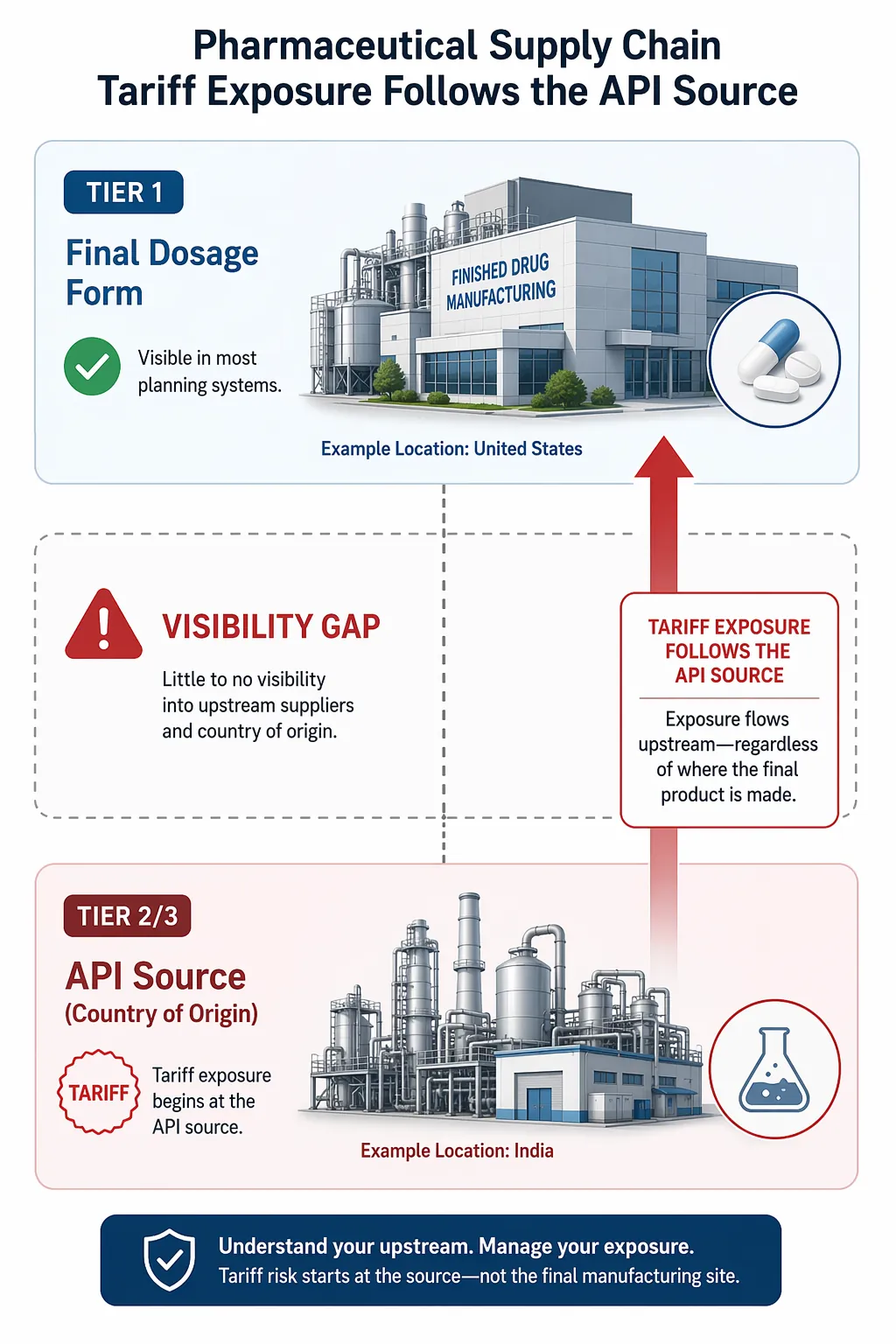
For pharmaceutical tariff planning, the uncomfortable starting point is not the model. It is the origin field. A planning system can know the finished dosage form manufacturer, the Tier-1 supplier, the ship-from country, and the purchase price, and still miss the exposure that matters under the 2026 pharmaceutical tariff regime.
Brookings’ reading of CBP ruling N344024 is the constraint planners have to design around: for a finished drug, country of origin generally follows the manufacturing source of the active pharmaceutical ingredient, not the country where the final dosage form is made. In practical terms, a tablet finished in India can still carry Chinese-origin tariff exposure if the API was manufactured in China.[1]
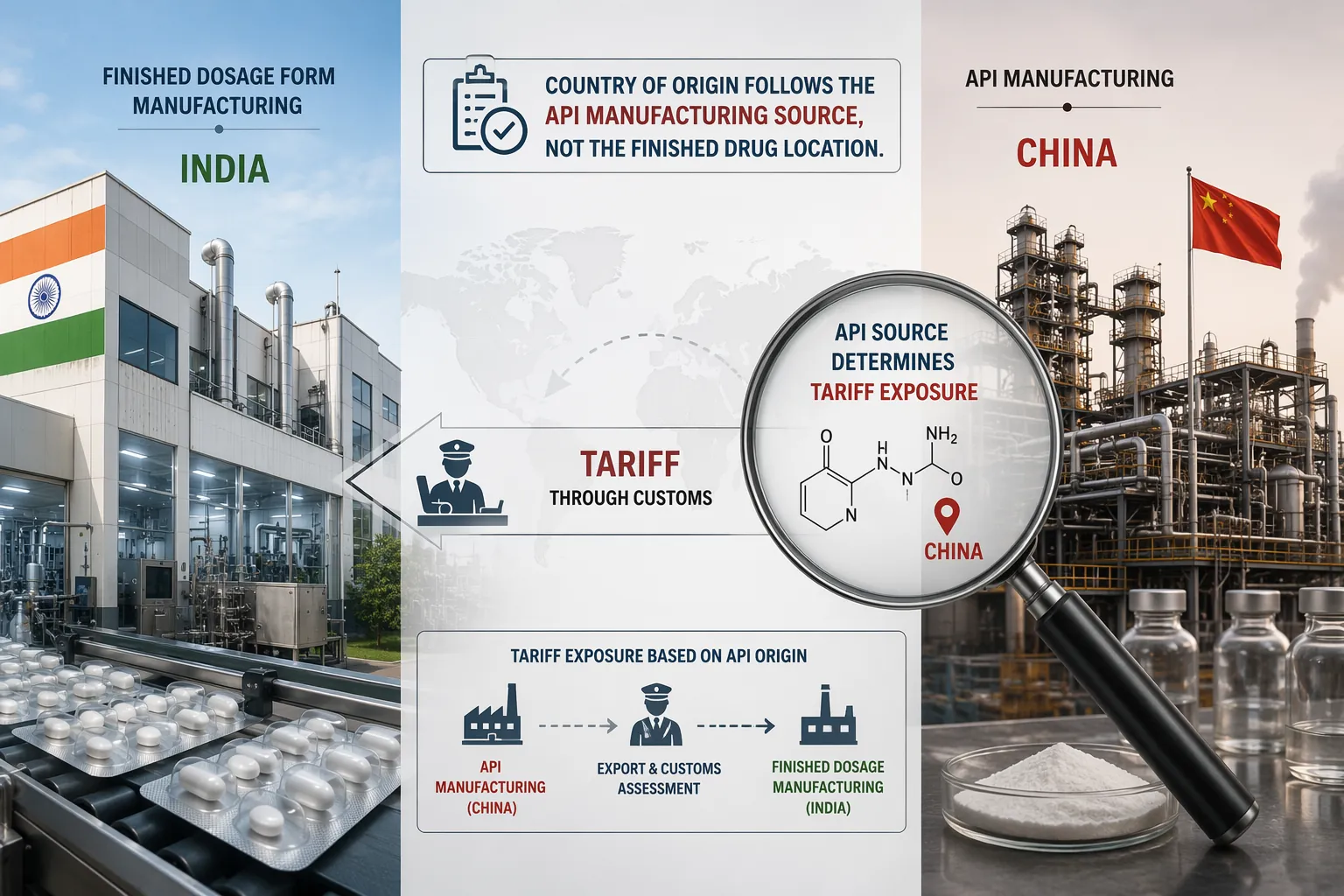
That does not mean every pharmaceutical product will be treated identically. Country-of-origin determinations can vary by product facts, multi-API formulations, USMCA coverage, and any implementation details following the April 2026 proclamation. But as a general planning rule, collapsing finished-product country, Tier-1 supplier country, and API country into one field is unsafe.
The exposure also does not hit every portfolio the same way. Brookings gives a sharp branded-versus-generic illustration: a $10,000 branded drug with $100 of API cost faces a 26x effective API cost increase under a 25% tariff, while a generic drug with the same API cost faces only a 30% increase.[1] The same tariff rate is not the same planning problem when margin structure, reimbursement pressure, and substitution risk differ.
The scale of the sub-tier problem is not marginal. Logistics Viewpoints reported that 70% to 80% of global API production is concentrated in India and China, and identified July 31, 2026 for listed companies and September 29, 2026 for others as key enforcement dates under the Section 232 proclamation it discussed.[2] A pharma planner cannot treat API origin as an exotic exception if most of the industry’s active ingredients are concentrated in two countries.
The Minimum Viable Tariff Model
A platform that says it can “assess tariff exposure” for pharma should be able to answer a chain of questions that ordinary Tier-1 visibility does not answer. The issue is not whether the system has AI features. The issue is whether the system can preserve the relationships that tariff classification and product economics depend on.
| Capability | What It Must Prove In Pharma |
|---|---|
| API-level sub-tier mapping | The system links each finished product to the API manufacturer, not only the finished dosage form site or Tier-1 supplier. |
| Country-of-origin logic | The system distinguishes finished-product country, supplier country, API source country, and origin rule assumptions. |
| HTS linkage | The product, ingredient, or import record is tied to the relevant HTS classification used in the tariff scenario. |
| Finished-product-to-API relationship mapping | The model handles one finished product using one or more APIs, and does not assume one SKU equals one origin. |
| Scenario economics | The tariff impact can be modeled differently for branded, generic, high-margin, low-margin, and constrained-supply products. |
| Pharma-specific validation | The vendor can demonstrate the process on pharmaceutical data, including API lineage, rather than only on general manufacturing examples. |
The evidence that is often missing in sales discussions is specific. “We ingest supplier data” is not the same as “we identify API-origin exposure under a stated origin rule.” “We model tariffs” is not the same as “we link HTS classification to the API source behind this finished drug.” Procurement teams should ask for a live walk-through on their own product hierarchy, not a generic tariff dashboard.
Where The Major Platforms Appear Strong
Kinaxis is the cleanest fit for teams that need a rapid tariff-response planning layer. Kinaxis announced its Tariff Response Solution in April 2025, claiming deployment in as little as 21 days, and its tariff materials describe SKU-level tariff exposure analysis with origin tracking.[3][4] That is useful language for pharma because SKU-level modeling is closer to the planner’s operating world than country-level trade commentary.
The open question is whether the SKU-level origin field can reliably follow API manufacturing source when the finished drug, supplier, and API are in different countries. Kinaxis may have the planning architecture to make tariff scenarios operational quickly, but the public materials do not publish a pharma-specific validation showing API-origin lineage through sub-tier suppliers.
Resilinc makes the most direct tariff-oriented multi-tier mapping claim. Its 2026 pharmaceutical tariff materials discuss mapping multi-tier suppliers specifically in preparation for pharmaceutical tariffs.[5] That matters because the API source is usually not sitting neatly inside a conventional Tier-1 supplier record.
Still, “multi-tier supplier mapping” has to be tested against the actual pharma object model. A tariff planner needs to know whether the platform maps supplier tiers around legal entities, sites, materials, APIs, key starting materials, excipients, or all of them. For Section 232 exposure work, a beautiful network graph is not enough if it cannot point from finished product to API source to origin assumption to HTS-linked scenario.
o9 has the deepest vendor-claimed sub-tier language in the field. Its tariff-resilience materials describe an Enterprise Knowledge Graph and supplier relationship management capabilities that provide multi-tier visibility, including sub-suppliers at API, KSM, and excipient levels.[6] That is exactly the vocabulary a pharma team wants to hear, because it recognizes that exposure may sit below the finished product and below the immediate supplier.
The caution is the same one planners should apply to any graph claim: structure is not validation. Public o9 materials support the claim that the platform is designed to represent deep supply relationships; they do not, on their own, prove that a buyer can produce a defensible API-origin tariff exposure file for its own portfolio under CBP logic.
Blue Yonder’s tariff materials are more early-warning and compliance-scanning oriented. Its 2025 tariff discussion describes AI-powered tariff tracking and compliance scanning within the Luminate platform.[7] That can be valuable where the immediate pain is monitoring changes, identifying affected flows, and keeping trade compliance teams from working off stale assumptions.
For pharma tariff exposure, the unresolved point is depth. A compliance scanner can flag tariff changes, but exposure assessment still depends on whether the system knows which API source controls country of origin for a given finished product. If the underlying data model stops at finished goods or Tier-1 suppliers, early warning arrives without enough lineage to decide what to do.
Anaplan sits in a different part of the problem. Its tariff-disruption materials frame supply-chain response across multiple planning horizons: strategic planning over 3 to 5 years, tactical planning over 6 to 24 months, operational planning over 0 to 18 months, and executional planning over 0 to 2 weeks.[8] That is useful for separating the CFO question from the sourcing question from the weekly allocation question.
But multi-horizon planning is not proof of API-origin mapping. Anaplan can help teams compare inventory, sourcing, pricing, and network scenarios once the exposure data is trustworthy. It should not be treated as evidence that the exposure data itself has been built correctly.
The Demo Questions That Separate Planning From Exposure
The fastest way to evaluate a vendor is to avoid asking whether it “supports tariffs.” Most do, in some form. Ask instead for a demonstration using a product where the finished dosage form country and API manufacturing country diverge. If the demo cannot preserve that distinction, it is not a pharma tariff exposure demo.
- Show one finished product, its API or APIs, each API manufacturing site, the supplier tier for each site, and the country-of-origin assumption used in the scenario.
- Show where HTS classification enters the model, who owns it, and how changes are governed.
- Show how the model treats an FDF made in one country with an API sourced from another country.
- Show whether branded and generic products with the same tariff rate produce different margin, price, supply, and substitution scenarios.
- Show the confidence level or evidence attached to each sub-tier relationship, especially where supplier-provided data is incomplete.
- Show an audit trail: which data came from ERP, supplier declarations, trade records, manual enrichment, or the vendor’s own network intelligence.
A credible answer will usually involve uncomfortable data work. APIs may be linked to multiple finished products. A finished product may have more than one API. Supplier names may not match across quality, procurement, ERP, and trade systems. A contract manufacturer may know the FDF operation but not expose the upstream API source in a form the planning system can use. AI can help reconcile and interrogate that mess, but it cannot make the origin rule disappear.
The economic scenario also has to be portfolio-aware. A tariff on an API feeding a protected branded product may be absorbed, priced, or negotiated differently from the same tariff on a generic product with limited pricing room. The Brookings branded-versus-generic example is useful precisely because it prevents a planner from reporting exposure only as tariff dollars by SKU.[1]
What Is Still Missing As Of Q3 2026
The five platforms cover important pieces of the capability set. Kinaxis is strong on fast scenario deployment and SKU-level tariff response claims. Resilinc speaks most directly to tariff-oriented multi-tier mapping. o9 publishes the richest sub-tier graph language for API, KSM, and excipient visibility. Blue Yonder is relevant for tariff tracking and compliance scanning. Anaplan is useful for connecting tariff assumptions to planning horizons and management decisions.
The missing evidence is narrower and more important: none of the five vendors has published, as of Q3 2026, an independently validated pharma-specific case showing API-level sub-tier mapping, country-of-origin logic, HTS linkage, and scenario economics working together for Section 232 pharmaceutical tariff exposure. Vendor claims may be directionally useful, but they are not a substitute for a demonstrated lineage file on the buyer’s own products.
That is the practical threshold. If a platform cannot show how a finished drug connects to its API source, how that source drives origin assumptions, how HTS classification is attached, and how the tariff changes portfolio economics, it should be described as helping with tariff planning, monitoring, or scenario management — not as fully assessing pharmaceutical tariff exposure.
References
- Will pharmaceutical tariffs achieve their goals?, Brookings, March 2025
- Pharmaceutical Tariffs and the Restructuring of Global Drug Supply Chains, Logistics Viewpoints, April 10, 2026
- Kinaxis Launches Tariff Response Solution, Kinaxis investor relations, April 2025
- Kinaxis Tariffs product page, Kinaxis
- Preparing for Pharmaceutical Tariffs in 2026, Resilinc, 2026
- Supply Chain Resilience in the Tariff Era, o9 Solutions
- U.S. tariffs: what's happening, and what does it mean?, Blue Yonder, 2025
- Leading Through Tariff Disruptions with the Future-Proof Supply Chain, Anaplan
§ 42 — Cited evidence
Flag an inaccuracy or submit a comparable account — Contribute or read how claims are verified in Methodology.