
§ 41 — Use-case analysis
Can AI Justify Its Cost for Hurricane Air Travel Disruptions?
An evidence-based look at what AI disruption-management tools actually save during hurricane-related air travel disruptions, with documented cost baselines and real peer outcomes to help procurement leaders build an honest investment case.
- Function
- airline disruption management
- AI technique
- forecasting and optimization
- Failure pattern
- overestimated savings scope
- Evidence source
- MarketIntelo Airline Disruption Management AI Market Research Report 2034, Jun 2026
The investment case for AI in hurricane-related air travel disruption usually looks strongest before anyone asks which cost line the software is supposed to remove. The headline disruption pool is large: Wipro has estimated global airline disruptions at about $60 billion a year, equal to roughly 8% of airline revenue, while Airlines for America put the cost of a delay minute at about $100 in 2024.[1][2] In the same operating universe, 22% of U.S. commercial arrivals in 2024 were delayed by at least 15 minutes, and nearly 220,000 EU/EEA/UK departures were delayed more than three hours or canceled, creating both customer-handling work and compensation exposure.[3]
Those figures make AI disruption-management tools financially plausible. They do not make every hurricane cost addressable. A procurement model has to separate the airline’s operational supply chain—aircraft, crews, fuel, bags, maintenance capacity, gates, catering, contact centers—from the broader logistics supply chain of ports, roads, warehouses, raw materials, ground handlers, freight forwarders, and power. The same storm may damage both systems, but an airline disruption platform cannot repair a washed-out road, reopen a port, or restore grid power.
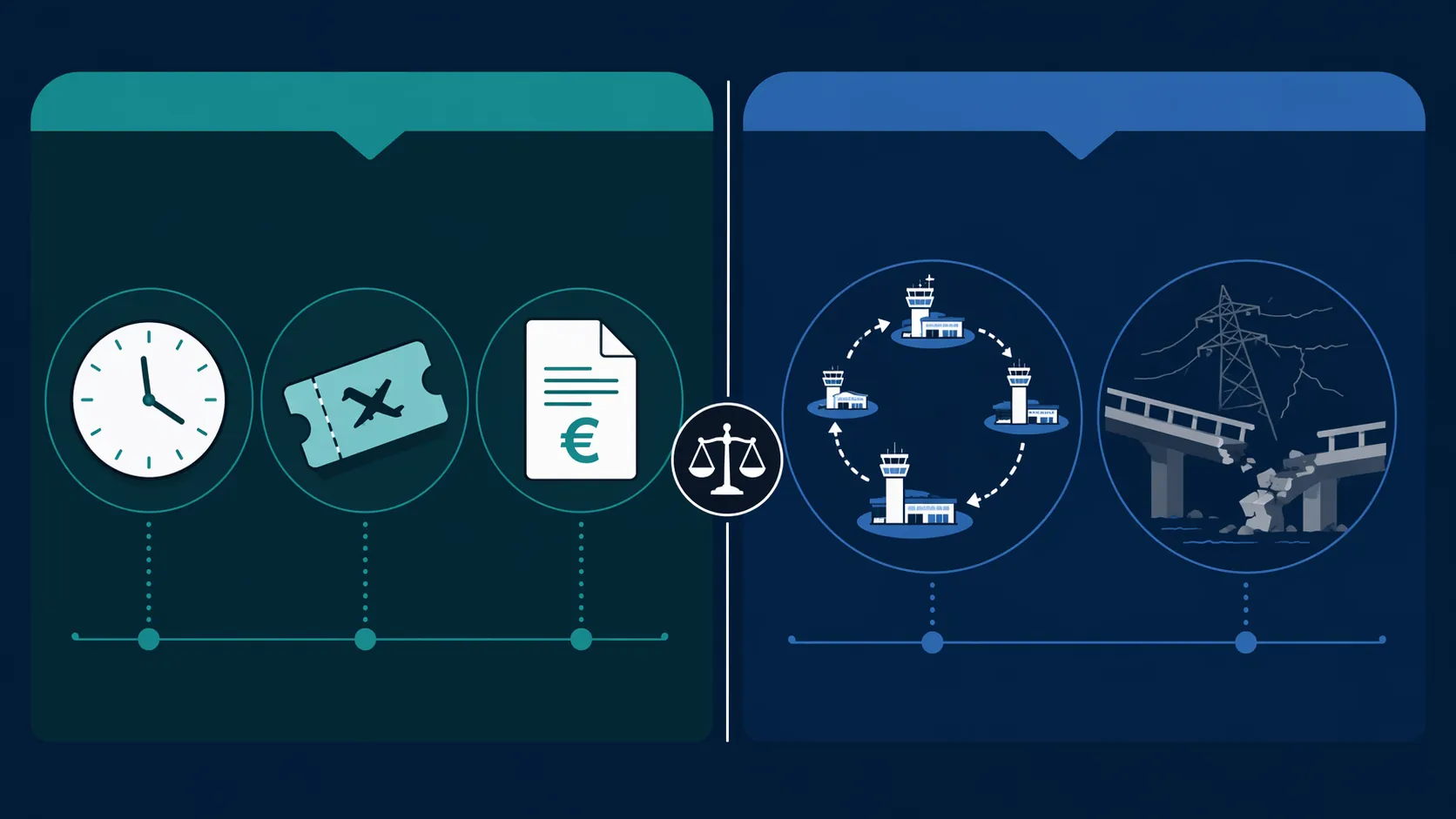
That boundary matters because hurricane damage is real but unevenly relevant to this buying decision. NOAA put Hurricane Ian’s total economic loss at $112.9 billion, a number that describes the scale of the disaster, not the recoverable savings pool for airline AI.[4] After Hurricane Harvey, 67% of supply chain managers surveyed by ISM reported negative raw-material price impacts, again a useful warning about hurricane exposure but not proof that air-travel disruption software can cut raw-material inflation.[5] IATA’s reported $11 billion supply-chain hit to airlines in 2025 is closer to the airline cost base, but even that figure includes pressures beyond a hurricane-specific AI recovery workflow.[6]
Start With The Costs The Tool Can Actually Touch
A defensible business case should begin with addressable work. During a hurricane disruption, that usually means decisions and administration that can move earlier: which flights to cancel before crews and aircraft are stranded, which passengers to reaccommodate before call volume spikes, which bags and cargo handoffs need exception handling, and which delay and cancellation records must be preserved for compensation or regulatory review.
| Cost line | What AI can plausibly reduce | What should not be counted without specific proof |
|---|---|---|
| Delay minutes | Weather-related delay minutes where earlier prediction and recovery choices change the operating plan | All downstream network delay minutes created after infrastructure closes or aircraft and crews are already displaced |
| Rebooking and customer recovery | Manual reaccommodation work, avoidable call-center load, and higher-cost last-minute recovery options | Customer dissatisfaction as a broad brand claim unless it is tied to refunds, compensation, churn, or service-cost data |
| Compensation and compliance | Administrative overhead, documentation gaps, and preventable compensation exposure | Statutory liability that still applies after the tool is used |
| Baggage and cargo exceptions | Some mishandling and routing errors during disruption recovery | Freight delays caused by closed roads, unavailable trucks, damaged warehouses, or power failure |
| Infrastructure and regional logistics | Better visibility into constraints and earlier contingency decisions | Physical damage to ports, roads, bridges, airport facilities, fuel supply, and grid infrastructure |
The first three rows are where the AI case has enough structure to underwrite. The last two are where many ROI slides quietly overreach. Visibility has value, but visibility is not the same as removed cost.
Delay-Minute Savings Are The Cleanest Starting Point
Delay minutes are attractive in a procurement model because the unit cost is already familiar to airline finance teams. If a carrier accepts the $100-per-minute baseline, the question becomes whether the tool demonstrably prevents enough weather-related delay minutes to cover license, integration, change-management, and operating costs.[2]
MarketIntelo’s June 2026 market research report says advanced AI modules are associated with a 22% reduction in weather-related delays.[7] That figure is useful, but it should be treated as secondary-source market research synthesized from industry interviews and public filings, not as primary operational proof from one carrier’s hurricane program. It is strong enough to build a scenario; it is not strong enough to approve a vendor’s full ROI claim without local delay history.
For hurricane planning, the important modeling step is not to apply 22% to all disruption cost. Apply it only to the carrier’s weather-related delay-minute pool in routes, stations, and seasons where the tool changes decisions before the cost is locked in. If the aircraft is already trapped at a closed airport, the model may still help recovery sequencing, but it did not prevent the original closure.
That distinction sounds narrow until the invoices arrive. A storm decision made six hours earlier can avoid a crew timing out in the wrong city, reduce deadhead moves, preserve aircraft rotations, and keep some baggage and cargo connections inside planned handoff windows. Those are real operating costs. They belong in the AI case when the buyer can trace them to historical event data.
Rebooking Savings Depend On Volume And Timing
The second measurable pool is reaccommodation. MarketIntelo reports 25–40% cost reduction per major disruption event for AI-enabled disruption management.[7] In a hurricane event, that saving is not magic fare shopping. It is the difference between controlled reaccommodation and a late scramble in which customers, agents, alliance desks, hotel vendors, ground transport, and contact centers all compete for the same limited options.
The practical value is earlier sorting. Passengers with tight onward constraints, regulated compensation exposure, limited mobility needs, or scarce international inventory should not wait in the same queue as customers with flexible alternatives. AI can help rank and execute those moves at a speed that manual station-by-station handling does not match. The savings show up as fewer high-cost reaccommodation choices, lower agent workload, fewer duplicate touches, and less manual exception handling.
The same logic applies to bags and some cargo handoffs. MarketIntelo reports a 35–45% reduction in mishandled baggage during disruptions.[7] That does not mean hurricane cargo flows are protected end to end. It means the airline-side exception process—where bags, unit load devices, transfer windows, and customer itineraries still exist inside the carrier’s control—may be less chaotic when decisions are made before the network is saturated.
This is also where softer benefits become financially legible. Traveler trust is hard to put in a procurement worksheet; avoidable repeat calls, refunds, hotel vouchers, mishandled-bag claims, and premium-customer service recovery are not. A tool does not need to turn sentiment into a perfect number. It needs to reduce the operational consequences that damaged trust creates.
EU261 Exposure Makes Administration Part Of The ROI
Compensation is not only a payout problem. It is also a documentation, classification, review, and response problem. The EU261 exposure pool is large enough to matter: available EU261 data indicate about €6.5 billion a year in administrative and compensation exposure across the EU/EEA/UK, alongside nearly 220,000 departures in 2024 that were delayed more than three hours or canceled.[3]
MarketIntelo reports 60–75% reduction in compliance-risk administrative overhead for EU261 reporting.[7] That is a narrower claim than “AI avoids compensation,” and it is the better claim. During a hurricane, some cancellations and delays may still qualify for exemptions or require case-specific handling. The system’s value is in preserving event records, standardizing classifications, reducing manual file-building, and getting recoverable claims out of email chains and station notes.
For a carrier with meaningful EU/EEA/UK exposure, the business case should keep compensation liability and administrative overhead separate. Liability avoidance requires proof that the tool changed operational outcomes or strengthened defensible extraordinary-circumstance documentation. Administrative savings require a different proof trail: fewer manual touches, faster claim triage, lower outsourced processing cost, and cleaner audit records.
Payback Claims Need Local Event Math
MarketIntelo reports that large carriers see 12–18 month payback periods on $8–15 million annual investments when expecting $25–50 million in annual savings, while mid-size carriers see 9–14 month payback periods.[7] Those ranges are credible enough to benchmark a first pass, but they should not be copied into a board paper without resizing the event base.
The buyer needs three local inputs before the payback range means anything: annual weather-disruption minutes by station and route, major-event reaccommodation cost by event type, and compensation or claims administration cost by jurisdiction. A Gulf Coast-heavy network, a transatlantic carrier with EU261 exposure, and a domestic airline with limited hurricane station density do not buy the same savings pool.
For readers building the wider enterprise case outside aviation, the broader hurricane ROI question belongs in a different model; the useful comparison is the general supply-chain treatment in The ROI of AI for Hurricane Season Supply Chain Resilience. Air travel has a more perishable operating clock. A missed departure slot, crew timeout, or passenger misconnection can become unrecoverable faster than a warehouse resequencing problem.
The Cascading Network Problem Is Still Under-Proven
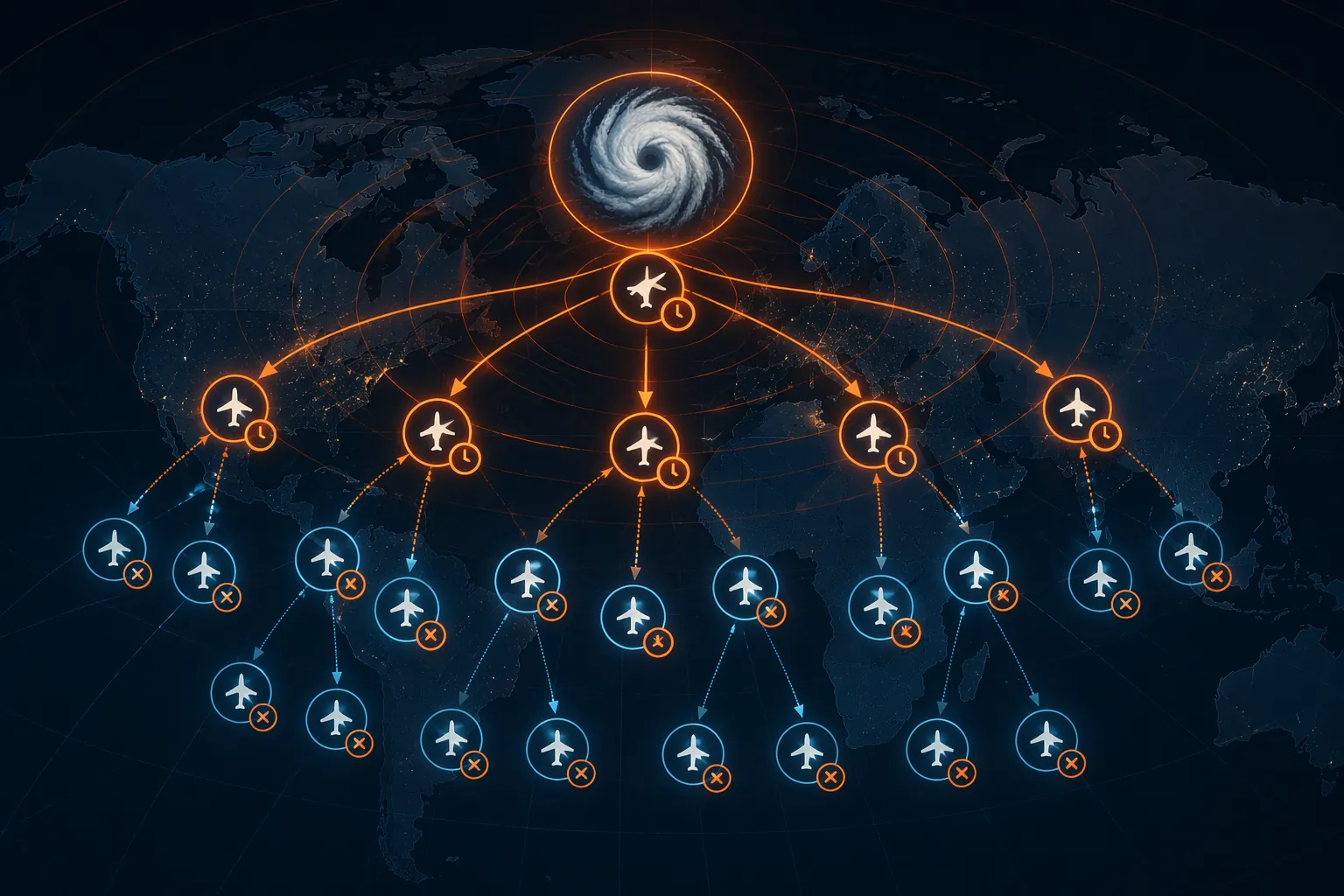
The hardest line to underwrite is the one airline people worry about most: cascading network delay. A single disruption can trigger 5–8 subsequent flight impacts. That is where hurricane disruption becomes a claims spreadsheet, a crew recovery exercise, a maintenance-positioning problem, and a customer recovery queue at the same time.
AI can help choose among bad options. It can compare aircraft swaps, crew legality, passenger misconnection risk, airport constraints, and recovery priorities faster than a manual desk can. What the available evidence does not yet establish is that AI consistently removes the full cascade cost across a hurricane-disrupted network. That is a much stronger claim than reducing weather-related delays or rebooking overhead.
This is the point at which vendor language often gets too broad. “Network resilience” may mean earlier situational awareness, better recovery sequencing, or faster passenger reaccommodation. Those are valuable. But if the business case counts every downstream delay from a hurricane as addressable savings, it assumes the tool can reverse airport closures, crew displacement, airspace constraints, and station capacity limits. The evidence supplied here does not support that assumption.
A cleaner procurement test is to ask vendors for event-level before-and-after evidence that separates prevented primary delay, reduced recovery time, and residual cascade. The same methodology used in other air-travel disruption reviews, such as the volcanic-ash platform evaluation in Can supply-chain AI platforms handle volcanic ash disruption?, is useful here because it forces the buyer to distinguish prediction, decision support, execution, and measurable recovery.
Physical Bottlenecks Stay Outside The Software Boundary
The broader logistics supply chain has a different failure pattern. The National Academies’ 2019 post-hurricane study of Harvey, Irma, and Maria found that problems concentrated around trucks, drivers, infrastructure, and distribution capacity rather than production itself.[8] That finding is important precisely because it is not an AI evaluation. It shows where hurricane bottlenecks accumulate after the weather event, and many of those constraints sit outside an airline disruption-management platform.
If roads are closed, drivers are unavailable, bridges are damaged, fuel access is constrained, warehouses lose power, or airport ground access is restricted, AI can flag the constraint and help planners resequence work. It cannot create the missing truck, open the bridge, or energize the warehouse. Counting those costs as software savings turns a useful decision-support tool into a weather-control fantasy.
That does not make weather intelligence irrelevant. Probabilistic planning can still move decisions earlier, especially for cargo tendering, station staffing, spare-parts positioning, and passenger reaccommodation thresholds. The better fit is to treat weather intelligence as an input to operational choices, not as a guarantee that physical logistics will remain available. For a broader treatment of that planning layer, see How AI Weather Intelligence Reduces Severe Weather Disruptions in Logistics.
What To Ask Before Funding The Platform
The buying conversation should be less about whether the model is impressive and more about which desk stops doing which work. If the vendor cannot map a feature to a delay-minute reduction, a rebooking cost reduction, a compensation-admin reduction, or a baggage/cargo exception reduction, the feature may still be useful, but it should not carry the ROI.
- Ask for event-level evidence by disruption type, not an all-weather, all-network average.
- Require separate savings lines for delay minutes, rebooking, baggage or cargo exceptions, and compensation administration.
- Exclude infrastructure damage, road closures, power outages, and port disruption from savings unless the vendor proves an operational cost was actually avoided.
- Separate airline operational supply chain benefits from broader freight and logistics benefits.
- Treat MarketIntelo-style benchmark ranges as scenario inputs, then replace them with carrier-specific event history before approval.
Delta’s often-cited cancellation improvement is a good example of why attribution discipline matters. The comparison of 55 cancellations in 2018 versus 5,600 in 2010 predates the later AI tool described at CES 2020, and the improvement was tied to predictive maintenance gains that were only partly AI-driven. It may be evidence that operational analytics can matter; it is not clean evidence that hurricane disruption-management AI produced those results.
Procurement also has to buy in a risk environment where weather is not the only shock. Everstream Analytics reports a 61% surge in cyber-attacks on logistics in 2025 and a 965% increase since 2021.[9] That does not turn a hurricane disruption article into a cybersecurity budget request. It does mean vendor due diligence should include resilience, data access, fallback workflows, and cyber controls, because a disruption-management system becomes operationally sensitive the moment the storm desk starts relying on it.
The Honest ROI Perimeter
AI can justify its cost for hurricane air travel disruptions when the buyer has enough event volume and the savings case is aimed at the recoverable slice: delay minutes that earlier decisions can prevent, rebooking work that automation can contain, compensation and compliance administration that better records can reduce, and some baggage or cargo exception handling inside the airline’s control.
The case weakens when it absorbs the whole hurricane loss universe. NOAA-scale economic losses, raw-material price shocks, airport access problems, road and power failures, and network-wide cascading delay costs may explain why the disruption hurts. They do not automatically become AI savings. Fund the platform for the costs it can remove from the operating system, and do not count infrastructure damage or full cascade effects as recovered value unless the evidence specifically proves they were reduced.
References
- Wipro disruption cost data, Wipro
- Airlines for America delay cost per minute, Airlines for America, 2024
- EU261 delayed and canceled departure data
- NOAA Hurricane Ian total loss figure, NOAA
- ISM survey post-Hurricane Harvey raw-material price impact, ISM
- IATA supply chain hit to airlines, IATA, Oct 2025
- Airline Disruption Management AI Market Research Report 2034, MarketIntelo, Jun 2026
- Strengthening Post-Hurricane Supply Chain Resilience: Observations from Hurricanes Harvey, Irma, and Maria, National Academies, 2019
- Are You Prepared for the Supply Chain Disruptions of 2026?, Everstream Analytics
§ 42 — Cited evidence
Flag an inaccuracy or submit a comparable account — Contribute or read how claims are verified in Methodology.