§ 41 — Use-case analysis
Which AI Vendor Has Real Proof for Geopolitical Disruption Planning?
This article compares the public evidence from o9, Kinaxis, Blue Yonder, RELEX, and Anaplan for AI-powered geopolitical disruption scenario planning, revealing where marketing claims diverge from verifiable data and quantified outcomes.
- Function
- scenario planning
- AI technique
- scenario modeling
- Failure pattern
- training data mismatch under shock conditions
- Evidence source
- o9, Kinaxis, RELEX, Anaplan, Blue Yonder public evidence (2025-2026), Xeneta risk report, KPMG/Gartner, MIT Sloan framework
For buyers evaluating AI for supply chain disruption planning around geopolitical risks, the useful question is not whether a platform can draw a scenario tree. It is whether the vendor has shown, in public, who used the tool, what disruption it modeled, how fast the organization acted, what financial exposure changed, and whether procurement, logistics, finance, and planning moved together under pressure.
On that standard, the public record is uneven. o9 has the most operationally concrete published framework. Kinaxis has the strongest broader validation signal, though one major source is sponsored. RELEX has selective quantified proof. Anaplan has a specific but anonymous operational claim. Blue Yonder has the widest public-evidence gap for this exact geopolitical-disruption use case. None of the five has published evidence of an AI platform autonomously managing a named, multi-tier geopolitical disruption end to end.
The Evidence Standard Buyers Should Apply
A strong public proof point would name the customer, identify the geopolitical event, show the timing of the disruption, quantify the operational or financial outcome, and explain how the platform connected planning to execution. A weaker proof point may still be useful, but it should be labeled correctly: a demo is not a deployment, a framework is not a post-mortem, and a survey finding is not proof that a platform worked in a live disruption.
| Vendor | Most useful public evidence | Main limitation for buyers |
|---|---|---|
| o9 | Detailed Hormuz disruption timeline and tariff scenario demo with quantified exposure figures [1][2] | Self-published framework and demo; not a named customer outcome |
| Kinaxis | Sponsored Economist Impact survey of 800+ leaders and a named MANE reference with hours-versus-weeks scenario comparison [3][4] | Less specific public evidence on a named geopolitical event |
| RELEX | Named Vita Coco case reporting $3M savings in year one and a 2026 tariff-impact survey of 514 leaders [5][6] | Useful but vendor-reported; savings case is not itself a geopolitical disruption post-mortem |
| Anaplan | Unnamed Swiss med-tech case claiming production reallocation in one day [7] | Operationally specific but not independently verifiable without customer name or dollar impact |
| Blue Yonder | 2025 retrospective describes supply-chain volatility and disruption themes [8] | No public dollar figures or named geopolitical-disruption outcomes in the cited material |
That distinction matters because geopolitical disruptions do not wait for a clean planning cycle. Ford’s three-week plant shutdown after Chinese rare-earth export controls in April-May 2025 is a useful pressure test: the hard part is not noticing that a policy shock exists, but tracing where constrained material enters production, which plants are exposed, what substitutions are feasible, and who can approve the trade-off before the line stops [9].
o9: The Most Granular Public Framework, Not a Verified Outcome
o9 deserves first review because its public material gets closer than the others to the mechanics buyers actually ask about in an evaluation memo. In its July 20, 2026 Hormuz article, o9 lays out a disruption timeline across Day 0-2, Day 3-30, and Day 30-90. The article describes 10-20% spot freight-rate jumps within 48 hours, a €30 million annualized logistics cost increase at a 15% rate lift, and Tier-2 and Tier-3 supply shocks materializing within 30 days [1].
That is the kind of specificity many vendor pages avoid. It forces a buyer to think in operating windows: what changes inside the first 48 hours, which suppliers become visible in the first month, and when the issue shifts from transportation premium to component availability. It also gives finance something to challenge. A €30 million annualized cost exposure is not a vague resilience benefit; it is a number that can be tested against lanes, volume, contracts, and surcharge assumptions [1].
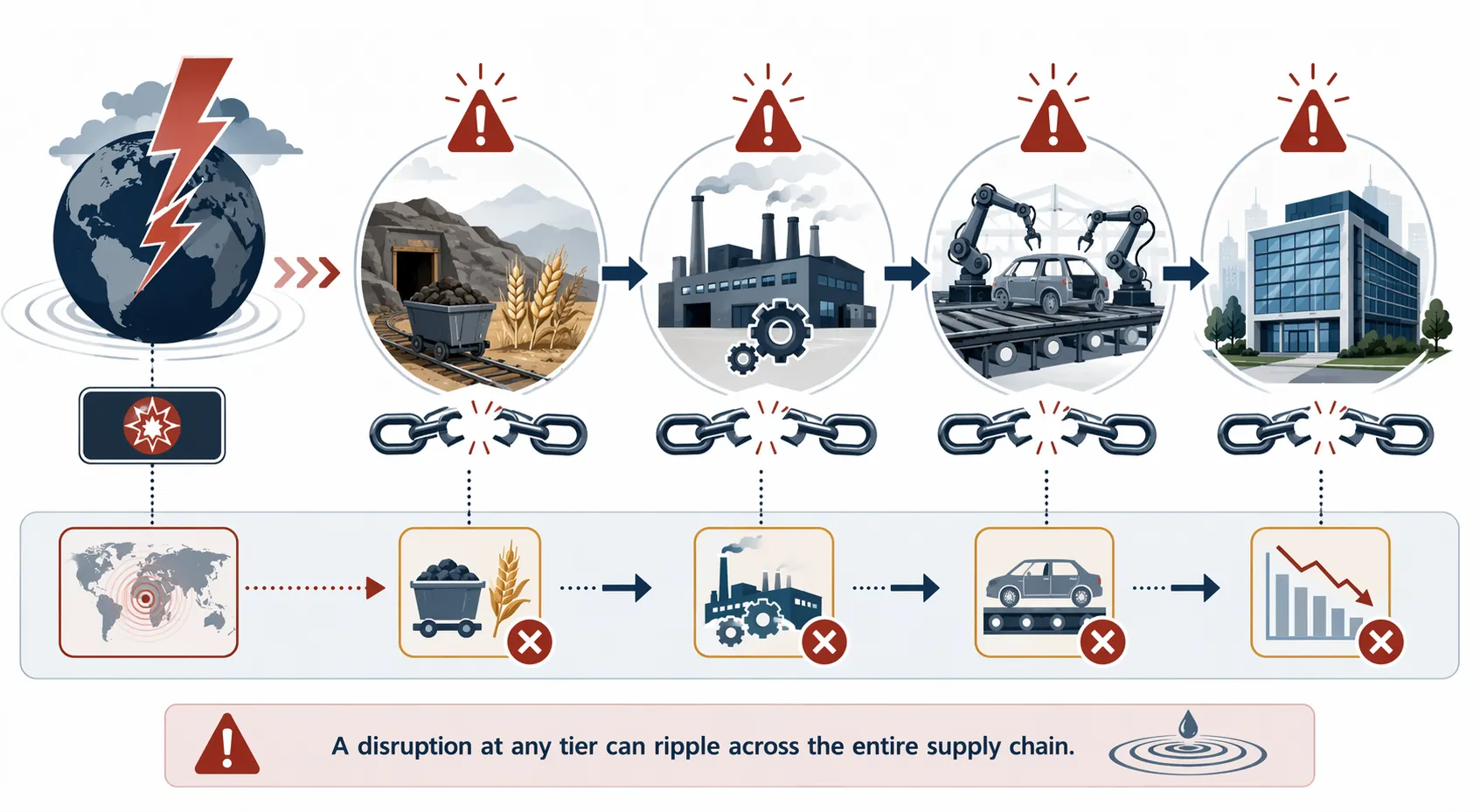
o9’s tariff scenario material is also unusually concrete for a public AI-planning claim. Its demo projects a $500 million-plus cost increase and 15% margin erosion under tariff scenarios, with tier-two visibility connecting tariffed raw materials to finished-vehicle revenue impact [2]. For a planning director, the important phrase is not only “AI-powered.” It is the connection from tariffed input to downstream revenue. That is where many scenario tools become presentation software: they model the shock but do not show the cross-tier translation into margin, supply allocation, and finished-goods exposure.
The limitation is just as important. These are o9-published materials. The Hormuz thresholds are presented inside the vendor’s own framework, not as an independently verified customer result. The tariff case is a demo, not a public post-mortem from a named manufacturer that used the platform during a named tariff event. Buyers can use o9’s material as a strong requirements template: ask other vendors to match the timeline, exposure math, tier-two linkage, and decision workflow. They should not treat it as proof that o9 has already delivered those outcomes in a live geopolitical disruption.
Kinaxis: Stronger Validation Signal, Less Event-Level Detail
Kinaxis comes next because its public evidence is stronger on market-level validation and named-customer credibility, even if it is less granular on a specific geopolitical event. A 2025 Economist Impact report sponsored by Kinaxis surveyed more than 800 leaders and found that 71% were accelerating AI deployment. The same report found a noticeable expectation gap: 67% of C-suite respondents expected AI ROI within 12 months, compared with 45% of managers [3].
The sponsorship matters and should stay attached to the claim. This is not the same as an independent academic study of platform performance. Still, the finding is useful for buyers because it frames a common evaluation problem: executives may be pricing AI as a near-term ROI lever while the people who have to integrate data, workflows, and exception management are more cautious. That gap shows up quickly in disruption planning, where a scenario that looks decisive in a boardroom can create unresolved questions for procurement, logistics, and plant schedulers.
Kinaxis also has a more operationally relevant public claim through a FreightWaves interview that describes multi-scenario comparison in hours rather than weeks and names MANE as a customer [4]. The named reference gives the claim more weight than an anonymous anecdote. The hours-versus-weeks comparison also speaks to a real planning bottleneck: when tariffs, export controls, or a chokepoint disruption move faster than the S&OP calendar, the question is whether scenario comparison can happen before the organization has already committed to a poor mitigation path.
What Kinaxis has not made public, in the cited materials, is a named geopolitical disruption post-mortem with a quantified financial result. MANE is identifiable, and the cycle-time claim is relevant, but the public evidence does not show a specific tariff, sanction, export-control, or shipping-lane shock with before-and-after cost, service, inventory, or revenue metrics. Kinaxis therefore looks better validated than o9 in the broad sense, but less detailed in the event-mechanics sense.
RELEX: Useful Quantified Proof, But Narrower Than the Geopolitical Claim
RELEX has two pieces of public evidence worth separating. The first is a named Vita Coco case reporting $3 million in savings in year one [5]. A named customer and a dollar outcome are meaningful; they give procurement and finance something firmer than a platform feature list. The caution is that the case, as represented in the cited material, is not a public post-mortem of a named geopolitical disruption. It supports the narrower conclusion that RELEX has published a quantified customer outcome in supply-chain scenario planning, not that it has publicly proven end-to-end geopolitical disruption response.
The second is RELEX’s 2026 tariff survey, which reports that 86% of 514 supply-chain leaders were impacted by tariffs [6]. That is current and directionally useful. It tells buyers that tariff exposure is not an edge case in the population surveyed. It does not, by itself, show that RELEX software reduced the impact, accelerated mitigation, or improved margin outcomes for those respondents.
For an evaluation team, RELEX’s evidence should trigger specific follow-up rather than a simple pass or fail. Ask whether the Vita Coco savings came from demand planning, inventory positioning, replenishment, scenario planning, or a combination. Ask whether tariff scenarios can be traced from landed-cost assumptions into assortment, supplier, and service-level decisions. The public material gives a credible starting point, but not enough to close the geopolitical-risk proof gap.
Anaplan: A Sharp Claim With an Anonymous Customer
Anaplan’s most relevant public example is an unnamed Swiss med-tech company that reportedly reallocated production in one day [7]. Operationally, that is a good claim. Production reallocation is not a dashboard vanity metric; it implies some combination of capacity, supply, demand, compliance, and financial review moving fast enough to change an executable plan.
The problem is verifiability. Without the customer name, the triggering geopolitical event, the affected products, the size of the exposure, or a dollar figure, the claim cannot carry the same evidentiary weight as a named case. It can still be useful in a sales process, but only as a prompt for diligence: show the workflow, identify the decision owners, explain what data refreshed, and clarify whether the one-day reallocation was simulated, approved, or actually executed.
Blue Yonder: The Public Gap Is the Finding
Blue Yonder’s cited 2025 retrospective discusses the supply-chain problem space at a general level, but it does not provide disruption-specific dollar figures or named geopolitical-disruption outcomes [8]. That absence should not be padded with general platform praise. For this use case, the issue is not whether Blue Yonder has broad planning capabilities; it is whether public evidence shows those capabilities being used against a specific geopolitical shock with measurable results.
A buyer can still evaluate Blue Yonder seriously. The practical point is that the public record, based on the cited material, gives the evaluation team less to benchmark before a private demo. That shifts more burden onto reference calls, proof-of-concept design, data-readiness testing, and contractual success measures.
Why Scenario Planning Still Fails Under Real Shock
The uncomfortable part of AI disruption planning is that the model often looks best in conditions that are least like the next crisis. Xeneta’s 2026 risk report warns that AI models “trained on normal conditions often fail precisely when decision-makers need them most” and identifies the gap between AI adoption and proven integration as widest at the multi-tier supply-shock level [10]. That warning fits the evidence pattern across these five vendors: plenty of modeling ambition, far less public proof of integrated response.
Integration is not a soft implementation detail. KPMG’s 2026 discussion of digital-twin scenario planning cites Gartner in stating that only 2 in 10 organizations fully integrate scenario planning into supply-chain strategy [11]. If the scenario tool sits outside the operating cadence, the forecast may improve while the response still waits for manual escalation, finance approval, supplier confirmation, or plant-level feasibility checks.
MIT Sloan’s geopolitical-risk intelligence framework is useful here because it treats risk sensing, interpretation, and organizational response as separate work rather than one undifferentiated analytics problem [12]. A platform may be good at sensing a tariff exposure and still weak at helping the business decide whether to absorb cost, shift supply, reprice, allocate scarce inventory, or redesign the network. Buyers should evaluate those handoffs explicitly.
What the Public Evidence Supports
o9 has the most operationally concrete public framework for geopolitical disruption planning, especially in its Hormuz timeline and tariff-impact demo. The material is useful because it shows timing, exposure math, and tier-two linkage, but it remains vendor-published framework and demo evidence rather than a verified customer outcome [1][2].
Kinaxis has the strongest broader validation signal, helped by the sponsored Economist Impact survey and a named MANE reference. Its public evidence is better for showing market urgency, ROI-expectation tension, and faster scenario comparison than for proving performance in a named geopolitical disruption [3][4].
RELEX has selective quantified proof through Vita Coco and current tariff-impact survey data, but those sources support narrower claims than full geopolitical-disruption response [5][6]. Anaplan has a concrete one-day production-reallocation claim, but the anonymous customer limits verification [7]. Blue Yonder, in the cited public material, has the thinnest disruption-specific evidence because it does not publish named geopolitical outcomes or quantified exposure figures [8].
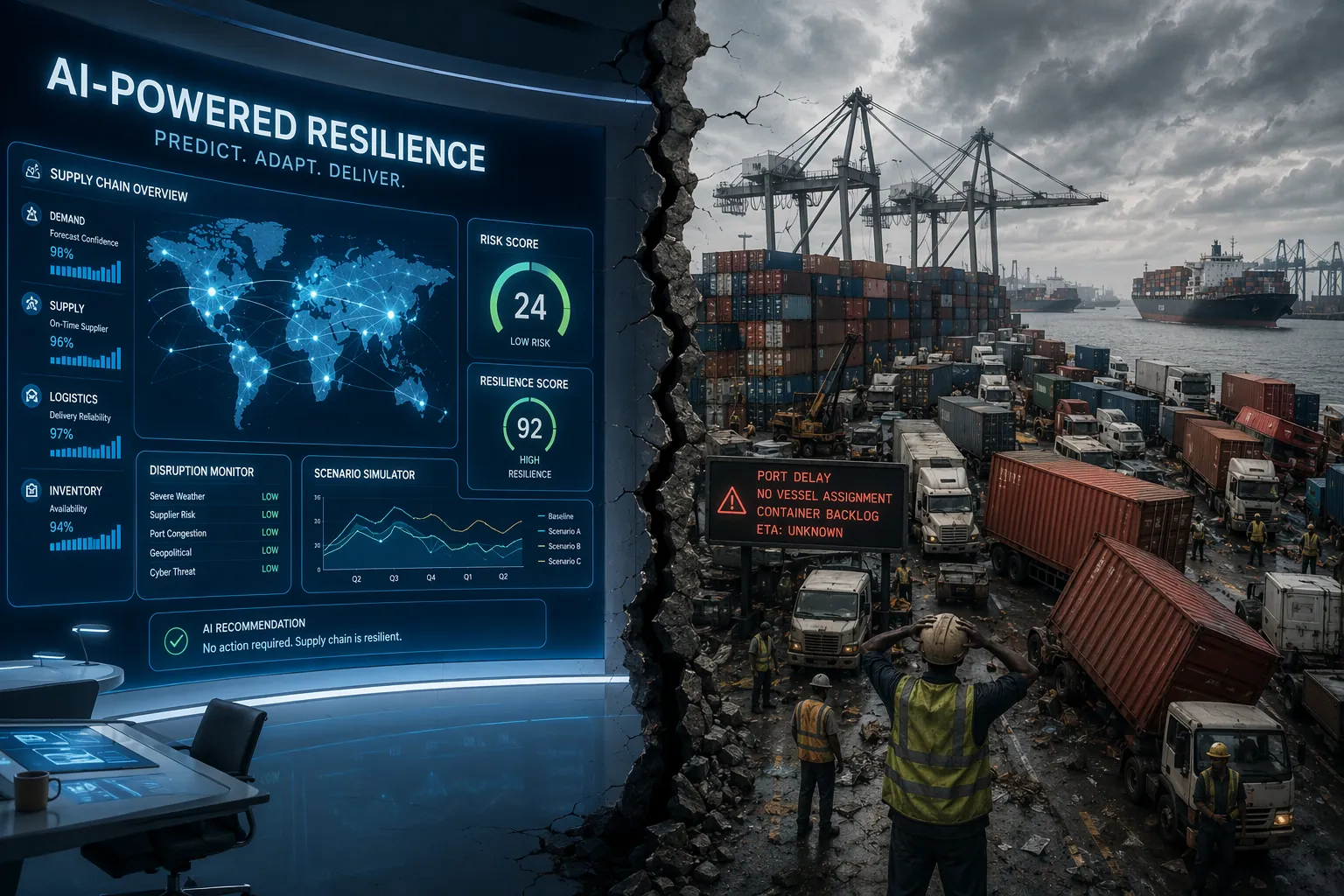
The missing proof is the same across the set: a named company, a named geopolitical disruption, a documented multi-tier exposure, an AI-supported decision path, and measured operational or financial results after execution. Until that appears, buyers should treat “AI-powered resilience” as a claim to be tested, not a result already proven.
References
- The Hormuz Rollercoaster: What Supply Chain Leaders Learn From the Back-and-Forth, o9 Solutions, July 20, 2026
- Building Resilience with AI-Powered Scenario Planning, o9 Solutions
- Kinaxis x Economist Impact report, Economist Impact and Kinaxis, 2025
- AI shifts from planning to execution, FreightWaves
- Supply Chain Scenario Planning, RELEX Solutions
- RELEX Report: 86% of Supply Chain Leaders Impacted by Tariffs, RELEX Solutions, 2026
- Dynamic Scenario Modeling for Supply Chain Resilience, Anaplan
- 2025 in Supply Chains: A Retrospective, Blue Yonder
- 22 Critical Supply Chain Risks to Watch for in 2026, Z2Data
- The Biggest Supply Chain Risks of 2026, Xeneta
- Supply Chain Scenario Planning, KPMG, 2026
- Stay Ahead of Geopolitical Supply Chain Risks, MIT Sloan Management Review
§ 42 — Cited evidence
Flag an inaccuracy or submit a comparable account — Contribute or read how claims are verified in Methodology.