
§ 41 — Use-case analysis
Can AI FX Hedging Protect Nigerian Import Supply Chains?
AI-powered FX hedging has delivered 30–40% cost savings for global firms, but Nigerian import supply chains face a different reality. This use-case analysis explains the infrastructure gap that prevents automated hedging for Naira-denominated procurement and what tools are available today.
- Function
- procurement
- AI technique
- forecasting
- Failure pattern
- infrastructure gap
- Evidence source
- Citi/Ant International pilot (July 2025), Capital A deployment (October 2025), Coronation Merchant Bank (2023), Vanguard NG (March 2026), Tech in Africa (2026)
The strongest evidence for AI forex hedging is no longer a slide deck claim. In July 2025, Citi and Ant International said a pilot for airline customers using Ant’s Falcon TST model, with 2 billion parameters, cut hedging costs by 30% and achieved more than 90% forecast accuracy across more than 70 currencies.[1] In October 2025, Capital A said a commercial deployment of the same broad approach reduced FX hedging costs by 40% and reached 90% forecast accuracy after integrating the model with a banking partner’s fixed FX rate infrastructure.[2]
Those numbers matter. A 30–40% reduction in hedging cost is real money when procurement margins are already being squeezed by supplier repricing, freight quotes, port charges, and working-capital delays. But for a Nigerian importer buying in dollars and selling into a Naira market, the question is not simply whether an AI model can forecast FX movement. The question is whether the signal can become an executable hedge before the next invoice, bank quote, or shipment cost changes again.

That is where AI forex hedging for Naira supply chains becomes a much narrower use case than the global case studies suggest. Citi and Capital A show that AI-assisted hedging can work when the currency universe is liquid, the banking infrastructure supports automated fixed-rate execution, and the exposure profile can be linked into that infrastructure. Nigerian import procurement does not yet sit on the same rails.
The Nigerian Importer’s FX Problem Is Operational, Not Just Analytical
A procurement team does not experience Naira volatility as a chart. It shows up as a supplier pro forma invoice that is suddenly stale, a landed-cost model that no longer protects gross margin, a bank quote that forces a new approval round, and a sales team being told that the price list needs to move again.
The recent history explains why treasury teams are paying attention. The Naira moved from about ₦465/$ in June 2023 to around ₦1,600/$ in early 2024, before later estimates placed the 2026 average around ₦1,387.96/$.[3] That is not a normal variance to absorb in a shipment budget. It changes the cash required to open Form M, fund letters of credit, settle supplier invoices, and clear goods.
Corporate accounts made the pain visible, although the figures should not be stretched beyond their period. Coronation Merchant Bank’s analysis of audited 2023 annual reports noted that Nestle Nigeria recorded ₦79.5 billion in FX revaluation losses, while MTN Nigeria recorded ₦137 billion in the same year.[4] Those were 2023 losses, before the later partial stabilization reflected in 2026 average-rate estimates, so they are better read as evidence of exposure under stress than as a direct measure of today’s loss level.
The pressure does not stop at the invoice currency. The Shipping Association of Nigeria testified in March 2026 that currency volatility feeds into freight and logistics costs, while one commonly cited Nigerian supply-chain education estimate places logistics costs as high as 70% of product prices in the country.[3][5] The second figure is not a primary statistical series, so it should be treated as an industry estimate rather than a hard national benchmark. Still, anyone who has priced an import shipment into Nigeria knows the direction of travel: FX instability travels through the whole landed-cost stack.
What The Citi And Capital A Cases Actually Prove
The airline cases are valuable, but their value is specific. They prove that AI forecasting can be connected to hedging execution in supported currency markets. They do not prove that a Nigerian importer can capture the same 30–40% savings on Naira/USD procurement exposure today.
| Case | What Was Reported | What It Supports | What It Does Not Prove For Nigeria |
|---|---|---|---|
| Citi and Ant International pilot | 30% hedging cost reduction and 90%+ forecast accuracy across 70+ currencies | AI FX forecasting can reduce hedging cost when execution infrastructure exists | That Naira procurement hedges are available through the same automated loop |
| Capital A deployment | 40% cost reduction and 90% forecast accuracy using Falcon with fixed FX rate infrastructure | Commercial deployment is possible when a banking partner can execute fixed-rate FX at scale | That airline receivables workflows transfer directly to importer supplier-invoice workflows |
Airlines and importers face different timing problems. An airline may collect passenger receivables in many currencies and use a fixed-rate service to manage conversion exposure. A Nigerian importer has to decide when and how to cover dollar obligations tied to supplier invoices, shipping schedules, customs processes, and domestic resale pricing. The forecasting technique may be related; the execution workflow is not the same.
There is also a plain coverage issue. The Citi announcement described support for more than 70 currencies, but the Naira was not identified as one of the liquid pairs supported through Citi’s Fixed FX Rates infrastructure.[1] For a Nigerian treasury desk, that detail is not a footnote. It is the difference between a model that can recommend and a platform that can actually trade.
The Two Missing Preconditions: Liquid Pairs And Automated Rails
AI hedging needs more than a good forecast. A model can estimate probability, timing, and direction, but a hedge is only useful if it can be executed at a reliable price, in an instrument deep enough to absorb the trade, with a process that repeats without a senior manager calling three dealers and waiting for quotes.
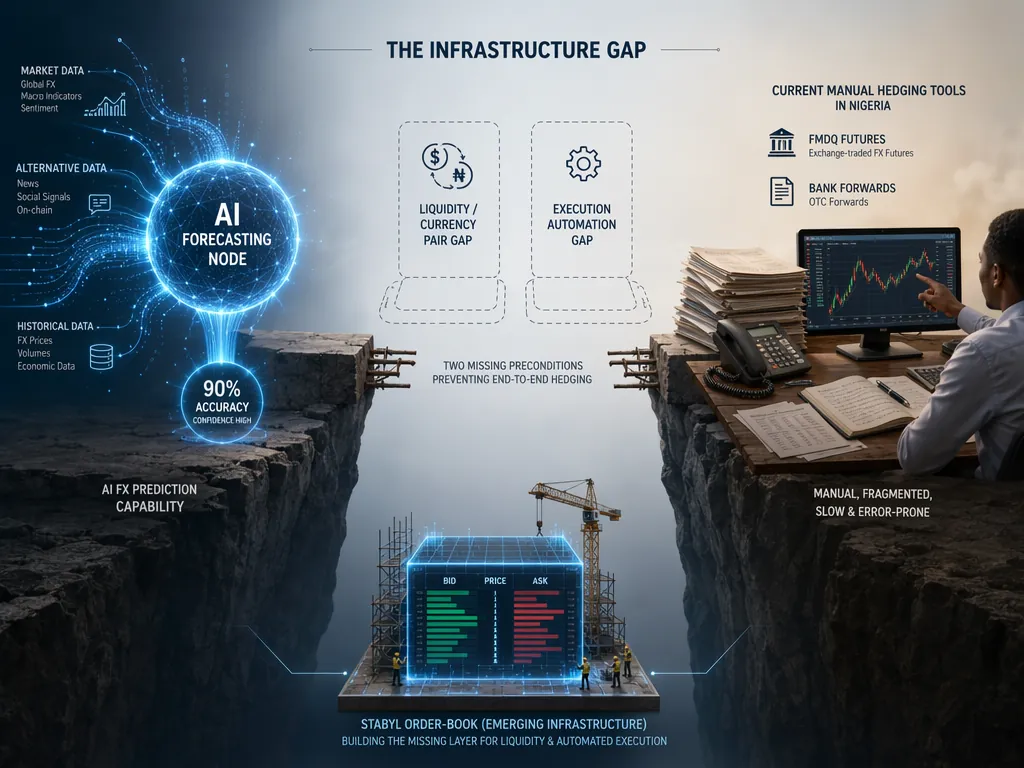
The first missing precondition is a liquid tradable pair. In major currency markets, the model’s signal can be translated into a forward, swap, option, or fixed-rate conversion with price discovery that is visible and repeatable. If liquidity is thin, fragmented, or relationship-driven, the model may still be analytically useful, but the execution price can erase the benefit. A forecast that says “hedge now” is not enough if the market cannot offer a clean hedge at scale.
The second missing precondition is an automated execution rail. The model has to move from signal to transaction without the workflow collapsing into phone calls, PDFs, email approvals, and manual dealer negotiation. That is why the Capital A example is important: the cost reduction was tied not only to Ant’s Falcon model, but to integration with a corporate banking partner’s fixed FX rate infrastructure.[2]
Nigeria’s gap is therefore not that treasury teams cannot run scenarios. Many already do, with spreadsheets, bank market updates, ERP data, and increasingly with AI-assisted analysis. The gap is that the trade still has to clear through market plumbing that was not built for continuous automated hedging of Naira procurement exposure.
What Nigerian Firms Can Use Today
There are hedging instruments in Nigeria. They should not be dismissed simply because they are not AI-native. For an importer with predictable dollar obligations, the practical toolkit still starts with conventional instruments: FMDQ-traded Naira futures, bank forwards, and currency options.
- FMDQ Naira futures can help lock in a future exchange rate where the contract matches the exposure window closely enough.
- Bank forwards allow a firm to agree a rate with a bank for a future settlement date, usually through relationship-led treasury execution.
- Currency options can protect against adverse movement while preserving some upside, although pricing and access depend on bank appetite, documentation, and market conditions.
Coronation’s example of the NGUS MAY 29 2024 futures contract shows why these tools can matter. The contract settled at ₦849.84/$ while spot was ₦1,401/$ at expiry, illustrating how a futures position could have protected a buyer against a much weaker spot rate in that period.[4] That is hedging value, even if no AI model is involved.
Where AI can enter today is before execution. A procurement or treasury team can use AI-informed analysis to compare exposure windows, test landed-cost sensitivity, flag invoice clusters, model the effect of delayed customs clearance, or estimate how much margin is at risk if the Naira moves beyond a threshold. The human team still decides whether to use a forward, futures contract, option, or no hedge. The bank or market counterparty still executes the trade.
That distinction matters because calling this “automated AI hedging” would overstate what exists. It is closer to AI-supported treasury decision-making: better visibility into exposure, faster scenario planning, and more disciplined hedge discussions with banks. The final mile remains manual.
Why Stabyl Is Worth Watching, But Not Overstating
The more interesting Nigerian development is not a chatbot that explains hedging. It is infrastructure. Stabyl raised $2.7 million in pre-seed funding to build a central-limit-order-book for Naira/USD, with the stated aim of replacing the manual, phone-based treasury process that still dominates Nigerian FX execution.[6]
A central-limit-order-book matters because it attacks the execution layer directly. If buyers and sellers can meet through a transparent order book, price discovery improves. If price discovery improves, a treasury system can begin to treat Naira/USD exposure less like a bespoke negotiation and more like a tradable workflow. If that workflow becomes deep and reliable enough, AI hedging models have something to connect to.
That is the promise. The caveat is just as important: Stabyl’s funding is for building the order-book. It is not evidence that fully automated AI FX hedging is already available for Nigerian import supply chains. Early infrastructure builders can change a market, but only after they prove liquidity, counterparty trust, compliance, settlement reliability, and repeat usage under stress.
A Practical Boundary For 2026
For a Nigerian importer in Q3 2026, the honest answer is split. AI can help the treasury and procurement teams understand exposure earlier, stress-test landed costs, prioritize which invoices deserve hedge cover, and prepare better conversations with banks. It can support a hedging decision.
It cannot yet plug Naira procurement exposure into the same automated loop shown in the Citi/Ant or Capital A examples. The liquid currency coverage and fixed-rate execution infrastructure behind those deployments are exactly the parts Nigeria has not yet reproduced for Naira-denominated supply chains.
The near-term operating model is therefore not glamorous, but it is usable: AI-informed analysis, human hedge approval, and execution through FMDQ futures, bank forwards, or options where available. The future automated model depends on whether new rails such as Stabyl’s order-book can create deeper Naira/USD price discovery and a transaction layer that software can trust.
Until that happens, AI forex hedging for Nigerian import supply chains is not a turnkey protection product. It is a decision-support layer sitting on top of traditional hedging tools, waiting for the market infrastructure to catch up.
References
- Citi and Ant International pilot for airline customers, Citi, July 2025, citigroup.com/global/news/press-release/2025/…
- Capital A commercial deployment of Ant International Falcon model, AirAsia Newsroom, October 7, 2025, newsroom.airasia.com/news/2025/10/7/…
- Vanguard NG reporting on Shipping Association of Nigeria testimony and Veriv Africa Naira projections, Vanguard NG, March 2026
- Lock in your profits, Coronation Merchant Bank, coronationmb.com/lock-in-your-profits…
- Logistics costs estimate, Nigerian supply chain education site, scm.postgradcollege.org
- Nigerian fintech Stabyl raises $2.7M, Tech in Africa, techinafrica.com/nigerian-fintech-stabyl-raises-2-7m…
§ 42 — Cited evidence
Flag an inaccuracy or submit a comparable account — Contribute or read how claims are verified in Methodology.