
§ 41 — Use-case analysis
How AI traceability cut food-safety outbreak response times
Three food-safety incidents—the 2024 Boar's Head listeria outbreak, a 2020 dairy listeria event, and Walmart's blockchain produce trace—demonstrate that AI traceability reduces outbreak response from days to minutes, but the magnitude of reduction depends on lot-level data integration architecture, not the specific AI technique used.
- Function
- traceability
- AI technique
- blockchain
- Failure pattern
- fragmented lot-level data
- Evidence source
- Food Logistics (Sep 2024)
An outbreak traceability story should not start with a dashboard. It should start in the room where investigators ask for lot history and the answer is incomplete.
In 2024, the Boar's Head listeria outbreak linked to its Jarratt, Virginia, facility became the kind of failure case that makes traceability less abstract. Food Logistics reported 9 deaths, 57 hospitalizations, and illnesses across 18 states, while manual record-keeping could not produce usable trace data within the investigation window.[1] That fact does not prove an AI system would have prevented the outbreak. It does show what slow traceability does once contamination is suspected: it leaves investigators, QA teams, distributors, retailers, and consumers inside a widening zone of uncertainty.
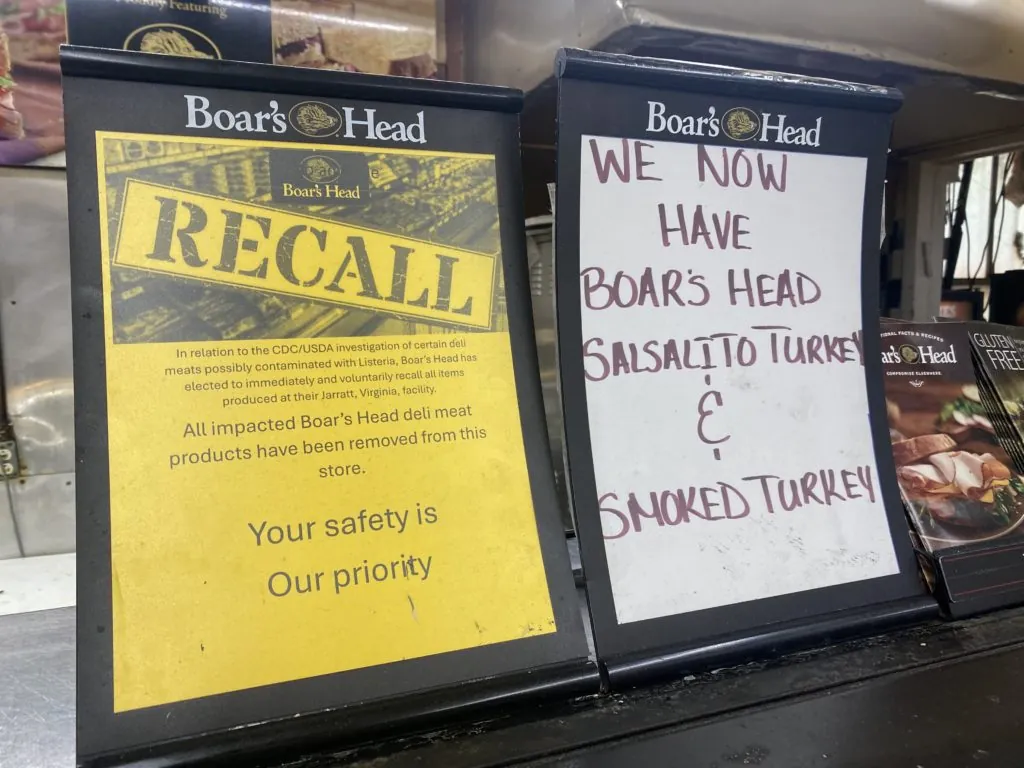
That is the baseline procurement teams should keep in mind when vendors claim outbreak response can move from days to hours or seconds. The operational question is not whether the software has AI in its label. It is whether, under pressure, the system can connect product, lot, supplier, facility, timestamp, shipment, and customer records tightly enough to narrow the recall decision before the only safe option becomes a blanket pull.
What slow traceability changes during an outbreak
Manual records do not fail only because paper is inconvenient. They fail because outbreak response is a timed evidence problem. Investigators need to know which lots moved through which facility, which suppliers fed those lots, where finished product went, and whether adjacent production runs shared the same risk. If that chain is partial, the response team has to treat more product as suspect.
The Boar's Head case is useful precisely because it is not an AI success story. It is a counterfactual baseline: when records cannot be assembled quickly enough, source attribution slows and recall scope tends to widen. The company, regulators, retailers, and plant-level food-safety staff are left making decisions with missing links. The consequence is not a neat technology gap; it is more product under suspicion for longer.
This is where response time has to be defined carefully. A vendor may measure how quickly a query returns after the data exists. A recall room needs to know how quickly the organization can produce usable, defensible lot history from messy operations. Those are not always the same thing.
Two time-compression examples, with caveats attached
The strongest case for AI traceability is not that it sounds modern. It is that several documented examples show a different response-time class than manual record assembly. The evidence is uneven, so the labels matter.
| Incident or deployment | Reported response-time change | What the number supports | Caveat |
|---|---|---|---|
| Boar's Head listeria outbreak, 2024 | Manual records could not provide usable trace data within the investigation window | Slow traceability can expand uncertainty and force broader recall action | This is a failure baseline, not proof that AI would have prevented illness |
| Unnamed dairy-company listeria event, 2020 | Source isolated within 48 hours versus a 7-day industry average | AI-enabled traceability can compress source isolation from days to hours | Vendor-reported case; company and methodology were not independently verifiable from the available material |
| Walmart / IBM Food Trust produce trace | Origin identification reduced from 7 days to 2.2 seconds | Connected trace records can make lot-level identification nearly immediate | Dated 2018-2019 case-study figure; 2026 applicability depends on current architecture and deployment |
In the 2020 dairy case reported by Food Guard, an AI-driven traceability system isolated a listeria contamination source within 48 hours, compared with a 7-day industry-average frame cited in the same vendor account. Food Guard also claimed the isolation prevented a network-wide recall that would have been required without precise source attribution.[2] That is operationally plausible. It is also vendor-reported, unnamed, and not an audited public case file. The right use of the example is not to treat 48 hours as a universal benchmark, but to see what becomes possible when the source can be narrowed before every connected facility or distribution lane is treated as contaminated.
The Walmart and IBM Food Trust example is cleaner as a trace-speed demonstration. The widely cited case reported that produce origin identification moved from 7 days to 2.2 seconds, enabling affected lots to be isolated rather than forcing broad product removal.[3] The number is old enough to deserve a raised eyebrow in a 2026 buying discussion. Architecture, participation, data standards, and supplier compliance can all change. Still, the example remains valuable because it shows the difference between searching for records and querying a pre-connected chain.
The architecture matters more than the technique name
Blockchain, predictive modeling, machine learning, computer vision, and AI-native traceability platforms can all appear in food-safety software decks. In an outbreak, the decisive distinction is more basic: did the organization already connect lot-level data before the incident, or is a team now trying to reconstruct the chain from invoices, emails, PDFs, spreadsheets, and plant logs?
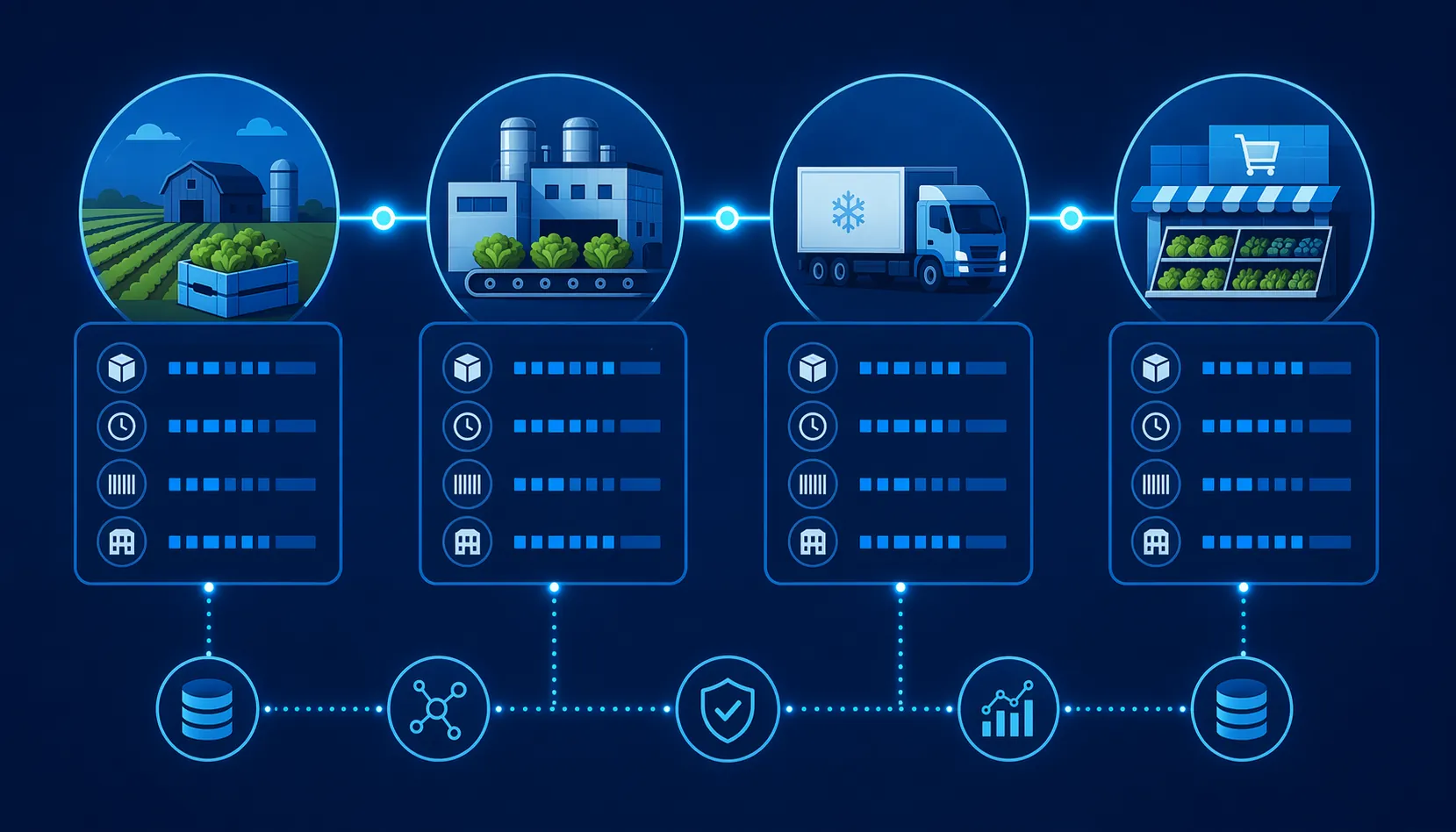
Lot-level integration is where the practical work lives. A usable system has to ingest supplier identifiers, product codes, lot numbers, production timestamps, facility IDs, sanitation or line-change context where relevant, shipment records, customer destinations, and exceptions. It also has to preserve enough relationship data to answer follow-on questions. If one ingredient lot is implicated, which finished-goods lots used it? If one finished-goods lot tests positive, which upstream lots, lines, shifts, and downstream customers are connected? If a distributor split a pallet, where did each unit go?
The AI layer can help find patterns, flag anomalies, reconcile inconsistent records, and accelerate the query. But it cannot reliably retrieve relationships that were never captured, standardized, or linked. A model trained on incomplete operational history may produce a fast answer that still leaves QA staff checking the underlying records by hand. In recall response, a quick partial answer is not the same as defensible containment.
This is why the dairy and Walmart examples are less a contest between AI and blockchain than a contrast with disconnected record-keeping. The reported time compression comes from having trace events available as a chain: product-to-lot, lot-to-facility, facility-to-shipment, shipment-to-destination. The software technique may determine how elegantly that chain is searched. The existence and completeness of the chain determine whether the answer can be trusted.
Benchmarks are useful only when the source quality is visible
The broader market numbers point in the same direction, though they should not be read as independent proof that every implementation will perform like the best case study. Dataintelo's May 2026 Food Traceability AI Market Report says modern traceability can reduce recall scope by 50-95% and reduce recall identification time from 21 days to under 2.5 seconds.[4] That is a striking range. It also appears to be an aggregated market-report figure, not a single controlled study of comparable outbreaks.
For planning directors, the useful takeaway is directional. Where lot records are integrated deeply enough, recall scope can shrink because the suspect population shrinks. Where records remain fragmented, the organization pays for uncertainty with broader holds, broader withdrawals, more manual labor, and slower regulatory response. For more on how scope compression is measured across recall scenarios, see ChainSignal's AI recall management measurement framework.
Regulatory readiness adds another pressure point. FoodReady reported from 2025-2026 industry surveys that less than 40% of affected food companies had implemented systems capable of meeting FSMA 204's 24-hour record-production requirement.[5] Because FoodReady sells food-safety software, that figure should be treated as a vendor-reported industry-survey claim. Even with that caveat, it describes a familiar operational gap: companies may know the rule is coming before their lot-level data is actually retrievable on demand.
Cost estimates explain why the procurement conversation keeps returning to recall scope. CIDRAP coverage of GAO work cites the common industry baseline of roughly $10 million in direct costs per recall incident.[6] The number is not a calculator for every outbreak; product category, distribution reach, litigation, brand damage, and plant downtime vary too much. It is enough to make one point concrete: the difference between recalling one affected lot and recalling every plausible lot is not just a communications problem. It is a capital allocation problem created by missing evidence.
What buyers should test before believing a response-time claim
The wrong first question is, "Which AI technique do you use?" That can come later. The first questions should sound more like a mock recall.
- Which lot-level records can the platform ingest today: supplier lots, ingredient lots, finished-goods lots, facility IDs, timestamps, shipments, distributor splits, retailer destinations, and test results?
- How are records linked when identifiers differ across suppliers, plants, ERP systems, warehouse systems, and customer portals?
- How quickly can the system produce records in a regulator-facing format, and does that clock include manual cleanup?
- Where do manual gaps remain: co-manufacturers, legacy plants, international suppliers, distributors, rework, sanitation records, or paper-based receiving?
- Are claimed response-time reductions sourced, dated, and comparable to the buyer's product category and network complexity?
A credible demo should not stop at a polished backward trace from a finished product. It should run both directions. Start with a supplier ingredient lot and ask which finished goods used it. Start with a finished-goods lot and ask which upstream lots and downstream customers are connected. Then introduce a realistic defect: one missing supplier field, one distributor split, one plant still using a spreadsheet, one lot code formatted differently. The answer to that messy query is a better procurement signal than a perfect dashboard.
QA leaders should also separate outbreak detection from outbreak traceability. AI can help detect anomalies across complaints, lab results, inspection records, and environmental data; ChainSignal covers that data-stream problem separately in AI outbreak detection across the supply chain. Once contamination is suspected, traceability has a narrower job: produce the connected lot evidence quickly enough to change the recall decision.
The recall-room standard
The Boar's Head outbreak shows the cost of missing usable trace data when the investigation clock is already running. The dairy case, with all vendor-reporting caveats attached, shows a plausible move from a 7-day frame to 48-hour source isolation. The Walmart case shows what happens when origin records are already linked well enough for a query to return in seconds rather than days.
Those examples support a narrow but important conclusion: AI traceability can cut food-safety outbreak response from days to hours or minutes, but only when lot-level records are integrated deeply enough for the system to retrieve, link, and narrow evidence under pressure. Without that foundation, AI becomes a faster way to discover that the chain is still broken.
The buying standard should follow the recall-room decision. If contamination is suspected tomorrow, will the team recall broadly because trace data is missing, or contain surgically because the affected lot is already connected to its upstream and downstream evidence? That answer matters more than the model name.
References
- Listeria Outbreak Highlights Need for More Digitalized Food Safety Approaches, Food Logistics, Sep 2024
- Transforming Food Safety: AI & The Future of Traceability in Complex Supply Chains, Food Guard / LinkedIn, Jan 2025
- How AI is Transforming Food Safety, IONI AI, May 2025
- Food Traceability AI Market Report, Dataintelo, May 2026
- Transforming Food Safety with AI-Native Traceability Across Hundreds Facilities, FoodReady, 2025-2026
- Oversight report urges FDA to finalize food traceability rule, CIDRAP / GAO, 2024
§ 42 — Cited evidence
Flag an inaccuracy or submit a comparable account — Contribute or read how claims are verified in Methodology.