§ 41 — Use-case analysis
Why AI Flood Risk Prediction Needs Multi-Tier Reach
Published data from Toyota, Johnson & Johnson, and other deployments shows AI flood risk prediction can deliver 7–11 days of lead time with 85–91% accuracy. But the real value hinges on reaching beyond tier-1 suppliers, where 85% of flood risks sit.
- Function
- disruption planning
- AI technique
- forecasting
- Failure pattern
- tier-1-only monitoring
- Evidence source
- DocShipper, Council Fire
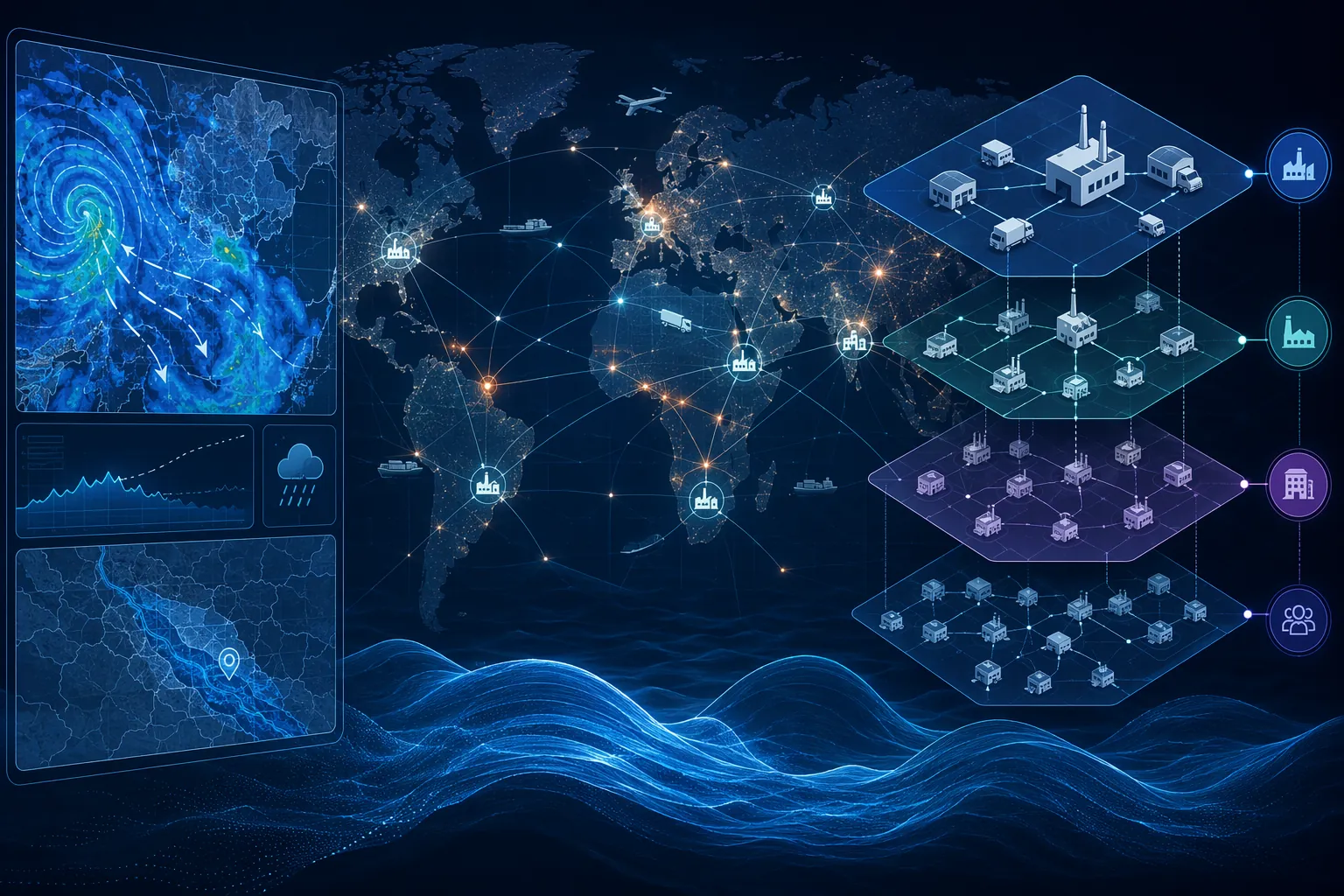
AI-based flood-risk disruption planning has a stronger evidence base than it did a few years ago, but the useful question is narrower than “Can the model predict a flood?” Published secondary-source accounts of Toyota and Johnson & Johnson deployments point to warning windows a planning team can act on: Toyota is reported to have identified at-risk components 11 days before physical impacts during Southeast Asia flooding, while Johnson & Johnson is reported to have averaged 7 days of lead time for major disruption warnings in 2024. The same source set puts reported disruption-detection or early-warning performance in the 85% to 91% range, depending on the deployment context.[1][2]
Those numbers matter because they describe time, not just model sophistication. Eleven days can be enough to pull inventory forward, move a purchase order, qualify a temporary route, or start uncomfortable supplier calls before a plant planner is choosing between expediting and downtime. Seven days is not luxurious, but it is often enough to get a cross-functional decision made if the alert is specific and trusted.
The catch is visibility. ClimateAi, citing Veridion, says 85% of supply chain risks are in tier-2 through tier-4 suppliers rather than direct tier-1 partners.[3] If that is the shape of the exposure, then a flood-risk system that watches only named tier-1 suppliers may be accurate and still miss the part of the network most likely to break production.
The business case starts with lead time, not weather intelligence
Flood risk deserves attention without turning every planning discussion into a climate-loss briefing. The cost background is real: NetSuite, citing J.S. Held, reports $184 billion in annual disruption cost, while OneStopESG reported $368 billion in global disaster losses for 2024.[4][5] Interos.ai also reported a 48% year-over-year increase in businesses at extreme-weather risk in 2025.[6]
Those figures explain why boards and procurement leaders are asking harder questions about flood exposure. They do not, by themselves, prove that an AI tool will protect a shipment, a qualified material, or a production schedule. For that, the evidence has to move from disaster scale to operational response: which supplier was seen, how early the warning arrived, what decision it triggered, and whether the warning covered enough of the supplier graph.
| Reported metric | Why it matters for disruption planning |
|---|---|
| Toyota: 11 days before physical impacts during Southeast Asia flooding | A usable window for alternate sourcing, inventory moves, and plant-level schedule decisions |
| Johnson & Johnson: average 7-day lead time for major disruption warnings in 2024 | Enough time for a structured response if supplier ownership, escalation, and decision rights are clear |
| 85% of supply chain risks in tier-2 through tier-4 suppliers | A warning system limited to direct suppliers can miss most of the exposure it is meant to manage |
What the Toyota and Johnson & Johnson reports actually claim
The Toyota and Johnson & Johnson examples are useful, but they need careful labeling. The figures available here come from DocShipper and Council Fire, not from direct Toyota or Johnson & Johnson corporate publications. That does not make them unusable; it means they should be treated as secondary-source deployment evidence rather than primary company disclosure.
For Toyota, the reported scope is substantial: AI monitoring across more than 175,000 tier-1 through tier-3 suppliers. During Southeast Asia flooding, the system is reported to have identified at-risk components 11 days before physical impacts and enabled alternate sourcing that avoided $280 million in lost production. The same secondary-source set reports 91% accuracy in the disruption-detection context described.[1][2]
The important word there is “components.” A flood alert attached only to a geography is still work for someone else. A component-level warning gives procurement and planning a more direct path: which material is exposed, which production lines consume it, which approved suppliers exist, and how much time remains before the risk becomes a physical constraint.
Johnson & Johnson’s reported deployment is different but similarly concrete. DocShipper and Council Fire report that the company monitors more than 27,000 suppliers across more than 100 countries and analyzes more than 10,000 risk signals daily. In 2024, the system is reported to have provided early warning of 85% of major supply disruptions, with an average lead time of 7 days.[1][2]
That 85% figure should not be casually restated as a universal AI accuracy benchmark. It is reported as early warning of major supply disruptions in a specific operating context. For a procurement steering committee, that is still a meaningful claim, but the question should be phrased correctly: did the system warn on the disruptions that mattered, early enough for the organization to act?
DHL’s Resilience360 example is a useful sign that this category has moved beyond small pilots. Emerj reported that after AI integration, Resilience360 expanded to more than 13,000 users globally and provided near-real-time visibility into flood and natural-disaster risks.[7] That supports the idea that natural-disaster monitoring can operate at enterprise scale, though it does not provide the same lead-time or avoided-loss detail as the Toyota and Johnson & Johnson reports.
The tier-2 through tier-4 problem changes the evaluation
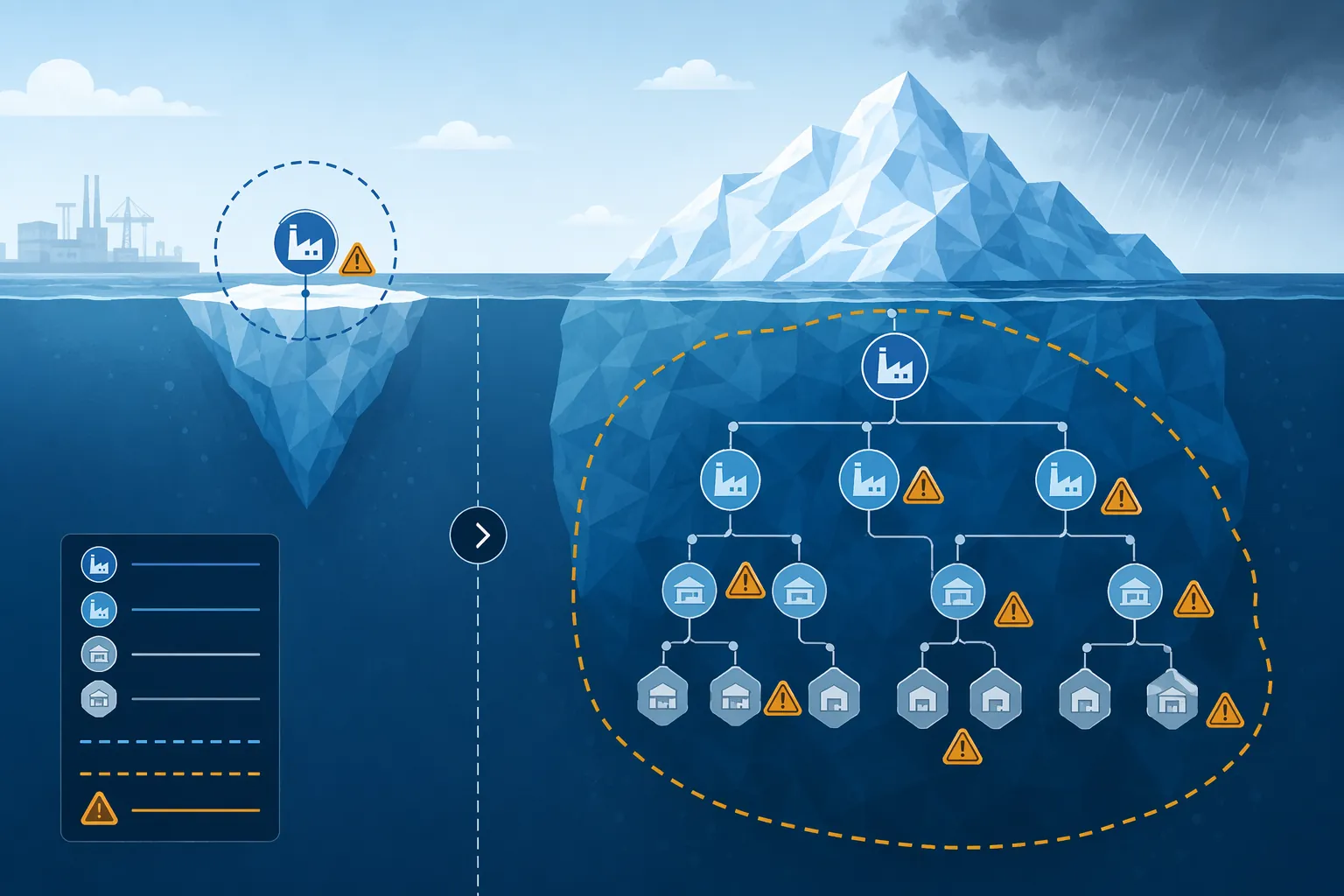
The 85% multi-tier-risk statistic is the hinge. If most risk sits below direct suppliers, the evaluation cannot stop at flood-model performance, weather-data coverage, or dashboard design. The evaluation has to ask whether the system knows the sub-tier suppliers, sites, materials, and dependencies that sit behind the tier-1 supplier name on the purchase order.
A tier-1-only alert can still be useful. If a direct supplier’s plant is inside a flood zone and that supplier is the only approved source, the warning belongs on the planner’s screen. But many failures arrive indirectly: a direct supplier remains open while a sub-tier component maker, packaging supplier, sterilization provider, resin source, or logistics node loses capacity. The purchasing relationship looks stable until the tier-1 supplier starts allocating supply or missing commits.
That is why the Toyota scope is more interesting than the headline avoided-loss number. Monitoring more than 175,000 tier-1 through tier-3 suppliers suggests the system was not built only around direct commercial relationships.[1][2] For flood disruption planning, that depth changes the quality of the alert. It can point to a constrained component before the direct supplier’s response becomes “we are assessing the situation.”
The planner downstream of the alert needs a supplier-level consequence, not a weather event. “Flood probability rising in a province” is situational awareness. “This sub-tier site supports these components, these purchase orders, and these production weeks” is where continuity work begins.
What should be tested before buying
A procurement team evaluating AI flood-risk prediction should not ask for a generic demo of alerts on a map. It should test the system against the decisions the organization actually has to make before water reaches a facility.
| Evaluation question | What a useful answer looks like |
|---|---|
| How far down the supplier network does monitoring reach? | Named coverage beyond tier 1, with a clear method for mapping tier-2 through tier-4 dependencies |
| What does the lead-time metric measure? | Days between the warning and the physical or operational impact, not just days before a forecasted weather event |
| What does accuracy mean? | Disruption-detection performance in the reported context, separated from broad weather-forecast accuracy |
| Who receives the alert? | The planner, procurement owner, risk team, and operations lead who can change inventory, sourcing, logistics, or production choices |
| What action is attached to the alert? | A supplier, component, site, shipment, or approved alternate path rather than a general regional warning |
| How are performance claims sourced? | Primary disclosure, independent study, secondary aggregator, or vendor case study clearly labeled |
This is also where warning windows need to be judged against the category. Seven days may be enough for a common component with an approved alternate and available logistics capacity. It may be too late for a constrained material requiring validation, regulatory review, or long international transit. Eleven days is more useful, but even that window depends on whether procurement already knows the alternate source and whether planning has authority to move inventory before the forecast becomes certain.
The strongest AI flood-risk tools will therefore look less like stand-alone prediction engines and more like decision systems connected to supplier master data, bills of material, site locations, order books, and escalation rules. The model can be impressive, but the business value appears only when the warning reaches the person who can change the plan.
Longer-horizon weather planning is useful, but the evidence is different
There is a place for longer-horizon climate and weather planning. ClimateAi’s own case study says a roofing manufacturer anticipated Hurricane Ian months before its 2022 landfall, adjusted supply timing and inventory positioning, and generated $15 million in additional sales.[3] That is a useful illustration of how extended warning can support commercial and inventory decisions.
It should also be labeled for what it is: a vendor-sourced case study. The claim may be directionally relevant, but it should not carry the same evidentiary weight as independently verified operational performance. A sales gain can be influenced by demand timing, competitor availability, local market exposure, and many other factors. For flood-risk disruption planning, it is better used as an example of possible planning value than as proof of causality.
The procurement-ready standard
The available evidence is enough to take AI flood-risk prediction seriously. Reported deployments describe warning windows of 7 to 11 days, supplier monitoring at meaningful scale, and disruption-detection performance that is relevant to planning rather than purely academic model scoring.[1][2]
The investment case should still be strict. A tool that sees only tier-1 suppliers can improve awareness while leaving most exposure outside the frame. A tool that cannot explain whether its claims are primary, secondary, or vendor-sourced will struggle in a serious risk review. And a tool that sends alerts without tying them to suppliers, components, inventory, and decision owners may create earlier anxiety rather than earlier action.
AI flood-risk prediction clears the first hurdle: it can appear early enough to matter. The harder hurdle is whether it reaches deeply enough into the supplier network and precisely enough into the operating plan for someone to protect production before disruption becomes physical.
References
- AI Changing Logistics & Supply Chain in 2025 — DocShipper, 2025.
- Adapting Supply Chains to Climate Disruptions and Trade Uncertainties: A Strategic Resilience Framework for 2025 — Council Fire, 2025.
- Climate Risk and Supply Chain Risk Mapping — ClimateAi, 2025.
- Supply Chain Risks — NetSuite, April 2026.
- Why P&G Uses AI to Tackle Supply Chain Disruptions — OneStopESG, May 2025.
- Protecting Your Supply Chain from Extreme Weather: Steps to Minimize Risk — Interos.ai, 2025.
- AI for Avoiding Supply Chain Disruptions – Two Use Cases — Emerj, 2023.
§ 42 — Cited evidence
Flag an inaccuracy or submit a comparable account — Contribute or read how claims are verified in Methodology.