§ 41 — Use-case analysis
What AI Supply Chain Disruption Planning Really Achieves
Vendor demos of AI supply chain disruption detection promise response times in minutes, but production results depend on data-governance prerequisites most enterprises don't have. This article examines the measured speed gains, the conditions required, and where human augmentation remains essential.
- Function
- disruption management
- AI technique
- agentic AI
- Failure pattern
- data governance gap
- Evidence source
- arXiv:2601.09680 (AlMahri et al., 2025)
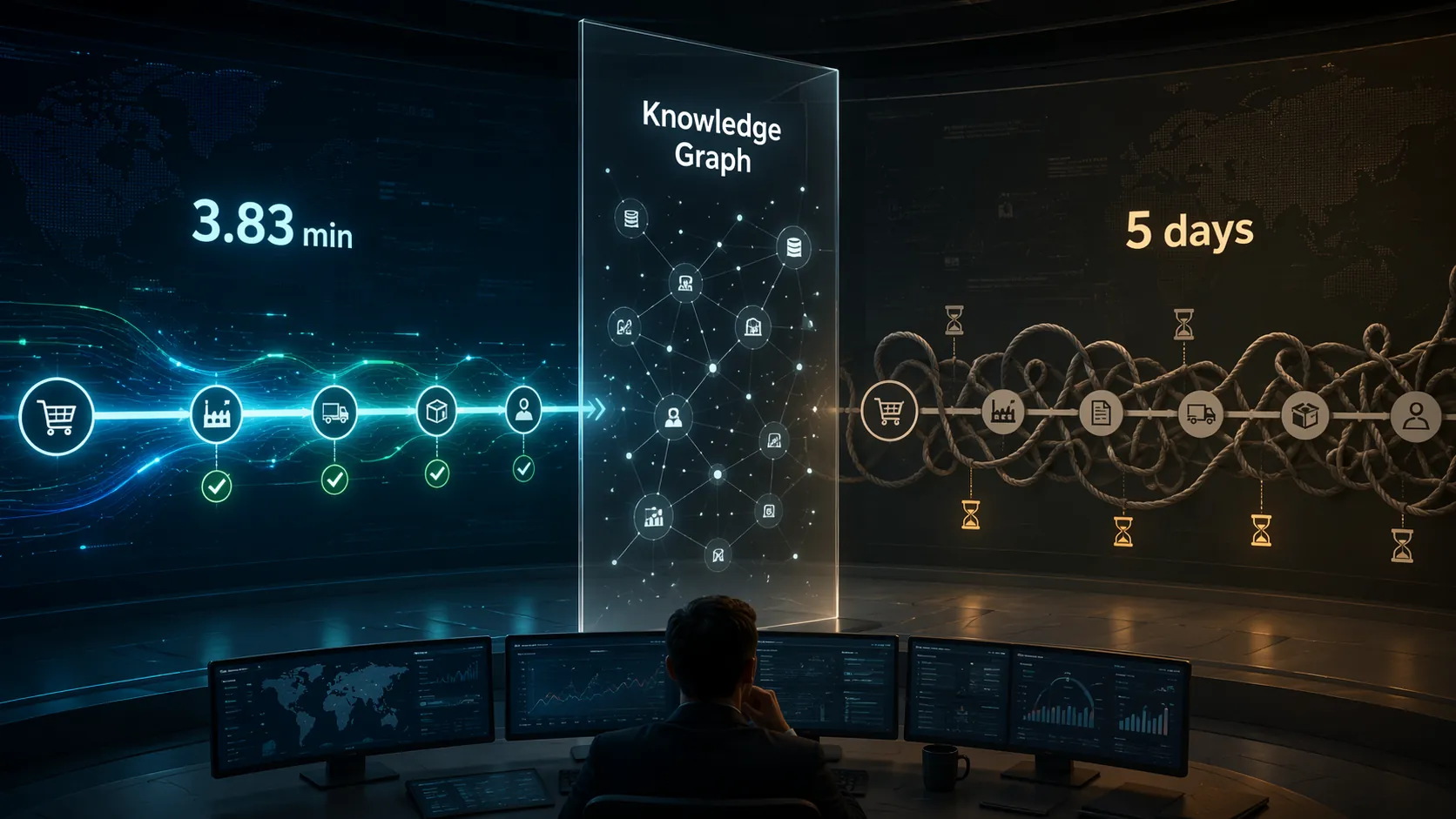
The cleanest published number for AI supply chain disruption planning outcomes is hard to ignore: 3.83 minutes mean response time, compared with a five-day industry disruption-response baseline cited from a Kinaxis/IDC 2024 survey. The result appears in a Cambridge arXiv pre-print by AlMahri, Xu, and Brintrup, posted as arXiv:2601.09680, and it is the kind of contrast that will travel quickly through steering committees because it turns a planning war room into a near-real-time workflow on paper.[1]
It should travel with its conditions attached. The study tested an agentic AI framework across 30 synthesized disruption scenarios involving three automotive OEMs. The system operated over a pre-built knowledge graph, returned F1 scores between 0.962 and 0.991, and reported an estimated $0.08 per analysis. Those are meaningful results, but they are not the same thing as proof that a live enterprise can drop an AI agent into fragmented supplier data and get production-grade autonomous recovery in minutes.[1]
What the 3.83-Minute Result Actually Measured
The useful part of the Cambridge result is not just speed. It is the full shape of the measured task: detect a disruption signal, reason over supplier and part relationships, and produce a response inside a structured environment. The result suggests that agentic workflows can compress the analytical portion of disruption response once the system already knows which suppliers, sites, parts, and relationships matter.
That distinction matters because the five-day comparison baseline measures industry response time, not merely algorithm runtime. In a normal disruption, those days can include waiting for supplier confirmation, reconciling part numbers across systems, checking whether an alternate site is actually qualified, and deciding who is allowed to change a plan. The Cambridge framework attacks a real bottleneck, but the comparison is not a like-for-like stopwatch test between two production control rooms.[1]
| Claim | What the evidence supports | What it does not prove |
|---|---|---|
| 3.83-minute mean response time | Fast agentic analysis in 30 synthesized automotive disruption scenarios | Universal production response time across industries and messy partner networks |
| F1 scores of 0.962-0.991 | Strong performance on the study's classification or detection tasks | That every recommended action will be operationally feasible in live supplier negotiations |
| $0.08 per analysis | Low estimated computational cost per run in the tested setup | Total cost of building, validating, and maintaining the required data foundation |
| Five-day baseline | A useful industry comparison cited through the Cambridge paper | A primary benchmark independently verified in this article |
The F1 scores are worth taking seriously because they indicate the system was not merely producing fast text. It was performing well against defined scenario outcomes. Still, F1 is a measurement of model performance on the task as framed. It does not measure whether a Tier-2 supplier will answer a request for capacity, whether a logistics partner can change a lane, or whether procurement has commercial authority to shift volume.
The $0.08 figure is similar. It is useful evidence that the marginal analysis cost can be small. It should not be stretched into an implementation-cost claim. The expensive part for many companies is not asking the agent a question. It is making sure the agent has a current, trusted map of the supply base before the question is asked.
The Knowledge Graph Is Not Background Plumbing
A pre-built multi-tier knowledge graph changes the problem. If the system already has structured links between suppliers, parts, sites, lanes, and risk signals, then a disruption can be treated as a graph query plus a decision problem. If those links are incomplete, stale, or trapped in separate supplier portals and spreadsheets, the same disruption becomes a coordination exercise.
This is where many AI disruption-planning demos get too smooth. They show the agent moving from detection to recommended action, but the demonstration often assumes that the supplier graph already exists and is reliable. For a buyer evaluating outcomes, that graph should be counted as part of the delivered capability. Without it, the agent may be fast at analyzing the wrong map.
The prerequisite is not minor. Berger et al. found that over one-third of disruptions emerge beyond Tier-1 suppliers, precisely where many companies have weaker visibility.[2] A disruption that starts at a sub-tier material supplier or a lower-tier manufacturing site is less likely to appear cleanly in the enterprise planning system. It may arrive as a late explanation from a Tier-1, a changed promise date, an expedite request, or a pattern of missed confirmations.
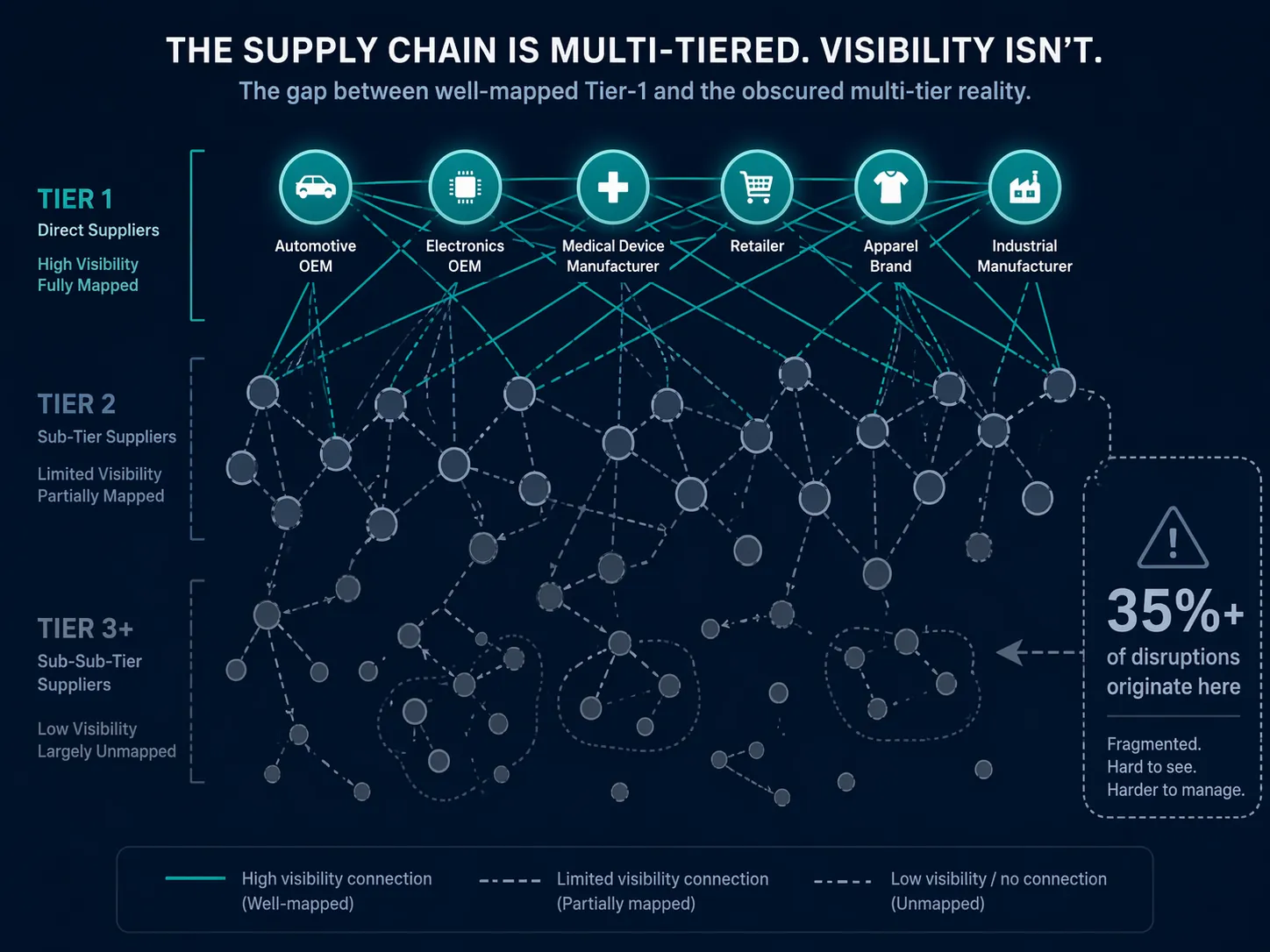
For autonomous disruption detection to work well in that environment, the system needs more than a supplier master. It needs maintained relationships: which lower-tier supplier feeds which component, which site supports which program, which part substitutions are approved, which logistics lanes are viable, and which contractual or quality constraints block an otherwise elegant recommendation.
That maintenance burden does not disappear after go-live. Suppliers change, alternates are qualified, plants move tooling, and risk signals decay. A knowledge graph that was accurate during implementation can become a decorative asset if no team owns the refresh cadence and exception process. The practical question is not whether knowledge graphs are useful. It is who keeps the graph true when the program team, procurement, supplier quality, logistics, and planning each own different fragments of the answer.
Where Autonomy Holds, and Where It Still Hands Work Back
The strongest near-term case for autonomy is a structured-data decision with a clear boundary: a known supplier, a known part, a known site, a defined shortage signal, and a set of approved response options. In that setting, an agent can rank impact, identify affected demand, suggest alternates, and prepare an action package faster than a planner working through disconnected extracts.
The harder case is cross-partner recovery. A system can recommend reallocating capacity, switching source, changing mode, or pulling from another region. But the recommendation still has to survive supplier acceptance, quality approval, commercial terms, logistics availability, customer prioritization, and sometimes regulatory constraints. Those are not all data fields. Some are commitments made by organizations that do not share the same system.
Gartner's March 2026 forecast points in the same direction. It predicts that 60% of disruptions could be resolved without human intervention by 2031, while also caveating that current technological immaturity restricts full automation to low-risk decisions.[3] That is an adoption and maturity signal, not a statement that most current deployments can already close complex disruptions end to end.
Deloitte's 2025 agentic supply chain report adds a useful economic brake. It reports that 85% of organizations increased AI investment, but only 6% saw ROI in under a year; most satisfactory returns arrived within two to four years.[4] That timing is consistent with the work required to operationalize governance, data ownership, exception handling, and user trust. It is not evidence against AI disruption planning. It is evidence against treating a demo-speed result as a same-quarter production outcome.
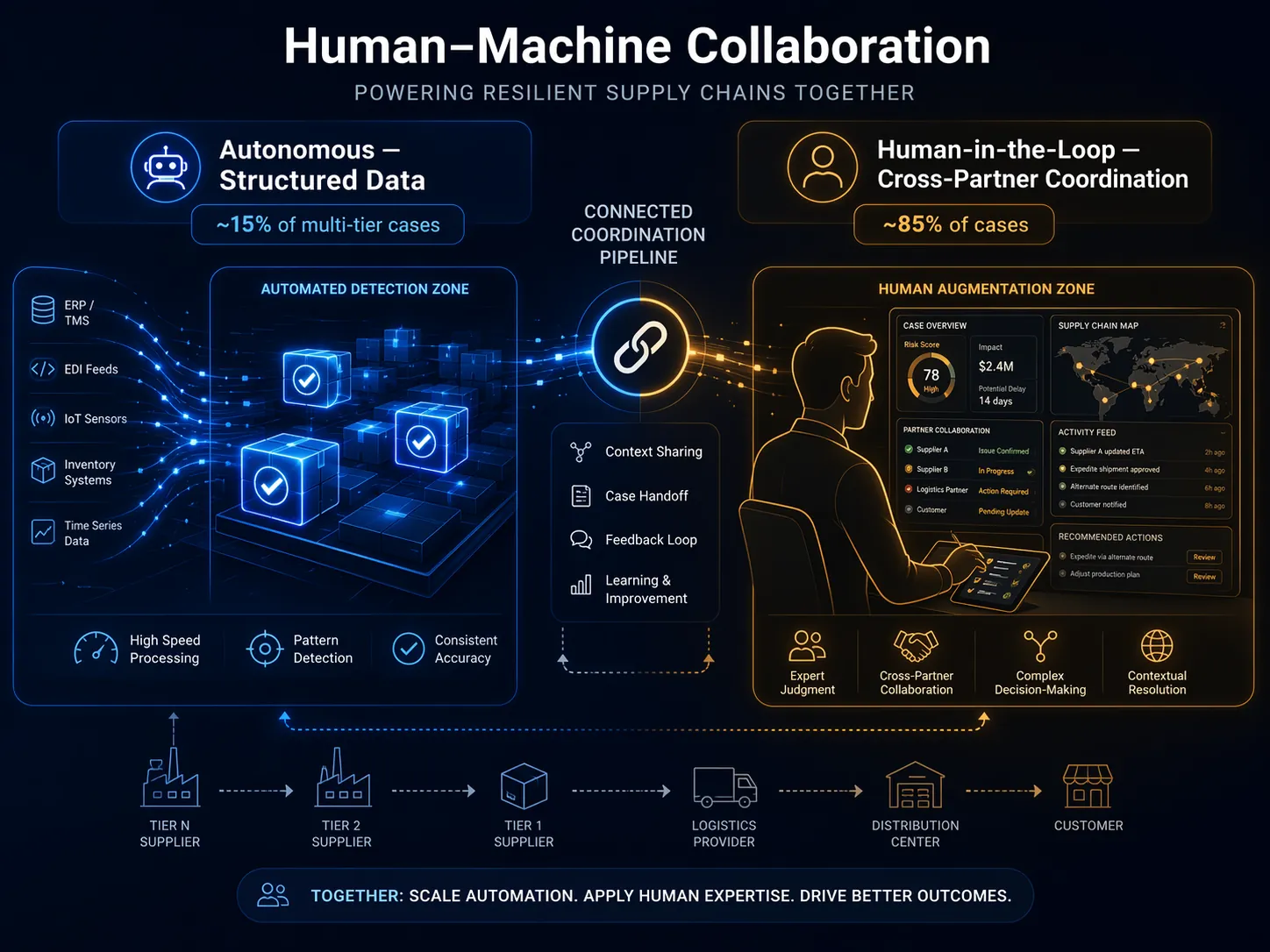
The human-augmentation numbers should be handled with care because they are cited by TraxTech as Gartner research rather than linked here to a primary Gartner publication. Still, they describe a pattern most implementation teams will recognize: successful AI implementations require human augmentation for cross-partner coordination in 85% of cases and for unstructured workflow management in 92% of cases.[5] The exact rates need primary-source caution; the operational message is narrower and more defensible. Autonomy breaks first where the work leaves the structured decision boundary.
A Better Benchmark Than Demo Speed
A buyer trying to benchmark AI supply chain disruption planning outcomes should separate four clocks. The first clock is signal detection: how quickly the system notices an event or risk pattern. The second is impact analysis: how quickly it maps affected parts, sites, orders, and revenue. The third is response recommendation: how quickly it produces feasible options. The fourth is partner execution: how long it takes humans and counterparties to approve, commit, and act.
The Cambridge result gives strong evidence on the middle of that chain in a controlled graph-based environment. It does not erase the fourth clock. If a company reports that AI reduced disruption response from days to minutes, the first follow-up should be which clock changed. Minutes to impact analysis is a very different outcome from minutes to supplier-confirmed recovery.
- Ask whether the measured response time ends at detection, recommendation, approval, or executed recovery.
- Check whether the supplier graph includes Tier-2 and Tier-3 relationships or only enriches Tier-1 master data.
- Separate model accuracy metrics from operational feasibility metrics such as accepted recommendations, avoided expedites, or time to confirmed alternate supply.
- Treat synthetic scenarios, pilots, and production deployments as different evidence classes.
- Include graph maintenance, data stewardship, and exception-review labor in the business case, not only per-analysis compute cost.
This also explains why vendor-by-vendor comparison is less useful than it first appears. Without verified post-mortems for o9, Blue Yonder, Kinaxis, or similar platforms on this exact disruption-planning outcome, the responsible comparison is architectural. Does the system have access to a maintained multi-tier graph? Can it distinguish approved from merely possible substitutions? Does it log why it recommended an action? Can humans override, audit, and feed back the result? Those questions will tell more about production outcomes than a polished screen showing a disruption resolved in a few clicks.
What to Fund First
The funding sequence should follow the decision boundary. If the organization already has reliable supplier-part-site relationships, good event feeds, and clear approval rules, then an agentic disruption layer can be a high-leverage investment. It can reduce analysis latency, standardize triage, and keep planners from spending the first day of a disruption rebuilding the same dependency map.
If the organization does not have that foundation, buying the agent first may still produce value, but the early outcome will likely be assisted analysis rather than autonomous recovery. The implementation team will spend much of its time resolving supplier identity, mapping part relationships, defining what counts as an approved action, and deciding which exceptions require human review. Those are legitimate rollout tasks. They should not be hidden behind an autonomy claim.
Autonomous disruption detection can be real, and the best published result is dramatic: 3.83 minutes against a five-day baseline in a controlled, graph-enabled study.[1] The production outcome for most companies today is not “minutes for everyone.” It is minutes where the graph, governance, and decision boundary are already in place, with humans still carrying much of the multi-tier coordination burden.
References
- AlMahri, Xu, and Brintrup, arXiv:2601.09680, arXiv, 2025.
- Berger et al., Supply chain disruptions beyond Tier-1 suppliers, 2023.
- Gartner, Gartner March 2026 press release, Gartner, March 2026.
- Deloitte, Resilient by design: The agentic supply chain, Deloitte, 2025.
- TraxTech, Gartner research on human augmentation in AI implementations, TraxTech.
§ 42 — Cited evidence
Flag an inaccuracy or submit a comparable account — Contribute or read how claims are verified in Methodology.