
§ 41 — Use-case analysis
How AI data center electricity costs change supply chain planning
As AI data centers drive structural electricity price increases, supply chain planners must treat electricity as a variable cost in S&OP, network design, and total-landed-cost models. This analysis provides the evidence and framework for updating planning assumptions.
The old S&OP shortcut was easy to defend when electricity moved like a background cost. Put it in plant overhead, index it loosely to inflation, and spend planning time on labor, freight, material yield, and inventory. That shortcut is now starting to contaminate the model. U.S. electricity prices rose 6.9% year over year in 2025, more than double the 2.9% headline inflation rate, according to Goldman Sachs Research reporting cited by CNBC.[1]
That does not mean every factory, warehouse, or cold-storage site should assume a uniform power shock. It does mean electricity has earned a different seat in the planning file. A cost line that used to be harmless when averaged across the network can now change the comparison between two plants, two suppliers, two warehouse automation designs, or two regions competing for the next capacity decision.

The planning problem is not the AI story. It is the assumption error.
Most supply chain teams do not need another broad reminder that AI data centers consume a lot of power. The useful question is narrower: where does that demand enter the operating plan, and what breaks if it stays buried in overhead?
The demand signal is strong enough to justify the question. Gartner expects global data center electricity consumption to reach 565 TWh in 2026, up 26% year over year, with AI-optimized servers accounting for 31% of that consumption.[2] Goldman Sachs Research also projects data centers will represent 40% of electricity demand growth and expects an additional 6% increase in household electricity prices through 2027.[1]
Those figures still need to be handled with care. Household electricity prices are not the same as a manufacturer’s contracted industrial tariff. Wholesale markets are not retail bills. A regulated utility territory does not behave like a fully exposed market purchase. Fixed-rate contracts can delay the hit. Fuel clauses, demand charges, riders, and renegotiation dates determine when the change shows up.
That is exactly why a flat CPI-linked assumption is the wrong planning response. It smooths away the mechanics that decide who actually pays more, when they pay, and which node in the network becomes less attractive.
National inflation is the warning light, not the planning input
The Dallas Fed has tried to translate data center build-out into a consumer inflation channel. Under plausible mid-capacity scenarios, its model estimates data center expansion would add 0.05 percentage points to annual PCE inflation in 2026 and 0.13 percentage points by 2030 through retail electricity prices alone.[3]
That number is small at the macro level and still meaningful for planning hygiene. A few basis points in a national inflation model can hide much larger movement in the regional power costs attached to one plant, one supplier cluster, or one refrigerated distribution lane. The Dallas Fed also labels its analysis tentative and notes that only 62% of existing data centers and 50% of planned data centers have known maximum power use.[3]
The Dallas Fed has not solved the forecast. It has made the electricity channel visible enough to move from commentary into scenario design.
Regional price exposure is where the model starts to matter
PJM is the figure most likely to get misused in a budget meeting. Wholesale electricity costs in PJM rose 75.5% year over year in Q1 2026, from $77.78/MWh to $136.53/MWh, and Monitoring Analytics attributed the increase directly to data center load.[4]
That is a real planning signal, but it is not a national manufacturing electricity forecast. PJM covers a specific regional market across 13 states. A supplier in that footprint may face a different pass-through path than a plant under a long-term retail contract in another region. A warehouse paying blended utility rates may see the change later than a large industrial buyer with market-indexed exposure.
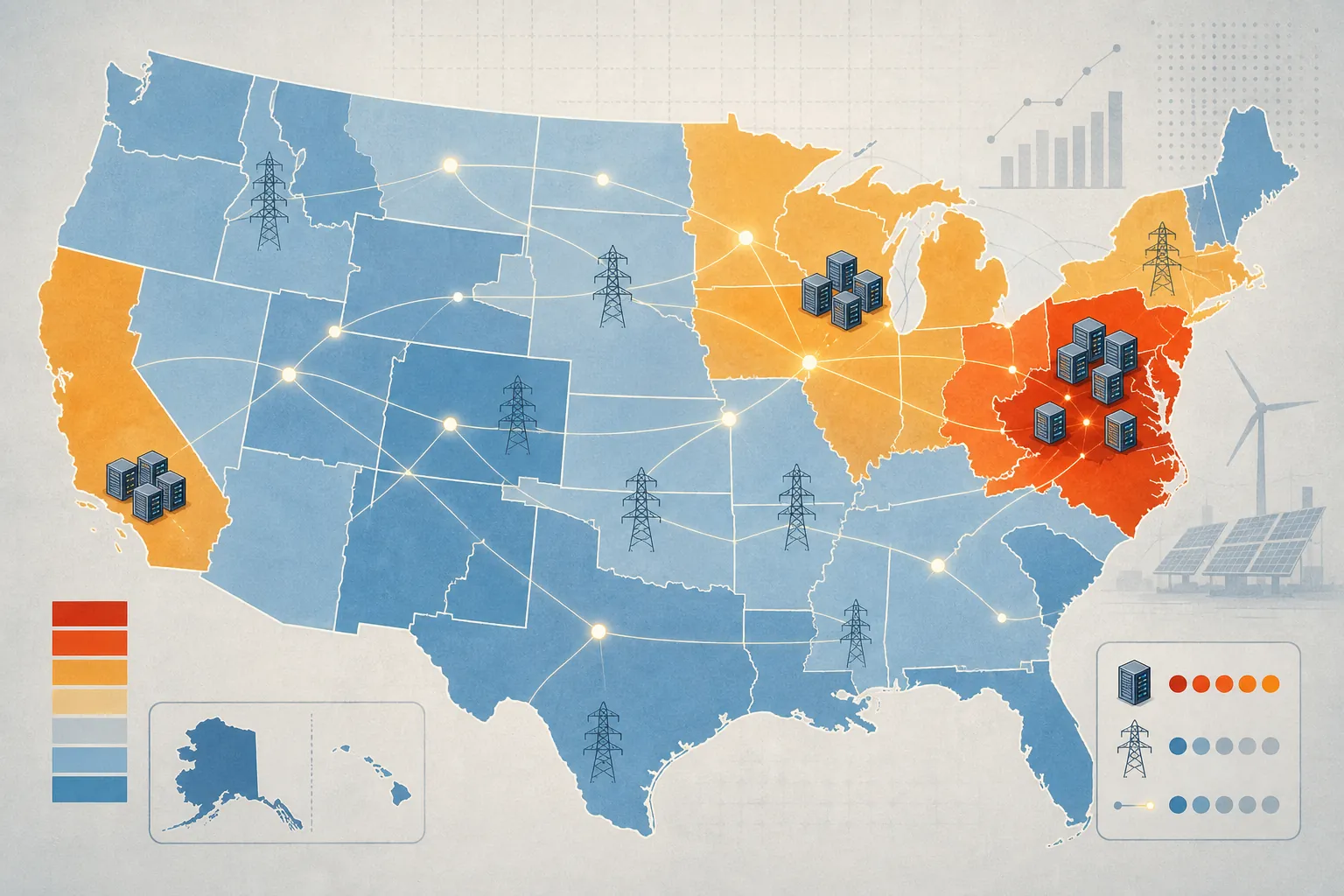
The regional pattern is not limited to one market. A Bloomberg analysis reported by SupplyChainBrain found wholesale electricity costs had more than doubled since 2020 in some U.S. markets, with more than 70% of the price increases occurring within 50 miles of data center hot spots.[5] Goldman Sachs Research also identifies California, the Midwest, and the mid-Atlantic as areas facing the most acute price pressure, and projects data centers’ share of U.S. peak summer power demand will rise from 4.1% in 2025 to 8.5% in 2027.[1]
For supply chain planning, the regional split matters more than the national average. Network models are built on location choices. Supplier scorecards compare landed costs by origin. Capacity plans assign volume to plants. If electricity is averaged across the enterprise, the model can keep selecting a site whose economics have already changed.
Where electricity should move in the planning model
The practical change is not complicated. Electricity has to move from a pooled overhead assumption into the same kind of explicit input treatment already given to freight, labor, duties, scrap, and working capital. The level of detail depends on the operation. A light-assembly site does not need the same treatment as cold storage, heat treating, injection molding, semiconductor packaging, food processing, or a highly automated warehouse.
| Planning area | Old treatment | Updated treatment |
|---|---|---|
| Total-landed-cost modeling | Electricity absorbed into overhead or supplier markup | Separate electricity component by site, process, tariff structure, and contract renewal date |
| S&OP scenarios | Generic inflation uplift applied across cost buckets | Regional electricity sensitivity bands tied to operating plans and margin scenarios |
| Network design | Site comparison based mainly on labor, freight, taxes, and service | Power price, capacity availability, demand charges, and interconnection risk included in node economics |
| Supplier sourcing | Quoted price treated as stable unless supplier announces increase | Energy intensity and regional pass-through exposure reviewed before award or renewal |
| Automation business cases | Energy use treated as a minor facility cost | Power draw and peak-demand charges included in payback and throughput economics |
This is a model conversion, not an accounting reclassification exercise. The point is to make electricity visible at the decision points where it can change the answer.
Total-landed-cost models need an energy line that can move by origin
A landed-cost model that compares two suppliers should not treat both quotes as equally exposed to electricity inflation unless the production process and tariff environment justify it. A fabricator using energy-intensive equipment in a constrained power region carries a different cost risk than a lower-energy supplier in a region with less visible data center pressure.
Procurement does not need to demand a full utility bill from every supplier. It does need enough structure to ask better questions before the quote becomes a frozen assumption: how energy-intensive is the process, when do electricity contracts reset, are utility riders or demand charges material, and is the supplier located near a market where data center load is already affecting wholesale prices?
The answer may not change the award. It may change the sensitivity case, the escalation clause, the dual-source logic, or the margin reserve attached to that supplier.
S&OP needs electricity scenarios that match the regions actually used
An S&OP team does not need one national electricity forecast. It needs exposure bands for the regions where the business produces, stores, and sources. The base case can still use contracted rates where contracts are fixed. The upside case should reflect renewal timing, tariff reopeners, indexed supply agreements, and volume shifts into more exposed nodes.
- Map plants, warehouses, co-packers, and top energy-sensitive suppliers by utility territory or wholesale market exposure.
- Separate fixed-rate contracts from indexed or pass-through arrangements.
- Identify renewal dates that fall inside the planning horizon.
- Create regional electricity bands rather than one enterprise-wide inflation assumption.
- Tie the bands to margin, production allocation, and inventory positioning scenarios.
This is where the planner avoids being blamed six months later for a variance that was already embedded in the budget. If the renewal date is known and the regional pressure is visible, the assumption should not be hidden inside a generic inflation field.
Network design should treat power as part of the cost surface
Network optimization tends to reward clean inputs: transport cost, labor availability, tax treatment, service time, capacity, and inventory. Power has often entered only indirectly through facility operating cost. That is no longer enough for energy-intensive operations or for sites in regions where data center demand is tightening the grid.
The site with the lowest lease cost and acceptable labor pool may not remain the best node if it carries higher peak-demand charges, constrained utility capacity, or exposure to a market where data center load is pushing wholesale costs higher. The same applies to automation. A goods-to-person system, freezer expansion, or electrified fleet charging plan can look attractive on labor savings while understating power availability and peak-load economics.
Grid equipment constraints sit behind some of these planning risks. Transformer availability, interconnection queues, and utility build-out timelines can delay capacity even before the monthly power bill changes. ChainSignal has covered those constraints separately in its reporting on transformer shortages reshaping AI energy supply chains, AI data center supply chain bottlenecks, and GE Vernova’s role in AI infrastructure constraints.
The uncertainty cuts both ways
The most useful planning posture is not panic. Goldman Sachs Research has cautioned that only 50% to 60% of scheduled data center capacity may materialize on time.[1] That matters. If a model assumes every announced AI campus arrives on schedule, it can overstate near-term electricity pressure and distort investment decisions in the other direction.
There are also smoothing mechanisms between wholesale price movement and the bill a supply chain organization actually pays. Retail contracts, utility regulation, procurement structures, hedges, riders, and rate-case timing all affect pass-through. A PJM wholesale increase can be a serious warning for an exposed site and still be the wrong number to paste into a national cost forecast.
The planning discipline is to keep both facts in the file: structural demand is rising, and realized cost exposure is local, contractual, and time-dependent.
A cleaner assumption set for the next planning cycle
The next budget or S&OP refresh should not wait for a perfect 2030 electricity forecast. It should ask whether the current assumption set can answer four basic questions.
- Which nodes in the network have material electricity exposure by process, temperature requirement, automation level, or operating hours?
- Which of those nodes sit in regions where data center demand is already linked to price pressure?
- Which electricity costs are fixed through contract terms, and which can reset inside the planning horizon?
- Which supplier quotes embed energy-intensive operations that could face pass-through pressure before the next sourcing event?
- Which network or automation decisions would change if electricity moved faster than headline inflation?
The output does not have to be elaborate. For many companies, the first useful artifact is a one-page electricity exposure table by facility and top supplier region, with contract reset dates and low/base/high cost assumptions. The second is a rule that network design studies and major automation business cases cannot treat electricity as a flat overhead percentage when power draw is material.
That is enough to change the quality of the conversation. Finance can still own the accounting treatment. Supply chain should own whether the planning model reflects how the network actually consumes power.
The practical judgment
AI data center electricity costs are not a side story for supply chain planning. They change the cost surface on which supply chain networks are optimized. The current evidence does not justify copying the highest regional wholesale spike into every plant budget. It does justify removing electricity from the background, assigning it regional sensitivity bands, checking contract pass-through, and making it explicit in S&OP, landed-cost analysis, and network design.
Planners do not need to know the exact electricity price in 2030 to stop using a stale assumption today.
References
- Data center boom could raise power bills and boost inflation, Goldman says, CNBC, February 2026.
- Gartner Says Data Center Electricity Demand to Grow 26 Percent in 2026, Gartner, June 10, 2026.
- Data Centers, Electricity Demand and Inflation, Federal Reserve Bank of Dallas, 2026.
- AI data centers trigger massive irreversible 76 percent electricity price spike in largest US region, Tom’s Hardware.
- Data Centers Fuel Surge in U.S. Electricity Prices, SupplyChainBrain.
§ 42 — Cited evidence
Flag an inaccuracy or submit a comparable account — Contribute or read how claims are verified in Methodology.