
§ 41 — Use-case analysis
Can AI Risk Management Reduce Cross-Contamination Recalls?
An evidence-tier assessment of where AI risk management tools have actually reduced cross-contamination-related pharmaceutical recalls, and where the claims still outpace independently published data.
- Function
- quality
- AI technique
- predictive environmental monitoring
- Failure pattern
- inadequate early detection of contamination signals
- Evidence source
- Lin and Hertig 2023 fuzzy DEMATEL study
The July 2026 recall of Cetirizine HCl Oral Solution by Unique Pharmaceutical Laboratories, announced because of cross-contamination with ranitidine, is a useful place to begin for one reason: it is current. Years after the 2019 ranitidine NDMA crisis changed how the industry thinks about legacy products, impurities, and shared manufacturing risk, a familiar contamination pathway is still reaching the recall channel. The public alert does not establish a root cause, and it should not be used to infer whether an AI system would have prevented this specific event. It does show that cross-contamination remains an active quality-system problem, not a closed chapter.[1]
For this article, cross-contamination means unintended transfer of one drug substance, product, contaminant, residue, or process-related material into another product or process stream. That includes shared-facility drug-to-drug contamination and cleaning-residue pathways when the cited source uses that scope. It does not automatically mean every microbial contamination event or every nitrosamine-type process concern. The distinction matters because AI claims often become more impressive when unlike hazards are grouped together.

The Recall Burden Is Large Enough To Justify The AI Question
The cleanest answer to “can AI risk management reduce cross-contamination recall risk in pharma?” is not yet “yes, proven at recall-rate level.” No peer-reviewed study in the supplied evidence directly measures AI adoption against reduced pharmaceutical recall rates. The better-supported answer is narrower: AI can plausibly reduce recall risk where it improves detectability, continuity of monitoring, and recognition of recurring deviation patterns before contamination becomes distributed product.
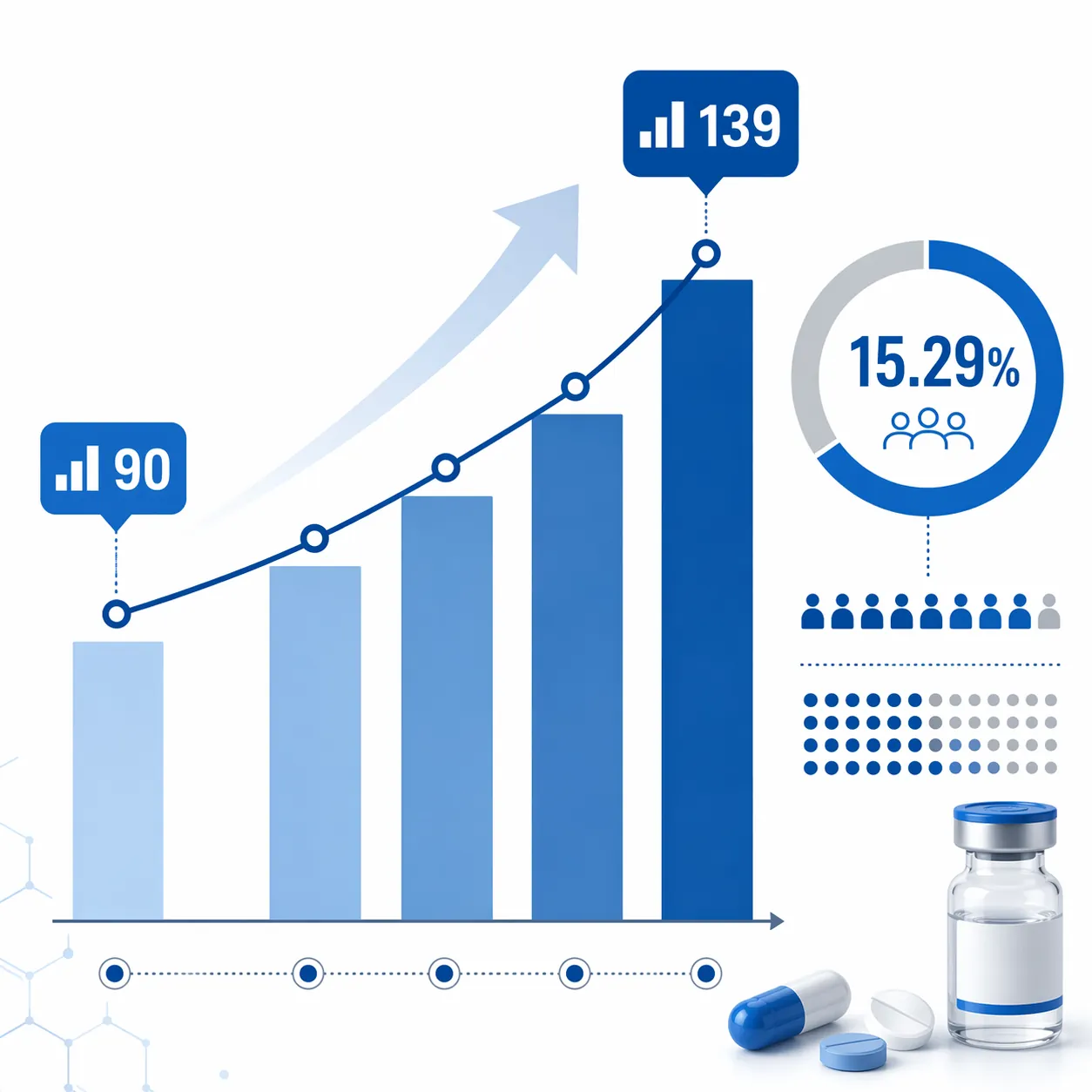
That narrower question is still worth asking. A 2026 preprint by Thamoadaran et al. analyzed FDA enforcement reports from 2015 through 2025 and found 12,869 recalled drugs, with contamination listed as the cause in 1,967 cases, or 15.29% of the total.[2] Because the study is a preprint, its number should be treated as provisional rather than settled epidemiology. It is still directionally important for procurement and quality leaders: contamination is not a one-off failure mode that can be ignored until the next inspection.
A separate FY2024 quality-data summary attributed approximately 17% of recalls to cross-contamination and 31% to microbial contamination.[3] That figure carries a sourcing caveat: the supplied material identifies it as a LinkedIn summary of FDA FY2024 quality data, not as a directly checked FDA report. It is useful as a signal, not as a number to build a capital request around without verifying the underlying FDA publication.
The trend line is less easy to dismiss. ISPE reported that contamination cases increased from 90 in 2007–2011 to 139 in 2017–2021, with cross-contamination specifically rising during that longer window.[4] That movement occurred across years when GMP expectations, cleaning validation programs, and quality oversight were hardly absent. The issue is not whether traditional controls exist. The issue is whether the system notices the right weak signals early enough.
| Evidence Area | What It Supports | What It Does Not Yet Prove |
|---|---|---|
| Predictive environmental monitoring and real-time viable particle detection | Earlier detection of facility and cleanroom contamination signals; strongest practical evidence path | Independently verified reduction in pharma recall rates |
| ML-based deviation pattern recognition | Better visibility into recurring weak signals and hazard detectability | Autonomous recall prevention |
| Predictive maintenance for contamination-linked equipment | Plausible reduction of equipment-driven contamination risk | Generalizable recall-rate impact |
| Behavioral analytics for cleanroom protocol compliance | Facility-level monitoring of practices that can create contamination pathways | Mature, independently replicated contamination-control outcomes |
| Digital twins, robotic cleaning at scale, end-to-end prediction | Aspirational planning and simulation value | Published outcomes showing reduced cross-contamination recalls |
Why Detectability Is The Practical Center Of The AI Case
Lin and Hertig’s 2023 fuzzy DEMATEL study matters because it gives this discussion a quality-risk structure rather than a technology pitch. Their study, based on input from 11 pharmaceutical experts, identified “system detectability of hazards” as one of the top causal criteria driving pharmaceutical recall risk.[5] That does not prove that any specific AI platform reduces recalls. It does explain why tools that make hazards more detectable sit closer to the recall-risk mechanism than broad claims about digital transformation.
In a contamination event, the costly failure is often not the first particle, organism, residue, or misplaced material. The costly failure is the lag between the first signal and the point at which the quality system understands that the signal is real, connected, and product-relevant. A single excursion may be investigated as isolated. A cleaning record may look complete until a later deviation reopens the question. A shared line may be technically permitted but practically brittle. AI risk management earns attention when it shortens that lag.
That is also where the strongest claims should stop. The defensible claim is not that AI “prevents recalls” in a blanket sense. It is that certain AI-enabled systems may improve detection of weak contamination signals and recurring deviations before they become recall-scale failures.
Predictive Environmental Monitoring Has The Strongest Evidence Path
Predictive environmental monitoring is the first place to look because it changes the timing and granularity of contamination data. Traditional environmental monitoring can generate valuable information, but much of it is reviewed in batches, after incubation, after sampling rounds, or after a human has enough time to reconcile events. Real-time viable particle detection changes the shape of the data stream.
Bio-Fluorescent Particle Counting, or BFPC, can generate real-time viable particle signals that are more suitable for continuous analysis than delayed, batch-style review. TSI has described the role of BFPC data in AI-enabled cleanroom monitoring, where continuous particle signals can be analyzed for trends, anomalies, and early warning patterns.[6] This is not the same as proving recall reduction. It is, however, a plausible technical bridge from “we sampled and later reviewed” to “we are watching a machine-readable signal as the process runs.”
The difference matters operationally. If a filling suite begins to show a subtle viable-particle pattern during a shift, the useful intervention is not a retrospective chart showing that something changed yesterday. It is escalation early enough for QA, manufacturing, and microbiology to decide whether to pause, inspect, resample, segregate, or protect downstream product. AI is valuable here only if it improves that decision window without drowning the floor in false alarms.
The evidence still needs careful labeling. PharmAlliance has reported a 60% reduction in contamination incidents associated with AI-driven environmental monitoring, but the supplied material identifies this as vendor-reported and not independently replicated; sample size, methodology, site mix, baseline rates, and endpoint definitions are not available.[7] A QA director can cite that number as an interesting market signal. It should not be treated as investment-grade evidence unless the vendor can provide the study design, denominator, implementation conditions, and post-installation verification plan.
The regulatory setting makes continuous monitoring more relevant, especially for sterile products. The 2022 revision of EU GMP Annex 1 requires a formal Contamination Control Strategy, which pushes firms to show how facility design, process control, monitoring, and quality decisions work together rather than exist as disconnected procedures.[8] AI can support that strategy when it strengthens observation and response. It does not replace the strategy, and it certainly does not excuse a weak one.
What A Purchaser Should Ask For
- The baseline contamination and excursion rates used to support any reduction claim.
- Definitions of “incident,” “contamination,” “near miss,” and “prevented event.”
- Evidence that alerts were reviewed, escalated, and acted on through approved quality procedures.
- False-positive and false-negative handling, including who can override the system and how overrides are trended.
- Validation documentation showing that the model performs under the facility’s actual process, personnel, and cleaning conditions.
Deviation Pattern Recognition Is The Other Strong Claim
The second strong application is ML-based deviation pattern recognition. It is less visually impressive than a real-time cleanroom dashboard, but it may be closer to how contamination failures actually mature. Many serious contamination problems are not born as one dramatic exception. They accumulate as small deviations, recurring cleaning questions, repeated maintenance anomalies, borderline environmental results, operator workarounds, and product-changeover friction.
Human review is not weak because QA people lack judgment. It is weak because deviation systems, CAPA records, batch records, maintenance histories, environmental data, and complaint signals are often stored in formats that make cross-pattern recognition slow. A reviewer may see the event in front of them. A machine-learning system, if properly governed and trained on relevant internal data, may see that similar events clustered around a room, line, component, cleaning agent, shift pattern, or campaign sequence.
This is where Lin and Hertig’s recall-risk framework becomes operational. If system detectability of hazards is a causal driver of recall risk, then a tool that improves detectability across scattered quality records is addressing a structurally important weakness.[5] The point is not to let an algorithm decide whether product is safe. The point is to surface the recurring signal before the next batch is released, the next campaign starts, or the next investigation closes as unrelated.
A reasonable implementation would not begin with “predict all contamination.” It would begin with narrower models: recurring deviations after product changeover, repeated cleaning verification failures, unusual co-occurrence of equipment interventions and environmental excursions, or patterns linking specific shared assets to later quality events. The model output should feed a formal investigation queue, not bypass QA judgment.
The highest-value output may be a defensible question rather than a definitive answer. “Why do these three minor cleaning deviations, two borderline viable-particle signals, and one maintenance intervention keep appearing around the same shared line?” is exactly the kind of question that can prevent an isolated-event culture from becoming a recall culture.
The Consequences Are Not Theoretical
ISPE’s contamination review included several cases that explain why early detection deserves more attention than broad AI optimism. At the Emergent BioSolutions facility, 75 million Johnson & Johnson vaccine doses were discarded after cross-contamination involving AstraZeneca material.[4] In another case, itraconazole-rilmazafone cross-contamination affected 245 patients and was associated with two deaths.[4] ISPE also described vincristine trace-contamination events affecting more than 107 patients across 12 Chinese hospitals, with reported trace concentrations of 0.28–18 µg/mL.[4]
Those cases should not be used as generic proof that AI would have changed the outcome. They are reminders of mechanism and consequence. Cross-contamination can move from a facility decision to a patient event. Once product is distributed, the recall decision is no longer an internal quality exercise; it becomes a public health, supply, regulatory, and reputational event.
Predictive Maintenance Belongs In The Middle Tier
Predictive maintenance has a credible place in contamination risk management, but the evidence is more moderate. Equipment failures can create contamination pathways: worn seals, misaligned components, failing HVAC elements, residue-retaining parts, or maintenance interventions that disturb a controlled state. AI models that detect abnormal vibration, pressure, temperature, airflow, or cycle behavior can plausibly reduce those equipment-linked risks.
The limitation is endpoint quality. Vendor case reports can show fewer unplanned equipment failures, better uptime, or earlier maintenance alerts. Those are useful operational outcomes. They do not automatically prove fewer cross-contamination recalls. A predictive-maintenance proposal is strongest when it identifies specific contamination-linked assets and explains how the alert changes a GMP-controlled action: earlier part replacement, targeted line hold, added inspection, cleaning reassessment, or campaign sequencing decision.
The FDA’s November 2025 warning letter to DeVere Manufacturing is a reminder that shared equipment is still a live enforcement issue. FDA cited unacceptable cross-contamination risk from shared OTC and industrial equipment and required a comprehensive risk assessment for all affected products.[9] An AI tool cannot make unsuitable equipment suitable. It may, however, help monitor the assets and patterns that a competent risk assessment has already identified.
Behavioral Analytics Can Help, But The Evidence Is Early
Cleanroom protocol compliance is a legitimate contamination-control target. Gowning errors, door discipline, material movement, cleaning execution, and aseptic technique can all create contamination pathways. Computer vision and behavioral analytics may help detect protocol drift, especially where human observation is intermittent or where supervisors are already stretched.
This category needs restraint. Facility-level evidence may show that a site reduced observed behaviors associated with contamination risk. That is not the same as proving fewer contaminated batches or fewer recalls. It also introduces governance questions that quality leaders cannot leave to the vendor: privacy boundaries, union or works-council expectations where relevant, bias in detection, retraining after process changes, and documentation of how observations become GMP actions.
Behavioral analytics is most defensible when it is tied to known contamination-control behaviors in a formal CCS and when alerts lead to coaching, retraining, procedural review, or documented deviation triage. It is weakest when sold as a surveillance layer with a vague promise of cleaner operations.
Digital Twins And End-To-End Prediction Are Still Mostly Aspirational
Digital twin validation, autonomous robotic cleaning at scale, and end-to-end contamination prediction are easy to overstate. They may become useful. A digital representation of airflow, equipment state, personnel movement, cleaning history, product sequence, and environmental signals could eventually support better scenario testing. Robotic cleaning may reduce variability in some controlled tasks. End-to-end models may one day combine upstream and downstream signals in a way that helps quality teams act earlier.
The supplied evidence does not include published outcomes showing that these approaches reduce cross-contamination-related pharmaceutical recalls. That absence matters. For a regulatory affairs lead who will later need to defend the system to inspectors, an impressive platform architecture is not the same as validated contamination-risk reduction.
How To Position AI Inside A Contamination Control Strategy
The best internal proposal will not ask executives to fund “AI for recall prevention.” It will ask them to fund specific improvements in contamination detectability and response. That framing is easier to validate, easier to audit, and less likely to collapse under inspection questions.
- Use predictive environmental monitoring where real-time or near-real-time data can change an actual quality decision.
- Use ML deviation pattern recognition where records are fragmented and recurring weak signals are being missed.
- Use predictive maintenance for assets with a defined contamination pathway, not as a generic reliability upgrade.
- Use behavioral analytics only where the monitored behaviors are tied to approved procedures and documented quality actions.
- Treat digital twins and end-to-end prediction as pilots unless the vendor can show published or inspectable outcomes relevant to the facility’s risk profile.
A defensible AI risk management program should also specify ownership. QA needs to know who reviews alerts, who decides whether a signal becomes a deviation, who approves model changes, who investigates false alarms, and who has authority to pause operations. If the answer is “the platform,” the control strategy is not ready.
The current evidence supports investment where AI strengthens monitoring, detectability, and deviation recognition inside a formal Contamination Control Strategy. It does not support crediting AI with independently proven reductions in pharma recall rates. That distinction is not conservative wordsmithing; it is the difference between a system a quality team can validate now and a promise it may have to defend later.
References
- Unique Pharmaceutical Laboratories Issues Voluntary Nationwide Recall of Cetirizine HCl Oral Solution Due to Cross Contamination With Ranitidine, Drugs.com FDA Alerts, July 18, 2026.
- Analysis of FDA Enforcement Reports for Drug Recalls 2015–2025, Thamoadaran et al., 2026 preprint.
- FDA FY2024 Quality Report Summary, LinkedIn summary of FDA FY2024 quality data.
- Contamination Trends and Proposed Solutions, ISPE, March-April 2023.
- A risk management framework for pharmaceutical recalls using fuzzy DEMATEL, Lin and Hertig, 2023.
- The AI Revolution in Pharma Cleanrooms, TSI.
- AI-Driven Environmental Monitoring Contamination Incident Reduction Claim, PharmAlliance.
- EU GMP Annex 1: Manufacture of Sterile Medicinal Products, European Commission, 2022 revision.
- DeVere Manufacturing FDA Warning Letter, FDA, November 2025.
§ 42 — Cited evidence
Flag an inaccuracy or submit a comparable account — Contribute or read how claims are verified in Methodology.