
§ 41 — Use-case analysis
Can AI climate attribution actually inform procurement decisions?
AI climate attribution has moved from post-event analysis to forward-looking risk intelligence, but most supply chain vendors still struggle to bridge probabilistic forecasts with concrete procurement and inventory actions. This article examines the latest academic research and operational case studies to help you assess the real readiness of these tools for your supply chain planning.
- Function
- procurement
- AI technique
- forecasting
- Failure pattern
- last-mile action gap
- Evidence source
- Jiménez-Esteve et al. (arXiv 2024) and CDP (May 2026)
The useful question for procurement is not whether an AI climate-attribution model can produce a sharper probability map. It is what changes this quarter if that map says a supplier region has elevated extreme-weather risk. Does a planning director pull forward a purchase order, increase safety stock, qualify an alternate lane, call a supplier, or simply add another red dot to a dashboard?
That handoff is where most of the value either appears or disappears. AI climate attribution is beginning to move beyond post-event explanations and toward forward-looking risk signals for heatwaves, hurricanes, and explosive cyclones. But a probabilistic climate signal is still not a procurement decision. Someone has to translate it into timing, volume, supplier priority, and accountability for false alarms.

The handoff from attribution to action
Traditional climate attribution has usually answered a question after the damage: how much more likely or more intense was an event because of human-caused climate change? That work matters for accountability, insurance, public policy, and long-term risk disclosure. It is less useful to a category manager watching a port, component supplier, or agricultural region that might fail next week.
The newer research direction is more operational. Jiménez-Esteve et al. describe anticipated attribution using AI hybrid models across heatwaves, hurricanes, and explosive cyclones, pointing toward attribution-style reasoning before or during an unfolding event rather than only after it has been analyzed in retrospect.[1] That does not mean an AI system can tell procurement teams exactly what to buy. It means the scientific layer is starting to produce signals early enough to be useful if the organization has already decided how to act on them.
The distinction matters because supply chain products often blur four different things: attribution science, event prediction, supplier exposure detection, and procurement execution. A model may be credible at one layer and weak at another. A forecast can be timely but disconnected from part numbers. A supplier map can show exposure but not inventory policy. A procurement team can see the warning and still lack authority to move the order.
Three layers that should not be collapsed
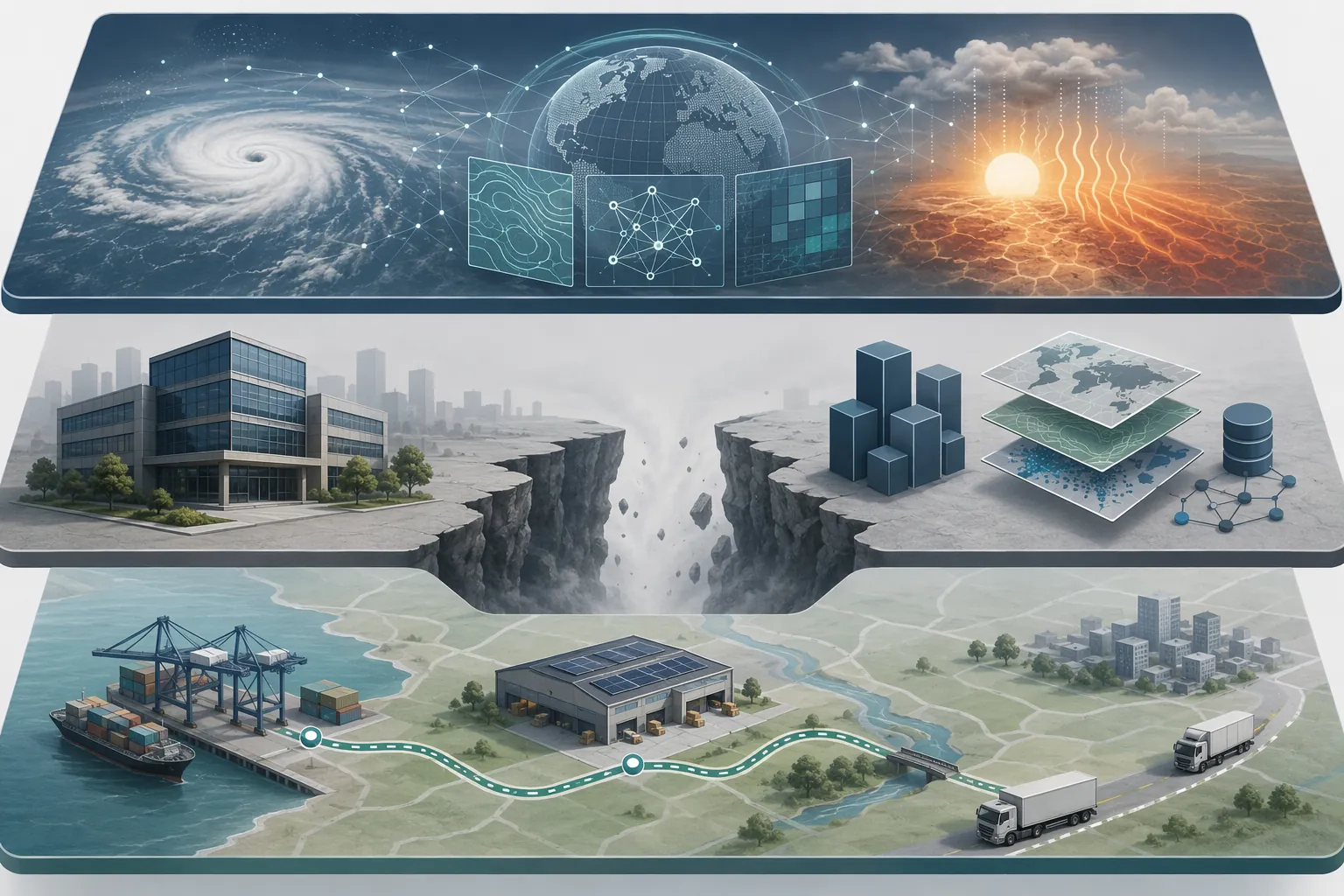
The readiness question becomes clearer if the stack is separated into three layers: scientific readiness, enterprise adoption, and decision integration. The first asks whether the signal is defensible. The second asks whether companies treat the risk as financially material. The third asks whether planners can change the sequence of buying, expediting, inventory, and supplier communication before the disruption arrives.
| Layer | What it proves | What it does not prove |
|---|---|---|
| Scientific readiness | AI hybrid methods can help generate forward-looking extreme-weather attribution signals. | That a supplier-level action is automatically justified. |
| Enterprise adoption | Companies increasingly have enough climate-risk information to disclose expected losses. | That the information is embedded in sourcing, inventory, or logistics decisions. |
| Decision integration | A planning team can act if exposure, thresholds, playbooks, and authority are connected. | That every vendor alert is accurate, independently validated, or worth acting on. |
On the scientific layer, the important movement is from retrospective event attribution toward anticipated attribution. Jiménez-Esteve et al. are load-bearing because they show how hybrid AI approaches can be used in advance-facing analysis rather than only in after-action studies.[1] For procurement, the value is not the elegance of the model. It is the possibility that a weather-risk signal arrives while there is still time to adjust inventory or supplier communication.
On the adoption layer, the bottleneck looks less like a lack of climate data and more like a failure to operationalize it. CDP’s May 2026 analysis covered 11,261 companies and reported projected extreme-weather losses of $714 billion, while only 35% treated extreme-weather risk as a material financial risk.[2] That gap is hard to square with the idea that corporate risk systems are already absorbing climate signals into normal planning routines.
On the decision layer, the evidence gets thinner but more interesting. This is where general climate-risk language has to give way to what actually happened to a purchase order, a stock position, or a supplier call.
The cases that matter are the ones with changed behavior
Hitachi’s work with ClimateAi in Chennai is useful because it links a seasonal cyclone forecast to inventory positioning rather than stopping at alerting. Hitachi R&D described using ClimateAi’s seasonal cyclone forecasts to pre-position inventory in Chennai, a concrete procurement-adjacent action that would be recognizable to any planning team trying to buy time before a disruption.[3]
That example should be treated as promising, not universal. Seasonal cyclone information may support pre-positioning when the exposed geography, materials, storage constraints, and cost of overstock are already understood. It does not automatically produce a reorder quantity or justify carrying extra inventory across every lane that appears on a risk map. The useful question for a planner is narrower: which items have enough margin, criticality, shelf life, and supplier concentration to justify acting on a seasonal signal?
The Cooper Health example is even more concrete. During Hurricane Idalia, Cooper Health used Interos to identify four suppliers in the storm’s path and placed critical orders hours before a shutdown, according to Interos reporting that was also covered by Forbes contributor Steve Banker.[4][5] This is the kind of last-mile behavior climate-risk systems have to support: identify exposed suppliers, connect them to critical supply, decide what to order, and act before operating windows close.
There is no mystery about why that case carries more operational weight than a generic risk score. The signal was tied to named suppliers. The timing mattered. The response was a procurement action, not a risk committee note. The order was placed before shutdown, which means the tool did not merely explain disruption after the fact.
The Suntory coffee example sits in a different evidentiary category. In a vendor-hosted ClimateAi fireside chat, Suntory was described as receiving coffee yield alerts 5–7 days before broader market awareness.[6] A 5–7 day lead on a commodity-market signal is exactly the kind of advance notice procurement teams want. But because the case is vendor-reported, it should be read as an indication of possible operational value, not as independent proof of forecast accuracy or repeatable procurement performance.
What has to exist before a forecast becomes a decision
A climate-attribution or extreme-weather signal can inform procurement only when it is attached to a decision structure. The minimum structure is not glamorous, but it is where most vendor claims should be tested.
- Exposure mapping: the organization knows which suppliers, facilities, ports, lanes, and materials sit inside the affected geography.
- Materiality filters: planners can separate critical, constrained, or revenue-linked items from commodities that do not justify intervention.
- Decision thresholds: the company has already defined what level of probability, lead time, and consequence triggers review or action.
- Procurement playbooks: the response options are known, including pull-forward orders, alternate sourcing, expediting, inventory rebalancing, or supplier confirmation.
- Human accountability: someone owns the decision to act, wait, or override the alert, including the cost of false positives.
Without those pieces, the forecast layer becomes a sophisticated waiting room. A planner may know that a region is at elevated risk and still have no approved budget to buy early, no alternate supplier to call, no expedited lane available, and no agreed tolerance for carrying extra inventory. The tool may be right and still arrive as operational noise.
This is also where vendor accuracy claims need careful handling. ClimateAi’s reported claim of a 50–60% more accurate six-month outlook may be relevant to buyer evaluation, but the briefed material does not provide third-party validation for that claim. Even if an outlook is directionally better, procurement still has to know whether the incremental accuracy changes a sourcing or inventory decision enough to justify cost.
Why hybrid systems remain the safer bet
The better direction is not AI replacing climate science; it is AI being integrated with physics, exposure data, and causal reasoning. Reichstein et al. argue for integrated AI early-warning systems while also flagging machine-learning bias, distribution shift, and the need for causal AI.[7] Those cautions are not academic footnotes for supply chain teams. A model trained on yesterday’s weather and supply patterns can fail in precisely the stressed conditions when procurement most needs it.
A May 2026 report summarized research finding that physics-based models still outperform AI models at extreme-event prediction, which supports a hybrid approach rather than a pure AI forecast layer.[8] For procurement, that should shape vendor evaluation. The question is not whether the product says “AI.” It is whether the system combines defensible weather science, transparent uncertainty, supplier-level exposure, and workflow integration.
Procurement teams do not need impossible certainty. They routinely make decisions under uncertain demand, supplier reliability, lead times, and logistics capacity. What they need from AI climate attribution is a signal early enough and specific enough to change the next action. That may mean holding a supplier call earlier than usual, pulling forward a limited order, pre-positioning critical inventory, or watching a commodity market before the rest of the market has priced in the risk.
The readiness boundary
AI climate attribution is ready to inform procurement when it is paired with exposure mapping, decision thresholds, inventory and procurement playbooks, and named human accountability. It is not ready when it is sold as a standalone forecast layer that leaves the planning team to invent the last mile during the event.
The strongest current evidence points to uneven readiness. The science is moving forward. Corporate financial recognition is lagging. The operational cases are encouraging when they show changed behavior, especially supplier identification and order placement before shutdown. The next proof will come from post-mortems that show whether warnings repeatedly changed buying decisions before ports, suppliers, or transportation lanes failed.
References
- Anticipated attribution of extreme weather events using AI hybrid models, arXiv, 2024, link
- CDP analysis of projected extreme-weather losses across 11,261 companies, CDP, May 2026, link
- Hitachi R&D source on ClimateAi seasonal cyclone forecasts and Chennai inventory positioning, Hitachi Research & Development, link
- Interos press report on Cooper Health and Hurricane Idalia supplier exposure, Interos, link
- Forbes coverage by Steve Banker on Cooper Health, Forbes, link
- ClimateAi fireside chat on Suntory coffee yield alerts, ClimateAi, link
- Integrated AI early-warning systems perspective, Nature Communications, 2025, link
- May 2026 report on physics-based models outperforming AI at extreme-event prediction, phys.org, May 2026, link
§ 42 — Cited evidence
Flag an inaccuracy or submit a comparable account — Contribute or read how claims are verified in Methodology.