
§ 41 — Use-case analysis
Real Outcomes from AI in City Waste Management
Cities deploying AI in waste collection logistics and sorting are reporting measurable gains—distance reductions of 13–37%, cost savings of 13%, and sorting accuracy above 90%—but nearly all evidence comes from single-city pilot studies whose scalability and generalizability remain unproven.
- Function
- collection logistics
- AI technique
- route optimization
- Failure pattern
- single-city pilot scalability
- Evidence source
- PMC 2023 review on AI in solid waste management
Municipal waste is a supply-chain problem that happens to be run by cities. Trucks leave depots, serve dense and sparse routes, return to transfer stations or material recovery facilities, and repeat the cycle under labor, fuel, equipment, resident-service, and budget constraints. That is why AI work for city sustainability planning should start with collection logistics rather than a smart-city control room.
The cost center is large enough to justify that focus. Collection logistics account for 70–80% of total municipal waste management costs, according to Sulemana et al. as cited in a 2023 review of AI applications in solid waste management.[1] If an algorithm reduces collection distance, idle time, duplicated coverage, or unnecessary pickups, it is working on the part of the system that usually carries the largest operating burden.
The measured results are no longer only speculative. The same 2023 review reports route-distance reductions of roughly 13% with ant colony optimization, about 28% with Dijkstra-Tabu search, a 28.22% time reduction with genetic algorithms, and a 36.78% efficiency gain with a backtracking search algorithm across different study settings.[1] On the sorting side, computer-vision systems using convolutional neural networks have reported classification accuracy from 72.8% to 99.95%, while AI-enabled robotic sorting has been reported at 160 recyclable materials per minute compared with 30–40 for human workers.[1]

The routing numbers are promising, but the method matters
A route optimizer is not one interchangeable product category. The underlying method changes what the system is good at, what data it needs, and how a city should test it before writing performance terms into an RFP.
| AI approach | Reported result | What the metric is really testing | Procurement implication |
|---|---|---|---|
| Ant colony optimization | About 13% route-distance reduction | Whether simulated route selection can find shorter collection paths through repeated candidate-route evaluation | Useful when the core problem is path selection across many collection points |
| Dijkstra-Tabu search | About 28% route-distance reduction | Whether shortest-path logic combined with search memory can avoid locally attractive but inefficient route choices | Relevant when street-network constraints and route sequencing both matter |
| Genetic algorithms | 28.22% time reduction | Whether iterative candidate solutions can improve service time, not just miles driven | Important where labor hours, shift limits, and vehicle utilization are the main constraints |
| Backtracking search algorithm | 36.78% efficiency gain | Whether route alternatives can be explored and rejected systematically to improve overall performance | Needs careful benchmarking because an efficiency metric may not be directly comparable with distance or time |
Those results belong in the same conversation, but not in the same column of a business case. A 13% reduction in distance, a 28.22% reduction in time, and a 36.78% efficiency gain may all be operationally meaningful, yet they are not identical measures. Distance affects fuel, maintenance, emissions, and available route capacity. Time affects crew scheduling, overtime risk, and missed-service exposure. A broad efficiency gain may combine several effects, depending on how the study defines it.
For a city buyer, the practical question is not whether “AI routing” works in the abstract. It is whether the vendor’s method maps to the city’s bottleneck. A municipality with long rural-edge routes may value distance reduction differently from a dense city where curbside access, double parking, transfer-station queues, and shift windows dominate. A district with frequent missed pickups may need service reliability metrics before fuel savings. A contract that pays per household served will judge gains differently from one that pays per ton, per route, or per vehicle-hour.
That is also why pilot design matters. If a route model is tested only on a favorable district, during a stable season, with clean fill-level data and cooperative crews, the result may still be real while overstating what the city can expect after expansion. The 2023 review notes barriers including data quality issues, black-box model opacity, and the absence of standardized evaluation frameworks across studies.[1] Those are not academic footnotes; they are the reasons two cities can buy similar-sounding systems and get different operating outcomes.
Dynamic scheduling changes the pickup decision, not just the route
Route optimization answers a sequencing question: given a set of stops, how should trucks serve them? Sensor-driven dynamic scheduling changes the earlier question: which containers need service at all today?
Barcelona is a useful city-facing example because the system combines AI and IoT smart bins with fill-level sensors, GPS-optimized routes, and dynamic scheduling based on real-time data, as described by the National League of Cities in 2024.[2] The operational point is straightforward. A half-empty container does not need to consume truck capacity just because a static calendar says it is Tuesday. A near-full container should not wait until a fixed pickup day if overflow will create a service complaint, contamination problem, or street-cleaning cost.
This is where AI planning starts to resemble other municipal logistics networks. The system is not only minimizing a path; it is continuously revising the work order. That affects dispatch, crew expectations, resident-facing service levels, and how supervisors explain changes when a district no longer sees the same truck at the same time every week.
The procurement test should separate the routing layer from the sensing layer. A vendor may have strong route sequencing but weak container-level data. Another may install reliable fill-level sensors but rely on ordinary routing logic. Cities need to know which part is producing the claimed gain before they lock in hardware, software, data ownership, and maintenance obligations.
Sorting accuracy is operational only when tied to material, speed, and contamination
AI sorting deserves attention for a different reason. Collection optimization reduces the cost of moving material. Sorting systems affect what happens after the truck unloads: recovery rates, residue, bale quality, labor allocation, and contamination management.
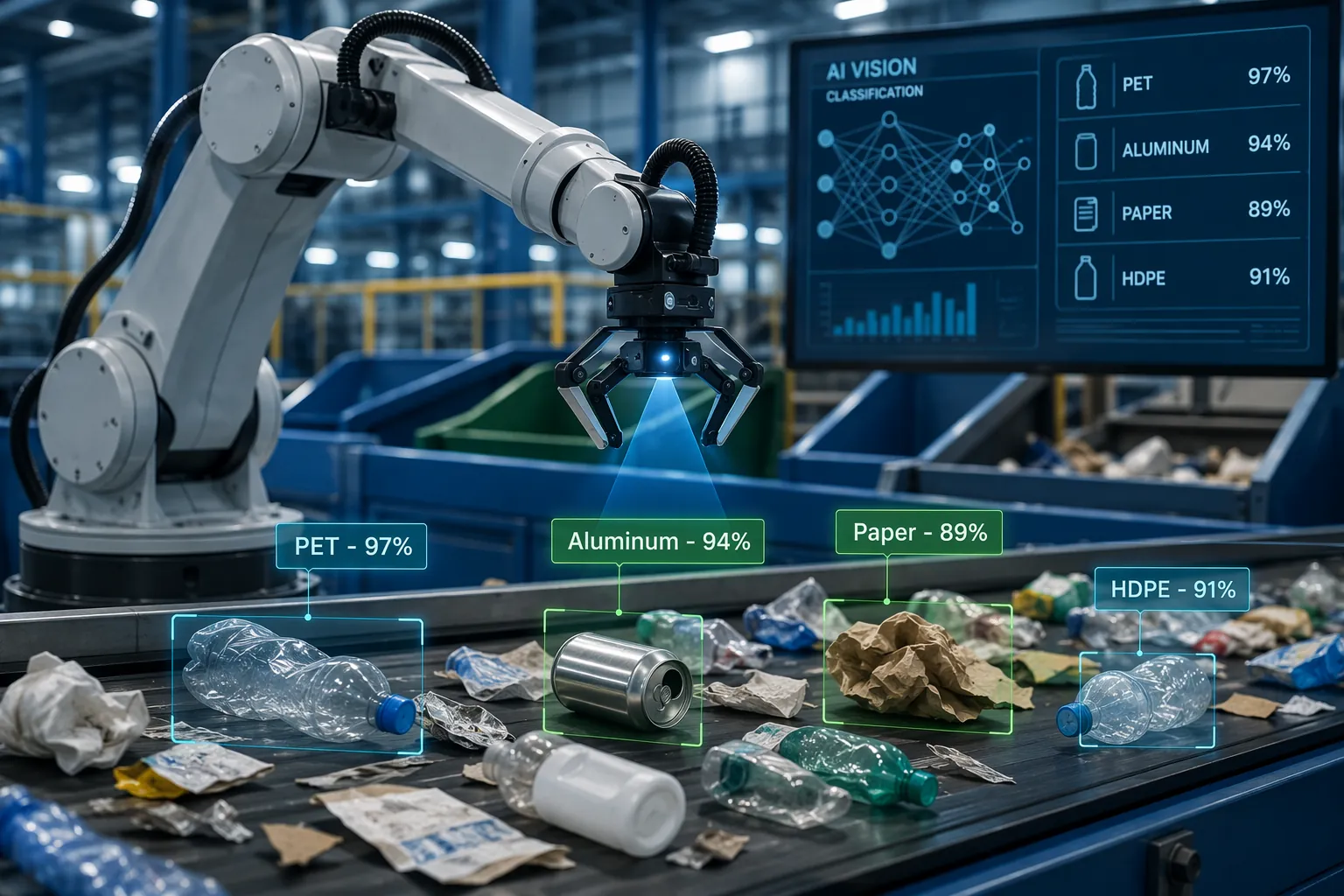
The headline accuracy range is wide. The 2023 review reports computer-vision-based waste classification accuracy from 72.8% to 99.95%, with CNN-based systems consistently reaching 90–99.95% in reported studies.[1] That range should slow down, not stop, adoption. A 99% result on a controlled image dataset is not the same thing as 99% performance on a fast belt with crushed containers, food residue, occluded labels, mixed plastics, and changing lighting.
Throughput adds another layer. AI-powered robotic sorting has been reported at 160 recyclable materials per minute, compared with 30–40 for human workers.[1] That is a meaningful operational comparison, but it does not by itself settle the business case. A facility still has to ask which materials the robot can identify, where in the line it is installed, how often it needs maintenance, what happens when the inbound stream changes, and whether the avoided labor or improved recovery offsets capital and service costs.
Classification accuracy also needs a denominator that operators can use. Accuracy across broad categories may hide poor performance on a high-value resin. Strong recognition of clean bottles may not solve film contamination. A system that improves aluminum capture may have a different payback profile from one that reduces residue in mixed paper. For waste facilities, the useful question is rarely “How accurate is the AI?” It is “How accurate is it on the materials that drive our contract penalties, resale value, and disposal costs?”
Prediction models can help planning, but accuracy is not the same as avoided cost
Prediction is the third category cities should keep separate from routing and sorting. A forecast model can help estimate where and when waste will be generated, but it does not automatically dispatch a better route or recover more material. It becomes valuable when it changes staffing, fleet allocation, container placement, transfer-station scheduling, or outreach priorities.
New York City’s AI waste-prediction model achieved 88% accuracy, according to the National League of Cities.[2] That is a credible planning signal, especially in a city where waste generation varies across neighborhoods, building types, commercial activity, and seasonal patterns. The next test is operational: did the prediction reduce missed pickups, rebalance routes, improve tonnage forecasting, or support better enforcement and education? Without that second step, prediction accuracy remains a planning metric rather than a budget result.
This distinction matters in RFP language. A city can ask for forecast accuracy, but it should also ask vendors to show how forecasts become decisions. Who receives the prediction? How far ahead? What threshold triggers a schedule change? Can supervisors override it? Does the model account for holidays, weather disruptions, special events, or service complaints? The answer determines whether prediction becomes useful logistics intelligence or another dashboard that operations staff learn to ignore.
One cautionary case: impressive claims need a benchmarkable city context
Some public case material reports much larger gains than the peer-reviewed ranges. DigitalDefynd’s 2026 case study describes Greenopolis, located on the outskirts of Tokyo, deploying an AI-based CleanCycle system and reporting a 50% operational cost reduction, 35% higher recycling rates, and 45% less landfill waste.[3]
Those figures are worth noting because they show the kind of outcomes vendors and city innovation teams are now claiming. They are not strong benchmark evidence for a municipal procurement file. DigitalDefynd uses illustrative city names, and the reported Greenopolis figures cannot be independently cross-checked against primary Tokyo-area municipal sources from the material available here.[3] A city should treat them as directional case material, not as a guaranteed performance band.
The problem is not that a 50% cost reduction is impossible in every setting. A poorly routed, under-instrumented, manually dispatched system can have large avoidable waste. The problem is comparability. Without a named operating authority, baseline year, route count, labor model, service geography, tonnage mix, and contract structure, another city cannot tell whether the case resembles its own system.
Global waste growth raises the stakes, but it does not validate every AI claim
The volume pressure is real. Global waste generation was 2.01 billion tonnes in 2016 and is projected to reach 3.4 billion tonnes by 2050, according to World Bank figures cited in the 2023 review.[1] That context explains why cities are looking for better planning tools, but it should not be used as a substitute for local evidence.
Waste systems are stubbornly local. Street geometry, housing density, alley access, union rules, disposal contracts, contamination patterns, source-separation laws, weather, tourism, and transfer-station geography all shape the result. An algorithm that performs well in one district may need retraining, new constraints, or different KPIs elsewhere.
That is the gap between adoption and effectiveness. A city can install sensors, buy a routing platform, or deploy computer vision and still fail to reduce cost if the operating model does not change. Conversely, a modest algorithmic improvement can matter if it removes a truck from a route, avoids overtime, raises facility throughput, or prevents repeated contamination penalties.
How cities should read the current evidence
The current evidence is strong enough to justify serious pilots and careful procurement requirements. It is not strong enough to promise citywide ROI from a generic AI waste platform. The most defensible reading is method-specific:
- Use route optimization evidence when the city’s largest pain point is vehicle miles, route time, crew utilization, or missed-service exposure.
- Use dynamic scheduling evidence when container fill levels vary enough that fixed pickup calendars create avoidable trips or overflow risk.
- Use computer-vision sorting evidence when the facility can define target materials, contamination costs, throughput constraints, and acceptable error rates.
- Use prediction models when forecasts are tied to specific dispatch, staffing, asset-placement, or enforcement decisions.
- Treat broad cost-reduction case studies cautiously unless the source provides a named city, baseline, method, deployment scope, and comparable operating conditions.
For procurement teams, the useful RFP language is less about “AI capability” and more about measurable operating commitments. Ask vendors to state the algorithmic approach, training data, required sensor inputs, baseline calculation, exception handling, human override process, and performance metric. Require separate reporting for distance, route time, fuel, labor hours, missed pickups, overflow events, contamination, recovery value, and system downtime where those measures apply.
The best evidence so far points to real gains: routing improvements across distance, time, and efficiency metrics in the 13–36.8% range, a reported 13.35% cost saving in the reviewed literature, and sorting accuracy that can exceed 90% in reported CNN applications.[1] Those are material outcomes for municipal operations. They are also pilot-benchmark outcomes. Cities should use them to set testable expectations, not to assume guaranteed returns across every neighborhood, waste stream, contract model, and regulatory setting.
References
- Artificial intelligence techniques and applications in solid waste management: A systematic review, PMC, 2023.
- How AI Can Support Cities’ Sustainability Goals, National League of Cities, April 8, 2024.
- AI in Smart Cities Case Studies, DigitalDefynd, 2026.
§ 42 — Cited evidence
Flag an inaccuracy or submit a comparable account — Contribute or read how claims are verified in Methodology.