
§ 41 — Use-case analysis
How AI Capex Is Reshaping Supply Chain Software Vendor Risk
A vendor-intelligence analysis of the five major supply-chain planning platforms—Kinaxis, o9 Solutions, Blue Yonder, Anaplan, and RELEX—maps their financial health and AI deployment evidence against the $700B+ hyperscaler AI capex wave. The findings reveal that only Kinaxis offers audited financials and verifiable AI outcomes, while the other four operate under private or subsidiary ownership that obscures financial and deployment risk, making the transparency gap itself a material selection factor for enterprise buyers.
AI capex is now large enough to distort the way enterprise software is sold. Goldman Sachs projects more than $500 billion in AI investment for 2026, Morgan Stanley projects $2.9 trillion in global data-center construction through 2028, and Forbes reported in June 2026 that Allianz Research sees a 46% divergence between AI infrastructure spending and revenue generation.[1] That is the backdrop behind a narrower procurement question: when investors talk about AI’s impact on supply-chain software stocks, what should buyers actually verify before signing a multi-year planning-platform contract?
The answer does not come from the size of the infrastructure buildout alone. Supply-chain planning software can plausibly benefit from better models, more compute, and agentic workflows because planning is full of constrained decisions, exception handling, scenario comparison, and cross-functional negotiation. But the buyer’s risk is not whether AI spending exists. It is whether a vendor can turn that spending into deployed capability, paid adoption, product reliability, and enough financial stamina to keep investing after the demo cycle ends.

That distinction matters because supply-chain software is moving directly into the agentic AI sales lane. Gartner forecasts that supply-chain management software with agentic AI will grow from less than $2 billion in 2025 to $53 billion by 2030.[2] The forecast is a market signal, not proof that every current module improves forecast accuracy, inventory turns, planner productivity, or service levels. It tells buyers that vendors will increasingly compete on AI. It does not tell them which claims have crossed into production.
There is also a useful brake on overconfidence. A Fortune report on MIT NANDA research said a study across 300 public AI deployments and 350 employees found that 95% of enterprise generative AI pilots produced no measurable P&L impact, with flawed enterprise integration identified as the core issue rather than model quality.[3] Sequoia Capital’s updated “$600B question” analysis similarly framed a gap between AI infrastructure spend and actual AI revenue.[4] Neither source says supply-chain planning AI cannot work. They say buyers should not treat model access or partnership announcements as equivalent to operating results.
The Evidence Gap Is Now Part of the Product Risk
For planning leaders, vendor risk used to sit mostly in implementation scope, integration complexity, user adoption, and upgrade path. AI adds another layer: the vendor must fund expensive product development while customers are still learning which agentic workflows they will actually trust. A roadmap can be technically serious and still fail to become paid production use. A vendor can have respected customers and still leave buyers unable to verify its current financial condition.
That is why the five-vendor comparison is asymmetric from the start. Kinaxis is publicly listed and discloses audited financials. o9 Solutions, Blue Yonder, Anaplan, and RELEX are private or subsidiary-owned, so buyers largely depend on funding announcements, secondary estimates, vendor press releases, analyst recognition, and executive statements. Opacity does not prove weakness. It does change the diligence burden.
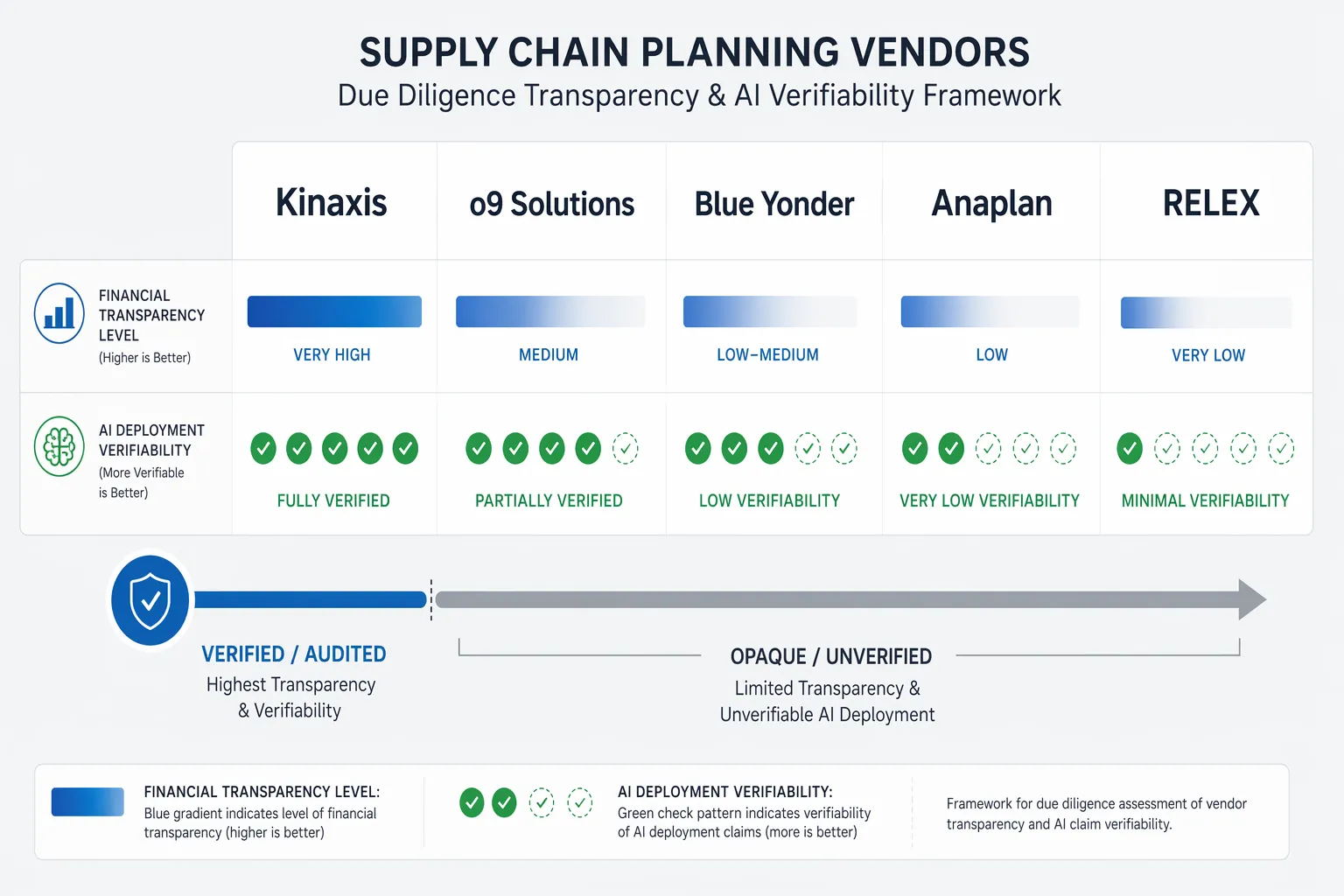
| Vendor | Ownership / disclosure position | AI evidence available from supplied materials | Buyer risk read |
|---|---|---|---|
| Kinaxis | Public company with current reported financials | Named paying Maestro Agents customers in Q1 2026 | Clearest evidence base in this set |
| o9 Solutions | Private company with valuation and older revenue/growth figures | APEX framework scheduled for September 2026; claimed value cases documented before GA | Promising trajectory, but current finances and post-launch outcomes remain hard to verify |
| Blue Yonder | Panasonic-owned subsidiary with no standalone public financials | NVIDIA partnership and Gartner recognition | Scale is visible; standalone financial and production AI evidence is less visible |
| Anaplan | Private-equity owned after Thoma Bravo acquisition | Publicly discussed AI investment and reported IPO interest | Strategic intent is visible; post-acquisition performance is not |
| RELEX | Private, Blackstone-backed company with valuation history | Vendor-reported subscription and ARR growth; AI survey publication | Growth claims are useful, but lack an absolute disclosed revenue base |
Kinaxis: The Cleanest Comparator Because the Numbers Are Current
Kinaxis is not automatically the best product for every enterprise. It is, however, the only vendor in this set where the buyer can line up audited-company disclosure, current operating momentum, and a dated AI monetization signal without depending mainly on fundraising-era numbers or partner announcements.
In Q1 2026, Kinaxis reported SaaS revenue growth of 21%, annual recurring revenue of $447 million, up 20%, total revenue of $165.6 million, up 25%, profit of $29.4 million, up 85%, and adjusted EBITDA margin of 32%. The company also issued FY2026 revenue guidance of $620 million to $635 million.[5] Those figures do not prove that every AI use case pays back. They do show a company with disclosed recurring revenue scale, profitability, margin, and guidance at the same time it is pushing AI functionality.
The more important AI detail is not a grand claim about autonomous planning. Kinaxis CEO Razat Gaurav said the company saw “good early-stage demand for Maestro Agents with new paying customers in Q1 2026.”[5] That is a narrow statement, and it should be kept narrow. It does not disclose customer count, contract value, retention, productivity impact, or planning outcome improvement. But it is dated, commercial, and tied to paying customers. In a market crowded with AI roadmaps, that matters.
For a planning executive defending a vendor choice two years later, the difference is practical. Kinaxis gives finance, procurement, and IT a public record to interrogate: revenue mix, ARR trend, profitability, guidance, and management commentary. The AI claim can be challenged against future filings and calls. That is a stronger position than trying to infer product durability from a private valuation or an ecosystem announcement.
o9 Solutions: High Expectations, Older Financial Markers, and APEX Still Ahead
o9 Solutions has the profile buyers often associate with a serious AI-era challenger: a private valuation of $3.7 billion, $536 million raised, and earlier reported revenue of more than $200 million from 2023, along with a claimed 84% ARR growth rate in 2023.[6] The caution is not that those numbers are irrelevant. It is that they are not current public-company disclosures, and the revenue and growth figures date from an earlier phase of the market.
Its AI story also needs careful timing. Nucleus Research described o9’s APEX framework and documented claimed 40% to 60% cycle-time gains and 15% to 25% inventory cost reductions, but the available evidence places APEX’s launch in September 2026 rather than as a generally available product with independent post-launch validation.[6] That makes the evidence directionally useful, not conclusive.
The diligence question for o9 is therefore specific: which of the claimed gains belong to currently deployed workflows, which belong to pre-GA framework positioning, and what customer references can verify business outcomes under production constraints? The answer may be strong. The public record available here does not let an outside buyer verify it with the same confidence available for Kinaxis.
Blue Yonder: Scale Without Standalone Visibility
Blue Yonder is not a small opaque startup. Available public materials point to approximately $1.4 billion in revenue based on 2024 Contrary Research data, Panasonic ownership, acquisitions of One Network Enterprises and flexis AG, a partnership with NVIDIA on a Model Training Factory for supply-chain AI agents, and recognition as a Leader in the 2026 Gartner Magic Quadrant for supply-chain planning solutions.[7] Those are substantial signals of market presence.
They still do not give the buyer standalone public financials. Panasonic ownership may provide strategic support, but subsidiary status makes it harder to isolate Blue Yonder’s current revenue quality, margin profile, cash needs, renewal performance, and AI investment intensity. Acquisitions can expand capability; they can also create integration work that customers eventually feel in roadmap sequencing and product architecture.
The NVIDIA partnership is worth attention because supply-chain agents need more than a branded AI layer. They need data pipelines, training patterns, orchestration, governance, and deployment methods that fit enterprise planning. But a partnership is not the same as measured production benefit. Buyers should separate platform ambition from customer-validated outcomes: which agents are live, in which workflows, under which human approval model, and with what operational result?
Anaplan: Strategic Interest Is Visible; Operating Proof Is Not
Anaplan sits in a different risk category because its planning footprint is broad and its ownership changed the disclosure equation. After the Thoma Bravo acquisition, post-acquisition financial performance is no longer publicly visible in the way it was when Anaplan traded as a public company. Public announcements and reports also point to interest in an IPO return and a CEO-announced AI product investment, but not a current audited operating profile available for side-by-side comparison.
That leaves enterprise buyers with a familiar private-equity diligence problem. Anaplan may have the resources, customer base, and product ambition to compete aggressively in AI-enabled planning. But without public post-acquisition results, buyers cannot independently inspect the trade-offs among growth, profitability, product investment, debt burden, customer retention, and go-to-market pressure.
For supply-chain planning specifically, the question is not whether Anaplan is talking about AI. It is whether its AI investment has produced deployed, referenceable planning use cases that can be evaluated against the buyer’s own operating model. Finance-led planning credibility does not automatically settle supply-chain execution risk.
RELEX: Growth Signals Without the Revenue Denominator
RELEX brings a different kind of evidence. Available public materials point to an approximately €5 billion valuation from its 2022 Blackstone Growth financing, €500 million from Blackstone Growth in that round, vendor-reported 30% subscription revenue growth and 28% ARR growth for 2025, and a 2026 AI survey of more than 500 supply-chain leaders.[8] These are useful signals, especially around market interest and reported subscription momentum.
The denominator is the problem. A 28% ARR growth figure means something different at different revenue bases, margin structures, and retention profiles. Without an absolute disclosed revenue figure and audited financials, buyers cannot independently judge whether growth is compounding from a large base, being bought through heavy sales investment, or accompanied by operating leverage.
The AI survey material should be read as an attitude and market-readiness source, not proof of RELEX product effectiveness. Surveys can reveal what supply-chain leaders say they are prioritizing. They do not establish that a vendor’s AI capability has improved planning outcomes for paying customers.
Analyst Recognition Helps, but It Does Not Replace Diligence
Analyst coverage confirms that the category is maturing. The ISG Buyers Guide released in July 2026 ranked 27 supply-chain planning vendors and named Anaplan, Kinaxis, and Oracle as Leaders, while describing AI as a force behind more agile supply-chain platforms.[9] Gartner’s agentic SCM forecast points in the same direction: AI is becoming central to how this software category is evaluated.[2]
That still leaves a gap between category capability and vendor-specific proof. Rankings can help shortlist vendors, especially when internal teams need external validation that a platform belongs in the conversation. They are less useful for answering whether a vendor’s AI revenue is material, whether its product claims are already deployed, whether its balance sheet can support continued investment, or whether a named customer reference matches the buyer’s planning environment.
This is where AI capex changes procurement behavior. Buyers are no longer only asking which planning system has the best interface, solver, workflow layer, or integration library. They are asking which vendor can survive the expensive middle period between AI roadmap and paid production use. That period can be uncomfortable: engineering costs rise, customer expectations rise, competitors copy language quickly, and measurable benefits take time to prove.
What Buyers Should Ask Before Treating AI as a Differentiator
The practical selection implication is not to reject private vendors. Some private vendors may have strong products, deep implementation teams, and serious AI roadmaps. The implication is to price the missing evidence into the decision. If the vendor cannot provide public filings, the buyer needs more private diligence. If the vendor cannot name deployed AI customers, the buyer needs narrower contract language around expected use cases and measurable milestones.
- Ask whether AI claims are tied to generally available product, controlled pilots, design partners, or future roadmap.
- Separate paying customer adoption from reported productivity estimates, survey attitudes, analyst recognition, and partner announcements.
- Request current financial indicators when public filings are unavailable: ARR scale, net retention, gross margin, burn profile, profitability, and investment commitments.
- Require references that match the buyer’s planning use case, such as demand planning, supply planning, inventory optimization, S&OP, or multi-enterprise orchestration.
- Tie renewal or expansion decisions to delivered workflow outcomes rather than broad AI positioning.
In this five-vendor set, Kinaxis currently provides the clearest independently verifiable evidence: public financial disclosure, current Q1 2026 operating results, FY2026 guidance, and a dated statement about paying Maestro Agents customers. o9, Blue Yonder, Anaplan, and RELEX may each be credible competitors, but the available evidence leaves more to verify: current financial stamina, absolute revenue scale, margin profile, AI deployment status, and customer-proven outcomes.
That transparency gap is not a footnote to product evaluation. It is part of vendor risk. The larger the AI capex wave becomes, the more important it is for supply-chain buyers to distinguish infrastructure-scale excitement from software-level proof.
References
- AI Spending Is Surging Faster Than Revenue And Markets Are Repricing, Forbes, June 2, 2026
- Gartner Forecasts Supply Chain Management Software With Agentic AI Will Grow to $53 Billion in Spend by 2030, Gartner, April 7, 2026
- MIT report: 95% of generative AI pilots at companies are failing, Fortune, August 2025
- AI’s $600B Question, Sequoia Capital
- Kinaxis Inc. Reports Record First Quarter 2026 Results, Kinaxis Investor Relations
- Highlights from aim10x Europe 2026 and the business value of APEX, Nucleus Research
- Blue Yonder Named a Leader in the Gartner Magic Quadrant for Supply Chain Planning Solutions, Blue Yonder, 2026
- Supply Chain AI, RELEX Solutions
- AI Fuels Rise of Agile Supply Chain Platforms, ISG Says, Morningstar / Business Wire, July 2026
§ 42 — Cited evidence
Flag an inaccuracy or submit a comparable account — Contribute or read how claims are verified in Methodology.