
§ 41 — Use-case analysis
Four organizational gaps behind the supply chain AI backlash
This article identifies four distinct organizational gaps—confidence, trust, readiness, and displacement fear—that explain why AI adoption in supply chains is stalling despite working technology. It provides evidence-based diagnostics supply chain leaders can use to target the real bottlenecks rather than the symptoms.
- Function
- cross-functional
- AI technique
- forecasting
- Failure pattern
- organizational-gap
- Evidence source
- Loadstar/Raft 2026 survey
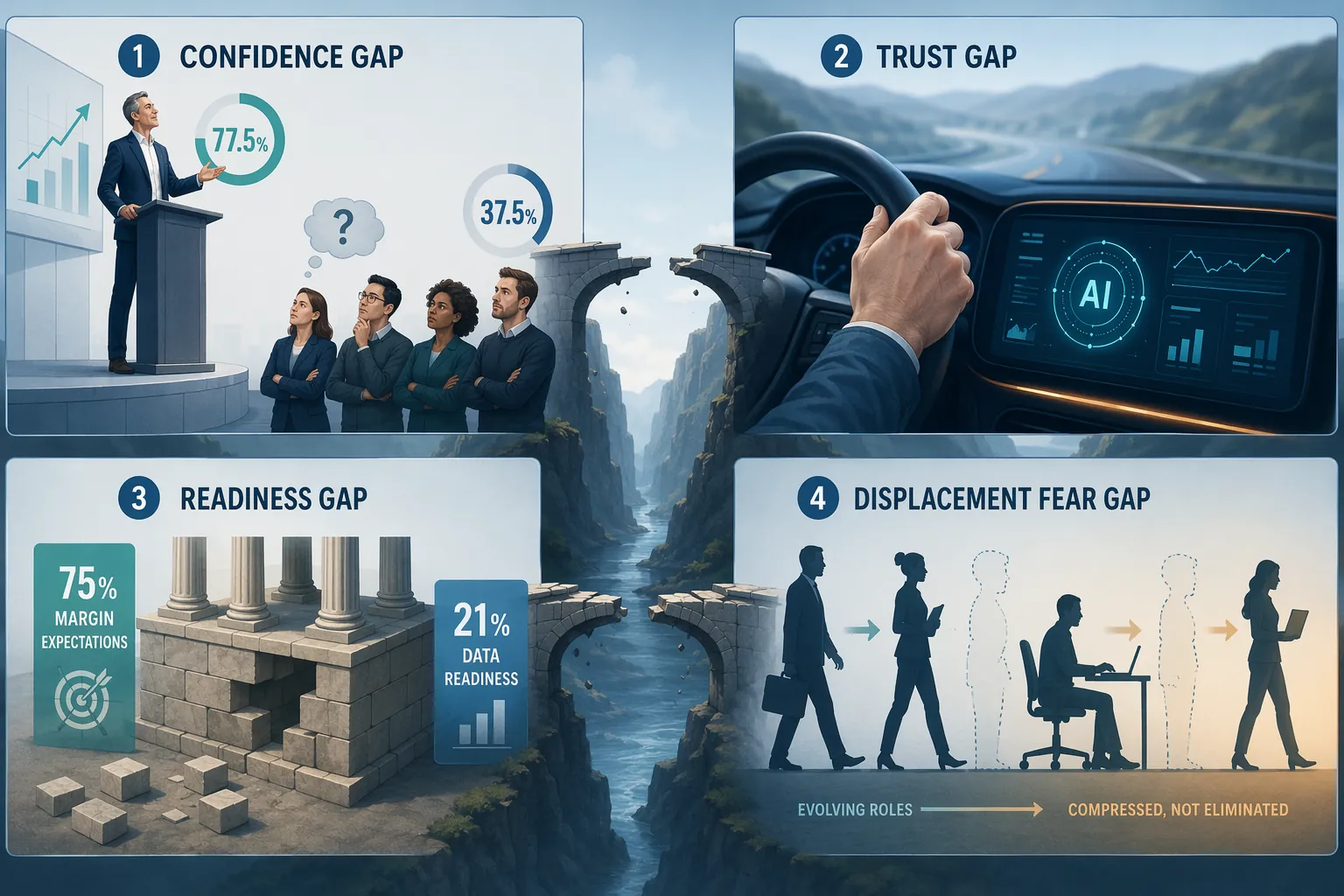
The phrase “AI backlash” is too blunt for what is happening on supply chain floors. In the Loadstar/Raft 2026 survey, 77.5% of vice presidents said they were optimistic about AI, compared with 37.5% of individual contributors. That looks like resistance until the next number lands: only 9% of frontline workers said they felt threatened by AI replacement.[1]
That split matters because it changes the diagnosis. If most frontline workers are not primarily saying “AI will take my job,” then a stalled rollout cannot be explained by fear alone. The harder question is whether the people expected to use the system believe it can survive the handoff from a controlled demo into exception-heavy planning, procurement, transportation, replenishment, and warehouse workflows.
Supply chain AI adoption usually stalls in one of four places. Confidence fails when users do not believe the deployment will work under real operating conditions. Trust fails when decision rights are unclear or autonomy moves faster than accountability. Readiness fails when the data, process, and governance base cannot support the promised value. Displacement fear becomes material when job design, career ladders, and role compression change how people behave around the system.
The Confidence Gap Is About Execution Credibility
Executive optimism is not meaningless. It often reflects a real view from budget meetings, vendor evaluations, and strategic planning: AI can reduce manual analysis, improve forecasts, prioritize exceptions, and surface decisions faster than current planning tools. The Loadstar/Raft split does not say executives are deluded. It says they are judging a different object.
A vice president may see the target operating model. An individual contributor sees the Monday morning queue: missing lead times, stale item attributes, a supplier that changed behavior last quarter, a planner who knows the promotion file is wrong, a freight lane with recurring disruptions, and a dashboard that now adds another recommendation requiring review. The same AI capability can look directionally valuable from one seat and operationally fragile from another.
That is why the 77.5% versus 37.5% gap should not be read as a morale score alone. It is a credibility signal. The workers closest to exceptions are being asked to accept not only a model output, but the surrounding promise that the workflow, master data, escalation path, and accountability model are ready enough to make the output usable.[1]
When confidence is the active gap, more claims about model accuracy usually do little. Users may already believe the model is impressive in the abstract. Their hesitation is about whether the rollout will reduce work or simply relocate it. If recommendations create new checks, new reconciliations, and new explanations to managers when the system is wrong, adoption slows even when the algorithm performs well in test conditions.
The observable symptoms are practical: planners delay using recommendations until they have rebuilt the logic manually; buyers export AI outputs into spreadsheets before acting; coordinators wait for a supervisor’s informal approval; integration teams keep parallel reports alive because nobody is sure which version will be trusted in the service review. None of those behaviors prove anti-AI sentiment. They show that the operating system around the tool has not earned confidence.
Trust Is Not the Same Thing as Confidence
Confidence asks whether the rollout will hold up. Trust asks whether the system should be allowed to act, and under what limits. Those are related, but they leave different evidence.
RELEX reported that 67% of leaders felt more confident in AI-driven decisions, while only 10% trusted AI to act autonomously. A majority, 54%, preferred a human-in-the-loop model.[2] That is not a rejection of AI decision support. It is a boundary on decision rights.
The distinction is especially important in supply chain work because the cost of a decision often lands somewhere else. A replenishment recommendation affects store availability. A sourcing recommendation affects supplier commitments. A transportation exception affects customer service. A forecast change affects production, inventory, and finance. If the system proposes the action but a human owns the miss, users will keep their hands on the steering wheel.
Infios describes trust failure through operational signals rather than attitude labels: override rates that do not decline, persistent manual workarounds, and alert fatigue.[3] Those signals are more useful than asking whether people “trust AI” in general. A planner can trust a system to rank low-risk replenishment exceptions and still refuse to let it autonomously change constrained supply allocations. A buyer can accept supplier-risk scoring and still require human review before a supplier switch.
This is where many rollouts drift. Leaders hear “users do not trust the tool” and respond with training, roadshows, or another accuracy comparison. But if the actual issue is autonomy, the adoption blocker sits in governance: which decisions can be automated, which need approval, which require explanation, which can be reversed, and who is accountable when the system’s recommendation conflicts with local knowledge.
A human-in-the-loop preference is not automatically a failure state. In complex supply chains, it may be the correct design for high-impact decisions. The problem appears when leaders budget for automation economics while the organization has only accepted advisory use. Then the business case assumes labor, cycle-time, or service improvements that the actual decision model cannot deliver.
What Trust Failure Looks Like in the Workflow
| Signal | What it usually means | Wrong response |
|---|---|---|
| Override rates stay high | Users do not accept the recommendation under real constraints, or the model is missing context | Telling teams the model is accurate in aggregate |
| Manual workarounds persist | The official workflow does not support how decisions are actually reviewed or explained | Treating spreadsheet use as simple noncompliance |
| Alert fatigue grows | The system is creating more review burden than decision value | Adding more notifications or broader exception rules |
| Autonomy remains blocked | Decision rights and accountability have not been settled | Assuming executive enthusiasm grants operational permission |
The GEP/UVA Darden finding cited in the same evidence set is a useful warning: fewer than 1 in 10 AI pilots in supply chains have scaled.[3] Pilot failure at that level is not explained by frontline emotion alone. Pilots often run with extra attention, cleaner scope, vendor support, and senior sponsorship. Scaling exposes whether trust rules can survive normal operating volume.
Readiness Is Where the Business Case Often Gets Ahead of the Plant Floor
The readiness gap is less visible during procurement because demos are built to show the destination. Live operations expose the starting point.
TCS/AWS data cited by TraxTech found that 75% of manufacturers expected AI to be a top-three margin driver, but only 21% had the data foundations to deliver.[4] Gartner data cited by Open Sky Group found that only 23% of supply chains had a formal AI strategy.[5] Those two numbers explain a large share of the post-demo stall: organizations are expecting margin impact from systems that depend on foundations many of them have not built.
Data foundations are not a generic IT concern in this context. They decide whether a recommendation can be acted on without rework. If lead times are inconsistent, supplier calendars are not maintained, item-location parameters are stale, units of measure are unreliable, or exception codes do not map cleanly to decisions, AI does not remove the planning burden. It can increase the number of questionable outputs that someone must investigate.
Formal AI strategy matters for the same reason. Without it, teams make local decisions about model use, approval thresholds, exception handling, data ownership, and measurement. One site may treat a recommendation as advisory. Another may treat it as default. Finance may count projected savings before operations has changed decision rights. IT may be asked to integrate workflows before the business has agreed which workflow is being standardized.
This is also where the widely repeated claim that 95% of generative AI projects return zero value should be handled carefully. The figure is frequently attributed to an MIT study, but the original DOI is difficult to verify from the available material. It should not be used as a standalone proof point for supply chain AI failure. The narrower, better-supported point is already strong enough: many organizations are making AI value assumptions while lacking the data foundations and formal strategy needed to realize them.[5]
When readiness is the active gap, buying another platform is rarely the fix. The symptoms are familiar: long integration queues, brittle mappings, disputes over source-of-truth fields, duplicated exception logic, inconsistent user roles, and value tracking that stops at adoption metrics rather than operational outcomes. A model can be capable and still be trapped inside an organization that has not prepared the surrounding system.
Displacement Fear Is Narrower Than the Backlash Story, but It Is Not Imaginary
The Loadstar/Raft finding that only 9% of frontline workers felt threatened by AI replacement should prevent lazy conclusions about a workforce broadly frozen by fear.[1] But it does not make labor concerns irrelevant. Displacement pressure can be concentrated in specific roles, specific career stages, or specific parts of the operating model.
Scope Recruiting identifies inventory clerks, tactical buyers, junior forecasters, and freight coordinators as supply chain roles most exposed to AI replacement or compression, while demand is rising for supply planners, S&OP analysts, and supplier relationship managers.[6] That is not a clean story of elimination. It is a revaluation of work: routine coordination and first-pass analysis become more automatable, while cross-functional judgment, scenario management, and supplier-facing work become more valuable.
The broader labor market signals are mixed and should stay mixed. RationalFX reported 245,000 tech layoffs in 2025, with 28.5% tied to AI. The same CIO report notes that Target cut about 400 supply chain roles.[7] Those cases show that AI-linked restructuring is real, but they do not prove that every supply chain AI program is primarily experienced as a replacement threat.
The more durable adoption issue may be the entry-level pipeline. CIO reported that 76% of HR practitioners worry AI will reduce entry-level hiring, and cited Randstad data showing entry-level hiring had collapsed by 29 percentage points in one year.[7] If junior roles are compressed before organizations redesign how people learn the business, the result is not just a hiring issue. It affects future planners, buyers, analysts, and managers who would normally build judgment by handling the lower-complexity work AI now absorbs.
That pipeline risk can shape behavior even among employees who are not personally afraid of immediate replacement. A junior planner may use the tool while wondering whether it removes the path to becoming a senior planner. A manager may support automation while worrying that the team will lose the training ground for exception judgment. A procurement lead may welcome tactical automation but resist headcount assumptions that leave nobody available to manage supplier escalation.
Udacity data cited by CIO found that only 9% of workers wanted full workforce replacement by AI, and the World Economic Forum projected a net gain of 78 million jobs globally by 2030.[7] Those numbers point away from a simple replacement narrative. They also leave room for a more operational concern: even if the labor market gains jobs overall, specific supply chain roles can still be compressed, redesigned, or made less useful as entry points.
The Damage Comes From Treating the Four Gaps as One Problem
A stalled AI rollout can look the same from a dashboard: low active use, high overrides, delayed decisions, weak realized value, and frustrated sponsors. The cause underneath can be different.
- If confidence is the gap, users doubt the deployment will hold up in real workflows.
- If trust is the gap, users may value the recommendation but reject the proposed autonomy.
- If readiness is the gap, the organization lacks the data, process, or governance foundation to convert AI output into operational value.
- If displacement fear is the gap, adoption behavior is shaped by role compression, career uncertainty, or headcount assumptions.
Conflating them leads to bad interventions. A confidence problem is not solved by repeating that the model performed well in the pilot. A trust problem is not solved by reminding users that executives support AI. A readiness problem is not solved by adding another layer of software. A displacement-fear problem is not solved by insisting workers are irrational when the operating model is visibly changing.
The practical test is to look at the evidence the organization already has. Override rates, exception aging, manual exports, approval bottlenecks, duplicate reporting, integration defects, data-quality disputes, alert closure rates, and role redesign assumptions will usually say more than another sentiment survey. They show where the workflow is refusing the operating model.
If adoption is stalling while the technology appears to work, the next leadership task is not to argue harder for AI. It is to identify which gap is active. Each one leaves different evidence, and each one demands a different response.
References
- AI adoption in supply chains hampered by change management, not technology, The Loadstar
- Supply Chain AI, RELEX Solutions
- AI Fails Without Trust: What Supply Chain Leaders Need to Know, Infios
- The AI Readiness Gap: 75% of Manufacturers Bet on AI, Only 21% Are Prepared, TraxTech
- Supply Chain AI Statistics, Open Sky Group
- Supply Chain Roles Replaced by AI 2026, Scope Recruiting
- Push to replace workers with AI faces backlash, even from management, CIO
§ 42 — Cited evidence
Flag an inaccuracy or submit a comparable account — Contribute or read how claims are verified in Methodology.