
§ 41 — Use-case analysis
Why AI Supply Chain Compliance Needs Audit-Traceability
When an AI tool generates a supply chain emissions figure for CSRD filing, can an auditor trace it to its source? This analysis compares purpose-built compliance platforms with general-purpose LLMs to show why audit-trail architecture, not speed or feature breadth, determines whether an AI output creates regulatory liability or passes limited-assurance scrutiny.
- Function
- supply chain compliance
- AI technique
- generative AI
- Failure pattern
- audit-traceability gap
- Evidence source
- Watershed 2026 analysis, IntegrityNext 2026 report
The uncomfortable moment in AI for EU sustainability reporting supply chain compliance comes after the emissions number appears. Someone asks where it came from.
For a CSRD filing, that question is not administrative housekeeping. CSRD requires reported sustainability information to undergo third-party limited assurance, so the buyer of an AI compliance tool has to assume that a future auditor will walk backward from the disclosed figure to the source documents, emission factors, assumptions, gap-fill methods, and approvals behind it.[1] A number generated quickly is useful only if that backward path still exists.
That distinction matters more in 2026 because many companies are trying to operationalize reporting under shifting rules. Wave 2 companies were expected to file first CSRD reports in 2026 for FY2025 under thresholds described as 250+ employees, €50M+ revenue, and €25M+ balance sheet in one 2026 timeline source.[2] At the same time, a post-Omnibus I provisional deal described in late-2025/2026 commentary raised proposed thresholds to 1,000 employees and €450M turnover, with formal adoption and national implementation still creating uncertainty.[3] The practical effect is messy: some companies are in scope now, some are watching scope change, and many still need defensible supplier evidence because customers, lenders, and regulators are not waiting for every legal detail to feel tidy.
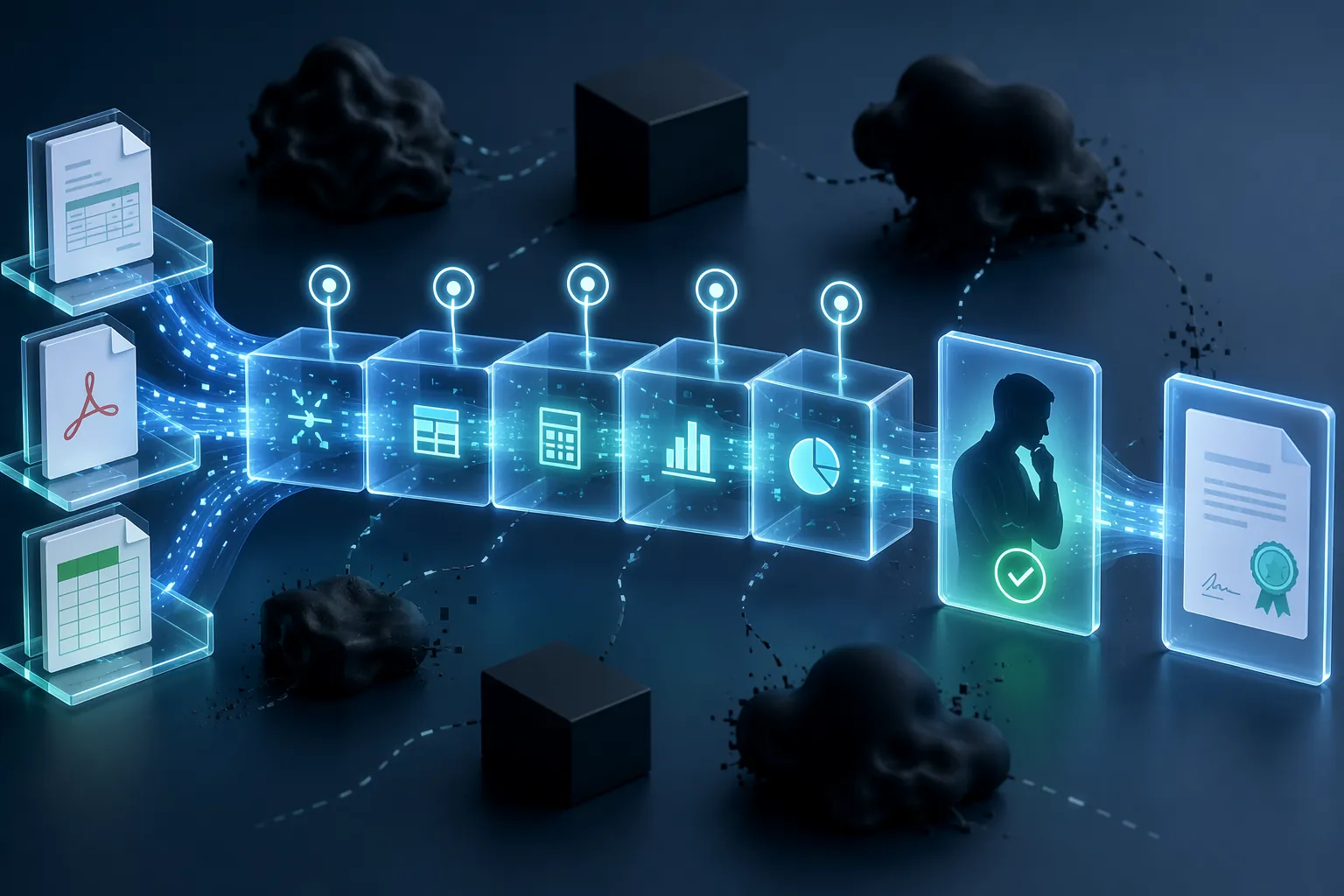
The Traceability Test Starts With One Number
Take a single AI-generated supply chain emissions figure intended for a CSRD report. Before anyone asks whether the interface is elegant or the assistant can answer questions in natural language, ask whether the tool can reconstruct the figure in a way a reviewer can challenge.
- Which supplier files, invoices, spend records, activity data, or questionnaires fed the calculation?
- Which fields were extracted from those sources, and were any extracted by OCR from PDFs or emails?
- Which emission factors were applied, and what version or source did the system use?
- Where primary supplier data was missing, did the tool use spend-based estimates, averages, proxies, or another gap-fill method?
- Who reviewed the exception, approved the method, or changed the assumption before the output entered the reporting record?
If the system cannot answer those questions at the level of an individual output, it has not solved the compliance problem. It may have produced a plausible number. It may even have saved time. But the liability sits with the organization that reports the figure, not with the chatbot that wrote the explanation.
This is where AI sustainability tools separate into two very different categories. One category uses AI to reduce drudgery while preserving a calculation record. The other uses AI to generate, summarize, or infer compliance assertions while leaving reviewers with a polished answer and a broken trail.
What AI Can Safely Remove From The Work
There is plenty of legitimate work for AI in sustainability reporting. Supplier evidence arrives as spreadsheets, PDFs, portal exports, questionnaires, certificates, and inconsistent local formats. Procurement teams spend months chasing files, renaming columns, checking duplicates, and asking suppliers to resubmit documents that were never machine-readable in the first place.
Watershed reports customer outcomes that show why buyers are interested: Smiths Group reportedly saved about 12 weeks per year on data management using Watershed AI agents, Harris Farm Markets reportedly completed emissions measurement 6x faster, and Watershed says customers using its PDF scanner saw an 80–90% reduction in data ingestion time with 95%+ extraction accuracy.[1] Those are vendor-reported figures, not independently audited benchmarks, but they describe a real pain point. Manual ingestion is a poor use of scarce sustainability and procurement capacity.
The useful question is not whether AI should touch supplier data. It should. The question is whether the tool treats extraction, normalization, estimation, and reporting as logged events rather than as invisible model behavior. OCR that pulls activity data from a supplier PDF can be valuable. OCR that cannot show the original document, extracted field, confidence issue, correction, and downstream calculation is just faster uncertainty.
Where The Audit Trail Breaks
Watershed’s 2026 analysis warns that general-purpose AI used for sustainability reporting can hallucinate emissions factors, silently fill data gaps, and break audit trails.[1] That evidence should be read carefully: it is Watershed’s own vendor framing, not an independent audit of every general-purpose LLM or ERP AI feature. Still, the failure modes are credible enough to be useful because they map directly to assurance risk.
| AI output problem | Why it matters under assurance |
|---|---|
| Hallucinated or unsupported emission factor | The reviewer cannot verify why that factor was selected or whether it was valid for the activity, geography, or reporting period. |
| Silent gap-fill | A reported number may mix primary data and proxy estimates without disclosing where judgment entered the calculation. |
| Summarized supplier evidence | The model may produce a confident compliance assertion while losing the document-level support needed for review. |
| No versioned calculation history | A changed assumption can alter the output without preserving what was reported, corrected, or approved. |
A thin AI wrapper on top of an ERP module can create the same problem. If it reads procurement data, applies an undisclosed mapping, produces a sustainability claim, and stores only the final answer, the buyer has gained convenience at the wrong layer. The issue is not that ERP systems are useless or that LLMs are inherently unsuitable. The issue is whether the architecture preserves source-to-output lineage.
That lineage has to survive ordinary business events: supplier corrections, late invoices, emission factor updates, methodology changes, entity restructuring, and auditor sampling. If the tool cannot show what changed and why, the team defending the filing is forced into reconstruction. Reconstruction is where a “fast” implementation becomes slow.
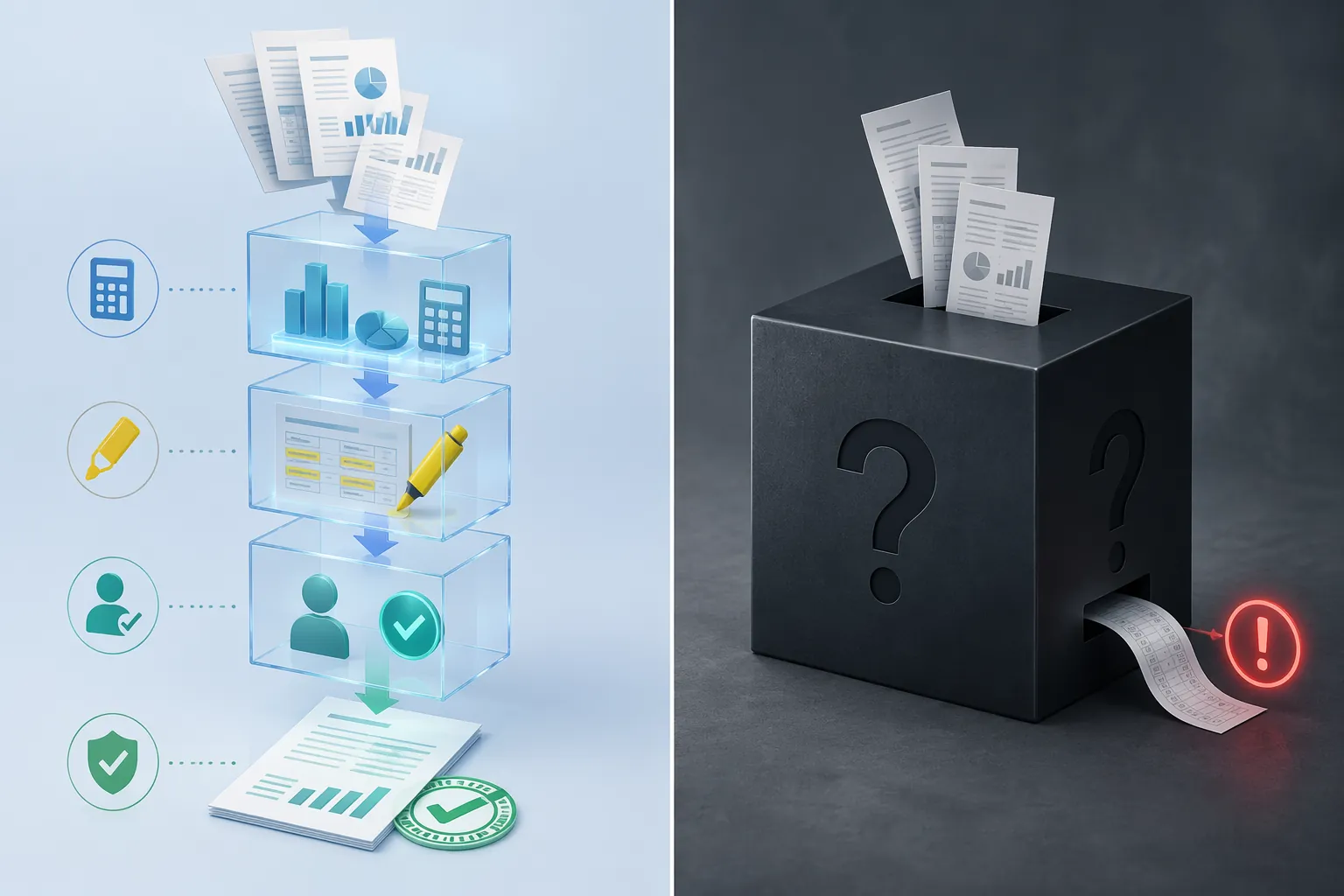
Purpose-Built Does Not Mean Magic
Purpose-built sustainability platforms deserve attention when they are built around the reporting record rather than the chat interface. In this context, “purpose-built” should not mean a vendor has renamed a chatbot as an ESG copilot. It means the system has explicit places for source files, data models, calculation methods, emission factor libraries, workflow approvals, exception flags, and regulatory mappings.
IntegrityNext’s 2026 analysis makes a useful point here: AI readiness in supply chain sustainability depends on harmonized primary data, regulatory logic, and expert methodology translation, not model sophistication alone.[4] That is the right emphasis. A model that can produce elegant prose cannot compensate for inconsistent supplier identifiers, missing product-level activity data, or a methodology that exists only in an ungoverned exchange.
Watershed, IntegrityNext, and Dcycle should therefore be evaluated less as “AI platforms” and more as audit-trail systems with AI embedded in selected steps. The relevant mechanisms are practical: logged calculation lineage, explicit gap-fill methodology, harmonized primary supplier data, regulatory logic that reflects CSRD and related requirements, expert translation of accounting methods into software rules, and human-in-the-loop checkpoints when the system is about to turn an estimate into a reportable assertion.
Human-in-the-loop is often used as a decorative phrase. In compliance software it has a narrower meaning. The system should force review at decision boundaries: when primary data is unavailable, when a supplier submission conflicts with past data, when a factor changes, when a proxy is selected, or when a disclosure-ready output is generated. A human does not need to retype every line item. A human does need to own the judgment the system cannot safely bury.
CSDDD Raises The Cost Of Weak Evidence
CSRD creates the reporting and assurance pressure. CSDDD sharpens the evidence problem because supply chain due diligence is not just about measuring emissions; it is about showing what the company knew, how it assessed risk, what actions it took, and how it followed up. An AI-generated supplier-risk statement that cannot be tied to underlying evidence is not a governance improvement. It is a discoverability problem waiting for a dispute.
This is also where overbroad AI claims become actively unhelpful. A tool that says it can “automate CSDDD compliance” should be pressed on what it stores as evidence: supplier records, risk-screening inputs, adverse media sources where applicable, remediation actions, approvals, escalation history, and changes over time. The compliance output is only as defensible as the record behind it.
The same procurement discipline used in other regulated AI-buying contexts applies here. ChainSignal’s supply chain AI vendor evaluation checklist is useful because it keeps buyers focused on integration, transparency, and ROI verification rather than demos alone. For sustainability compliance, transparency needs to be interpreted very literally: can the buyer inspect the path from source to claim?
Why Production Governance Is Still Rare
The shortage of mature implementations is not surprising. Oliver Wyman and Prequel Ventures report that only about 15% of companies have fully industrialized AI across supply chain functions.[5] Sustainability reporting is harder than many supply chain AI use cases because the output eventually leaves the planning dashboard and enters an assurance file, customer disclosure, or legal record.
That industrialization gap explains why pilots often feel more impressive than production systems. A prototype can summarize supplier documents, classify risks, or estimate emissions from partial records. A production compliance system has to manage permissions, versioning, evidence retention, exception workflows, methodology updates, and audit sampling. ChainSignal’s AI bot adoption reality check makes a similar point for supply chain bots more broadly: adoption intent does not equal production readiness.
The software market context adds noise. Watershed cites MarketsandMarkets projections that the ESG reporting software market will grow from $1.31B in 2026 to $2.93B by 2031 at a 17.4% CAGR.[1] That explains why buyers are seeing more “AI-powered” claims. It does not prove those claims are audit-ready. A growing market attracts serious engineering and opportunistic labeling at the same time.
Vendor Questions That Expose The Architecture
A sustainability AI demo should include a reverse walk from a final output. Pick one supplier emissions figure, one supplier-risk assertion, or one disclosure metric and ask the vendor to trace it backward without switching to a slide about product vision.
- Show the original source documents and the extracted fields used in this output.
- Show which emission factors, databases, or methodology rules were applied, including version history.
- Show every place where missing data was estimated, averaged, proxied, or gap-filled.
- Show who approved the assumption, when they approved it, and what alternatives were available.
- Show what happens if the supplier later corrects the source file or submits primary data after an estimate was used.
- Show the export an auditor receives, not only the dashboard the executive sees.
The vendor’s answer should be observable in the product. If the response depends on professional services manually reconstructing lineage after the fact, that is not the same as having an audit trail. If the system can only explain the current value but cannot show previous values, corrections, and approvals, the buyer should treat the output as operationally useful but not yet assurance-ready.
Buyers should also separate three claims that vendors often blend together.
| Vendor claim | What to verify |
|---|---|
| “We automate emissions measurement” | Which parts are automated: ingestion, mapping, calculation, estimation, review, or reporting? |
| “We use AI agents” | What decisions can the agent make, what decisions require approval, and how are both logged? |
| “We are CSRD-ready” | Can the system produce an assurance file that links each reported value to sources, methods, assumptions, and approvals? |
| “We integrate with ERP and procurement systems” | Does the integration preserve supplier identifiers, document lineage, and change history, or only import summarized fields? |
This is not a request for vendors to slow everything down. It is a request to put speed in the right place. Automate the collection. Automate the extraction. Automate the normalization. Flag the exceptions. Draft the explanation. But preserve the evidence path and make approval explicit before the number becomes part of a CSRD or CSDDD record.
The Buying Standard
For EU sustainability reporting, the decisive procurement question is not whether the AI can produce a supply chain emissions number faster. It is whether every step behind that number can be reconstructed, challenged, corrected, and approved before it is reported.
That standard favors systems designed around audit-trail architecture: calculation lineage, explicit gap-fill logic, harmonized primary data, regulatory methodology, version history, and human review at decision points. It does not rule out LLMs, ERP AI, or agents. It confines them to roles where their outputs remain tied to source evidence and accountable workflow.
When a vendor cannot demonstrate that path, the buyer has learned enough. The tool may still help the team work faster. It should not be trusted as the system of record for a limited-assurance sustainability disclosure.
References
- Sustainability AI in 2026: what works, what doesn't, and why the difference matters, Watershed
- CSRD Compliance Timeline 2026, Socious
- ESG Outlook 2026, Dydon AI
- AI in Supply Chain Sustainability: Building Data Foundations for 2026, IntegrityNext
- EU Supply Chain Tech Report 2026: AI And Startup Impact, Oliver Wyman / Prequel Ventures
§ 42 — Cited evidence
Flag an inaccuracy or submit a comparable account — Contribute or read how claims are verified in Methodology.