
§ 41 — Use-case analysis
What AI Deployments in African Solar Supply Chains Cost
This article examines six documented AI deployments in African solar energy supply chains, detailing the cost impacts, failure modes, and the notable absence of enterprise SCP vendors. Readers will learn which deployment patterns deliver savings and which barriers remain unresolved.
- Function
- demand-forecasting
- AI technique
- forecasting
- Failure pattern
- data quality
- Evidence source
- Atlas AI / Engie Energy Access
The most useful clue in the public record on AI cost in African solar energy supply chains is not a familiar enterprise software logo. It is the absence of one. Across six documented African solar and solar-adjacent AI deployments, the visible systems are startup-built, project-specific, or specialized platforms. They are not o9, Blue Yonder, Kinaxis, RELEX, or Anaplan.
That is not a victory lap for startups, and it is not proof that large supply-chain planning vendors have no private deployments in African energy. Public-source absence has limits. But it is too consistent to ignore. The deployments that show up are not trying to replicate a Western enterprise planning stack and then extend it into the field. They start closer to the physical constraint: a sales agent deciding where to go next, a minigrid balancing load, a battery losing capacity, a cold-chain route wasting food, or a distributed network needing cleaner coordination.

The Deployment Evidence
The six cases do not measure the same kind of cost. That matters. A demand-targeting model can lower customer acquisition waste without touching maintenance. A battery-health model can reduce downtime without proving anything about sales. A routing model can protect value in a solar-enabled cold chain while saying little about generation economics. Treating all of this as one clean AI ROI bucket would flatten the part that is actually informative.
| Deployment | Market scope stated in source | AI function | Reported cost or reliability impact | Caveat |
|---|---|---|---|---|
| Atlas AI / Engie Energy Access | Kenya, Coast region | Machine-learning customer targeting for off-grid solar appliance sales | Reported 48% increase in monthly solar appliance sales in a field-validated 2023-2024 case study [1] | Sales lift is commercially legible, but the public case should still be read as reported outcome rather than an independently audited savings figure |
| OrxaGrid | Uganda | IoT sensors and edge-computing ML for solar performance degradation detection | Detects degradation weeks before critical failures and is described as reducing O&M costs for renewable energy producers [2] | The source describes reliability and O&M benefits but does not provide a public percentage cost reduction |
| enee.io | Nigeria | AI-driven battery State of Health and load profiling | Provides battery capacity and load insights intended to minimize system downtime and reduce operational costs [2] | Useful because battery degradation is a real operating cost; public evidence is directional rather than a quantified counterfactual |
| Hubl Logistics | Malawi | IoT-monitored passively cooled pods feeding AI route optimization | Uses accumulated cooling and route data to reduce food waste across fragmented rural distribution networks [2] | Solar is an enabling infrastructure layer for cold-chain logistics, so the cost impact is distribution waste rather than pure solar asset O&M |
| Husk Power | Nigeria and India | AI demand prediction and generating-asset optimization at 30-minute intervals | As announced in November 2025, the platform optimizes distributed energy resource operations and the company said it served 2.2 million people across India and Nigeria [3] | Date-sensitive as of Q3 2026; announced financing and 2030 capacity targets should not be treated as completed outcomes |
| NeedEnergy | Zimbabwe | AI-powered energy tracking, network management, and peer-to-peer trading | Backed as part of a €4M EU-AFD Digital Energy programme involving I&P and Gaia Impact Fund [4] | Funding and platform scope are documented; public evidence does not quantify realized operating-cost savings |
The strongest single cost claim is the Atlas AI / Engie Energy Access result: a reported 48% increase in monthly solar appliance sales in Kenya’s Coast region after using predictive analytics to target customers more effectively [1]. That is not a vague “AI improved performance” statement. It connects a model to a selling motion: which households or communities are more likely to convert, where sales effort should be concentrated, and how a field organization spends scarce time.
For a solar distributor, that kind of gain affects cost even when it is presented as revenue growth. Field sales visits, agent time, stock positioning, financing conversations, and after-sales service all become more expensive when the target list is weak. A better demand signal does not make panels cheaper. It can make the route to a paying, supportable customer less wasteful.
Cost Means Different Things Once the System Leaves the Slide Deck
The cases fall into a rough operating map, but not a tidy maturity model. One end is commercial demand: find customers who can be reached, financed, installed, and serviced. Another is asset reliability: detect degradation before failure, profile battery health, and balance generation against load. A third is network coordination: route goods, manage energy flows, track distributed assets, and enable trading.
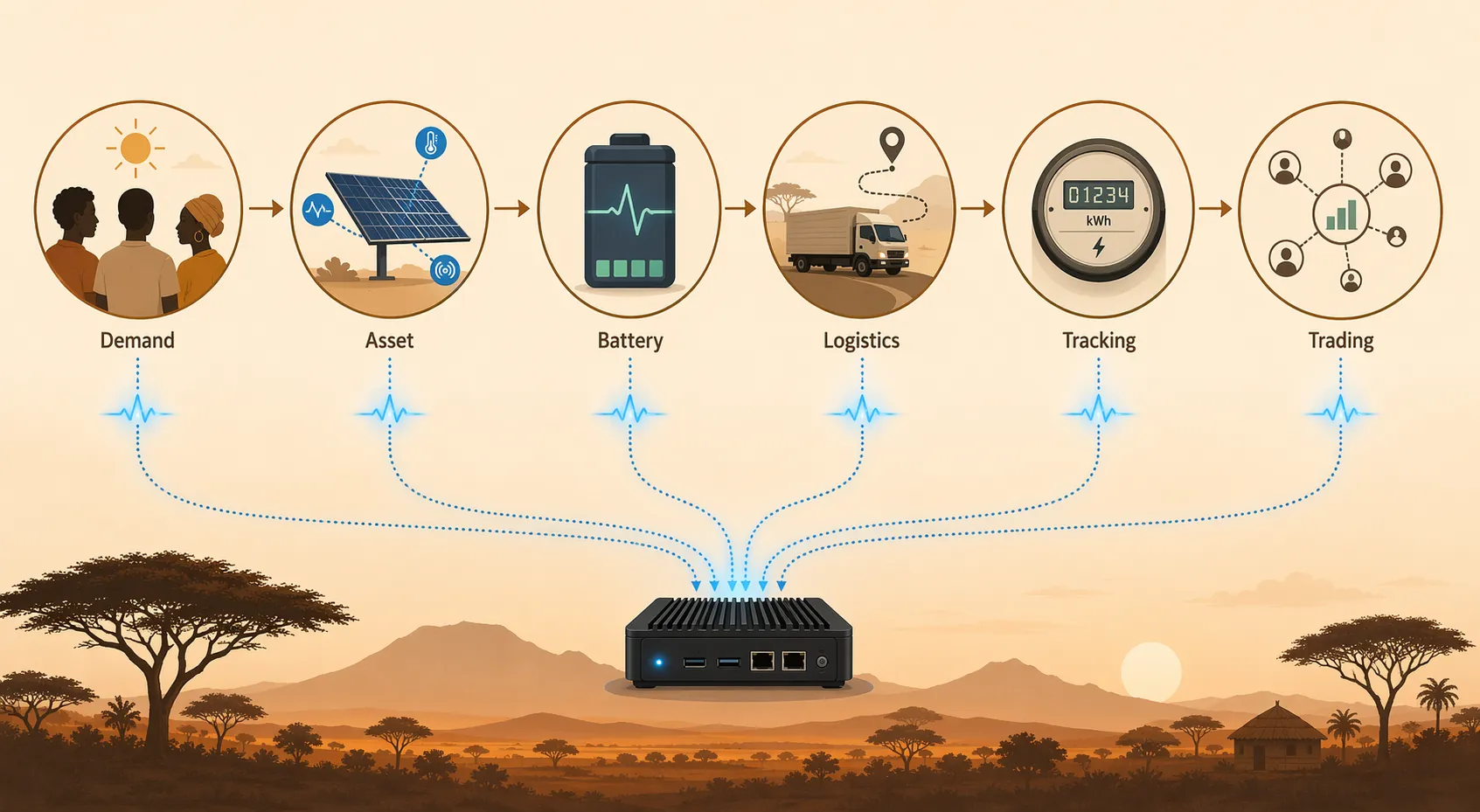
Atlas AI belongs to the demand side. It is useful because it makes the customer-acquisition problem measurable. Off-grid and distributed solar operators do not only need a technical installation plan; they need to know where demand, ability to pay, appliance need, and service feasibility overlap. A customer target that looks good in a national spreadsheet can still be expensive if the household is difficult to reach, the local agent network is thin, or repayment support is weak.
OrxaGrid and enee.io sit closer to the maintenance ledger. OrxaGrid’s public description is especially relevant because it combines IoT sensors with edge-computing ML to detect solar performance degradation weeks before critical failures [2]. That phrase, “weeks before,” is the part worth underlining. Earlier detection changes the maintenance sequence. A technician can be scheduled before the equipment fails. Spare parts can be positioned with more warning. A site can avoid a longer outage that would otherwise ripple into service-level failures and customer dissatisfaction.
enee.io addresses a quieter but stubborn cost center: batteries. Its AI-driven State of Health system provides battery capacity and load profiling insights intended to minimize downtime and reduce operating costs in Nigeria [2]. Public summaries do not give a percentage saving, so the claim should stay narrow. Still, battery health is not a side issue in distributed solar. A degraded battery can turn an otherwise functional installation into a reliability complaint, a truck roll, a replacement-capex decision, or a financing dispute.
Husk Power widens the lens from component health to site-level operation. In its November 2025 announcement, Husk said its AI-enabled distributed energy resources platform predicts energy demand at each minigrid site and optimizes generating asset operations at 30-minute intervals [3]. That is the kind of operating cadence that makes AI more than a dashboard if the controls are actually used. Forecasting demand every half hour matters because overgeneration wastes asset potential and undergeneration breaks trust with customers.
The guardrail is timing. Husk also said it served 2.2 million people across India and Nigeria and referenced a financing path toward a $400 million Series E tied to a 2 GW target by 2030 [3]. Those are company-reported claims from late 2025, not confirmed Q3 2026 operating results. They show ambition and architecture. They do not, by themselves, prove that the projected scale has been achieved.
Hubl Logistics is the odd case only if solar is defined too narrowly. Its CoolRun system uses IoT-monitored passively cooled pods, with accumulated data feeding AI route-optimization algorithms to reduce food waste across fragmented rural distribution networks in Malawi [2]. The cost object here is not panel maintenance or inverter uptime. It is spoilage and distribution inefficiency in a cold chain that depends on decentralized energy and thermal performance. That still belongs in the solar supply-chain conversation because energy reliability is what allows the logistics service to exist.
NeedEnergy moves toward coordination across the network. Impact Investor reported in April 2025 that I&P invested in the Zimbabwean AI-driven smart energy startup as part of a €4 million EU-AFD Digital Energy programme with Gaia Impact Fund [4]. The documented function set is energy tracking, network management, and peer-to-peer trading [4]. The public record supports a platform-scope and funding claim; it does not support a hard savings claim. That distinction is important because trading and tracking platforms can look transformational in architecture diagrams before they have enough liquidity, metering quality, and participant trust to change operating cost.
The Pattern Is Specialized, Not Suite-Led
What connects these cases is not a common vendor category. It is the decision to put the model near a specific operating bottleneck. Atlas AI improves targeting before the sale. OrxaGrid watches degradation before failure. enee.io reads battery health before downtime becomes the only signal anyone trusts. Husk Power adjusts generation operations on a short interval. Hubl Logistics uses field data to route perishable goods through fragmented rural networks. NeedEnergy aims at tracking, network management, and trading.
That shape is very different from the standard enterprise SCP buying motion. In a mature retail or manufacturing planning environment, the evaluation often starts with demand planning, inventory optimization, S&OP, scenario planning, and ERP integration. The assumption is that the company already has relatively stable master data, workable connectivity, established transaction history, and a budget model that can absorb license and integration cost before field savings arrive.
Many African solar deployments start with a harsher question: what signal can be trusted enough to act on this week? If sensor readings are intermittent, if customer data is sparse, if a battery’s real capacity is drifting, or if a rural route changes because road and demand conditions are unstable, a planning model sitting far from operations may be too late or too clean. The useful AI is often the one that narrows the next physical decision.
This helps explain why the visible vendor landscape is fragmented. The documented systems are not general-purpose supply-chain suites with an African solar module attached. They are narrower tools built around energy access, minigrids, battery diagnostics, routing, or distributed energy coordination. That fragmentation creates integration headaches, but it also shows why the deployments have traction: the tool is close to the cost it is supposed to change.
Where the Savings Claims Still Need a Pencil Beside Them
The public evidence is strong enough to reject the idea that AI in African solar supply chains is only theoretical. It is not strong enough to treat every savings claim as audited. The difference matters for buyers building an investment case.
The Atlas AI / Engie result is the most quantified case, with the reported 48% increase in monthly solar appliance sales in Kenya’s Coast region [1]. Even there, the buyer should ask what baseline was used, how long the comparison period lasted, whether sales quality held up after installation, and whether the lift persisted outside the region studied. Those questions do not make the result weak. They make it usable.
For OrxaGrid and enee.io, the public claims are more operational than financial. Detecting degradation weeks before failure and profiling battery health are exactly the right mechanisms for reducing O&M cost and downtime [2]. But the public summaries do not give enough information to calculate avoided truck rolls, deferred replacement cost, or customer-retention effect. A buyer can still value the mechanism; they should not invent a percentage saving to make the business case look finished.
Husk Power has the most expansive strategic framing. A platform that predicts demand and optimizes generating assets at 30-minute intervals could reduce waste, improve asset utilization, and support growth across minigrids [3]. It also sits close to the emerging idea of more autonomous operational systems, the kind discussed in agentic AI supply-chain work. But public material available here is an announcement, not a post-implementation audit. For teams comparing this with broader automation patterns, the useful parallel is agentic AI in supply chains: short-cycle sensing, decisioning, and adjustment only become valuable when the system is trusted enough to alter operations.
NeedEnergy is a reminder that funding and platform scope are not the same as demonstrated savings. The €4 million EU-AFD Digital Energy programme backing gives the company credibility and runway [4]. It does not tell a procurement team how much network-management cost has fallen or whether peer-to-peer trading has reached enough density to change economics at scale.
The Failure Modes Are Operational, Not Cosmetic
The recurring constraints in these deployments are not the usual harmless footnotes about change management. They sit inside the operating model.
- Data quality: customer, load, asset, and battery data may be thin, noisy, delayed, or collected for a different purpose than the model needs.
- Connectivity: systems that depend on continuous cloud access can struggle when sites, routes, or devices operate with weak or intermittent networks.
- Financing: even a technically good intervention can fail to scale if operators cannot fund hardware, integration, field service, or customer repayment support.
- Attribution: reported savings are hard to isolate when baselines are incomplete, demand is changing, and deployments are embedded in broader commercial programs.
These problems are often blurred together under “implementation risk,” but they require different responses. Bad data needs instrumentation, cleaning, and sometimes a narrower model. Weak connectivity pushes more logic toward the edge or demands offline-tolerant workflows. Financing constraints change vendor pricing, hardware choices, and rollout sequencing. Attribution problems require better baselines before the case study is written, not after the procurement committee asks for proof.
That is why the enterprise-suite absence is not merely a branding detail. A cloud-heavy planning system designed around stable enterprise data may still be useful, especially for larger solar developers or diversified energy operators. But it is not automatically the system of record for a minigrid, a solar home-system sales force, a battery-health workflow, or a rural cold-chain route. The planning layer has to survive contact with devices, technicians, repayment behavior, and weather-exposed assets.
What Enterprise Buyers Should Take From the Absence
The practical lesson is not to avoid established SCP vendors. It is also not to assume startups always win. The lesson is that platform fit in African solar has to be tested against edge operation, intermittent connectivity, uneven data, and financing models before anyone imports a case study from a Western retail or manufacturing deployment.
A buyer evaluating AI for this environment should ask where the model acts. If it acts only at monthly planning cadence, it may miss the degradation signal, route exception, load swing, or customer-prioritization decision that actually drives cost. If it acts near the edge but cannot integrate with finance, inventory, field service, or customer systems, it may become another isolated operations tool. The valuable architecture is not necessarily the biggest one. It is the one that connects the physical bottleneck to a decision someone can fund, execute, and verify.
The six documented deployments show AI already reducing waste, improving reliability, and sharpening commercial execution in African solar supply chains. They also show a market that is specialized and locally adapted rather than enterprise-suite-led. Public sources do not prove that o9, Blue Yonder, Kinaxis, RELEX, or Anaplan are absent from every African solar operator. They do make the absence visible enough to treat it as a material pattern. Any buyer assuming their existing planning stack will fit this market should investigate that assumption before the ROI deck reaches the field.
References
- Case Study: Using Predictive Analytics to Promote Off-Grid Solar Connectivity in Kenya, Atlas AI, field-validated 2023-2024.
- Unlocking off-grid potential: how AI is powering smarter energy solutions across Africa, Energy Catalyst / UKRI, July 2025.
- Husk launches AI-enabled Distributed Energy Resources (DER) Platform Dedicated to Powering Prosperity for 30 Million in the Global South, Husk Power Systems, November 2025.
- I&P invests in African AI-driven smart energy start-up, Impact Investor, April 2025.
§ 42 — Cited evidence
Flag an inaccuracy or submit a comparable account — Contribute or read how claims are verified in Methodology.