
Vendor Move
What Kenmore Air's New CEO Signals for Logistics
Evidence readout
- Vendor
- Kenmore Air
- Event Type
- leadership change
- Event Date
- 2026-07
- Source
- Kenmore Air press release
This article examines what Andrew Bonney's appointment as CEO of Kenmore Air signals for the carrier's logistics, fleet utilization, and cost control strategy, drawing on his COO tenure at Cape Air and current industry pressures.
Kenmore Air’s July 2026 decision to name Andrew Bonney as CEO is easiest to misread if it is treated as a standard leadership announcement. The useful fact is the sequence. In April 2026, Kenmore posted a CEO role that emphasized safety, service, memorable customer experiences, and stronger operational excellence; in July, the company announced Bonney’s appointment, effective September 1, 2026; and the hire makes him the first fully external, non-family CEO in Kenmore Air’s 80-year history, now under Seattle Hospitality Group ownership.[1]
That makes the central logistics question less about personality and more about fit. Why would a seaplane carrier with a maintenance-heavy business choose a Cape Air operations executive rather than a growth marketer, a hospitality-first leader, or a route-expansion specialist?
The answer is not that Bonney has already changed Kenmore’s logistics. He has not started yet. The answer is that the board selected a leader whose public record points toward fleet availability, operating discipline, and cost control as the work that matters next.
The Cape Air signal is operational volume, not résumé polish
Bonney’s most relevant credential is not that he has an Ivy League degree or a polished executive profile. It is that he spent about 18 years at Cape Air and, as chief operating officer, was publicly described as responsible for the “safe, reliable and efficient operation” of an airline operating roughly 75,000 flights per year across small communities.[2]
Seventy-five thousand annual flights is not a vanity number. It means dispatch decisions made over and over again in weather, crew, maintenance, and customer-service conditions that rarely line up cleanly. It means aircraft that need to be in the right place after a disruption, pilots who time out, passengers who still expect the trip to happen, and local stations that cannot absorb endless complexity just because headquarters has a plan.
Cape Air is not Kenmore Air. The aircraft, operating environments, and network shape are different. But the management problem rhymes: keep many small flights dependable without the redundancy or margin that larger carriers can hide behind. A leader who has had to make that kind of system work at Cape Air arrives with a more relevant operating background than someone whose main claim is brand growth.
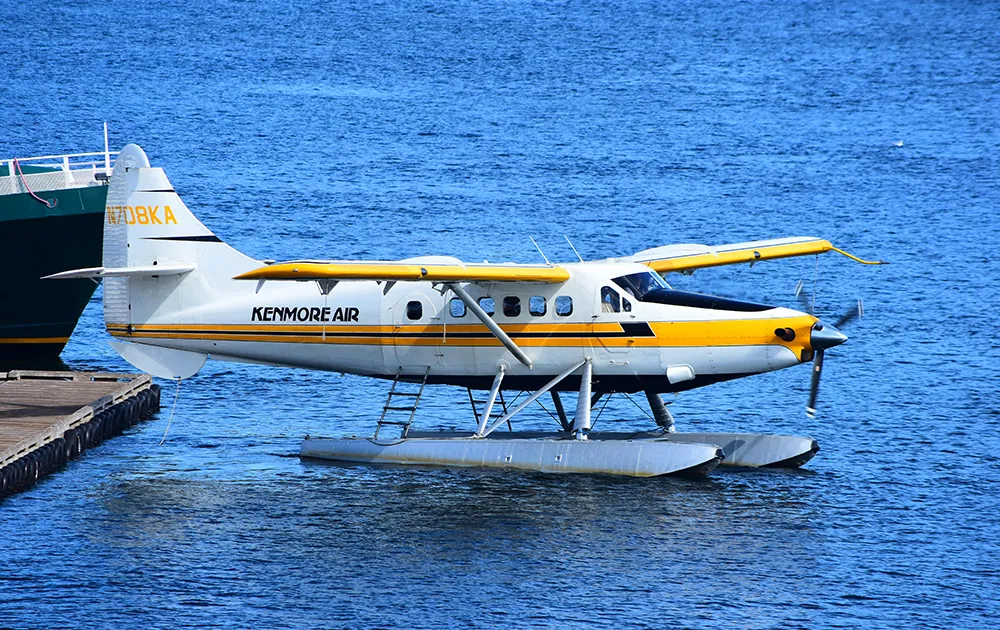
Kenmore’s operation is smaller on paper, but it is more specialized in ways that matter. Public fleet information lists 25 aircraft, including de Havilland Beavers, Otters, and Cessna Caravans; the company has 52 pilots and more than 250 staff during peak season.[3] That size is deceptive. A 25-aircraft fleet can be harder to protect than a larger standardized fleet if the airplanes are older, seasonal demand is concentrated, and maintenance capability is part of the business model rather than a back-office function.
This is where Bonney’s Cape Air experience becomes more than a line in a biography. Kenmore does not simply need someone who understands passenger service. It needs someone who can see the operating chain from aircraft readiness to crew coverage to schedule reliability to customer consequences. In a small aviation business, those are not separate departments. A weak link in one becomes a visible failure in another.
Kenmore’s logistics problem sits inside the aircraft
The hardest part of Kenmore Air’s logistics story is not only moving people between Seattle, the San Juans, British Columbia, and other seaplane markets. It is keeping specialty aircraft available in the first place.
Kenmore’s de Havilland Beaver and Otter work is tied to airframes that are no longer in production. The Beaver went out of production in 1967, and the Otter in the 1980s.[4] That changes the supply-chain problem. The question is not simply whether a part can be ordered. It is whether the company can source, repair, fabricate, certify, schedule, and install what the aircraft needs quickly enough to keep the revenue operation intact.
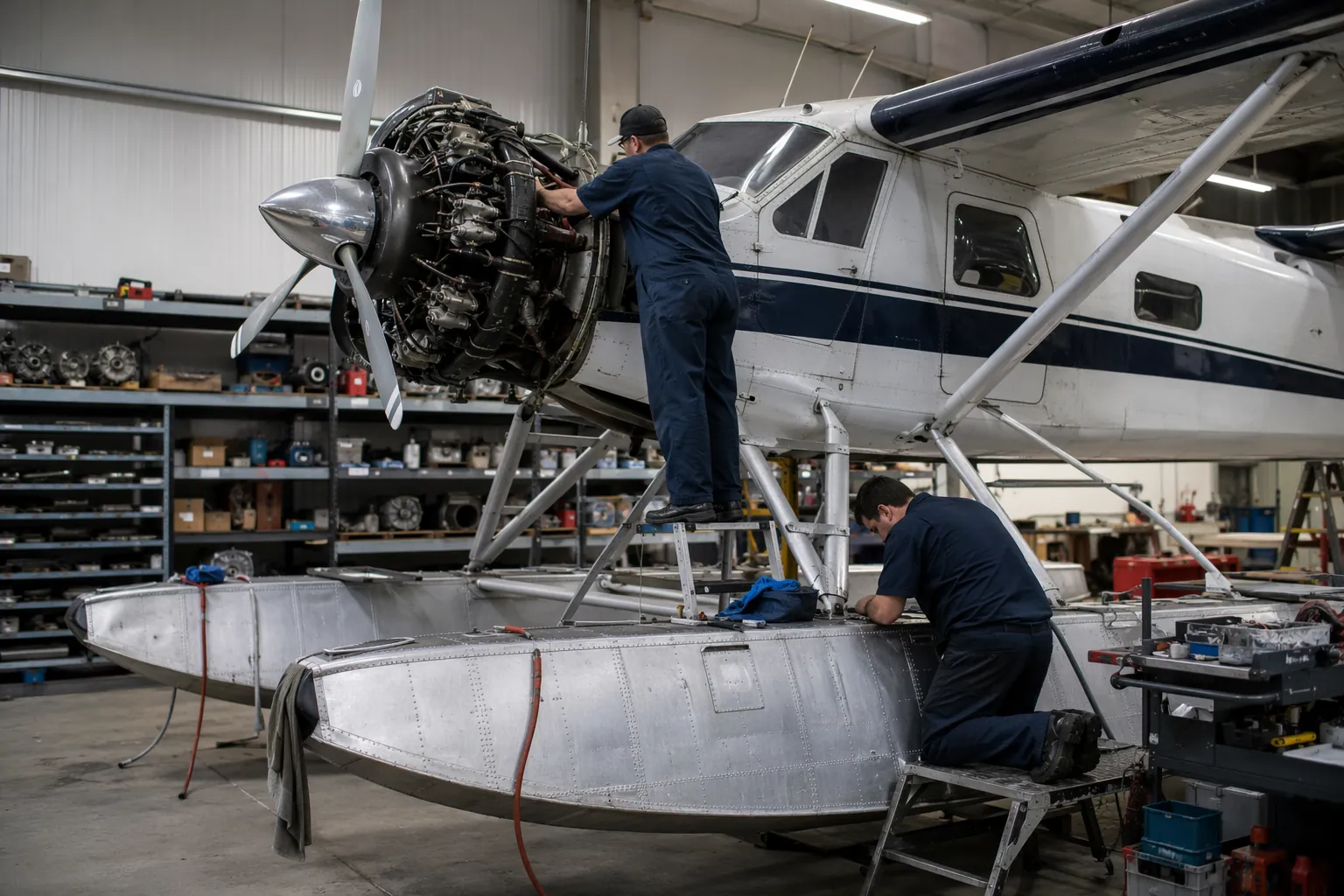
Kenmore’s own history and parts materials describe a business that extends well beyond passenger flying. The company has rebuilt more than 125 Beavers, known as “Kenmore Beavers,” and fabricates FAA-certified replacement parts for the de Havilland Beaver and Otter community.[4][5] That is not a decorative side business. It is a logistics capability sitting next to the flight schedule.
For an operator like this, maintenance is not merely a cost center to be squeezed. It is capacity. A shop decision can determine whether an aircraft returns to service before the next weather window. A parts decision can affect both Kenmore’s own fleet and outside customers relying on its MRO and fabrication capability. A staffing decision in peak season can ripple into dispatch, maintenance planning, and customer recovery.
| Operating pressure | Why it matters for Kenmore |
|---|---|
| Out-of-production aircraft | Parts availability and repair capability affect aircraft readiness more directly than in standardized modern fleets. |
| Small fleet size | One unavailable aircraft can remove a meaningful share of daily capacity. |
| Seasonal staffing | Peak-season demand requires enough pilots, mechanics, dispatch support, and parts flow at the same time. |
| Passenger service plus MRO and parts | The company must balance flying its own schedule with supporting aircraft and parts customers. |
That is the real logistics impact implied by the CEO choice. Bonney’s appointment suggests Kenmore wants tighter coordination among flight operations, maintenance planning, parts availability, and cost control. It does not prove that specific routes will be added, aircraft purchased, or expenses reduced by a given amount. The public record does not support that level of prediction.
The 2026 airline environment rewards fewer avoidable failures
Kenmore’s board made this decision in a year when airline executives are being pushed back toward fundamentals. Deloitte’s 2026 Airline CEO Survey, based on 21 CEOs, found that roughly 90% ranked cost control as a top-three priority, about 60% cited volatile fuel prices as the top risk, and supply-chain failures cost the industry $11 billion in 2025.[6]
Those figures should not be stretched into a claim about Kenmore’s private finances. They do not tell us Kenmore’s margins, fuel exposure, parts costs, or maintenance profitability. They do explain the climate in which a board would value a leader trained around reliability and efficiency rather than one hired primarily to tell a bigger growth story.
The same pressure was visible at Farnborough in July 2026, where airline leaders spoke about the need for agility around fuel and supply-chain problems. British Airways CEO Sean Doyle said supply-chain disruption would persist “for the next four to five years.”[7] For a carrier dependent on aging specialty aircraft, that kind of time horizon matters. It makes parts planning, vendor relationships, maintenance sequencing, and aircraft utilization board-level issues, not just shop-floor concerns.
In that setting, cost control does not mean simply spending less. In a small fleet, crude cuts can create larger losses if they reduce aircraft availability or overload the people who keep the schedule moving. The better target is avoidable waste: preventable downtime, poorly sequenced maintenance, mismatched staffing, unused aircraft hours, repeated recovery costs, and parts delays that could have been anticipated.
That is why the Cape Air comparison is meaningful. A COO responsible for tens of thousands of small-community flights has had to live with the operational consequences of inefficiency. A missed turn, a crew imbalance, or an aircraft out of place may look minor in isolation. Repeated across a network, it becomes the difference between a system that absorbs disruption and one that keeps paying for the same failure.
The credentials matter only where they touch the workforce
Bonney’s academic and service background is useful only if it helps explain why a pilot-heavy, maintenance-sensitive company might accept an external CEO. He has an MBA in Aviation from Embry-Riddle, earned with distinction and ranked first in his class, a BA from Yale, active commercial pilot credentials, and an Air National Guard medical-officer role.[8]
The pilot credential is not cosmetic in this environment. Kenmore’s frontline credibility problem is different from that of a software company or hotel group. Pilots, mechanics, dispatchers, and parts staff tend to notice quickly whether a leader understands the physical constraints of the operation: weather limits, aircraft quirks, maintenance deferrals, inspection timing, customer promises, and the uncomfortable tradeoffs around launching or holding a flight.
The Embry-Riddle MBA and planning background point in a different direction: analytical discipline. Kenmore’s next CEO will inherit a business where the operating schedule, maintenance calendar, parts pipeline, and seasonal labor plan have to be read together. That is less glamorous than announcing new markets, but it is the work that keeps a small aviation company from confusing activity with productivity.
What supply-chain professionals should watch after September 1
The appointment gives supply-chain and aviation operations professionals a directional read, not a completed scorecard. Bonney does not take over until September 1, 2026, and public sources do not provide enough detail to judge his future effect on Kenmore’s costs, maintenance throughput, or route reliability.[1]
The early signs worth watching are practical ones. Does Kenmore change how it talks about aircraft availability? Does the MRO and FAA-certified parts operation become more visibly integrated with fleet planning? Do hiring patterns point toward maintenance depth, dispatch resilience, or operational analytics? Does the company emphasize better use of the existing fleet before making claims about expansion?
None of those moves would be dramatic from the outside. They are exactly the kinds of decisions that determine whether a specialty carrier becomes more reliable under pressure. For Kenmore, the board’s signal is clear enough: operational rigor, fleet utilization, and cost control appear to matter more than expansion for its own sake. The actual impact will have to be measured only after Bonney is in the seat and visible operating decisions begin to appear.
References
- Andrew Bonney Named CEO of Kenmore Air, Kenmore Air, July 2026.
- Andrew Bonney LinkedIn profile, LinkedIn.
- Our Fleet, Kenmore Air.
- A Tour of Kenmore Air’s Hangar in Kenmore, WA, AirlineReporter.
- Parts, Kenmore Air.
- Deloitte 2026 Airline CEO Survey, World Aviation Festival, 2026.
- Airline CEOs call for agility to counter fuel and supply-chain challenges, FlightGlobal, July 20, 2026.
- Kenmore Air Names Andrew Bonney as CEO, Flying Magazine, July 2026.
Adjacent events
This is the only tracked event for this vendor so far
As more events are sourced and dated, they will appear here.
Spotted something inaccurate or incomplete in this entry? ChainSignal reviews corrections and additional evidence before publishing an update — this is not a public comment thread.
Flag an inaccuracy / submit evidence for this entry →