Walmart and Kroger Show How AI Reduces Recall Costs
Drawing on Walmart's blockchain traceability and AI defect detection alongside Kroger's contrasting experience, this analysis quantifies how AI shifts recall economics from multi-million-dollar broad sweeps to targeted, preventable interventions. Procurement leaders can use these proxy-case numbers to build a business case for AI recall investments.
The cleanest business case for AI supply chain recall management at Walmart and Kroger does not start with software. It starts with the size of the loss when recall boundaries are too wide, too slow, or too hard to defend.
The most-used recall cost baseline is still the Grocery Manufacturers Association figure of about $10 million in direct costs per event. That number is old enough to deserve caution: it comes from a 2011 study, so it should be treated as a conservative floor, not a fresh market benchmark. Even so, the same cost framing remains useful because 52% of companies reported total recall impact above $10 million, 1 in 20 suffered more than $100 million, and business interruption accounted for 49% of total cost, nearly double direct recall operations.[1]
That is the part that tends to get buried in enterprise AI pitches. Labor savings matter, but the recall ledger is broader: product destruction, store labor, call centers, freight, legal exposure, supplier disputes, replenishment disruption, food safety investigation, and lost customer confidence. For a grocery CFO, the question is not whether AI can make a process look modern. It is whether the system can move intervention earlier, narrow the affected lot, or produce evidence strong enough to avoid a blanket action.
The timing makes that question less theoretical. In Q1 2026, recalled units across U.S. sectors reached 492.31 million, up 27% quarter over quarter and the highest level in four years. FDA food recalls alone totaled 140 events during the quarter, with undeclared allergens the most frequent cause and foreign material next.[2]
The ROI Problem Is the Recall Boundary
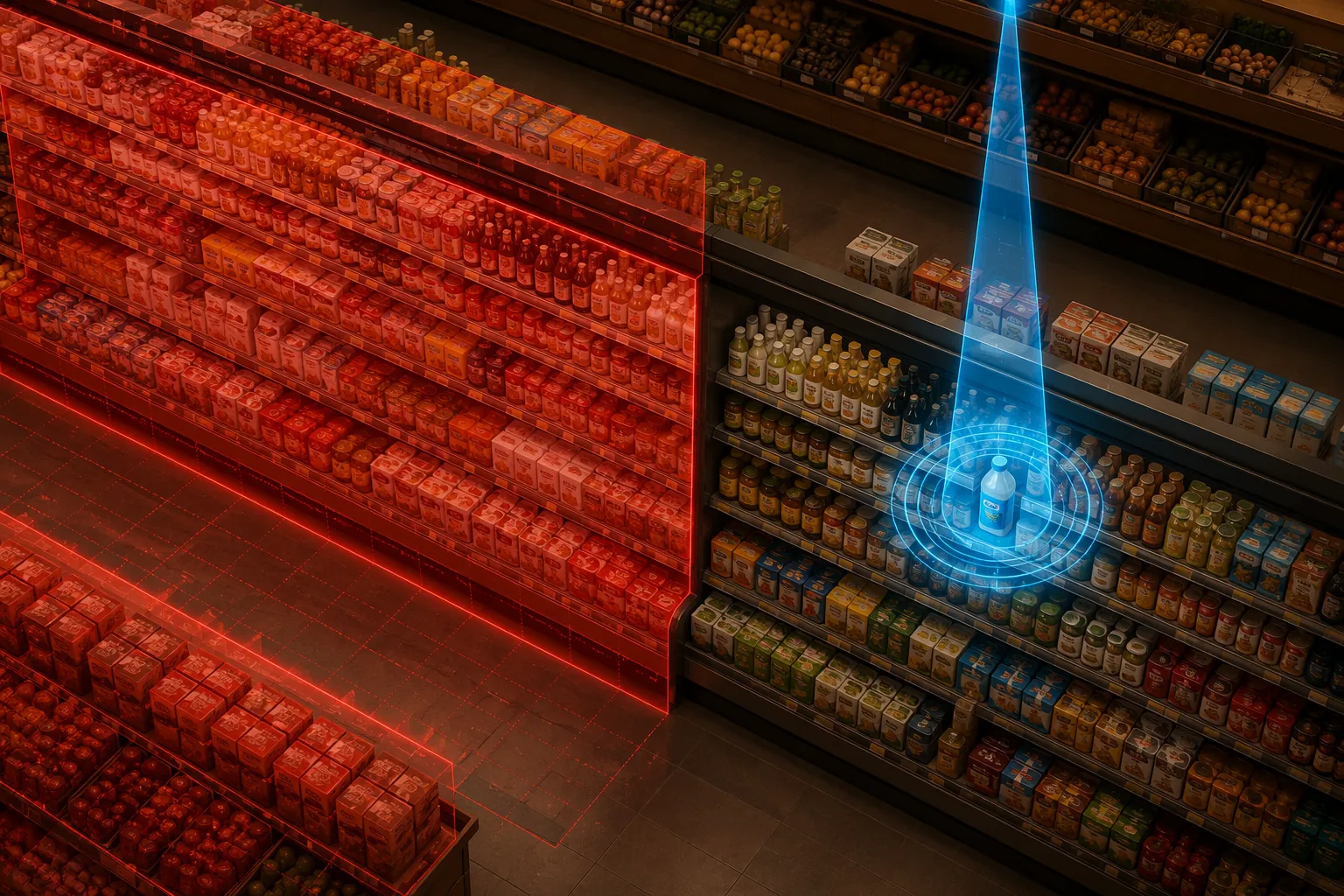
A recall has two different economic shapes. In the first, the company knows a product category is suspect but cannot prove which lot, supplier, shipment, store cluster, or date window is clean. Operations responds by sweeping broadly because the cost of under-recalling is worse than the waste. In the second, the company can isolate origin, movement, exposure, and store reach quickly enough to take a narrower action.
That difference is where recall technology earns or fails to earn its capital. A platform that only digitizes records after the fact may help the investigation but still leave the business with a wide product pull. A platform that shortens trace time, flags defects before shipment, or warns of cold-chain failure before product quality is compromised changes the decision available to food safety, procurement, store operations, and finance.
No public source provides a unified study tying Walmart, Kroger, AI, blockchain, and recall ROI into one controlled comparison. The evidence has to be read as a transparent synthesis: recall cost benchmarks from industry studies, Walmart traceability and AI operating claims from public technology disclosures, and Kroger’s traceability investments compared with later public recall exposure. That is less tidy than a vendor ROI calculator, but it is closer to how a capital committee actually has to underwrite the risk.
Walmart’s Useful Result: Traceability First, Prevention Second
Walmart’s most concrete recall-management result remains its blockchain traceability proof point. In the Hyperledger Fabric case study, Walmart reduced the time required to trace mango origin from seven days to 2.2 seconds.[3] That number has been repeated often for good reason: it changes the first hour of a recall investigation. Instead of waiting for paper trails, emails, supplier responses, and manual reconciliation, the team can identify source data fast enough to consider a targeted response.
The value is not that blockchain is impressive on its own. The value is that traceability can reduce uncertainty at the moment when uncertainty is expensive. If the business cannot prove where a contaminated or mislabeled product went, a larger product pull becomes the defensible choice. If it can prove lot scope, store reach, and supplier origin quickly, the recall boundary may shrink.
That distinction matters because traceability is still reactive. It answers “where did this come from?” after a problem has been identified. It does not, by itself, stop a bad seal, a damaged case, a barcode failure, a refrigeration problem, an undeclared allergen, or a supplier contamination event from occurring.
Walmart’s later AI layer moves closer to prevention. In 2025, Walmart described Automated Defect Detection that inspects 100% of conveyable cases for issues such as loose tape, crushed boxes, and barcode problems before shipment. The same corporate update described a Digital Twin capability that predicts refrigeration failure up to two weeks in advance and automatically generates work orders.[4]
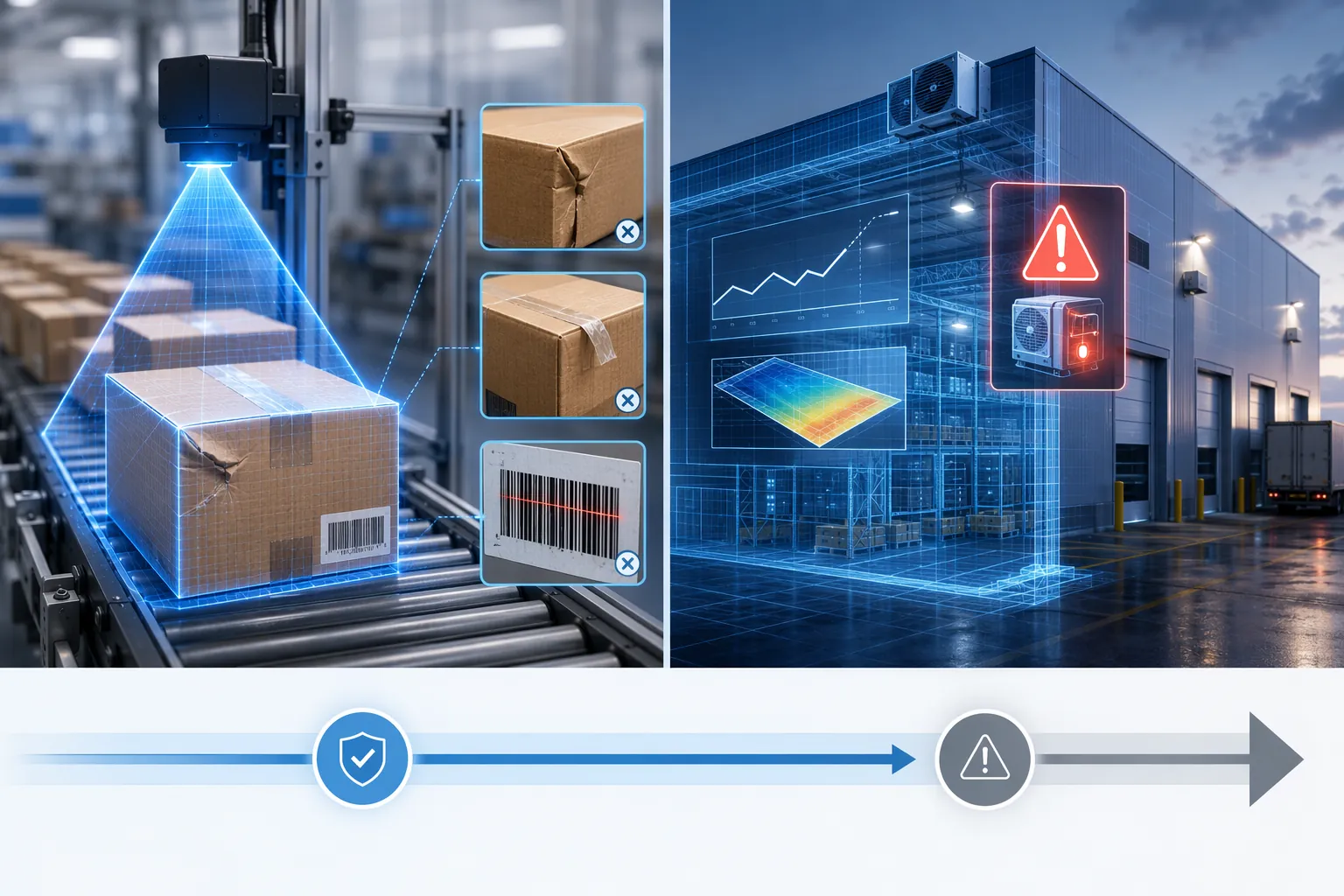
Those AI claims should not be treated as equivalent to the 2.2-second blockchain benchmark. The traceability result is a crisp before-and-after measurement from a specific proof of concept. The AI disclosures are operational claims about coverage and warning time, not public recall-cost measurements. Still, they point to a more valuable control layer: detect physical problems before they leave the distribution environment, and identify refrigeration risk before temperature abuse turns into spoilage, quality failure, or a food safety exposure.
Fortune’s 2025 reporting placed Walmart among retailers using AI to reinvent supply chain operations, while Walmart’s own update said its broader AI revamp was live in the U.S., Costa Rica, Mexico, and Canada, with some project timelines compressed from months to weeks.[4][5] That may support a productivity case. For recall economics, the more important question is narrower: did earlier detection reduce the chance that a defect became a recall trigger, or did better system visibility reduce the volume of product caught inside the recall boundary?
| Control layer | What it changes | Recall-cost relevance |
|---|---|---|
| Blockchain traceability | Cuts origin-tracing time from days to seconds in Walmart’s proof of concept | Supports narrower, evidence-backed recall scope after a problem is found |
| Automated Defect Detection | Scans all conveyable cases for visible case and labeling issues | May catch defects before shipment, reducing downstream investigation and withdrawal exposure |
| Digital Twin refrigeration monitoring | Predicts refrigeration failure up to two weeks early and creates work orders | May reduce cold-chain failures before they become quality or safety incidents |
The Proxy Math: One Narrowed Event Can Matter More Than Years of Small Savings
A procurement team building a CFO case should separate three savings pools instead of blending them into a generic AI ROI claim.
- Avoided recall: the event is prevented because a defect, refrigeration risk, or quality signal is caught upstream.
- Narrowed recall: the event still occurs, but traceability limits the affected product, locations, suppliers, or date range.
- Cheaper recall execution: customer contact, claims handling, documentation, and service resolution cost less once the recall is underway.
The first two pools are where grocery recall economics become asymmetric. A retailer can go months without a major event, then one allergen, pathogen, foreign-material, or cold-chain failure can absorb the savings from many smaller optimization projects. The $10 million direct-cost baseline is not a forecast for every grocer’s next event, but it gives finance a conservative stress-test number. The tail risk above $100 million explains why the approval discussion should not be limited to headcount reduction.[1]
For example, a hypothetical mid-size grocery chain does not need to claim that AI will eliminate recalls. A more defensible model asks: how many high-risk categories are exposed, how often does the company face material withdrawals or recalls, how much product is destroyed because lot scope cannot be proven, how long do stores and suppliers wait for investigation results, and what percentage of a broad pull might become avoidable if traceability and upstream detection improve?
That model will not produce a universal percentage. It should not. A retailer with dense private-label exposure, complex prepared-food operations, and fragmented supplier data has a different risk profile from a retailer with simpler assortment and fewer high-risk fresh categories. The useful output is a break-even event: how much recall scope must be avoided, or how many severe incidents must be prevented, for the platform to pay for itself.
Kroger Shows Why Traceability Is Necessary but Not Sufficient
Kroger is useful in this analysis because it prevents the Walmart story from becoming a simple technology victory lap. Kroger was an early participant in the IBM Food Trust blockchain food safety initiative alongside Walmart and suppliers in 2017.[6] It also moved aggressively on traceability, mandating FSMA 204+ traceability for all foods by June 2025, six months ahead of the FDA timeline reported by industry sources.[7]
Those are meaningful investments in records, supplier discipline, and recall readiness. They do not prove recall prevention. Public recall exposure continued: FoodNavigator reported listeria-linked recalls in 2025–2026 involving products sold at retailers including Kroger, Walmart, and Trader Joe’s, with affected products spanning more than 28 states and linked to four deaths and 19 hospitalizations.[7]
The inference has to stay narrow. Public information does not show that Kroger’s traceability program failed in a specific post-mortem, nor does it disclose how much the program may have helped investigation speed, supplier coordination, or product removal. What the public record does show is that traceability investment and continued large-scale recall exposure can coexist. That is enough to reject a weak business case that treats traceability alone as a complete food safety control system.
Kroger has also discussed AI in operational terms rather than recall-specific terms. In Q2 2025 earnings commentary, Chairman Ron Sargent said AI drove “more competitive pricing, shrink improvements and faster fulfillment.” Kroger’s 2026 Corvus One autonomous cold-chain test focused on stock accuracy and cold-chain blind spots, not contamination detection or quantified recall reduction.[8]
That gap matters for procurement leaders using Kroger as a proxy. AI that improves stock accuracy, pricing, fulfillment, or shrink can still be valuable. But unless the system connects to defect detection, temperature risk, supplier quality, allergen controls, recall documentation, or customer notification, it should not be counted as recall-management ROI.
Where Automated Recall Service Economics Fit
There is a smaller, later-stage savings pool after the recall decision has already been made: customer contact and service resolution. TechSee’s recall-management case study reported more than 300,000 automated customer interactions, 40% faster resolution, and double-digit cost reduction for an unnamed consumer goods brand.[9]
That evidence should stay in its lane. It is a vendor case study, not a Walmart or Kroger result, and it does not prove lower contamination risk or narrower product scope. It does show that once a recall reaches consumers, automation can reduce service friction and operating cost. For CFO modeling, that belongs below avoided and narrowed recall exposure, not above it.
What Procurement Should Put in Front of Finance
The strongest proposal will not say, “Walmart uses AI, so we should too.” It will show where the company currently pays for uncertainty. That means building the case from operating evidence rather than feature lists.
- Map recall decision points: when the issue is detected, who confirms lot scope, who authorizes product removal, who contacts suppliers, and who tells stores what to pull.
- Quantify broad-pull waste: product value destroyed when the team cannot prove which lots or locations are affected.
- Separate traceability from prevention: blockchain-style records support faster origin tracing, while AI inspection and cold-chain prediction support earlier intervention.
- Assign cost owners: recall operations, business interruption, store labor, supplier chargebacks, legal review, customer care, replenishment, and disposal.
- Use scenarios, not certainty: model one avoided severe event, one narrowed event, and one service-automation event instead of claiming universal recall elimination.
Walmart supplies the clearest public mechanism: traceability narrows the field after discovery, while automated defect detection and refrigeration prediction move some controls upstream. Kroger supplies the useful caution: traceability investment can improve readiness without proving prevention, and general AI operating gains should not be counted as recall savings unless they connect to recall triggers or recall execution.
That is the CFO framing: AI recall management is not mainly incremental efficiency software. It is an insurance-like operational control whose ROI depends on the probability, scale, and avoidability of high-cost recall events. The investment case is strongest where the company can show that earlier detection or narrower evidence would have changed a real product-removal decision.
References
- The Real Cost of a Product Recall and How to Prevent One, Lumafield, 2026.
- Product Recalls Drop in Frequency but Surge in Scale — Q1 2026, Risk & Insurance.
- How Walmart brought unprecedented transparency to the food supply chain with Hyperledger Fabric, LF Decentralized Trust / Hyperledger.
- Retail, Rewired, Walmart Corporate, July 24, 2025.
- How Walmart, Amazon, and other retail giants are using AI to reinvent the supply chain, Fortune, July 23, 2025.
- Walmart, Kroger join suppliers in blockchain food safety initiative, Supermarket News.
- Global food recalls surge: Top products, causes and solutions, FoodNavigator.
- Kroger tests autonomous inventory system to solve cold chain blind spots, SCW Mag.
- How AI Is Transforming Product Recall Management Services, TechSee.
Cited evidence
- Walmart’s Dresser Recall Exposes the Compliance Blind Spot in Logistics AI
Walmart’s 2026 Mainstays dresser recall (165,000 units, STURDY Act violation) reveals that its advanced supply chain AI—optimized for packaging defects and cost—did not inspect product safety compliance. This case helps retail leaders understand where logistics AI falls short on safety.
- How AI Recall Management Improves Food Safety Outcomes
This article examines measurable outcomes from AI-driven recall management deployments, including trace-speed reductions, recall-scope compression, and cost avoidance, while distinguishing verified claims from marketing assertions. It provides evidence to help supply-chain leaders evaluate AI investments for food safety.
- How AI computer vision detects spoilage to prevent food recalls
This analysis of four computer vision deployments at Tyson Foods, Walmart, Kraft Heinz, and Nestlé shows that AI-powered inspection catches defect classes that manual methods miss, with clear recall-prevention implications. But the impact depends on upstream placement and is limited to visible-surface defects.
Ready to check your own team's readiness for this pattern?
See the procurement readiness checklist →Spotted something inaccurate or incomplete in this entry? ChainSignal reviews corrections and additional evidence before publishing an update — this is not a public comment thread.
Flag an inaccuracy / submit evidence for this entry →