Walmart’s Dresser Recall Exposes the Compliance Blind Spot in Logistics AI
Walmart’s 2026 Mainstays dresser recall (165,000 units, STURDY Act violation) reveals that its advanced supply chain AI—optimized for packaging defects and cost—did not inspect product safety compliance. This case helps retail leaders understand where logistics AI falls short on safety.
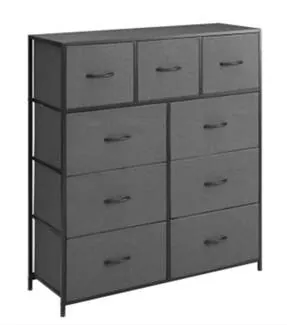
Walmart recalled the Mainstays 9-drawer fabric dresser on May 28, 2026, after the U.S. Consumer Product Safety Commission said the unit violated the mandatory federal stability standard for clothing storage furniture. The notice covered about 165,000 dressers, sold for roughly $80 at Walmart stores and online from September 2023 through December 2025, and identified Hop Thang Interior Wood Co. Ltd. of Vietnam as the manufacturer.[1]
That is a product-safety failure with a logistics footprint. For more than two years, the dresser moved through a retail network that Walmart has been steadily wiring for automation, inventory intelligence, supplier optimization, and defect detection. The uncomfortable question is not whether a conveyor-side AI camera should have recognized a federal furniture stability violation. It is more basic: what was Walmart’s supply-chain AI actually designed to see?
That answer matters for the logistics outcomes of the Walmart dresser recall. A system can be excellent at detecting crushed cartons, unreadable barcodes, and inventory exceptions, and still have no view into whether the product inside the carton passed the legal test that decides whether it can be sold.
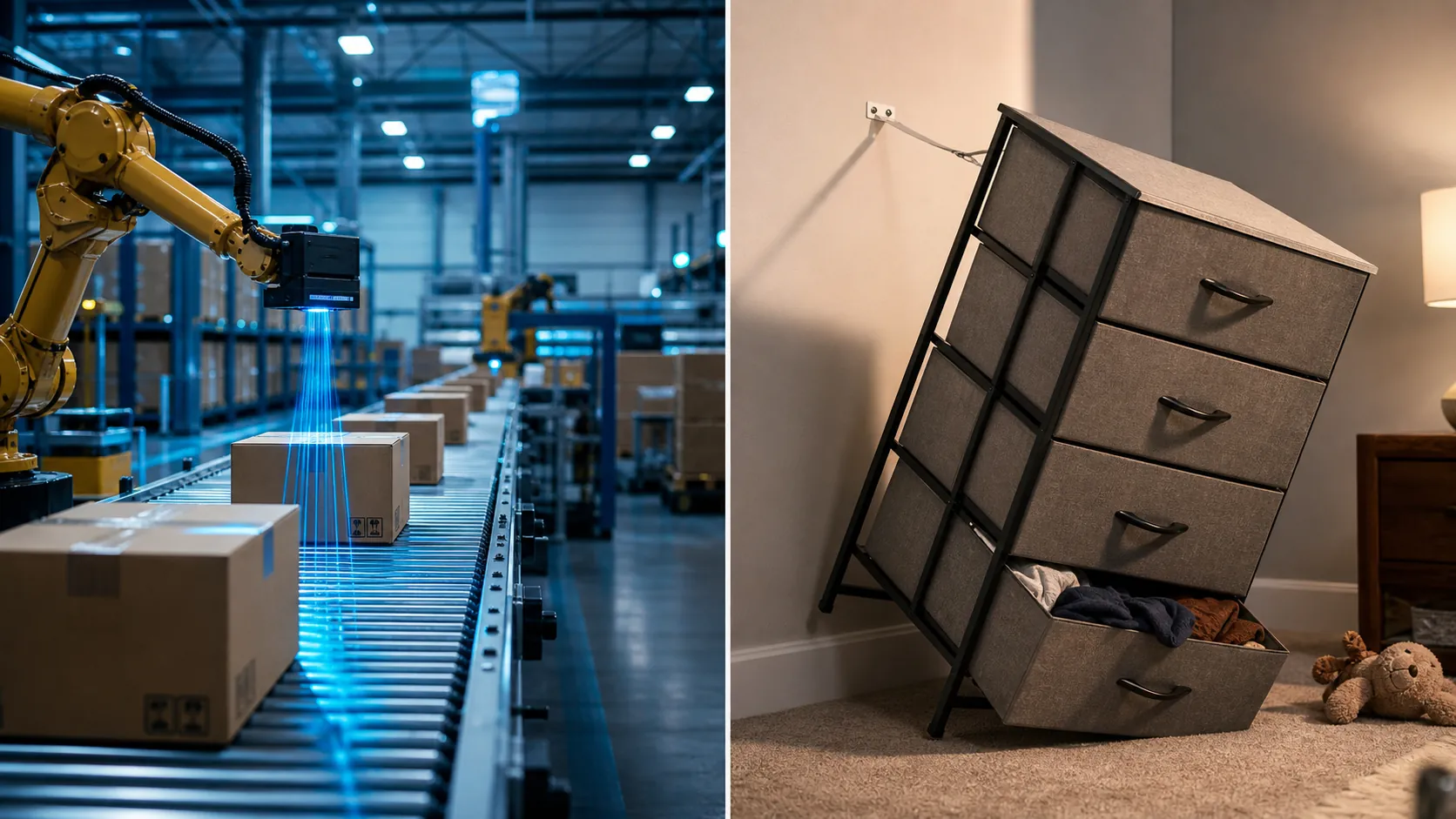
The violation was inside the product, not on the box
The CPSC did not describe the recalled dresser as a shipment damaged in transit. It said the product violated the STURDY Act and could tip over if not anchored to the wall, creating serious injury or death risks from tip-over and entrapment hazards.[1] Walmart’s remedy was a full refund after consumers stopped using the dresser and disposed of it under the recall instructions.[1]
That distinction is the center of the case. A crushed box is visible after a product enters distribution. A missing or failed stability design requirement belongs much earlier: product specification, supplier qualification, factory testing, documentary compliance review, and acceptance into the retail assortment.
Under the CPSC’s business guidance for clothing storage units, the rule requires stability testing that includes simulating the force of a child climbing, testing on a carpeted surface, and testing with drawers extended and weighted.[3] For this dresser category, the relevant condition included a 60-lb child-climbing simulation on carpet with extended weighted drawers.[3]
Those are not packaging signals. They are product-behavior signals. They ask how the dresser performs when gravity, drawer extension, surface friction, load, and child interaction are brought into the same test. A distribution-center scanner can confirm that a case is presentable and scannable. It cannot infer that the furniture inside resists a mandated tip-over scenario unless that compliance data has been generated, structured, attached to the SKU, and governed before the case reaches the conveyor.
What Walmart’s public AI stack claims to inspect
Walmart has not been quiet about automation. In July 2025, the company described Automated Defect Detection, a system that scans 100% of conveyable cases for issues such as loose tape, crushed boxes, open flaps, damaged packaging, and barcode problems.[2] It also described agentic AI used to help self-heal inventory exceptions, Pactum AI for supplier negotiations, and a target to automate 65% of stores by 2026.[2]
| Publicly described capability | Where it operates | What it appears to see | What the dresser recall required |
|---|---|---|---|
| Automated Defect Detection | Distribution and fulfillment flow | Conveyable case condition: tape, flaps, crushing, barcode readability | Furniture stability under STURDY Act test conditions |
| Agentic inventory self-healing | Inventory records and exception workflows | Availability, mismatch, and replenishment signals | Proof that a specific SKU passed mandatory product-safety testing |
| Pactum AI supplier negotiations | Supplier commercial terms | Negotiation engagement and cost outcomes | Design-stage compliance evidence and test validity |
| Supplier forecasting and planning tools | Demand, replenishment, and operational planning | Legal fitness of the product before retail acceptance |
Walmart’s own figures make clear how operationally serious these systems are. The company said Pactum AI produced 68% supplier engagement and 1.5% cost savings in the context it described.[2] Those are real supply-chain outcomes. They are also the wrong outcome class for a dresser that should have been excluded or corrected before it ever became sellable inventory.
A supplier-facing interpretation of Walmart’s AI tools similarly frames Pactum, Element ML, demand forecasting, and computer vision around cost, speed, availability, and operational execution rather than product-safety validation.[4] That does not make the tools superficial. It makes their boundary visible.
Scope fidelity is not a semantic exercise here. If an AI system is trained and deployed to inspect the outside of a conveyable case, its success metric is whether the case can move cleanly through the network. If another system corrects inventory records, its success metric is whether stock positions become more accurate. If a negotiation agent improves supplier terms, its success metric is commercial. None of those claims should be allowed to drift into implied assurance that the underlying product complies with a federal safety rule.
The STURDY Act sits upstream of logistics optimization
The STURDY Act changed the question that clothing storage furniture has to answer. The issue is not simply whether a dresser stands upright in ordinary display conditions. The required stability tests are designed to reflect foreseeable use, including a child interacting with open drawers on a carpeted surface.[3]
That kind of compliance evidence has to be built before the logistics network becomes efficient. A retailer needs the product specification, the applicable rule mapping, the supplier’s test evidence, the testing method, the lab or internal validation record, and the version control that connects those records to the exact product being ordered. If the product changes, the evidence may need to change with it. If the supplier changes, the burden does not disappear into the purchase order.
This is why the recall is a poor fit for a simple “AI failed” headline. Walmart’s public logistics AI could have performed exactly as described and still missed the hazard, because the hazard was not encoded in the inspection field. The stronger governance critique is narrower and more useful: the visible automation layer was downstream of the risk that mattered.
A hypothetical compliance-aware workflow would not need to pretend that a distribution camera can run a furniture stability test. It would instead prevent or flag commercial movement when required safety evidence is missing, expired, mismatched to the product version, or inconsistent with the rule that applies to the SKU. The control point belongs before item setup, sourcing approval, manufacturing release, import acceptance, or retail replenishment—not after the carton is already moving through an optimized network.
A design-stage problem can travel very efficiently
The Walmart recall is also not an exotic supply-chain edge case. AQI Service’s 2026 CPSC compliance analysis reported 142 recall notices in Q1 2026, a 40.6% year-over-year increase, and said furniture accounted for 10.8% of actions.[5] The same analysis attributed more than 40% of recalls to the design stage and said more than 90% of recall actions involved imported products.[5]
Those figures should be handled with care. AQI Service is a commercial inspection provider, and the aggregate enforcement statistics were not independently cross-checked here against a separate CPSC rollup. Still, the pattern it describes fits the governance problem in this case: a retailer can invest heavily in downstream flow, while the defect that triggers the recall originates in design, testing, supplier assurance, or import compliance.
Once that upstream failure becomes sellable inventory, the modern network can make the problem larger rather than slower. Better forecasting moves product to demand. Better automation reduces handling friction. Better inventory systems correct availability signals. Those are strengths when the product is compliant. They are accelerants when compliance status is assumed rather than verified.
Adjacent AI tools exist, but they are not a plug-in answer
There are AI categories that sit closer to product quality than Walmart’s public logistics examples. Agmis, for example, describes an automotive seat manufacturing case in which AI defect detection achieved more than 99% accuracy and reduced inspection time by 27 times.[6] That is useful as an existence proof for vision-based production inspection. It is not evidence that the same model, data, and controls would validate a fabric dresser against STURDY Act stability requirements.
Recall orchestration is also developing. Cegeka announced a Quality Impact Recall Agent for Dynamics 365 MCP in January 2026 as an AI-supported recall-management tool.[7] That class of software can help identify affected lots, structure case work, and coordinate downstream actions. It does not make the original product compliant.
Reverse logistics has a similar place in the sequence. McKinsey estimated annual reverse logistics spend at $200 billion and described a baseline of about 50% value recovery, rising to about 75% with AI dynamic dispositioning in the context of its survey and analysis.[8] For a recall, that kind of capability can reduce loss, improve routing, and recover value where lawful and appropriate. It is outcome management after the failure has entered the market.
For readers focused on the logistics side of the problem, ChainSignal’s AI reverse logistics value recovery analysis is the more direct path into dynamic dispositioning. The important boundary in the Walmart dresser case is that recovery tools do not close the sourcing and compliance gap that allowed the recall population to form.
The governance question for retail AI budgets
Retail leaders are under pressure to show AI return, and logistics is one of the easiest places to make the return visible. A crushed carton photographed on a conveyor is tangible. A corrected inventory exception is measurable. A negotiated supplier term has a number attached. Product-safety compliance is harder to render in the same dashboard because the evidence is fragmented across regulation, test protocols, suppliers, factories, labs, product versions, and import records.
That difficulty is not an excuse to let compliance remain invisible. It is the reason the control architecture has to be explicit. A retailer that can tell executives what percentage of conveyable cases are scanned should also be able to tell them which regulated product classes require documentary or physical validation before purchase orders are released, which supplier records are missing, and which SKUs cannot enter replenishment until the evidence is complete.
The practical separation is straightforward:
- Packaging inspection asks whether a case can move through the network without obvious handling defects.
- Inventory intelligence asks whether records, availability, and replenishment signals are accurate enough to operate.
- Supplier-negotiation AI asks whether commercial terms can be improved at scale.
- Product-safety compliance asks whether the item is legally and physically fit to be sold before logistics execution begins.
The Mainstays dresser recall sits in the last category. The public AI systems Walmart has described sit mostly in the first three. Treating them as one enterprise AI success story blurs the very line procurement and compliance teams need to defend.
A stronger retail AI portfolio would not ask logistics systems to become product-safety experts after the fact. It would put a parallel compliance layer upstream: rule mapping by product class, required evidence by SKU, supplier and factory validation, exception escalation, and hard stops before noncompliant or unverified goods can be sourced, manufactured, imported, or replenished.
Logistics AI can reduce friction after goods enter the network. It can also make recalls less chaotic once they occur. What it cannot do, by itself, is prove that a dresser passed the stability test that determines whether it should have entered retail flow in the first place.
References
- Walmart Recalls Mainstays 9-Drawer Fabric Dressers Due to Risk of Serious Injury or Death from Tip-Over and Entrapment Hazards; Violates Mandatory Standard for Clothing Storage Units, U.S. Consumer Product Safety Commission, May 28, 2026.
- Retail, Rewired, Walmart Corporate, July 24, 2025.
- Business Guidance: Clothing Storage Units, U.S. Consumer Product Safety Commission.
- How Walmart Uses AI, 5G Sales Consulting, November 2025.
- CPSC Compliance 2026, AQI Service.
- Automotive Seats AI Defects Detection, Agmis.
- Transforming Product Recalls with AI, Cegeka, January 2026.
- From cost center to competitive advantage: Modernizing reverse logistics with AI, McKinsey & Company, February 2026.
Cited evidence
- Walmart and Kroger Show How AI Reduces Recall Costs
Drawing on Walmart's blockchain traceability and AI defect detection alongside Kroger's contrasting experience, this analysis quantifies how AI shifts recall economics from multi-million-dollar broad sweeps to targeted, preventable interventions. Procurement leaders can use these proxy-case numbers to build a business case for AI recall investments.
- Why Walmart's AI Didn't Automate the EnHomee Recall
This article examines why Walmart's self-healing inventory and blockchain traceability systems were not deployed in the EnHomee dresser recall, and what that capability-execution gap means for enterprises evaluating AI-driven returns and recall logistics solutions.
- How AI computer vision detects spoilage to prevent food recalls
This analysis of four computer vision deployments at Tyson Foods, Walmart, Kraft Heinz, and Nestlé shows that AI-powered inspection catches defect classes that manual methods miss, with clear recall-prevention implications. But the impact depends on upstream placement and is limited to visible-surface defects.
Ready to check your own team's readiness for this pattern?
See the procurement readiness checklist →Spotted something inaccurate or incomplete in this entry? ChainSignal reviews corrections and additional evidence before publishing an update — this is not a public comment thread.
Flag an inaccuracy / submit evidence for this entry →