Taylor Farms cyclospora exposes AI traceability gaps
An analysis of four documented traceability failures during the Taylor Farms cyclospora outbreak, evaluating which current AI technologies could have addressed them and delivering a vendor-neutral verdict for enterprise buyers evaluating food safety traceability platforms.
If a buyer installed an AI traceability platform before the Taylor Farms cyclospora outbreak, the next recall meeting would not automatically become clean, fast, or narrow. The better answer is less satisfying and more useful: current AI and traceability technology could have helped most with record-sharing, exception detection, and risk prioritization; it could have helped only indirectly with recall scope; and it could not have solved cyclospora detection itself.
That distinction matters because the Taylor Farms case is exactly the kind of event vendors like to flatten into a technology story. It had a prominent produce supplier, a live public-health investigation, unclear public recall communication, slow traceback, a broad recall footprint, and biological uncertainty around the pathogen. Those are not one problem. They are several different failure modes sitting on top of one another.
The practical question is not whether AI can make a supply chain look more visible in a demo. It is whether, during a moving outbreak, the system can identify affected lots, customers, and movement history quickly enough to narrow action and answer regulators before another day is lost.

The first failure was public communication without customer specificity
Taylor Farms' voluntary recall notice did not name specific distributors or retailers, a gap the FDA publicly noted before the notice was withdrawn, according to Ars Technica's reporting on the outbreak confusion.[1] For a procurement lead or QA director, that is not a cosmetic omission. It pushes work downstream into phone calls, email chains, distributor portals, and internal SKU matching while product is still moving or sitting in inventory.
An AI platform could improve this kind of failure only if the customer and shipment relationships already exist in usable form. Entity resolution can reconcile customer names. Workflow software can push notices to known recipients. Natural-language tools can help draft targeted communications. But none of that creates a reliable customer list after the fact if the supplier, distributor, and retailer records were never connected at the lot and shipment level.
This is where "visibility" language usually hides the hard requirement. A recall notice needs named counterparties, product identifiers, dates, lot codes, and distribution paths. If the platform cannot expose which customers received which lots, it has not solved the communication problem. It has just made the dashboard more polished.
The record layer failed before the AI layer ever had a chance
The heavier failure was not that a model failed to predict the outbreak. It was that traceback still depended on records spread across paper invoices and siloed digital databases, which Bloomberg Law identified as one reason the hunt for the source took weeks.[2] That is the part enterprise buyers should sit with, because most traceability failures do not begin with a brilliant algorithm starved of compute. They begin with missing, mismatched, or inaccessible fields.
The Food Safety Modernization Act traceability rule, commonly referred to as FSMA 204, was designed to force a different record posture for foods on the Food Traceability List. The FDA rule requires covered entities to maintain additional traceability records for defined Critical Tracking Events and Key Data Elements, including information that can support lot-level tracing.[3] Bloomberg Law reported that the rule would have required lot-level Critical Tracking Event records accessible to FDA within 24 hours, but the compliance deadline had been delayed to 2028.[2]
That 24-hour point is the operational center of the whole story. A regulator's request does not wait for an ERP cleanup project. During an outbreak, someone has to answer: what lot, from which field or source, through which facility, shipped to which customer, on which date? If the answer requires staff to pull paper invoices, export spreadsheets, call brokers, and reconcile inconsistent lot names, the delay is already built into the architecture.
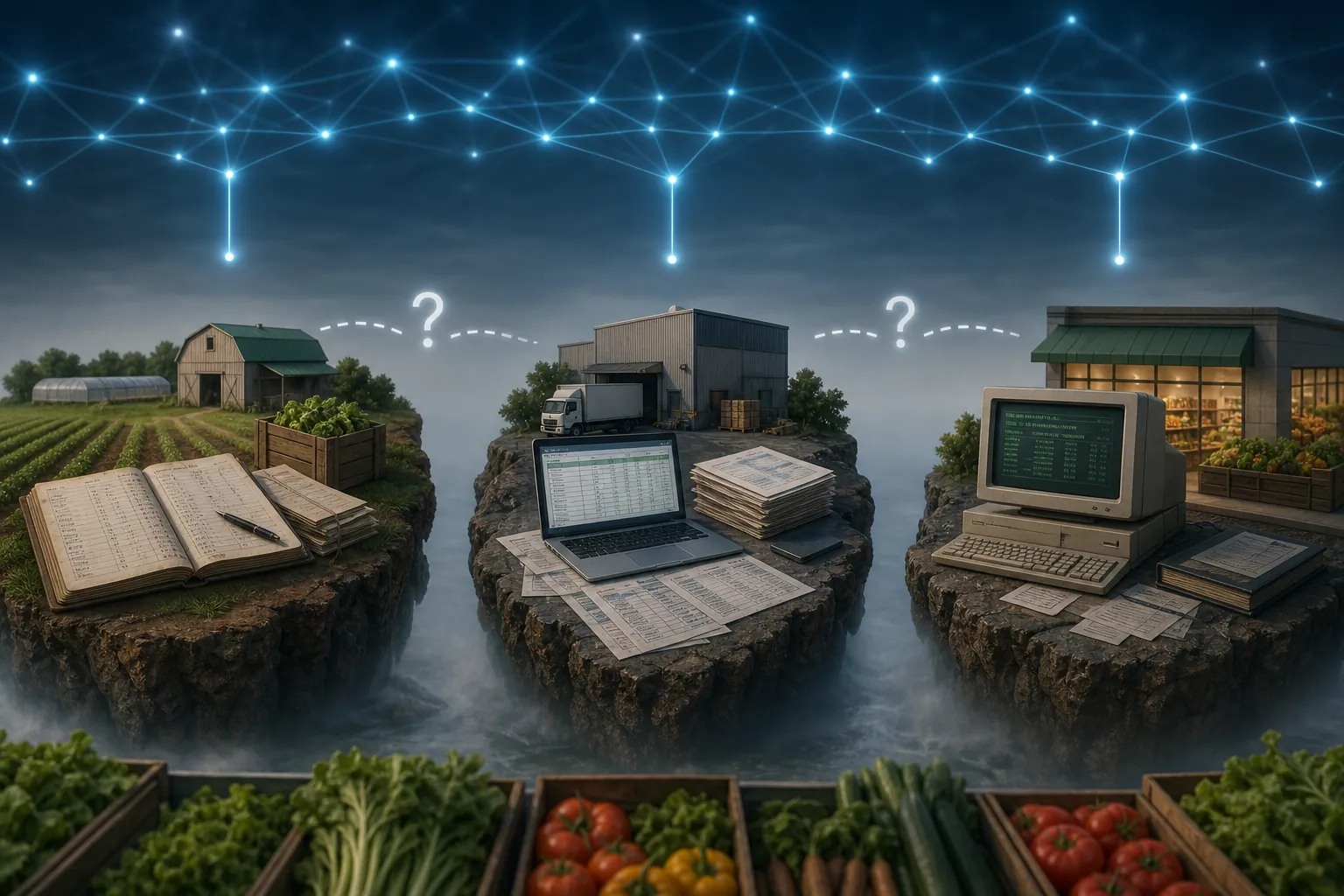
AI can help here, but only in a bounded way. It can extract fields from invoices, standardize product names, match supplier aliases, flag missing lot codes, and detect when a shipment record lacks a required event. It can also make exception queues much more useful: instead of discovering during a recall that a distributor's lot field is blank, a buyer can see the gap when the shipment is received.
But that is not the same as substituting for a mandatory interoperable record standard. A model can infer that two records probably refer to the same product. It cannot make that inference legally or operationally sufficient if a recall decision depends on exact lot movement. The closer the decision gets to pulling product from shelves, the less tolerance there is for probabilistic reconstruction.
| Traceability task | What current technology can improve | What still has to be present |
|---|---|---|
| Customer identification | Entity matching, notification workflows, customer hierarchy cleanup | Accurate customer and shipment records tied to product lots |
| Traceback | Digitization, field extraction, record reconciliation, exception alerts | Lot-level Critical Tracking Event and Key Data Element records |
| Recall narrowing | Scenario analysis and affected-network mapping | Granular lot, source, facility, and distribution data |
| Risk prioritization | Machine-learning scoring using external and internal signals | Transparent inputs and usable surveillance data |
| Pathogen confirmation | Decision support around uncertain evidence | Reliable biological testing, which cyclospora does not currently provide |
The broad recall was a granularity problem, not just a speed problem
CBS News reported that the recall covered central-Mexico iceberg lettuce across 27 states.[4] The available material supports a narrower, concrete conclusion: when lot-level granularity is not available or not trusted quickly enough, companies and regulators have to act at a broader product and geography level than they otherwise might.
That is where recall scope becomes expensive. A broad pull may be the right public-health decision when records are incomplete, but it means safe product can be removed along with suspect product. It also means retailers, distributors, foodservice buyers, and category managers are left deciding how far to extend internal holds while the official facts are still catching up.
A traceability system can materially change that meeting if it can show the affected lot network with confidence: which fields or growers fed which production runs, which facilities handled them, which finished-product identifiers carried them, and which customers received them. AI can make that map faster to generate and easier to query. It can also simulate recall boundaries and show which customers fall inside or outside a proposed scope.
The weak point is that recall narrowing is only as good as the underlying identifiers. If the system knows "central-Mexico iceberg" but cannot distinguish lot histories at the level needed for action, AI does not narrow the recall. It may only produce a more confident-looking version of the same coarse boundary.
This is also where buyers should separate blockchain, AI, and basic data governance. Blockchain can make records harder to alter and easier to share across parties. AI can reconcile messy records and prioritize exceptions. Neither one is a substitute for suppliers actually capturing the required lot and movement fields at the right moments.
Surveillance degraded the early-warning layer
The outbreak also unfolded against a weaker surveillance backdrop. CIDRAP reported that in July 2025 the CDC changed FoodNet's Cyclospora reporting from required to optional.[5] A CDC Health Alert Network notice later reported 1,645 confirmed domestically acquired cyclosporiasis cases by July 2026, compared with 249 at the same point in 2025.[6]
Those numbers should not be stretched into a simple causal claim that the reporting change caused the outbreak or the case increase. They do show why external signal quality matters. A company's internal platform can ingest complaint data, supplier histories, weather signals, inspection outcomes, and purchase patterns. It cannot fully replace public-health surveillance when the external network that detects unusual illness patterns becomes less complete.
This is one legitimate place for machine learning in food safety. Risk-scoring models can prioritize growing zones or suppliers when they combine historical outbreak patterns, environmental data, and internal nonconformance records. Satellite weather data and IoT cold-chain sensors can add useful context. But they are risk tools, not proof tools. They may tell a buyer where to look first, which lots deserve extra scrutiny, or which supplier records need immediate review. They do not establish that a specific lettuce lot carried Cyclospora.
Cyclospora puts a hard ceiling on detection claims
The most important limit is biological, not digital. CIDRAP reported that Cyclospora cannot be cultured in a lab, which removes a standard route for confirmatory testing.[7] The same reporting emphasized that what was known about the outbreak remained incomplete while the investigation continued.[7]
PCR testing on produce is also not a clean escape hatch. During the Taylor Farms investigation, FDA initially reported a positive PCR finding and then reversed it within 24 hours after re-review found "no true amplification," according to Ag Bull Trading and Trustwell's discussion of the false-positive episode.[8][9] A model trained on unreliable or ambiguous test signals inherits that uncertainty. It does not launder weak lab evidence into certainty.
This is where vendor language needs the most discipline. AI can help rank suspect lots, surface similar historical patterns, and integrate epidemiological, environmental, and supply-chain evidence. It cannot culture an organism that cannot currently be cultured. It cannot convert an unreliable produce PCR signal into a definitive product-level finding. For cyclospora, better traceability and better detection are related during an investigation, but they are not the same capability.
The Walmart mango benchmark is useful, with limits
The strongest commonly cited benchmark for rapid produce traceback remains Walmart's IBM Food Trust pilot. In the mango pilot, traceback time reportedly fell from seven days to 2.2 seconds.[10] That is a real operational result and it should not be dismissed just because it appears in a blockchain case study. Seven days to seconds is the difference between a staff-intensive investigation and a searchable record network.
But the benchmark has to stay in its lane. It was a 2018-2019 mango pilot, not published proof that a live central-Mexico iceberg lettuce cyclospora investigation at Taylor Farms scale would have resolved in seconds.[10] The pilot shows what fast traceback can look like when participating parties capture and share the right data. It does not prove that every supplier, distributor, broker, and retailer in a real outbreak has production-grade participation, clean lot fields, and regulator-ready records.
Still, the lesson is practical. If buyers want Taylor Farms-style events to unfold differently, they should not ask vendors whether their platform uses blockchain or AI as a first question. They should ask how long it takes to answer a regulator's lot-level request using actual supplier records, how the system handles missing fields, and whether the customer distribution map can be exported while legal, QA, and sales are all working from the same facts.
The FSMA 204 delay belongs in the procurement file
The policy timeline around FSMA 204 has become part of the Taylor Farms discussion, and it should be handled carefully. Snopes reported that the FDA proposed a FSMA 204 compliance extension on March 20, 2025, and that Taylor Fresh Foods donated $1 million to MAGA Inc. on March 26, 2025, six days later.[11] Snopes also reported HHS's denial of any connection.[11] The available record supports noting the timing and the denial; it does not support treating the donation as proven causation for the delay.
What is directly relevant for buyers is the consequence of the delay. Former FDA food safety head Susan Mayne told Bloomberg Law that the rule "would have greatly facilitated FDA's ability to more quickly trace suspect product back to the field in Mexico."[2] That is not an abstract compliance point. It is a description of the missing operational capability that buyers were trying to approximate manually during the outbreak.
A company can adopt FSMA 204-style practices before every legal deadline forces the market to do so. The hard part is that one buyer's readiness does not guarantee ecosystem readiness. If a retailer has excellent internal records but a supplier's inbound lot data is incomplete, or a distributor cannot pass through Critical Tracking Event data in a usable format, the chain still breaks at the handoff.
What buyers should require from traceability platforms now
The vendor-neutral procurement verdict is straightforward: buy for the record layer first, the intelligence layer second, and the pathogen-detection promise last. A platform that cannot enforce lot-level data capture, expose missing fields, and share interoperable records is not ready for the recall conditions that mattered in this outbreak.
- Require lot-level capture tied to receiving, transformation, shipping, and customer delivery events, not just product master data.
- Test interoperability against FSMA 204-style Critical Tracking Event and Key Data Element records, even where compliance deadlines have moved.
- Demand customer and distributor visibility that can produce named affected parties during a recall, not only internal inventory views.
- Evaluate auditability: who changed a record, when it changed, what evidence supports it, and whether regulators can receive the data quickly.
- Pressure-test exception handling with missing lot codes, inconsistent supplier names, partial shipments, commingled product, and delayed distributor updates.
- Treat risk scoring as decision support and require transparent inputs, especially when models use weather, geography, supplier history, or outbreak data.
The Taylor Farms cyclospora outbreak was not simply a story about a missing AI system. Buying AI alone would not make the next event clean. A materially different outcome comes from pairing useful automation with mandatory lot-level traceability, shared records that survive handoffs, and clear limits on what technology can claim when the biology itself remains uncertain.
References
- Confusion swirls on source of diarrhea outbreak, but it's still Taylor Farms, Ars Technica
- Cyclospora Hunt Highlights Need for Delayed Food-Tracing Rule, Bloomberg Law
- FSMA Final Rule on Requirements for Additional Traceability Records, FDA
- What to know about Taylor Farms, the produce giant tied to the cyclospora outbreak, CBS News
- CDC cuts back foodborne illness surveillance program, CIDRAP
- Domestically Acquired Cyclosporiasis Cases in Multiple U.S. States, 2026, CDC HAN
- What we truly know about the huge US Cyclospora outbreak—and what we don't, CIDRAP
- FDA Reverses Taylor Farms Cyclospora Finding, but Recall Remains, Ag Bull Trading
- What a Cyclospora False Positive Teaches Us About Food Traceability, Trustwell
- Food Traceability on Blockchain: Walmart's Pork and Mango Pilots with IBM, JBBA
- Making sense of claims about Taylor Farms, CEO's Trump donations and meetings, Snopes
Cited evidence
- Why AI Traceability Failed in the 2026 Cyclospora Outbreak
The 2026 multistate cyclosporiasis outbreak — with over 1,645 confirmed cases and a 2.5-month FDA investigation lag — exposed a stark divide: AI-powered diagnostic screening identified cases at 3-4x human sensitivity, but the produce supply chain still lacks the lot-level digital traceability needed to pinpoint contamination. This case study examines what the outbreak reveals about AI's real limits in food safety today.
- Could AI Traceability Have Prevented 2025 Fruit Puree Recalls?
An analysis of three major 2025–2026 fruit puree recalls—PT Organics, WanaBana, and Tippy Toes—shows how commercially available AI traceability tools like supplier risk scoring, N-tier visibility, and spectral screening could have cut the average contamination-to-recall lag from 23–31 days to near-real-time targeted removal, based on FDA recall data and deployment benchmarks from Walmart and Nestlé.
- What Trump's Ratepayer Pledge Means for AI Data Center Supply Chains
The Ratepayer Protection Pledge shifts grid upgrade costs but lands on a supply chain already crippled by transformer shortages, tariff exposure, and multi-year lead times—forcing enterprise AI buyers to plan for higher costs and delays through at least 2028.
Ready to check your own team's readiness for this pattern?
See the food safety readiness checklist →Spotted something inaccurate or incomplete in this entry? ChainSignal reviews corrections and additional evidence before publishing an update — this is not a public comment thread.
Flag an inaccuracy / submit evidence for this entry →