Why the Ratepayer Protection Pledge Won't Protect Your AI Platform Budget
The nonbinding Ratepayer Protection Pledge covers hyperscalers, not supply-chain AI platform vendors. This article gives enterprise procurement managers a five-point due diligence framework to assess whether rising data-center energy costs will flow through to their SaaS pricing.
The Ratepayer Protection Pledge sounds, at first pass, like the sort of upstream commitment an enterprise buyer would like to see before signing another AI-heavy platform renewal. Its five commitments are aimed at utility cost sharing, grid upgrade contributions, renewable matching, community engagement, and bill-impact transparency for data centers.[1] Those are the right nouns. They are also not the same thing as a price protection clause in an o9, Blue Yonder, Kinaxis, RELEX, or Anaplan renewal.
The practical gap is simple: AWS, Microsoft Azure, Google Cloud, Oracle Cloud, and xAI signed the Pledge; the supply-chain planning application vendors that sit on top of cloud infrastructure did not. The Pledge is also nonbinding, and implementation runs through state utility and public utility commission processes rather than through enterprise SaaS contracts.[1][2] A procurement team cannot treat it as a budget shield unless the vendor’s own order form, pricing exhibit, or master subscription agreement says how upstream energy cost pressure is handled.
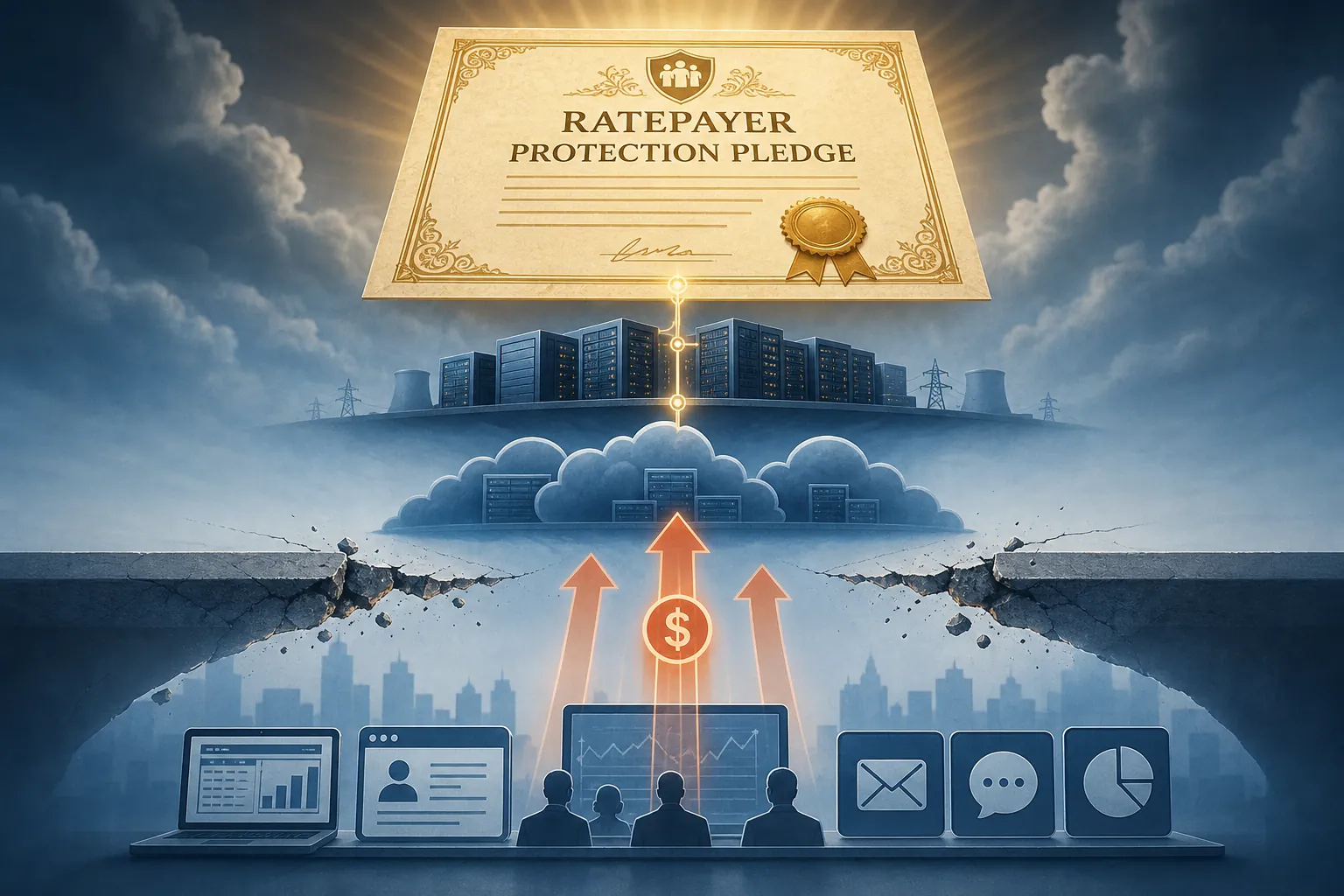
That is why the useful question is narrower than the public debate over AI data centers’ impact on ratepayers. The question for a 2026 or 2027 enterprise buyer is not whether AI data centers will raise everyone’s bills in a uniform way. It is whether a particular vendor’s AI inference, training support, redundancy, and service-level architecture create a plausible cost path from a constrained cloud region into a SaaS renewal.
What the Pledge Covers, and Where Your Contract Begins
The Pledge is useful context because it confirms that the data-center power issue has moved from engineering planning into rate design and public accountability. It asks signatories to pay a fair share of utility costs, contribute to necessary grid upgrades, match energy use with clean power, engage affected communities, and improve transparency around customer bill impacts.[1] Those commitments are directionally aligned with what enterprise buyers want: fewer hidden subsidies, fewer surprise infrastructure bottlenecks, and fewer costs socialized in ways that later reappear as platform price increases.
But a pledge is not a cost-allocation exhibit. It does not tell a buyer whether a supply-chain AI vendor absorbs higher hosting expense, passes it through at renewal, rebuilds packaging around usage tiers, reduces included capacity, throttles expensive workloads, or shifts regions. State utility law also matters because the Pledge depends on local regulatory mechanisms that vary by jurisdiction.[2] The buyer’s risk lives in that translation layer.
There is already enough pressure in the system to justify asking. Utilities requested more than $29 billion in rate increases in the first half of 2025, more than double the amount requested in the first half of 2024.[3] Residential electricity prices rose 7.1% in 2025, while the Dallas Fed projected that data centers could add 0.04 to 0.13 percentage points to PCE inflation by 2030.[4] Those national inflation effects are modest; they do not make a platform renewal automatically more expensive. They do show that electricity and capacity costs are no longer background assumptions for AI infrastructure.
Regional concentration is the sharper procurement issue. Virginia data centers consume about 40% of the state’s electricity, and Bloomberg has reported wholesale price spikes of 267% in high-concentration areas such as Northern Virginia.[3] That figure should not be read as a national average or as a forecast for every SaaS vendor. It is a warning about location-specific exposure. If a planning platform runs latency-sensitive inference in a constrained region, national averages will not answer the renewal question.
The Five Questions to Put in the RFI
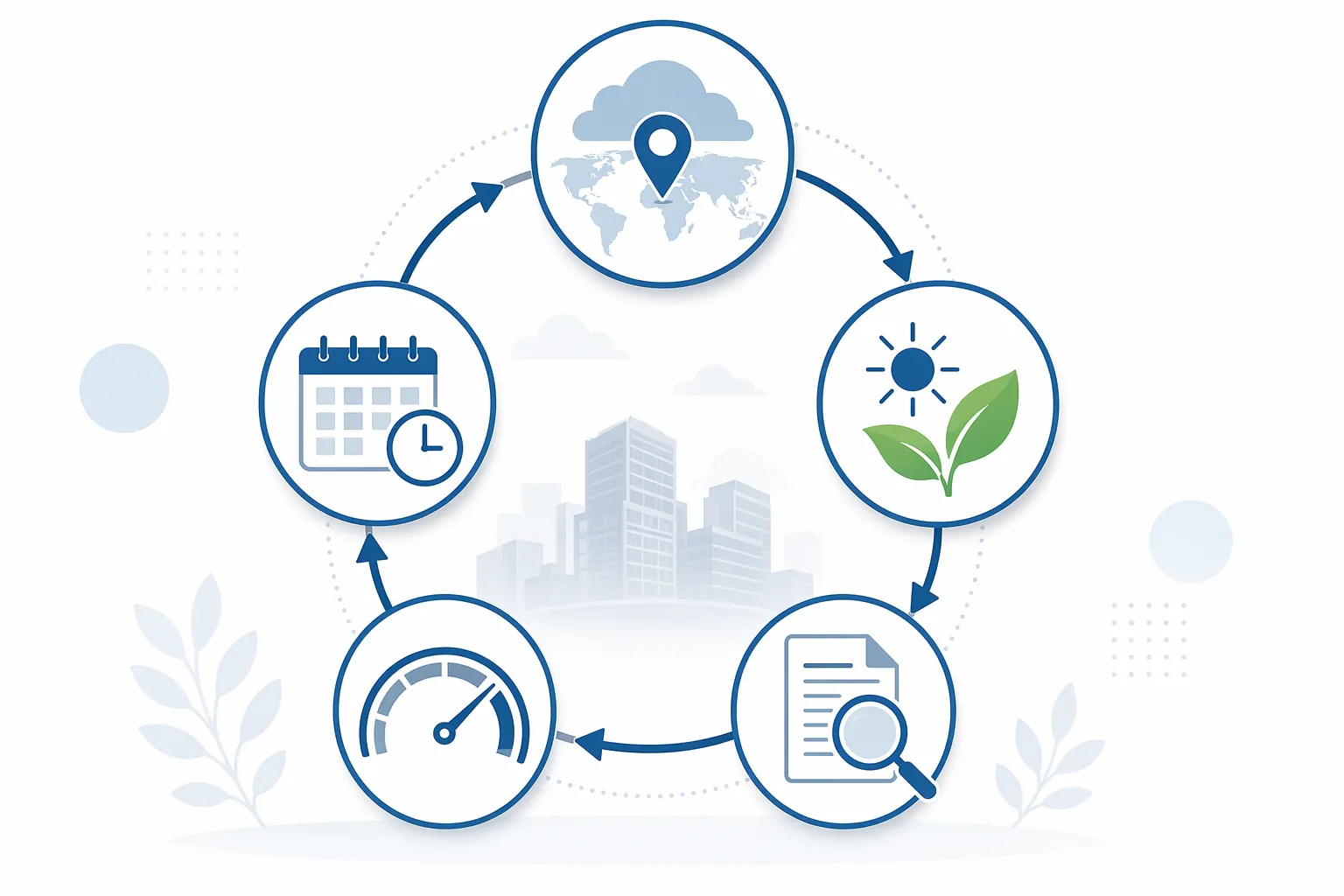
The following framework is not a pricing model. It will not calculate a vendor’s marginal inference cost from the outside. It is a way to force traceability: where the workload runs, which costs are contractually absorbed, which costs can be repriced, and what operational compromises appear before a price increase is called a price increase.
| Due diligence question | What the answer should clarify |
|---|---|
| What cloud regions power your AI inference? | Whether the workload is concentrated in states or utility territories with large-load tariffs, interconnection strain, or high data-center density. |
| What share of hosting energy is covered by renewable PPAs or equivalent procurement? | Whether the vendor can point to supply arrangements rather than relying on hyperscaler-level statements. |
| Do your SaaS contracts include energy-cost pass-through provisions? | Whether energy, hosting, capacity, or cloud-provider increases can reappear as fees, tier changes, minimum commitments, or renewal uplifts. |
| Have you experienced data-center capacity-related latency or throttling events in the last 12 months? | Whether cost pressure is already showing up as performance management. |
| What is your multi-region redundancy strategy for the next 36 months? | Whether the vendor can maintain service levels if one preferred region becomes expensive, constrained, or politically delayed. |
1. What cloud regions power your AI inference?
This is the first question because rate exposure is not evenly distributed. A vendor answer such as “we run on Azure” or “we use Google Cloud” is too broad for procurement. The relevant answer identifies primary and secondary regions for inference, model serving, data processing, and disaster recovery, with enough specificity to map those regions against large-load tariff regimes and capacity constraints.
A 50-state review found that 36 states have large-load tariffs while 14 do not.[5] That split matters because a large-load tariff can change who pays for grid upgrades, demand charges, and infrastructure needed to serve data centers. It does not mean every workload in a tariff state becomes expensive, and it does not mean a state without such a tariff is risk-free. It means “cloud region” is now a commercial exposure field, not just an architecture detail.
For supply-chain planning buyers, this should sit next to the normal security and data-residency questions. The platform set discussed in ChainSignal’s AI demand forecasting tools comparison spans vendors with different cloud strategies, model architectures, and deployment assumptions. Region diversity is not automatically better; unnecessary sprawl can add latency and governance work. But if a vendor’s inference layer depends heavily on one constrained geography, the buyer should know that before accepting a three-year pricing schedule.
A useful RFI response names the cloud provider, the relevant regions, the failover regions, and any customer restrictions that prevent workload movement. A weaker response says only that the vendor’s cloud provider has signed the Pledge. That may be true, but it does not answer where the buyer’s workload runs or how regional utility costs flow through the commercial model.
2. What share of hosting energy is covered by renewable PPAs?
The Pledge’s renewable matching commitment is attractive because it points to an actual hedge: long-term clean power procurement can reduce exposure to volatile wholesale markets and reputational backlash.[1] For an enterprise buyer, the question is whether that hedge exists at the SaaS vendor level or only at the hyperscaler brand level.
The vendor does not need to reveal every energy-procurement detail. It should, however, be able to distinguish between three claims: the cloud provider has corporate renewable targets; the specific regions used for AI workloads are matched by renewable procurement; and the vendor has its own contractual coverage or commitments for the hosting capacity it consumes. Those are not interchangeable claims.
A procurement team should avoid turning this into a consumer sustainability questionnaire unless that is already part of the company’s sourcing policy. The commercial reason to ask is narrower: renewable PPAs and similar instruments can affect the vendor’s cost stability, public-policy exposure, and ability to explain future hosting surcharges. If the vendor cannot connect its AI hosting footprint to any energy-coverage mechanism, the buyer should treat the Pledge as upstream context only.
3. Do your SaaS contracts include energy-cost pass-through provisions?
This is the question that belongs in the pricing exhibit, not in a vendor webinar. ChainSignal has not found a standard, disclosed data-center-energy-cost rider in the public SaaS terms of the major supply-chain planning vendors in this category. That absence is not proof that energy costs will be passed through. It is proof that the buyer cannot assume the pass-through path has been ruled out.
Procurement should look beyond the word “energy.” The relevant language may appear as hosting-cost adjustments, third-party cloud-provider increases, usage-based compute fees, premium AI capacity, model-execution limits, overage charges, indexation clauses, or renewal repricing rights. A vendor can preserve margin without ever creating a line item called an energy surcharge.
The RFI should ask vendors to place each cost pressure into one of five buckets: absorbed during the subscription term, passed through during the term, deferred until renewal, converted into usage or capacity tiers, or handled through service-level changes. If the vendor says “the cloud absorbs it,” the next question is whether that statement is contractual, policy-based, or merely the vendor’s current expectation.
This is also where buyers should separate AI enthusiasm from commercial discipline. Supply-chain planning investment may still be justified, especially where forecasting accuracy, planner productivity, or inventory decisions are material. ChainSignal’s buyer framework for AI forecasting tools covers the capability side of that decision. The point here is narrower: a business case that assumes stable platform costs should not ignore a cost category that the vendor has not contractually allocated.
4. Have you experienced capacity-related latency or throttling events?
Price is not the only way infrastructure pressure reaches an enterprise user. Capacity constraints can first show up as slower response times, queueing, degraded batch windows, reduced concurrency, or stricter controls on model calls. For planning teams, those symptoms matter because AI features are often embedded into time-sensitive workflows: forecast refreshes, scenario planning, allocation simulations, exception triage, and planner copilots.
The infrastructure constraints are not short-cycle annoyances. Transformer lead times are reported at 18 to 36 months, and interconnection queues can run 3 to 5 years.[7] That gives procurement a reason to ask about the last 12 months of capacity incidents and the next 36 months of mitigation, rather than treating every outage or latency complaint as an isolated support issue.
The answer should separate cloud-provider outages from vendor architecture decisions. A retry storm, for example, can turn a contained cloud incident into a larger application failure if client behavior, queue design, and backoff logic are weak. ChainSignal’s analysis of an Azure OpenAI retry-storm failure is useful because it keeps the discussion out of abstraction: the buyer’s exposure is not just whether the cloud has enough power, but whether the application vendor has engineered graceful degradation when shared AI infrastructure becomes unstable.
A credible vendor response identifies any recent capacity-related service incidents, explains whether AI features were throttled or queued, and states whether customer workloads were prioritized by contract tier. If the vendor has never seen capacity pressure, that may be true. It should still be able to describe what would happen if the primary inference region becomes constrained.
5. What is your multi-region redundancy strategy for the next 36 months?
Redundancy used to be a resilience question first and a cost question second. For AI planning workloads, it is now both. If a vendor has only one economical region for inference, redundancy may exist on paper but become commercially painful when the preferred region faces tariff changes, grid constraints, or local opposition.
The next 36 months deserve attention because new power and data-center capacity cannot be added instantly. Reporting on the AI-energy supply chain overlap has pointed to 46 planned data centers representing 56 GW moving behind the meter, while Data Center Watch identified $98 billion in projects blocked or delayed by community opposition in a March-to-June 2025 snapshot.[8] That single-quarter figure should not be treated as a permanent trend line. It does show why a vendor’s redundancy plan should not assume that every planned region or facility arrives on schedule.
The RFI should ask for region-level redundancy, not just a generic disaster-recovery statement. Can inference move across regions without retraining, data-residency conflicts, or model-quality degradation? Are there customer-visible differences in latency by region? Are premium AI features dependent on one cloud provider’s model endpoint? What happens to committed service levels if the vendor has to shift workloads into a more expensive region?
This is where the engineering nuance matters. Multi-region design has trade-offs: replication cost, data-governance complexity, model consistency, and latency. The procurement goal is not to demand maximum redundancy at any price. It is to understand whether the vendor has an executable plan, who pays for it, and whether the buyer’s contracted service levels survive the move.
How to Read Vendor Answers Without Overreading Them
A strong answer will usually be specific without pretending to be omniscient. The vendor should know its cloud regions, failover design, usage-metering logic, renewal levers, and service-level commitments. It may not know how every state commission will implement the Pledge, how each utility will price large loads, or how wholesale markets will behave in a constrained region. Procurement should not ask a SaaS vendor to forecast utility regulation with false precision.
A weak answer leans on public hyperscaler commitments while refusing to map them to the buyer’s contract. “Our cloud provider signed the Pledge” is not a pass-through policy. “We are committed to sustainability” is not a capacity plan. “AI is included” is not an answer to whether the included tier can be repriced, throttled, or constrained as inference costs change.
Consumer concern is useful atmosphere, not proof of enterprise SaaS repricing. A March 2026 Consumer Reports survey found that 78% of U.S. adults were concerned that data centers would raise their electricity bills.[6] That tells buyers the issue has political force. It does not tell them whether a Kinaxis, Blue Yonder, o9, RELEX, or Anaplan renewal will include an AI hosting uplift. The contract still has to do that work.
The same caution applies in the other direction. Modest national inflation estimates do not eliminate regional exposure. A vendor serving inference from a constrained region may face a different operating environment than the national average implies. Buyers should ask for traceability, not certainty.
Where This Belongs in the Renewal Process
The best time to raise these questions is before finalist selection or before the renewal baseline is accepted. Once the commercial model is framed as a standard uplift against last year’s subscription, energy and capacity exposure becomes harder to isolate. The buyer should ask for a written response, then carry any unresolved exposure into the pricing schedule, service-level exhibit, and renewal cap language.
- In the RFI, ask for primary and secondary AI workload regions, not just cloud-provider names.
- In the security and architecture review, ask how inference fails over and whether model performance changes by region.
- In commercial negotiations, ask whether cloud, energy, capacity, or third-party infrastructure cost increases can change pricing during the term.
- In SLA review, ask whether throttling, queueing, or reduced concurrency counts as service degradation.
- In renewal language, ask whether AI usage tiers can be redesigned before the next contracted renewal window.
This does not require treating every vendor as evasive. Some vendors may have sound cloud commitments, reserved capacity, conservative AI packaging, and credible redundancy. Others may be early in the process and still learning how much inference demand their customer base will create. The buyer’s job is to prevent that uncertainty from being resolved later as a surprise uplift.
The Ratepayer Protection Pledge is relevant context. It is not a contractual protection for enterprise AI platform budgets. Until supply-chain planning vendors disclose how AI hosting energy costs are absorbed, passed through, deferred, bundled, or operationally managed, buyers should treat data-center energy exposure as a due diligence item rather than a settled prediction.
References
- Ratepayer Protection Pledge — The White House, March 4, 2026.
- State utility laws are the primary barrier to Trump's AI ratepayer protection pledge — Utility Dive.
- Data Center Power Demands Are Contributing to Higher Energy Bills — EESI.
- Data center boom expected to raise electricity component of PCE inflation — Dallas Fed.
- AI Data Centers and Your Electric Bill: What Are Ratepayer Protection Laws? — Super Lawyers.
- AI Data Centers Impact on Electric Bills, Water, and More — Consumer Reports, March 2026.
- Why AI's Future Depends on the Supply Chain: Inside the Energy, Construction, and Logistics Constraints of the Data Center Boom — Logistics Viewpoints, October 9, 2025.
- The risks of the AI-energy supply chain overlap — Latitude Media.
Cited evidence
- What Trump's Ratepayer Pledge Means for AI Data Center Supply Chains
The Ratepayer Protection Pledge shifts grid upgrade costs but lands on a supply chain already crippled by transformer shortages, tariff exposure, and multi-year lead times—forcing enterprise AI buyers to plan for higher costs and delays through at least 2028.
- How AI computer vision detects spoilage to prevent food recalls
This analysis of four computer vision deployments at Tyson Foods, Walmart, Kraft Heinz, and Nestlé shows that AI-powered inspection catches defect classes that manual methods miss, with clear recall-prevention implications. But the impact depends on upstream placement and is limited to visible-surface defects.
- Why Walmart's AI Didn't Automate the EnHomee Recall
This article examines why Walmart's self-healing inventory and blockchain traceability systems were not deployed in the EnHomee dresser recall, and what that capability-execution gap means for enterprises evaluating AI-driven returns and recall logistics solutions.
Ready to check your own team's readiness for this pattern?
See the procurement readiness checklist →Spotted something inaccurate or incomplete in this entry? ChainSignal reviews corrections and additional evidence before publishing an update — this is not a public comment thread.
Flag an inaccuracy / submit evidence for this entry →