What Trump's Ratepayer Pledge Means for AI Data Center Supply Chains
The Ratepayer Protection Pledge shifts grid upgrade costs but lands on a supply chain already crippled by transformer shortages, tariff exposure, and multi-year lead times—forcing enterprise AI buyers to plan for higher costs and delays through at least 2028.
The Ratepayer Protection Pledge is clean enough to fit in a utility commission talking point: large new power users, including AI data centers, should pay for the grid upgrades they trigger rather than pushing those costs into general electricity rates. The Trump administration announced the pledge in March 2026, and Reuters reported in July that the administration was moving to expand it to data centers more directly.[1][2]
That cost-allocation principle is not trivial. If a hyperscale campus needs a new substation, transmission work, or distribution reinforcement, utilities should not be able to hide the bill inside a broad rate case and call it system modernization. The problem for enterprise AI buyers is that payment responsibility is only one half of the procurement equation. The other half is whether the equipment exists, whether it can be imported at an acceptable cost, and whether the utility can energize the site inside the contract calendar.
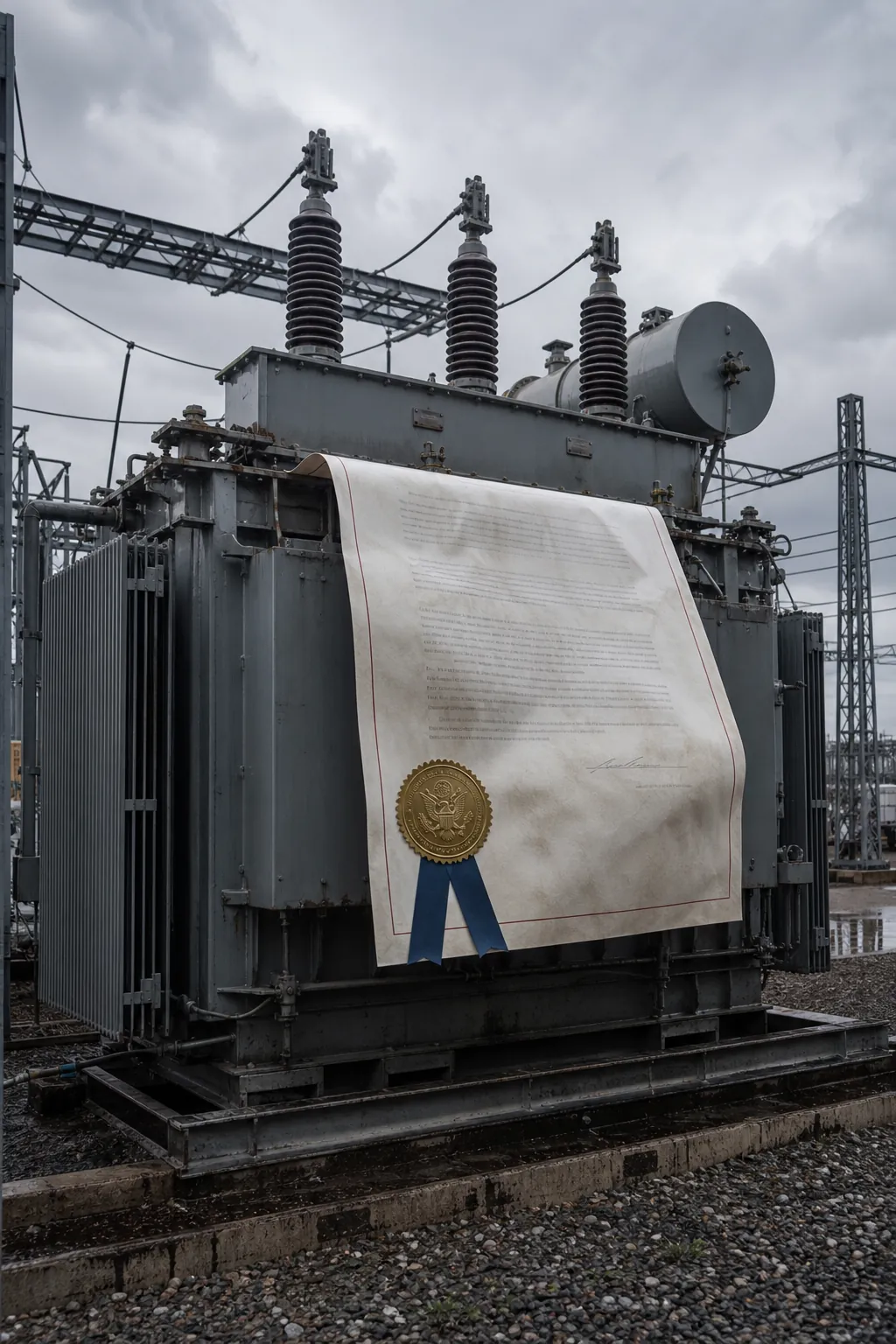
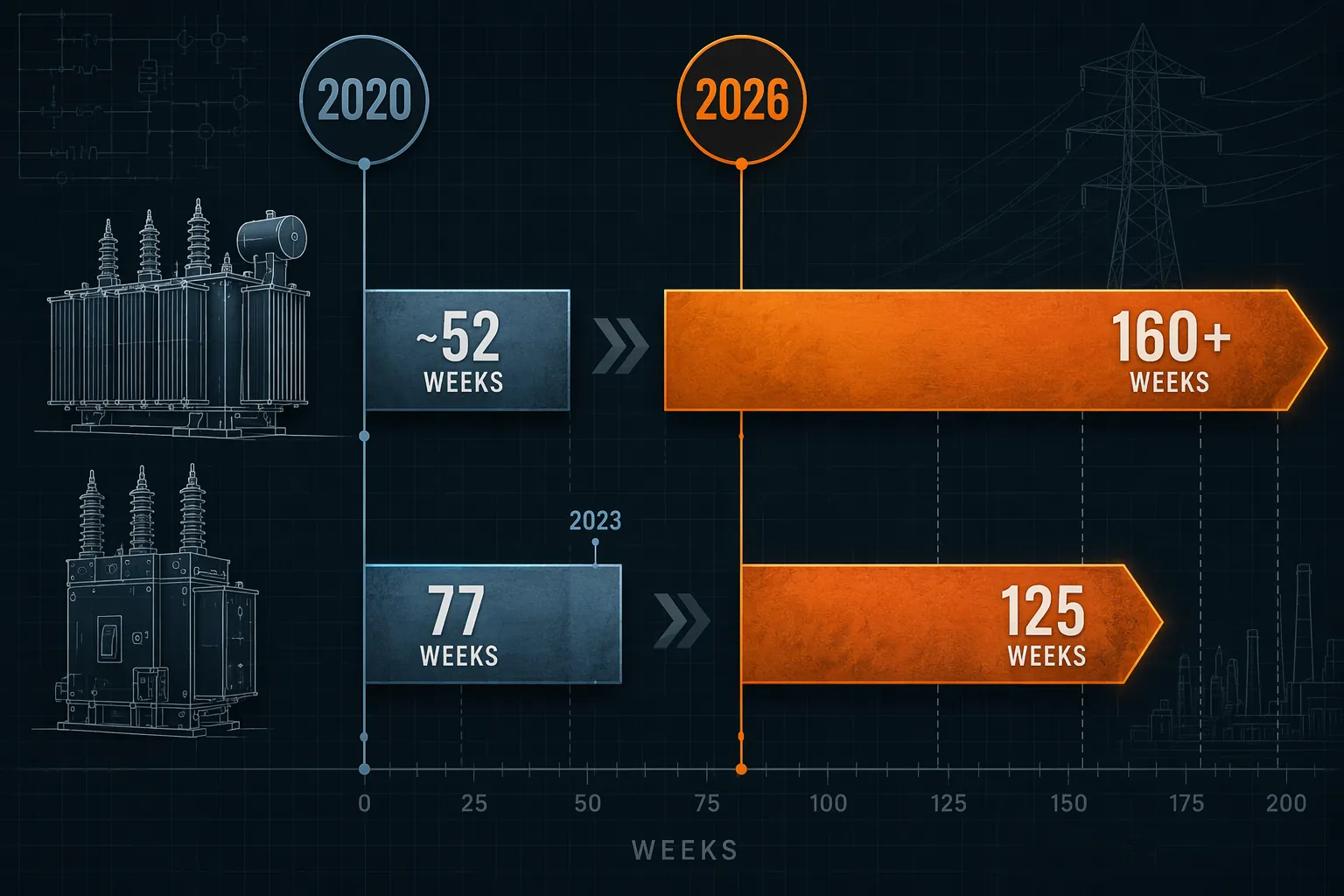
That is where the Trump ratepayer pledge, AI data center costs, and the supply chain collide. A pledge can decide who is expected to pay for a transformer. It cannot make a generator step-up transformer arrive sooner than a 160-plus-week lead time, or make a high-voltage circuit breaker appear before a 125-week queue clears. The White House's April 2026 Defense Production Act determination described domestic grid infrastructure equipment capacity as "dangerously limited," and Utility Dive's analysis of that determination put current lead times for generator step-up transformers above 160 weeks, compared with roughly 52 weeks in 2020-2021; high-voltage circuit breakers were at 125 weeks, up from 77 weeks in 2023.[3][4]
For a procurement director buying AI infrastructure in Q3 2026, that difference matters more than the political branding. A cloud quote that assumes capacity in a preferred region is also assuming a long chain of upstream commitments: utility interconnection studies, transformer slots, breakers, cable, tariff exposure, construction sequencing, and energization. If any one of those slips, the enterprise customer may not see a line item labeled "ratepayer pledge." It may see a delayed AI rollout, a region substitution, a revised energy pass-through clause, or a higher reserved-capacity price.
What the pledge changes, and what it leaves untouched
The pledge is best understood as a cost-responsibility instrument. It aims to prevent the cost of serving very large loads from being socialized across households and smaller commercial customers. In principle, that can improve price signals: if a data center developer causes a substation expansion or transmission upgrade, the developer should face the cost of that upgrade rather than relying on a utility to spread the bill.
But the pledge does not resolve the physical work behind the invoice. It does not shorten transformer production cycles. It does not remove tariffs embedded in imported components. It does not clear interconnection backlogs in Northern Virginia, Phoenix, or Dallas. It does not give a utility procurement team a spare fleet of large power transformers when every other utility, renewable developer, industrial customer, and data center developer is also trying to reserve equipment.
That distinction is easy to lose because rate design language and construction language often sit in the same public debate. A state can decide that a large-load customer must bear grid upgrade costs. A utility can then issue a procurement package and discover that the required transformer slot is years away. Those are connected events, but they are not the same constraint.
For buyers downstream of the data center developer, the practical question is not whether the pledge has already raised enterprise AI prices. It is too recent for that claim. The March announcement and July expansion report are close to the current contracting window, and measured pass-through into enterprise AI service pricing will take time to show up. The better question is whether 2026 contracts are being signed before developers, utilities, and cloud providers have fully priced the equipment cycle now forming underneath them.
The equipment queue underneath AI capacity
The grid equipment shortage is not a single missing part. It is a layered procurement failure across large transformers, high-voltage breakers, cables, substations, and skilled installation capacity. A data center can have land, financing, servers, and a customer pipeline while still waiting for the utility-side equipment that turns a site into usable capacity.
The pressure is visible in market share. Wood Mackenzie data cited by Reuters projects data centers rising from about 2% of the electrical equipment market in 2020 to 40% under accelerated scenarios.[5] That does not mean data centers are the only reason equipment is scarce. It does mean the sector is moving from a niche load category into a buyer class large enough to change the order book for utilities and manufacturers.
The import picture makes the timing worse. Utility Dive reported that Chinese transformer imports rose from fewer than 1,500 units in 2022 to more than 8,000 units in 2025, while China supplies more than 40% of U.S. battery imports and 15%-25% tariff cost adders are embedded in each import.[4] That is not a comfortable dependency for an administration trying to use wartime production authorities to rebuild domestic grid equipment capacity.
The April 2026 Defense Production Act action matters because it is an official acknowledgement that the equipment base is strategically thin. The White House invoked Section 303 of the Defense Production Act for grid infrastructure equipment and supply chain capacity on April 20, 2026.[3] Utility Dive separately cited a Center for Biological Diversity estimate that FY2026 DPA funding stood at about $323 million, and noted that reshoring relevant capacity can take two to three years.[4] That funding figure is not a White House number, and the reshoring timeline is not a cure for projects seeking energization in the next several quarters.
The broader transmission supply chain was already flashing red before the pledge. The International Energy Agency said in February 2025 that cable costs had nearly doubled since 2019, power transformer prices were up about 75%, cable procurement timelines had stretched to two to three years, and large power transformers could take up to four years.[6] Deloitte reported in June 2025 that U.S. construction material costs were up 40% over five years, another cost layer for data center and grid buildouts.[7]
| Constraint | What it means for AI infrastructure buyers |
|---|---|
| Generator step-up transformers above 160 weeks | Capacity plans can miss enterprise AI deployment windows even when financing and demand are in place. |
| High-voltage circuit breakers at 125 weeks | Substation and interconnection work can lag behind building construction. |
| Cable procurement at two to three years | Transmission and distribution upgrades become scheduling risks, not just engineering tasks. |
| Large transformer procurement up to four years | Region selection and cloud capacity reservations need longer risk horizons. |
| 15%-25% tariff adders on imports | Equipment-cost escalation can flow into developer economics and later customer pricing. |
This is the part of the market where neat policy language runs into purchase orders. If the pledge makes a data center developer pay directly for a grid upgrade, the developer still has to join the same queue. If the developer absorbs tariffed equipment costs, those costs do not disappear; they sit in the project's required return, lease rate, power charge, cloud-service price, or availability commitment.
Interconnection waits are now part of the AI procurement calendar
The most dangerous assumption in 2026 AI procurement is that data center capacity is mainly a server and GPU problem. In the tightest U.S. markets, the harder gate may be electric service. Tech Insider, aggregating Bloomberg and Sightline Climate reporting, described four- to seven-year grid interconnection waits in Northern Virginia, Phoenix, and Dallas, and estimated that 30%-50% of planned 2026 U.S. data centers had been delayed or canceled.[8] Those figures should be treated with the caveat that they come through a secondary aggregation of Bloomberg/Sightline material, not a public primary dataset, but they are directionally consistent with what the equipment lead times imply.
The same Tech Insider aggregation reported PJM congestion costs rising 81% to $3.2 billion in 2025.[8] Congestion costs are not the same as transformer procurement costs, and they should not be blended into one causal story. Together, though, they describe an electric system where location, deliverability, and timing are becoming commercial variables for technology buyers, not background utility details.
This is also where other delay mechanisms compound the equipment problem. Community opposition can hold projects in local review even before energization is solved, as covered in Why AI Data Center Opposition Is Now a Supply Chain Risk. Moratoriums and fragmented local rules can freeze site decisions, as covered in AI Data Center Moratoriums Are Creating Supply Chain Constraints. Those issues do not replace the transformer shortage. They make it harder to sequence around it.
How the cost moves from the substation to the enterprise contract
Enterprise buyers usually do not buy high-voltage breakers. They buy cloud commitments, managed AI platforms, model training capacity, inference services, supply-chain planning software, or private data center services. That distance can make the grid equipment problem feel indirect. It is not.
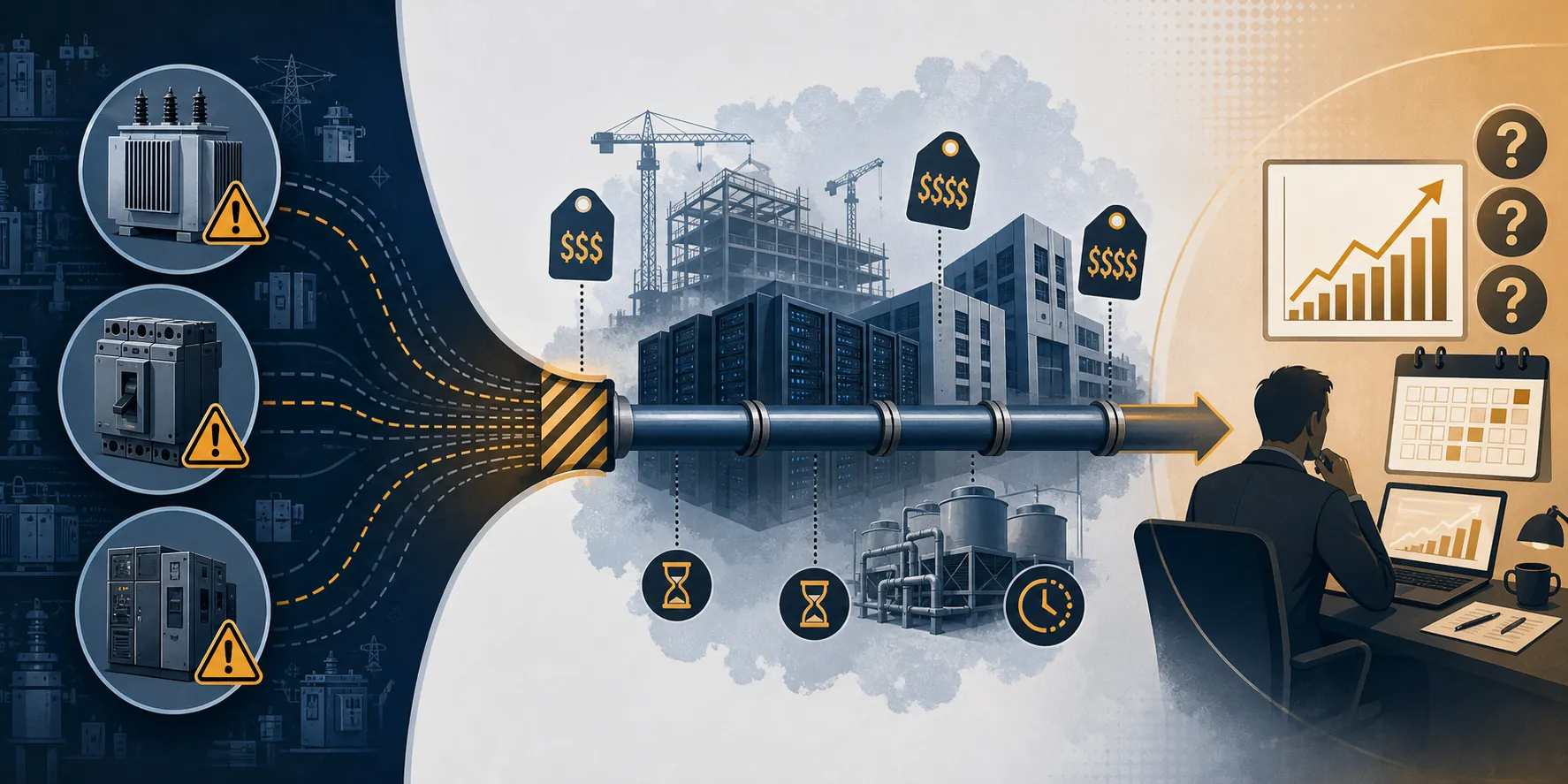
The pass-through path is not instant, and it will not look the same in every contract. A data center developer facing direct grid upgrade responsibility may raise lease rates, require longer commitments, narrow the regions where it offers capacity, or push more power-cost volatility into customer terms. A cloud provider may absorb some near-term cost to protect strategic accounts, then reprice future reservations, tighten service availability language, or steer workloads into regions where power can be secured. A software vendor relying on AI infrastructure may package the increase as a usage tier, an energy surcharge, a capacity reservation fee, or a longer implementation timeline.
The likely lag matters. A 12- to 24-month delay between upstream equipment-cost escalation and visible enterprise AI service pricing is an analytical inference, not a sourced measurement. Existing data support the upstream pressure: long equipment lead times, higher component prices, tariff exposure, and interconnection delays. They do not yet prove a specific percentage increase in enterprise AI prices caused by the pledge. That distinction is important because procurement teams need to plan for exposure without pretending the market has already produced clean attribution.
In practice, the risk often appears in contract language before it appears in a headline price. Watch for terms that let providers revise energy charges, substitute regions, delay reserved capacity, exclude utility interconnection events from service-level remedies, or reopen pricing after a threshold change in power costs. A quote can look stable while the exceptions around it quietly transfer grid risk to the buyer.
The pledge may sharpen that behavior. If data center operators are more clearly responsible for upgrade costs, they have less room to assume that part of the cost will sit with general ratepayers. That is a healthier allocation signal for the power system. It is also a reason to expect more disciplined, more conditional, and potentially more expensive capacity offers from providers that used to treat utility upgrade costs as a slower-moving externality.
What procurement teams should ask before signing 2026 AI capacity deals
The planning response is not to freeze AI procurement until the grid catches up. It is to stop treating power as a buried input. In a long-lead industrial market, the buyer who asks only for compute price and implementation date is not seeing the constraint that may control both.
- Ask which data center region will support the workload, whether capacity is already energized, and what utility interconnection dependencies remain.
- Require disclosure of energy-cost pass-through terms, including tariff-related equipment charges if they can affect future pricing.
- Separate reserved compute availability from planned future capacity, especially in Northern Virginia, Phoenix, Dallas, and other constrained markets.
- Review force majeure, delay, and region-substitution language for utility interconnection, substation equipment, transformer, breaker, and cable dependencies.
- Treat AI platform implementation dates as conditional until the provider identifies the physical capacity path behind them.
The strongest vendor answer is not a generic statement about sustainability, renewable power, or hyperscale buying power. It is evidence that the capacity being sold is already powered, already under firm utility commitment, or insulated from near-term grid equipment procurement. If the answer depends on future substation work, the buyer should know which party owns the equipment order, where it sits in the queue, and what happens if energization slips.
Large buyers also need to compare regions differently. The lowest nominal compute price may be less attractive if it sits behind a weaker power-delivery path. A somewhat higher price in a region with confirmed capacity can be cheaper than a delayed deployment that forces workarounds, dual sourcing, or a rushed migration later. That is basic supply-chain math, even when the product is AI compute rather than steel or semiconductors.
The 2028 risk window
Through at least 2028, enterprise AI buyers should assume that power availability, energy-cost pass-through, data center region selection, and vendor capacity commitments are supply-chain risk variables. That time frame follows from the equipment lead times already visible in the market: two to three years for cables, up to four years for large power transformers, and more than 160 weeks for some generator step-up transformers.[4][6]
The Ratepayer Protection Pledge may protect households and smaller commercial customers from some direct upgrade burden. That is a real policy objective. But it does not shorten transformer lead times, remove tariff exposure, expand domestic manufacturing overnight, or resolve multi-year interconnection queues. It changes who is expected to pay; it does not guarantee that the paid-for equipment can be delivered on a normal planning horizon.
Contracts signed in Q3 2026 can still look acceptable before delayed equipment costs and energization limits fully surface. The prudent buyer treats that gap as procurement exposure now, not as a utility problem to discover after an AI rollout date has already been promised.
References
- Ratepayer Protection Pledge, White House, March 2026
- Trump set to expand power cost pledge to data centers, Reuters, July 22, 2026
- Presidential Determination Pursuant to Section 303 of the Defense Production Act of 1950, as Amended, on Grid Infrastructure Equipment and Supply Chain Capacity, White House, April 20, 2026
- What does Trump's wartime powers flex mean for transformers and other grid equipment shortages?, Utility Dive, April 22, 2026
- US power companies scramble to secure equipment as surging data center demand strains grid, Reuters, July 9, 2026
- Rising component prices and supply chain pressures are hindering the development of transmission grid infrastructure, International Energy Agency, February 2025
- Can US infrastructure keep up with the AI economy?, Deloitte Insights, June 2025
- U.S. AI Data Center Delays: 7 GW Capacity Crisis, Tech Insider, May 2026
Cited evidence
- Intel's AI Data Center Growth Strains CPU Supply Chain
Intel's 22% DCAI revenue jump to $5.1B has created a CPU shortage with lead times up to 22 weeks and allocation fulfillment around 40%. This article analyzes how enterprise procurement leaders should navigate allocation risk, pricing, and product prioritization through Q3 2026.
- How AI data center electricity costs change supply chain planning
As AI data centers drive structural electricity price increases, supply chain planners must treat electricity as a variable cost in S&OP, network design, and total-landed-cost models. This analysis provides the evidence and framework for updating planning assumptions.
- What IBM's AI Software Delays Mean for Supply Chain Planning
IBM's Q2 2026 earnings miss and 25% stock drop reveal that AI software revenue delays are tied to client capex shifts, not product rejection. This article examines whether the setback is a temporary blip or a structural risk for supply chain planning buyers evaluating IBM.
Ready to check your own team's readiness for this pattern?
See the procurement readiness checklist →Spotted something inaccurate or incomplete in this entry? ChainSignal reviews corrections and additional evidence before publishing an update — this is not a public comment thread.
Flag an inaccuracy / submit evidence for this entry →