Why Random Data Corrupts AI Supply Chain Forecasting
Random, noisy, and poor-quality data does not merely degrade AI forecasts—it amplifies data problems at scale. This use-case analysis documents the specific failure mechanisms, prevalence statistics, and financial implications supply chain planning teams face when deploying AI forecasting without data readiness.
“Random data problem” is not the phrase most planning teams use in the conference room. They usually call it garbage in, garbage out; noisy data; poor master data; bad demand signals; data-readiness risk; or, after the first failed pilot, “why did the model believe that number?” In AI supply chain forecasting, the implication is blunt: the model does not quietly absorb random, stale, incomplete, or contradictory inputs and turn them into operational clarity. It gives those inputs more authority, moves them faster, and lets them travel deeper into replenishment, inventory, allocation, procurement, and finance decisions.
That is the part that tends to get softened in software business cases. A forecast engine can be more adaptive than a spreadsheet. It can find demand patterns a planner would miss. It can reduce manual reconciliation if the data foundation is sound. But when the input layer is random in the practical sense—missing store inventory, mismatched SKU hierarchies, late shipment confirmations, distorted promotion history, ungoverned customer attributes—the AI forecast becomes a high-speed distribution mechanism for bad assumptions.

The Data Problem Is Not a Fringe Hygiene Issue
The strongest reason to take the AI random data problem seriously is not that data people have been warning about GIGO for decades. It is that the preconditions for AI forecasting are still missing in many operating environments where executives are already funding AI.
TraxTech cites industry research indicating that 70% of AI projects fail because of data quality issues rather than algorithmic limitations. The same source says supply chain managers can spend up to 60% of analytics time identifying and correcting data quality issues instead of generating insights. It also cites an average annual poor-data-quality cost of $12.9 million for organizations, a useful directional figure but not one that should be read as a clean, supply-chain-only estimate because it appears to aggregate broader organizational costs.[1]
PwC’s 2026 Digital Trends in Operations survey makes the readiness gap more concrete. Among 767 US-based operations leaders, 87% said poor data quality has affected their ability to achieve value from digital initiatives. Only 30% reported significant improvement in data quality and reliability over the prior two to three years, and only 51% said they establish a clean, structured data foundation before scaling digital initiatives.[2]
Inventory visibility shows the same weakness at the operational edge. OpenSky Group’s 2026 statistics roundup cites Impinj’s Supply Chain Integrity Outlook 2025, in which only 33% of supply chain managers consistently obtain accurate, real-time inventory data. The same roundup reports data accuracy as the top AI implementation challenge at 43%, followed by data availability at 39% and real-time access at 36%.[3]
Access and governance are not in better shape. Cloudera reported in 2026 that 79% of IT leaders said data-backed initiatives are hindered because they cannot access all needed data across environments, while only 18% of organizations said all their data is fully governed.[4]
Those figures describe a familiar Monday morning problem. A demand planner is not debating whether neural networks are impressive. They are trying to understand why the forecast for a family of SKUs moved, whether the movement reflects true demand, whether the replenishment run already consumed it, and whether anyone can trace the input that caused the change. If the data estate cannot answer those questions, the model’s precision becomes cosmetic.
How Bad Inputs Become Bad Forecasts
AI forecasting failure is often described as if poor data merely lowers a model score. In planning, the damage is more specific. Different data-quality failures create different forecast behaviors, and those behaviors create different operating consequences.
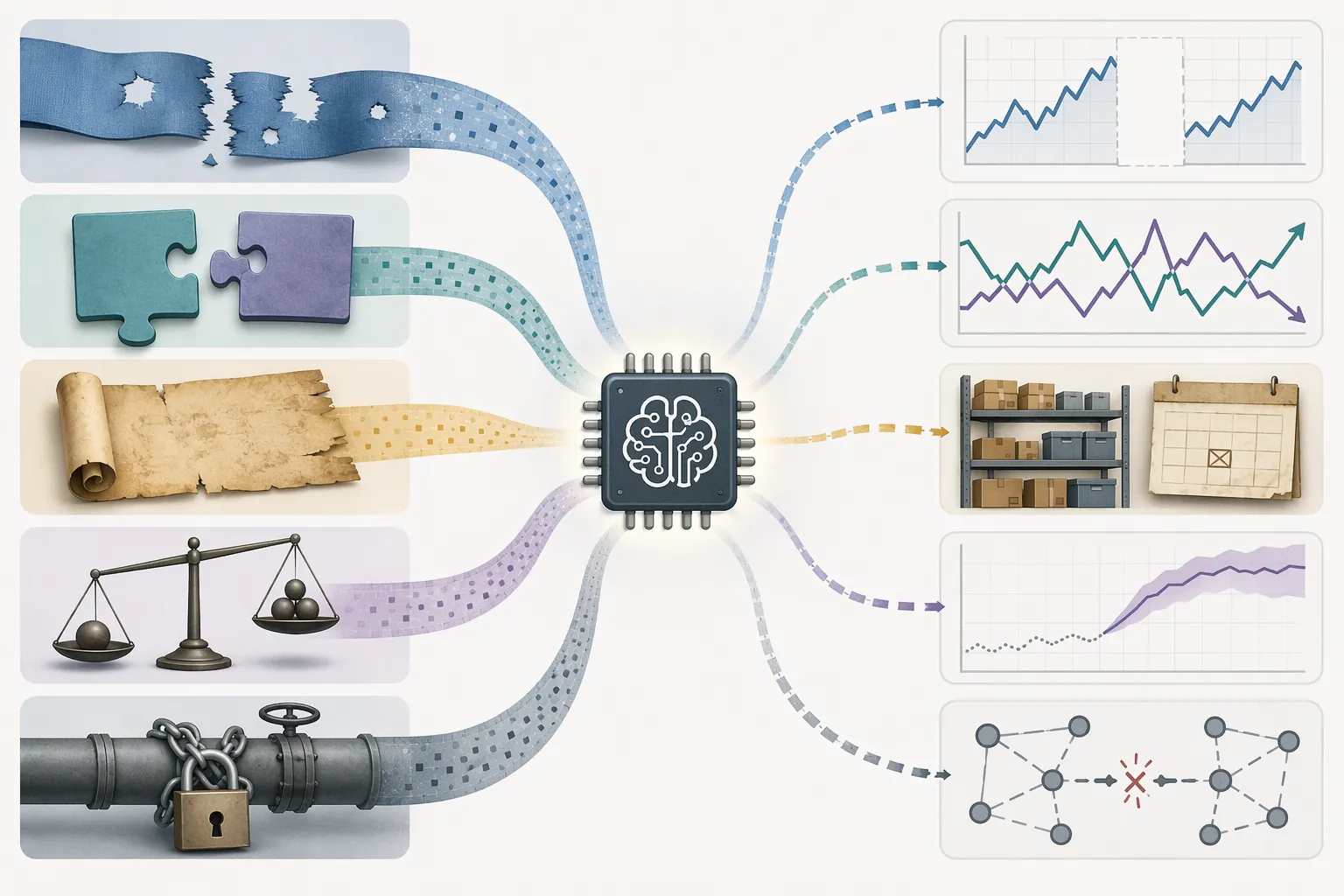
| Input failure | Forecast consequence | Planning impact |
|---|---|---|
| Incomplete data | The model sees only part of demand, inventory, supply, or channel activity. | Blind spots appear in the forecast, planners compensate manually, and replenishment may underreact or overreact. |
| Inconsistent data | The model learns contradictory relationships across SKU, location, customer, or calendar structures. | Forecast changes become difficult to explain, damaging planner trust and increasing override work. |
| Outdated data | The model preserves yesterday’s reality as if it still describes the current operating environment. | Inventory positions, lead-time assumptions, and demand signals lag actual conditions. |
| Biased data | The model overfits to distorted history, such as stockout-constrained sales or one-off promotion effects. | The forecast repeats the bias and may reinforce allocation, service, or margin errors. |
| Siloed or inaccessible data | The model cannot connect demand, supply, inventory, pricing, and execution signals end to end. | The forecast looks precise inside one system while failing at the handoff to another. |
Incomplete data is the easiest failure mode to underestimate because the forecast still produces a number. If store inventory is missing for a portion of the network, if marketplace demand is loaded later than wholesale demand, or if lost sales are absent during stockouts, the model is not forecasting the business. It is forecasting the visible slice of the business. The planner then sees a number with no obvious warning label, because the AI can interpolate smoothly across a blind spot.
Inconsistent data is more corrosive. One system groups SKUs by selling style, another by manufacturing family, another by financial hierarchy. A planner may know these differences and mentally translate them during a meeting. A model consumes them as if they are stable signals unless the data layer reconciles the definitions. The result can be a forecast that appears to respond to demand but is actually learning from contradictory category, location, or customer relationships.
Outdated data creates a different kind of miss. The model may be technically accurate against the data it receives while operationally wrong against the world the planner has to manage. A late inventory feed, stale supplier lead time, old lane constraint, or yesterday’s order status can make the system recommend action for a network that no longer exists. This matters especially when AI outputs flow automatically into replenishment or allocation before a planner has time to challenge the premise.
Biased data is harder to spot because it often looks like history. Sales during a stockout can teach the model that demand was low. A promotion with poor execution can teach it that the offer was weak. Allocation rules can make one region look structurally less attractive because it never received enough supply to reveal true demand. The model does not know which parts of the record are demand signals and which parts are artifacts of constraint unless the organization marks them properly.
Siloed data is the failure mode that creates the most political noise. Commercial teams see demand. Supply teams see constraint. Finance sees working capital. Logistics sees service risk. If the AI forecast draws from one side of that picture, the number may satisfy the system that generated it and still fail the meeting where the decision has to survive. Cloudera’s access and governance findings help explain why this persists: many organizations are trying to run data-backed initiatives without full access to the data estate or full governance over it.[4]
Scale and Speed Change the Risk
A bad spreadsheet forecast is painful. A bad AI forecast connected to replenishment, procurement, transportation, and inventory targets is a different class of problem. The forecast does not stay in the planning team. It becomes purchase orders, deployment logic, safety-stock changes, labor assumptions, supplier commits, and margin explanations.
This is why “random data” is a misleadingly small phrase. In supply chain forecasting, randomness often enters as ordinary operational residue: a null field, a delayed feed, a duplicate location, a calendar mismatch, a one-time promotion loaded as baseline demand, a substitution recorded as true preference, an inventory snapshot taken after the allocation run instead of before it. None of those items looks dramatic by itself. At model scale, each can change what the system treats as signal.
The planner sees the consequence later. Forecast error rises in some item-location combinations and improves in others, making the aggregate KPI look less alarming than the operating pain. Trust erodes because the model cannot explain a miss in terms the business recognizes. Rework increases because planners spend review cycles chasing data defects rather than demand exceptions. Inventory exposure grows when the wrong signal enters automated replenishment. ROI slips because the business case assumed planner productivity and accuracy gains that the data foundation cannot support.
Security-related model corruption is a parallel pathway, not the same issue. A breach can also poison AI outputs by altering model states or data flows; the data-quality problem discussed here is more mundane and more common in planning rooms. The useful connection is that both failure modes ask the same operational question: can the business trace why the model produced the number it produced? That is the same lens explored in ChainSignal’s discussion of how an AI model breach disrupts your supply chain.
The Upside Exists, but It Is Conditional
The answer is not to keep planning trapped in manual reconciliation because the data is imperfect. That argument wastes almost as much money as the vendor pitch that implies the model will clean up the mess. AI forecasting can create value when the data foundation is ready enough for the output to be trusted and acted on.
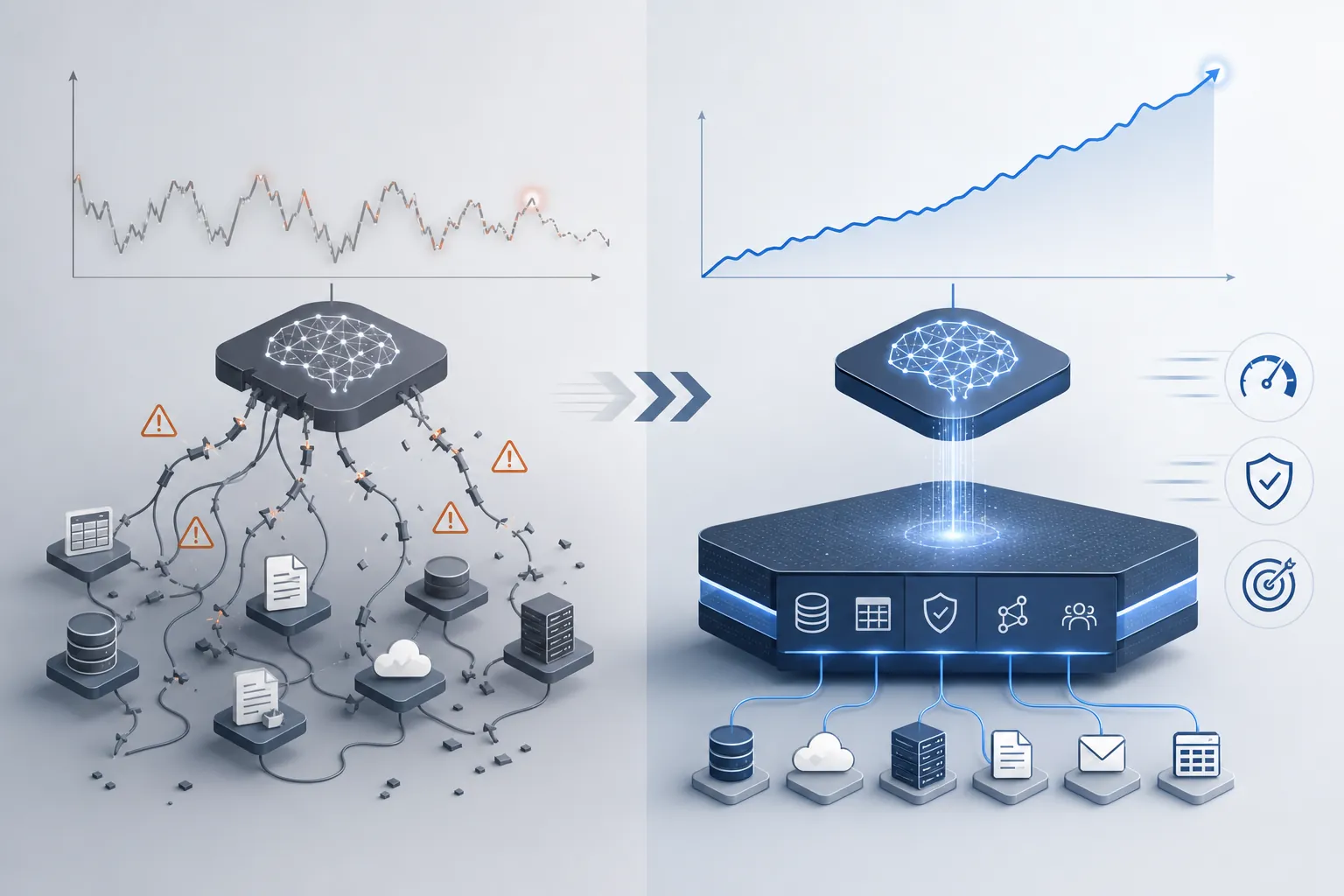
TraxTech reports that companies investing in data infrastructure first achieve 3 times better AI ROI, 45% better AI performance outcomes, and 35% faster implementation timelines.[1] Those are not guarantees for any specific o9, Blue Yonder, Kinaxis, RELEX, Anaplan, or adjacent planning deployment. They are a reminder that the data layer is not preparatory paperwork. It is part of the value mechanism.
McKinsey has described sizable potential from AI-enabled operations, including 5% to 20% logistics cost reduction, 20% to 30% inventory reduction, and 5% to 15% procurement spend reduction in AI-enabled distribution contexts. It has also reported that AI-driven forecasting can reduce errors by 20% to 50% and lost sales by up to 65%. Those ranges should be read as conditional upside, not baseline entitlement; they depend on whether the organization can supply usable signals and mitigate weak-data conditions.[6]
Accenture’s 2024 findings, as summarized by OpenSky Group, point in the same direction from a maturity angle: AI-mature supply chains are 23% more profitable than peers and 6 times as likely to use AI or generative AI widely.[3] That does not prove that AI alone caused the profitability gap. Mature AI users are also more likely to have better processes, better governance, and better executive alignment. For a planning leader, that distinction matters. Adoption is not effectiveness.
The structured-task counterexamples are instructive. In ChainSignal’s coverage of OpenAI frontier agents in supply chain, HP-style demand forecasting work appears more plausible where the task is bounded and the data environment is controlled enough for the agent to operate against a defined problem. In grocery pricing, AI value depends heavily on freshness, sell-through, inventory, and local demand data being current enough to support price changes. In tropical storm landfall planning, even sophisticated AI tools depend on accurate, real-time disruption signals; a late or wrong feed does not become more useful because the model is advanced.
Why the Failure Persists
Poor-input forecasting failures persist because they are not mainly a mystery of model science. They are an operating model problem with technology labels attached. Finance wants a return date. IT wants architecture clarity. Vendors want a pilot. Planning wants fewer manual overrides. Data governance wants ownership decisions that business functions often postpone.
Gartner figures summarized by OpenSky Group show that only 23% of supply chain organizations have a formal AI strategy, even among organizations already deploying AI, and only 29% have built the capabilities needed for future readiness.[3] ABC Supply Chain’s 2025 survey, with approximately 1,000 respondents, found that 97% of supply chain professionals acknowledge AI is part of their role, while only about 20% feel capable of evaluating an AI project. Its methodology should be treated as directional, but the gap it describes is recognizable: exposure to AI has moved faster than evaluation capability.[5]
PwC’s 2026 survey adds a useful severity check. Only 4% of organizations reported success across all four areas PwC assessed: AI fully embedded, no scaling barriers, a horizontal structure, and investments delivering expected results.[2] That is not just a strategy statistic. It explains why a technically promising forecast engine can remain trapped between a pilot dashboard and operational adoption.
This is where many AI forecasting initiatives become unfair to planners. The organization buys automation, but the planner remains the last human buffer between a bad input and a financial decision. When the model misses, the planner explains. When the data is stale, the planner notices. When the hierarchy is wrong, the planner reconciles. If the business case assumed automation but left the exception burden with the planning team, the ROI calculation has already started to drift.
What to Ask Before Trusting the Forecast
The useful evaluation lens is not a universal readiness score. Supply chains differ too much by category, channel, cycle time, service model, and system landscape. But the questions that expose the AI random data problem are fairly stable.
- Complete: Does the model receive the demand, inventory, supply, pricing, promotion, substitution, and constraint signals needed for the decision it is influencing?
- Current: Are the feeds fresh enough for the replenishment, allocation, or S&OP cadence that will consume the forecast?
- Consistent: Do SKU, location, customer, calendar, and hierarchy definitions match across the systems feeding the model?
- Governed: Can the business trace ownership, definitions, transformations, and exceptions when the forecast changes?
- Accessible: Can the forecasting system see the end-to-end signal, or only the portion that one function has made available?
These questions matter more than a demo accuracy chart. A model trained on a partial view may look better in a controlled pilot than it performs in the replenishment run. A forecast that improves aggregate error may still create unacceptable misses in volatile item-location combinations. A planning platform may have strong algorithms and still fail if the organization cannot govern the input layer with enough discipline.
AI forecasting value is real, but it is conditional. Poor data does not merely reduce accuracy. It industrializes error by giving bad signals more speed, reach, and apparent authority. Before asking what a forecasting model can predict, the planning organization has to ask whether the data estate is complete, current, consistent, governed, and accessible enough for the prediction to deserve operational trust.
References
- Why Supply Chain AI Projects Fail: The $100M Data Quality Problem, TraxTech
- PwC 2026 Digital Trends in Operations Survey, PwC
- Supply Chain AI Statistics: 18+ Statistics You Should Know for 2026, OpenSky Group
- Bridging The Gap Between Data Readiness And AI Confidence, Forbes/Cloudera, Apr 2026
- Artificial Intelligence Readiness In Supply Chain 2025 — 1000 Respondent Survey, ABC Supply Chain
- Stronger forecasting in operations management — even with weak data, McKinsey
Cited evidence
- What Trump's Ratepayer Pledge Means for AI Data Center Supply Chains
The Ratepayer Protection Pledge shifts grid upgrade costs but lands on a supply chain already crippled by transformer shortages, tariff exposure, and multi-year lead times—forcing enterprise AI buyers to plan for higher costs and delays through at least 2028.
- How AI data center electricity costs change supply chain planning
As AI data centers drive structural electricity price increases, supply chain planners must treat electricity as a variable cost in S&OP, network design, and total-landed-cost models. This analysis provides the evidence and framework for updating planning assumptions.
- What IBM's AI Software Delays Mean for Supply Chain Planning
IBM's Q2 2026 earnings miss and 25% stock drop reveal that AI software revenue delays are tied to client capex shifts, not product rejection. This article examines whether the setback is a temporary blip or a structural risk for supply chain planning buyers evaluating IBM.
Ready to check your own team's readiness for this pattern?
See the demand planning readiness checklist →Spotted something inaccurate or incomplete in this entry? ChainSignal reviews corrections and additional evidence before publishing an update — this is not a public comment thread.
Flag an inaccuracy / submit evidence for this entry →