
Predictive Analytics in Supply Chain Management: Definition, Techniques, and Implementation Roadmap
A definitive glossary entry for supply chain leaders and practitioners. Defines predictive analytics, explains the analytics maturity continuum (descriptive → predictive → prescriptive), details key techniques with a decision framework, provides source-attributed ROI data from enterprise deployments, and outlines implementation challenges, tooling costs, and emerging trends.
Definition: What Is Predictive Analytics in Supply Chain Management?
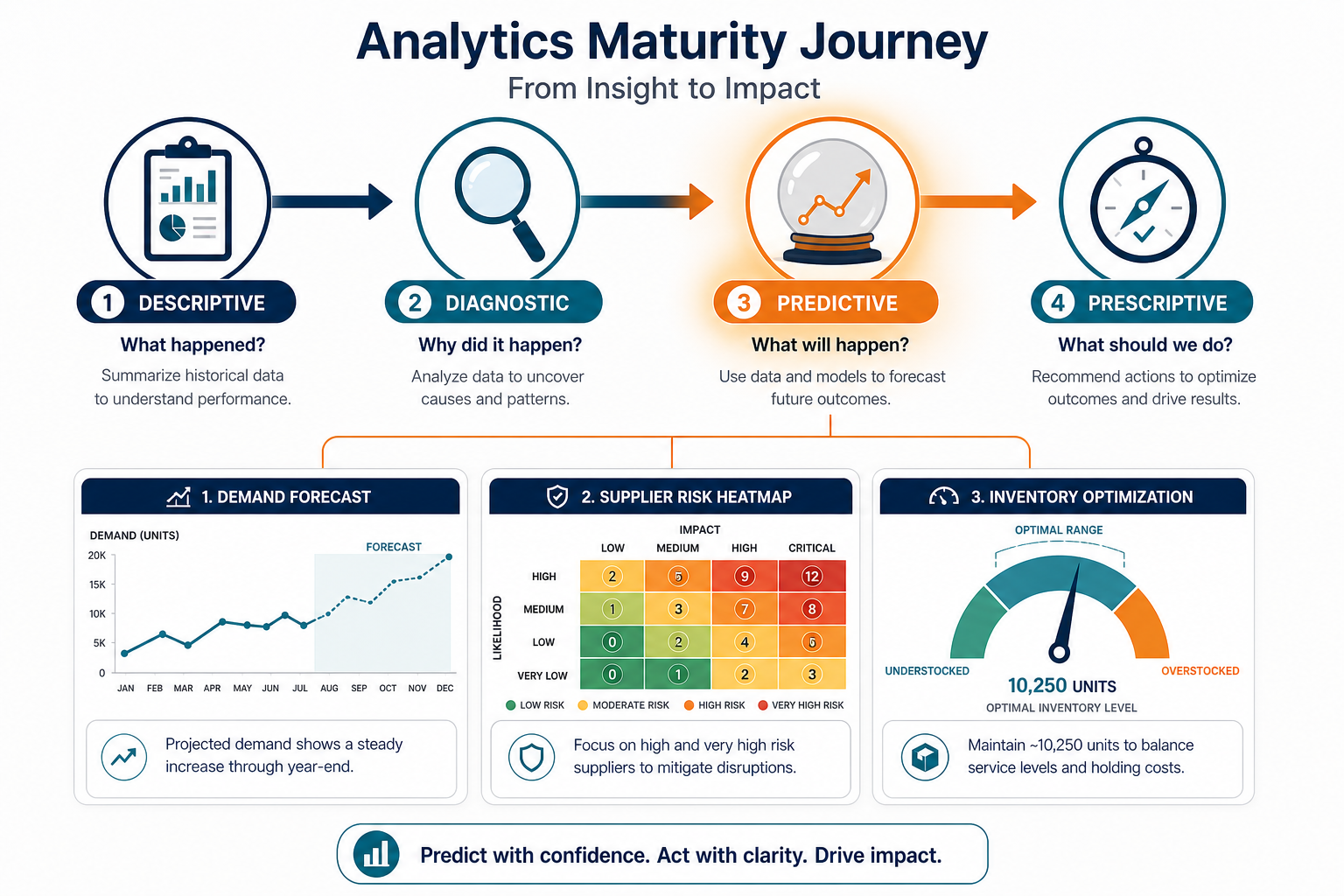
Predictive analytics in supply chain management is the application of historical data, statistical models, and machine learning techniques to forecast future outcomes across planning, procurement, logistics, and warehouse operations. It answers the question “What will happen?” — distinguishing it from descriptive analytics (“What happened?”) and prescriptive analytics (“What should we do?”). This distinction forms the backbone of the analytics maturity continuum, which organizations progress through as they build data-driven supply chain capabilities.
Cited evidence
- The Five Functional Types of Supply Chain Control Towers: Logistics, Fulfillment, Inventory, Supply Assurance, and End-to-End
Supply chain control towers are not one-size-fits-all. This glossary entry disambiguates the five distinct functional scopes—logistics, fulfillment, inventory, supply assurance, and end-to-end—detailing each type's integration patterns, data sources, and KPIs to help operations managers and IT architects select the right scope for their operational bottlenecks.
- Multi-Echelon Inventory Optimization (MEIO): Definition, AI Techniques, and Supply Chain Applications
A practitioner-grade reference entry defining Multi-Echelon Inventory Optimization (MEIO), explaining how AI and machine learning augment it beyond classical methods, and covering what supply chain directors, inventory planners, and technology evaluators need to know about implementation requirements, quantified benefits, and representative vendor approaches.
- Machine Learning in Supply Chain Management: Techniques, Applications, and Measured Impact
A glossary-style reference for supply chain leaders and planners that defines machine learning in a supply chain context, catalogs the key ML techniques (supervised learning, reinforcement learning, time series forecasting, clustering), maps each technique to specific supply chain functions, and provides source-attributed outcome ranges from McKinsey, Gartner, PwC, and other analysts.
Spotted something inaccurate or incomplete in this entry? ChainSignal reviews corrections and additional evidence before publishing an update — this is not a public comment thread.
Flag an inaccuracy / submit evidence for this entry →