Oracle's $7B Pentagon Contract Reshapes Defense Supply Chain Procurement
The July 2026 Oracle Enterprise Software Initiative gives DoD agencies a standardized vehicle to acquire Oracle Fusion Cloud SCM modules, potentially shifting procurement dynamics. But defense leaders must weigh the streamlined acquisition against unresolved risks—including the DCHRMS failure—before committing to Oracle over multi-vendor planning ecosystems.
Oracle’s new Pentagon agreement matters first as a buying mechanism, not as a product announcement. The July 2026 Enterprise Software Initiative gives the Department of War, the intelligence community, and the Coast Guard a 10-year indefinite-delivery/indefinite-quantity vehicle with a $3.31 billion base and a ceiling of up to $6.99 billion for Oracle on-premises software, SaaS, and professional services.[1] For defense supply-chain organizations, that changes the starting point of the Oracle evaluation. Oracle Fusion Cloud SCM is no longer just another suite that has to fight through a separate procurement path; it can now ride a standardized enterprise vehicle.
That does not make the defense supply-chain software decision under the Oracle Pentagon contract simple. It makes it faster to ask the hard questions. A defense agency can now plausibly evaluate Oracle SCM through the same enterprise channel that covers broader Oracle software, but the contract does not by itself prove that Oracle’s planning, sourcing, logistics, manufacturing, transportation, or AI workflows can carry mission-critical supply-chain requirements.
The important asymmetry is procedural. Oracle now has a pre-authorized, 10-year enterprise lane. o9, Kinaxis, Blue Yonder, SAP IBP, and other planning platforms may still have strong functional claims, but they do not gain the same default acquisition posture from this ESI. That is a real advantage in federal software buying. It is not the same thing as operational validation.
What The ESI Actually Puts Within Reach
Oracle’s SCM footprint is broad enough that the contract cannot be read as only an ERP or HCM consolidation event. Oracle lists Fusion Cloud SCM capabilities across supply chain planning, procurement, manufacturing, inventory management, warehouse management, transportation management, global trade management, order management, and product lifecycle management.[2] Those are exactly the domains where defense agencies and defense industrial base partners already struggle with fragmented demand signals, long supplier lead times, controlled inventory, aging parts, transportation constraints, and sourcing risk.
| SCM area | What a defense buyer would still need to prove |
|---|---|
| Supply chain planning | Whether demand, supply, and S&OP workflows can represent mission-driven priorities, readiness constraints, and exception handling without excessive customization. |
| Procurement and source-to-pay | Whether contracting, sourcing, approval, and supplier workflows fit federal controls and agency-specific buying processes. |
| Manufacturing and inventory | Whether execution and stock controls can handle defense-specific traceability, controlled items, repair loops, and constrained capacity. |
| Warehouse, transportation, and global trade | Whether logistics execution can handle complex movement rules, compliance requirements, and handoffs across government and contractor systems. |
| Order management and PLM | Whether item, configuration, product, and order data can stay governed across program, depot, supplier, and sustainment boundaries. |
The table is not a module checklist for a task order. Detailed task-order scope has not yet been made public, and the contract was announced only on July 23, 2026.[1] The point is narrower: the ESI creates a credible acquisition path for these SCM domains if agencies decide to buy them through Oracle. It does not tell planners which modules will be selected, how they will be configured, which legacy systems will remain, or who owns the operational result when the software meets live logistics data.
The Savings Claim Is Procurement Evidence, Not SCM Evidence
The reported savings target is material. The Pentagon’s broader enterprise software consolidation effort, led under CIO Kirsten Davies, is tied to a claimed $441 million in savings on Oracle alone.[1] That number should get attention from any acquisition lead who has watched duplicated licenses, inconsistent terms, and agency-by-agency negotiations consume time that could have been spent on implementation.
But the savings claim needs to stay in its lane. The available reporting ties the savings primarily to Oracle software consolidation, including on-premises license rationalization, not to proven new supply-chain performance from Oracle SCM.[1] It supports the case that enterprise contracting can reduce commercial waste. It does not show that a demand plan became more accurate, that a depot shortage cleared faster, that a transportation exception was resolved earlier, or that a supplier-risk signal entered a sourcing decision in time to matter.
That distinction matters because defense supply-chain leaders inherit the operating consequences after the contracting vehicle does its job. A clean vehicle can shorten the path to award. It cannot compensate for weak process design, thin data governance, poor integration sequencing, or an implementation partner that treats logistics exceptions as ordinary enterprise data hygiene.
Where Oracle Becomes The Practical Default To Evaluate First
There are cases where the ESI should move Oracle to the front of the evaluation queue. If an agency is already standardized on Oracle finance, HR, or core enterprise data, adding adjacent SCM modules through the same vehicle may reduce procurement friction, commercial negotiation time, identity and access complexity, and integration burden. If the requirement is close to standard source-to-pay, inventory, order management, or transportation workflows, the burden of proof shifts. A specialized planning vendor then has to show enough operational advantage to justify the extra acquisition and integration effort.
That is not a small bar. Defense programs often underestimate the administrative cost of maintaining a multi-vendor planning architecture: separate contracts, separate security reviews, separate data models, separate support boundaries, and a familiar argument after every defect about whether the issue belongs to the planning engine, ERP, middleware, master data, or the integrator. A single enterprise path has value when the mission requirement does not demand a specialized engine.
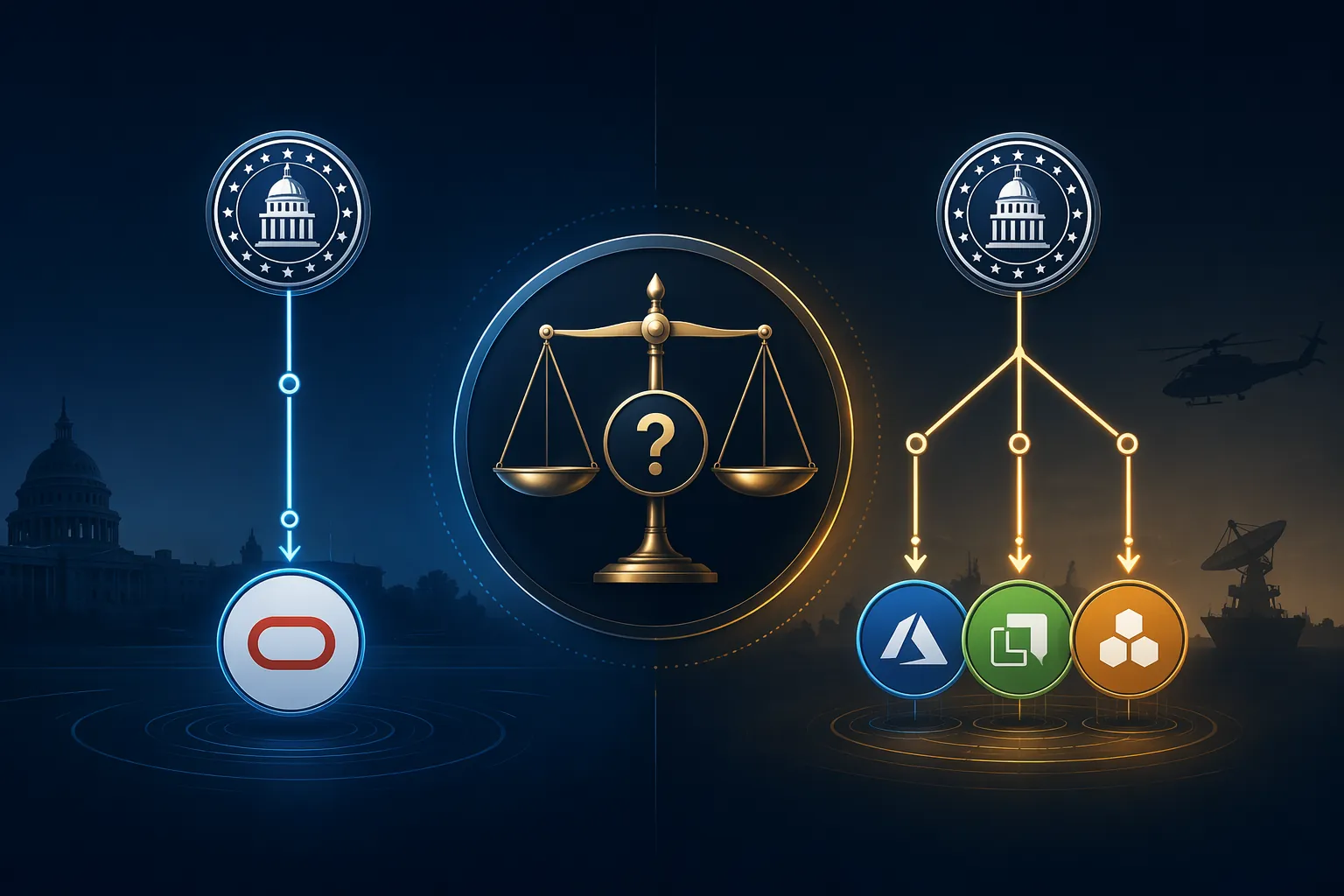
The strongest Oracle-first cases are not the most glamorous ones. They are the programs where standardization is itself part of the mission: consolidating fragmented procurement workflows, replacing brittle legacy inventory tools, improving master data control, reducing the number of interfaces around order and fulfillment processes, or bringing planning closer to finance and execution data. In those settings, the ESI gives Oracle an administrative advantage that a supply-chain leader would be wrong to ignore.
Where A Multi-Vendor Planning Ecosystem Still Has A Case
The ESI does not erase the functional case for o9, Kinaxis, Blue Yonder, SAP IBP, or other specialized supply-chain platforms. It changes how that case has to be argued. Before the Oracle vehicle, a best-of-breed planning platform and Oracle SCM could compete more evenly on capability, price, integration, and contract path. Now the specialized platform has to overcome Oracle’s lower procurement friction.
That may still be justified when the requirement is genuinely planning-intensive: constrained supply allocation across programs, complex scenario modeling, multi-echelon inventory tradeoffs, supplier-risk-driven replanning, rapid what-if analysis, or planning workflows that must sit across government, prime, subcontractor, and sustainment data. In those cases, a defense supply-chain leader should not accept “available through the ESI” as a proxy for fit.
The evaluation should be practical. Can Oracle handle the planning decision inside standard modules with acceptable configuration? If not, can it expose the right governed data to a specialized engine without creating another fragile integration layer? Which system becomes the record of planning assumptions? Who approves overrides? How are classified, controlled, supplier-owned, and contractor-operated data separated? Which workflow survives when a planner needs an answer before the nightly batch or interface reconciliation finishes?
A multi-vendor ecosystem earns its place when it answers those questions better than the suite and when the mission value is large enough to justify the added acquisition and integration load. That is a higher standard than a generic “best of breed” argument, and it is the right one after the ESI.
Oracle’s Defense Footholds Help, But They Do Not Close The SCM Case
Oracle is not entering defense from the outside. In October 2025, the Department of the Air Force deployed Oracle Fusion Cloud Applications at DISA Impact Level 4, a meaningful reference point for cloud environment readiness in defense operations.[3] In February 2026, Oracle also booked an $88 million Air Force Cloud One task order.[4] Those facts make it harder to dismiss Oracle as merely a commercial enterprise suite looking for a defense logo.
They also have to be kept precise. A Fusion Cloud deployment at DISA IL-4 and a Cloud One task order support the case that Oracle has defense-cloud presence and can operate within important federal environments.[3][4] They do not prove that Oracle SCM planning modules have already been tested across the hardest parts of DoD logistics: contested supply, depot maintenance constraints, supplier fragility, classified or controlled data segmentation, transportation disruption, and cross-agency demand prioritization.
Oracle’s own defense references add useful context. The company points to the Marine Corps ERP as supporting the first clean audit for a Department of War agency and to Army IPPS-A as an HCM reference.[5] Those examples matter because they show Oracle-linked programs can operate in serious defense settings. They are still not a substitute for public, task-order-level evidence that Oracle SCM can deliver planning and logistics outcomes under the new ESI.
AI Is The Part To Test, Not The Part To Take On Faith
Oracle’s AI roadmap is relevant because defense supply-chain work is already moving beyond dashboard modernization. In February 2026, Oracle announced 13 named SCM AI agents, including agents for planning cycles, component replacement, autonomous sourcing, and inventory tasking.[6] In April 2026, it introduced six supply-chain-facing agentic applications, including a Logistics Execution Command Center, Design-to-Source, and Warehouse Operations Workspace.[7] Those are Oracle claims, not independent evidence of scaled defense logistics deployment.
The distinction is more than editorial caution. An AI agent that drafts a sourcing action, recommends a component replacement, or reprioritizes inventory tasks is entering a governed decision chain. In a defense setting, someone must know what data the agent used, what policy constraints it honored, which human approved the action, how the recommendation is logged, and how the workflow behaves when data is incomplete or sensitive. A demo can show the happy path. A task order has to assign accountability.
DLA’s current AI work shows why the demand is real. The Defense Logistics Agency established an AI Center of Excellence in June 2024, and its May 2025 white paper says BDA Supplier Risk models analyzed 43,000 vendors and flagged more than 19,000 as high-risk.[8] That is defense supply-chain AI aimed at a real operational problem: supplier risk. But it should not be treated as evidence for Oracle unless future task orders connect DLA workflows, Oracle SCM modules, and deployed AI use cases.
The right test for Oracle’s agents is not whether the catalog sounds comprehensive. It is whether an agency can point to a governed workflow where the agent reduces planner load, improves decision timing, or strengthens compliance without creating opaque automation in a mission-critical process. Until that evidence is public, the agentic layer is product ambition that deserves evaluation, not credit.
The DCHRMS Precedent Cannot Be Brushed Aside
The most uncomfortable evidence around the new Oracle vehicle is not about SCM functionality. It is about delivery risk. In July 2026, the American Accountability Foundation sent an inspector general referral asking for review of the Oracle Pentagon contract, citing the Defense Civilian Human Resources Management System as a warning case.[9] According to the referral as reported, DCHRMS grew from $36 million to $280 million, a more than 700% increase, and was terminated in March 2025 by Secretary Hegseth.[9]
Those figures should be handled carefully. They come from the AAF referral and have not been presented here as findings verified by a court or an inspector general. But a defense supply-chain leader does not need a final legal conclusion to treat the episode as a serious implementation-risk signal. A failed enterprise software program at that scale is relevant when the next discussion is whether to put planning, procurement, inventory, transportation, or manufacturing workflows onto a suite under an enterprise contract.
The lesson is not “never buy Oracle.” That would be too easy and not especially useful. The lesson is that the ESI should not let agencies collapse commercial streamlining, product selection, system integration, data migration, change management, and operational acceptance into one optimistic story. A task order for SCM needs explicit success measures: which planning cycle changes, which manual reconciliation steps disappear, which supply-risk signals enter sourcing, which inventory decisions move faster, which interfaces are retired, and which users can reject a workflow that is not fit for mission.
What Future Task Orders Need To Prove
The next useful evidence will not be another ceiling value. It will be task-order detail. Which agencies buy SCM modules rather than only licenses or professional services? Which modules go live? Which legacy systems are retired? Which integrations remain? Which planning decisions move into Oracle, and which remain in specialized tools? Which AI agents are enabled, and under what approval controls?
A serious Oracle SCM task order should make several things visible before anyone treats it as proof of a broader DoD market shift:
- Mission scope: the exact planning, procurement, logistics, inventory, manufacturing, or PLM decisions Oracle is expected to support.
- Integration boundary: the systems Oracle replaces, the systems it feeds, and the systems that remain authoritative.
- Data governance: ownership for item, supplier, demand, inventory, transportation, and program data across government and contractor environments.
- AI controls: approval rules, audit logs, exception handling, and accountability for agent-generated recommendations.
- Operational acceptance: measurable improvements in cycle time, visibility, exception resolution, compliance, or workload that users can validate.
- Failure containment: off-ramps, phased deployment gates, and responsibility when configuration, data, or integration assumptions break.
That is also where the comparison with Microsoft’s May 2026 enterprise software agreement belongs. The reported $9.69 billion Microsoft ESA and the Oracle ESI are part of a broader Pentagon move toward enterprise software consolidation.[1] The consolidation trend may be rational from a buying standpoint. It still leaves each mission owner responsible for proving that the standardized path supports the work rather than merely simplifying the contract file.
The Procurement Calculus Has Changed. The Operational Burden Has Not.
For defense SCM buyers, the ESI materially changes the first move. Oracle should be evaluated early when the agency needs standard SCM capability, already runs Oracle-heavy enterprise systems, wants to reduce procurement drag, or can benefit from tighter alignment across ERP, procurement, inventory, order, and logistics workflows. In those cases, ignoring the vehicle would be performative neutrality.
The ESI does not settle the harder choice. If mission planning requires specialized optimization, cross-enterprise scenario modeling, supplier-risk intelligence, rapid replanning, or workflows that standard Oracle modules cannot support without heavy customization, then a multi-vendor ecosystem may still be the stronger design. The burden is on that ecosystem to justify the extra acquisition and integration complexity. The burden is on Oracle to show that the easier vehicle leads to a working planning capability, not just a cleaner purchase.
The credible claim is therefore disciplined and limited: the Oracle ESI changes how DoD agencies can procure supply-chain software. It does not yet prove Oracle will dominate defense SCM, and it does not verify the real-world value of Oracle’s agentic SCM roadmap in defense logistics. That proof will have to come from task orders, deployments, governed AI workflows, user acceptance, and measurable operating results.
References
- Oracle wins 10-year Pentagon software contract worth up to $7 billion, CNBC, July 23, 2026
- Oracle Fusion Cloud Supply Chain & Manufacturing, Oracle
- United States Department of the Air Force Advances Mission-Critical Operations with Oracle Fusion Cloud Applications, PR Newswire
- Oracle books $88M Air Force Cloud One contract, Washington Technology, February 2026
- Defense and Intelligence, Oracle
- Oracle AI Agents Help Boost Supply Chain Efficiency and Strengthen Resiliency, Oracle, February 10, 2026
- Oracle Introduces Fusion Agentic Applications for Finance and Supply Chain, Oracle, April 9, 2026
- Utilization of Artificial Intelligence (AI) to Illuminate Supply Chain Risk, Defense Logistics Agency, May 2025
- Watchdog calls for inspector general review of Oracle Pentagon contract, Washington Examiner, July 2026
Cited evidence
- Intel's Server CPU Supply Crunch Reshapes AI Procurement
Intel's server CPUs are sold out through 2026, with distributors fulfilling only ~40% of orders, creating a structural bottleneck for enterprises building AI data centers. This analysis covers the procurement strategies—forward-buying, BOM flexibility, and alternative CPU qualification—that supply chain leaders need to adopt now.
- What Trump's Ratepayer Pledge Means for AI Data Center Supply Chains
The Ratepayer Protection Pledge shifts grid upgrade costs but lands on a supply chain already crippled by transformer shortages, tariff exposure, and multi-year lead times—forcing enterprise AI buyers to plan for higher costs and delays through at least 2028.
- Intel's AI Data Center Growth Strains CPU Supply Chain
Intel's 22% DCAI revenue jump to $5.1B has created a CPU shortage with lead times up to 22 weeks and allocation fulfillment around 40%. This article analyzes how enterprise procurement leaders should navigate allocation risk, pricing, and product prioritization through Q3 2026.
Ready to check your own team's readiness for this pattern?
See the procurement readiness checklist →Spotted something inaccurate or incomplete in this entry? ChainSignal reviews corrections and additional evidence before publishing an update — this is not a public comment thread.
Flag an inaccuracy / submit evidence for this entry →