OpenAI Frontier Agents in Supply Chain: Where They Excel
An analysis of OpenAI Frontier's six confirmed launch customers — including HP's demand forecasting and inventory management deployment — shows that Frontier agents excel at structured cross-system coordination and exception management, not at the strategic planning tasks handled by specialized platforms like o9, Blue Yonder, or Kinaxis.
The cleanest supply-chain fact about OpenAI Frontier is also the one with the least room for interpretation: OpenAI and HP announced a strategic partnership on June 28, 2026, covering demand forecasting and inventory management across HP’s global supply chain.[1] That makes HP the first confirmed Frontier customer whose stated deployment lands directly inside supply-chain operations rather than next to it.
It is also where the evidence stops being comfortable. The announcement does not disclose forecast-accuracy gains, inventory-turn improvements, service-level effects, working-capital impact, planner productivity, or implementation scope by region, business unit, or system landscape.[1] For a planning director trying to brief finance, that matters. “Demand forecasting and inventory management” can mean several very different things: generating a better statistical forecast, reconciling exceptions around an existing forecast, pulling decision context from multiple systems, or pushing approved actions back into ERP and planning tools.

That distinction is the useful starting point for evaluating OpenAI Frontier in supply-chain operations. Frontier may turn out to be important for supply-chain teams, but the first deployments point less toward autonomous strategic planning and more toward a layer that helps work move across systems, approvals, exceptions, and enterprise rules.
What the launch customers actually show
HP is the anchor case because the use case is explicitly supply-chain-related. The other named Frontier launch customers matter for a different reason: they show the kind of operating pattern OpenAI appears to be targeting. Uber’s driver-service automation, State Farm’s claims processing, Oracle’s database agent, and Thermo Fisher’s scientific workflows are not supply-chain planning deployments, but they share a family resemblance: structured, high-volume, rule-sensitive work that depends on context from more than one system.[2][3]
| Confirmed customer | Stated or reported Frontier-related workflow | Supply-chain relevance |
|---|---|---|
| HP | Demand forecasting and inventory management across a global supply chain | Direct supply-chain case, but public outcomes are not yet disclosed |
| Uber | Driver-service automation | Comparable coordination pattern for logistics partner or carrier support workflows |
| State Farm | Claims processing | Relevant by analogy to disruption, cargo, insurance, and documentation claims |
| Oracle | Database agent | Relevant to supply-chain data-query assistance and enterprise context retrieval |
| Thermo Fisher | Scientific workflows | Relevant to regulated, documentation-heavy operating environments |
The pattern is narrower than the market language around agentic AI often suggests. These are not examples of an agent deciding a global network redesign, setting a consensus demand plan, or replacing a multi-echelon inventory optimizer. They are examples of work where an agent needs to understand enterprise context, follow permissions, retrieve information, trigger actions, route exceptions, and leave an auditable trail.
That is still valuable. In many supply-chain organizations, the expensive friction is not only the math inside the planning engine. It is the waiting: waiting for a planner to find the right exception, waiting for a buyer to verify a supplier response, waiting for finance to approve a working-capital tradeoff, waiting for logistics to confirm whether an alternate route is actually available, waiting for IT to explain why two systems disagree.
Frontier looks more like a coordination layer than a planning engine
The architecture explains the likely boundary better than the customer logos do. Frontier has been described around five layers: Semantic Layer, Agent IAM, Sandboxed Execution, Coordination Engine, and Memory & Learning.[2][3] Those labels are not incidental. They describe the plumbing required to let agents operate inside enterprises where “take action” means something very different from “answer a question.”
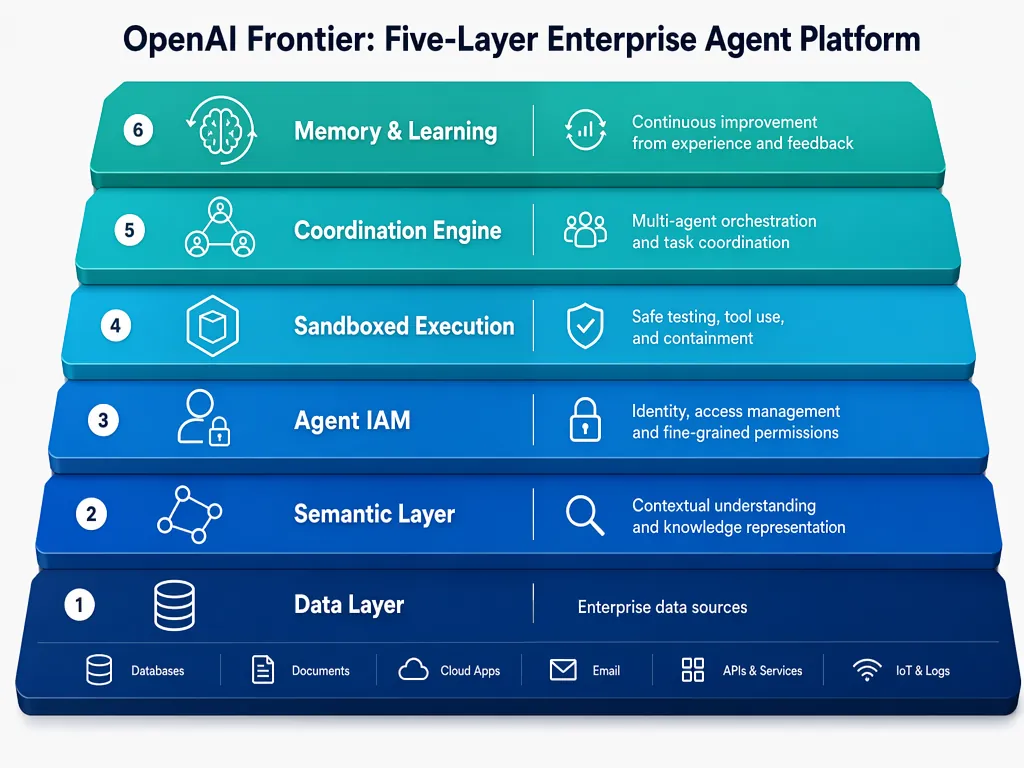
The Semantic Layer is the most supply-chain-relevant piece because enterprise planning data is full of words that look obvious until a system has to act on them. “Available inventory” may mean physically on hand, ATP, nettable stock, unrestricted stock, regionally allocable stock, or inventory after quality hold. “Customer priority” may live in CRM, an allocation policy, a key-account spreadsheet, or a commercial escalation note. Without context, an agent can produce a fluent answer and still send the wrong work to the wrong queue.
Agent IAM matters because supply-chain work is permissioned in ways that are rarely elegant. A regional planner may be allowed to recommend an inventory transfer but not approve expedited freight. A customer-service manager may see order priority but not supplier cost. A procurement analyst may initiate a supplier follow-up but not change payment terms. If an agent is expected to act across systems, identity and access are not security details added at the end; they define what the agent is allowed to do.
Sandboxed Execution is equally practical. Supply-chain teams do not need an agent experimenting directly in production ERP to discover that a field mapping is wrong. They need a controlled place where the agent can draft the purchase-order follow-up, simulate the inventory-transfer request, validate the document package, or test the routing logic before a human or policy rule releases the action.
The Coordination Engine is where Frontier’s supply-chain role becomes easiest to imagine. A late inbound shipment is rarely one task. It can require checking the order promise, finding constrained customers, reviewing substitute inventory, asking a supplier for a new date, alerting transportation, updating a ticket, and preparing a recommendation for the planner. Those steps cross systems and owners. A coordination layer can reduce handoff loss even if the underlying planning logic still comes from a specialist platform.
Memory & Learning is useful when the same classes of exceptions recur. If a certain supplier frequently requires a particular documentation sequence, or a certain market always needs an extra compliance check before inventory can move, an agent platform can become more useful by retaining workflow context. That is different from learning a new demand model. It is learning how work gets resolved inside a specific enterprise.
The plausible supply-chain use cases are mostly exception and follow-up work
If HP’s Frontier deployment is eventually shown to improve demand forecasting and inventory management, the first thing to inspect will be which part of the workflow improved. Did Frontier create the forecast? Did it reconcile inputs around an existing forecast? Did it detect exceptions faster? Did it reduce the number of manual follow-ups needed before an inventory decision could be executed? Those are materially different outcomes.
A bounded Frontier use case in demand planning could start when the statistical forecast is already generated. The agent identifies products where forecast change, open orders, inventory position, and service risk no longer line up. It gathers the relevant context, checks whether a planner has handled similar exceptions before, drafts a recommended escalation, and routes the case to the right owner. The planning engine still supplies the forecast signal; the agent reduces the coordination load around exception resolution.
In inventory management, the same boundary applies. Frontier is more credible as a way to follow through on inventory exceptions than as the source of the optimization itself. It could help assemble the facts behind an imbalance, check transfer constraints, prepare approval notes, contact the relevant site, update a workflow ticket, and monitor whether the decision was executed. The decision logic for optimal stock placement, safety-stock targets, and multi-echelon tradeoffs still belongs elsewhere unless proved otherwise.
- Good Frontier candidate: shipment exceptions where the agent gathers order, carrier, inventory, and customer-priority context before routing a decision.
- Good Frontier candidate: supplier follow-up where the agent drafts status requests, checks prior commitments, and updates the case record.
- Good Frontier candidate: claims and documentation workflows where forms, evidence, approvals, and status updates move across teams.
- Good Frontier candidate: supply-chain data-query assistance where the agent helps users locate the right table, metric, or operational definition.
- Weak Frontier candidate without additional proof: demand sensing, network optimization, MEIO, and S&OP or IBP algorithmic planning.
This is not a small distinction for buyers. A coordination use case can be funded by reducing manual touches, cycle time, rework, and exception backlog. A planning-optimization use case needs evidence on forecast accuracy, service levels, inventory investment, margin, capacity utilization, or working capital. HP’s public announcement supports the existence of the deployment, not those measured effects.[1]
Why data context is the blocker Frontier is trying to monetize
PwC’s 2026 Digital Trends in Operations Survey is useful here because it names the operating condition Frontier is selling into. In a January-February 2026 survey of 767 US operations leaders, 89% said technology investments had not fully delivered expected outcomes, and 87% said poor data quality affected the value of digital initiatives.[4] That is not an argument that agent platforms solve the problem. It is evidence that many operations teams are still stuck before the glamorous part of AI begins.
Poor data quality in supply chain is not just duplicate supplier names or missing lead times. It is also the absence of shared operational meaning. A planner may trust a spreadsheet because the ERP field is technically correct but commercially misleading. A finance sponsor may reject an automation business case because the savings cannot be tied to a controllable metric. A transportation team may work from a carrier portal that never reconciles cleanly with the order-management system. If Frontier’s Semantic Layer can make enterprise context usable by agents, that is the part worth watching first.
OpenAI’s own internal data-agent environment is a useful credibility check, not a proof point. Its internal infrastructure has been described as spanning 600 PB and 70,000 datasets, with employees still facing table-disambiguation problems.[5] The important lesson is not that OpenAI has a large data estate. It is that even technically sophisticated organizations struggle to help users and agents find the right data object for the question being asked.
Supply-chain leaders should read that as a warning against shallow pilots. If the agent cannot distinguish booked demand from unconstrained demand, supplier requested date from confirmed date, or gross inventory from usable inventory, the interface may be impressive while the workflow remains unsafe. The work before deployment is the same work that has slowed previous waves of supply-chain digitization: master data ownership, metric definitions, exception rules, role permissions, and escalation paths.
Specialized planning platforms still own the optimization core
The practical boundary is easiest to see by separating coordination from optimization.
| Work type | Better fit for Frontier agents | Better fit for specialist planning platforms |
|---|---|---|
| Demand planning | Explaining forecast exceptions, gathering inputs, routing approvals, preparing planner briefs | Generating demand-sensing models, statistical forecasts, forecast-value-add analysis |
| Inventory management | Following up on imbalances, preparing transfer requests, checking execution status | Optimizing safety stock, service levels, replenishment parameters, multi-echelon inventory |
| Supply planning | Coordinating constraint escalations and collecting responses from owners | Finite-capacity planning, constraint optimization, scenario tradeoff modeling |
| S&OP / IBP | Preparing meeting packs, tracking decisions, chasing action owners | Scenario modeling, consensus-plan generation, financial reconciliation logic |
| Logistics | Managing shipment exceptions, document checks, carrier follow-up | Network design, routing optimization, transportation planning algorithms |
Platforms such as o9, Blue Yonder, Kinaxis, and similar planning suites are built around planning data models, optimization methods, scenario structures, and supply-chain-specific workflows. Frontier’s architecture, as currently described, is built around enterprise context, permissions, execution containment, orchestration, and repeat-work learning.[2][3] Those are complementary design centers, not interchangeable ones.
That does not mean Frontier will never move deeper into planning logic. Agent platforms may eventually call optimization services, compare scenarios, explain tradeoffs, and help planners interact with specialist engines in more natural ways. But as of Q3 2026, the confirmed evidence supports a narrower claim: Frontier is credible around the work that surrounds planning decisions, while specialist platforms remain the system of record for algorithmic planning until named, dated, numbers-backed deployments show otherwise.

The market is moving, but the value pools are not the same
Gartner has projected that 40% of enterprise applications will embed AI agents by the end of 2026, and that 50% of cross-functional supply-chain management solutions will use intelligent agents by 2030.[6][7] It has also projected SCM software with agentic AI to reach $53 billion in spending by 2030.[7] Those figures help explain why every supply-chain software roadmap now sounds agentic. They do not settle what the agents should be trusted to do.
Procurement is one area where the distinction is already visible. McKinsey has described agentic AI as capable of improving procurement efficiency by 25% to 40%, but the claim is tied to data readiness rather than magic autonomy.[8] Deloitte’s CPO research similarly points to enhanced analytics and decision-making at 68% and productivity gains at 49% as top GenAI value drivers, which fits a coordination-and-decision-support pattern more than a full planning replacement pattern.[9]
BCG analysis cited by Dataiku adds another useful check on the hype curve: agentic systems accounted for 17% of total AI value in 2025 and are projected to reach 29% by 2028.[10] The direction is significant, but the split still leaves most AI value in other systems, including specialized algorithmic models. For supply-chain buyers, that argues for architectural clarity rather than platform tribalism.
How to evaluate Frontier in a supply-chain operating model
The first evaluation question should not be “Can Frontier do supply chain?” It should be “Which decision or handoff will Frontier own, and which system remains authoritative?” If the answer is vague, the project will drift into the same ambiguity that has hurt earlier digital investments.
- Define the trigger: the exact exception, request, threshold, document, or status change that starts the agent workflow.
- Name the system of record: the planning platform, ERP, TMS, WMS, CRM, supplier portal, or data warehouse that remains authoritative for each field.
- Separate recommendation from execution: specify when the agent drafts, when it submits, when it updates, and when a human must approve.
- Set override rights: document who can reverse, amend, or block an agent-triggered action and how that decision is logged.
- Measure the right outcome: use cycle time, manual touches, backlog reduction, error rate, or escalation quality for coordination use cases; use forecast, service, inventory, and margin metrics only when Frontier is actually affecting those outcomes.
A good pilot would not ask Frontier to “improve inventory” in general. It would ask Frontier to handle a defined class of inventory exceptions: for example, items with a shortage risk, an available substitute, an approved transfer path, and a planner approval requirement. The agent’s job would be to assemble context, draft the action, route approval, update the workflow, and track completion. That is testable. It also avoids pretending that a coordination layer has replaced an inventory optimizer.
The same logic applies to demand forecasting. If Frontier is used to collect account intelligence, reconcile comments, explain outliers, or chase missing inputs before a demand-review meeting, the success metric should reflect those tasks. If a buyer claims it will outperform a demand-sensing engine, the evidence needs to be model-level and outcome-level, not workflow-level.
What is still unproven in Q3 2026
Frontier is still new. It launched on February 5, 2026, and the HP strategic partnership was announced on June 28, 2026.[1][2] That leaves very little time for public, audited, mainstream enterprise outcome evidence. The named customers are useful signals, but they are not a performance benchmark.
HP’s case is the one to watch because it is both named and directly supply-chain-relevant. If HP later discloses measurable improvements in forecast accuracy, planner productivity, inventory turns, service levels, exception cycle time, or working capital, the evaluation can become more specific. Until then, the responsible reading is bounded: Frontier has a credible architecture for high-volume exception management and rule-heavy coordination inside defined guardrails; it has not yet publicly proved that it can replace the algorithmic planning core of established supply-chain platforms.
References
- HP and OpenAI announce strategic partnership, OpenAI, June 28, 2026, link
- Insight: OpenAI Frontier, Meta Intelligence, link
- OpenAI Frontier Enterprise AI Agent Platform Guide, Digital Applied, link
- 2026 Digital Trends in Operations Survey, PwC, link
- OpenAI Frontier Readiness, Atlan, link
- Gartner Says 40% of Enterprise Applications Will Feature Task-Specific AI Agents by 2026, Gartner, May 2025, link
- Gartner Says 50% of Cross-Functional Supply Chain Management Solutions Will Use Intelligent Agents by 2030, Gartner, April 2026, link
- Transforming procurement functions for an AI-driven world, McKinsey & Company, link
- Agentic AI in supply chain, Deloitte, link
- Supply Chain AI Trends 2026, Dataiku, link
Cited evidence
- How Supply Chain AI Fared Under the Red Sea Chokepoint
The Red Sea crisis tested supply-chain AI platforms like no other event since the category matured. This analysis compares how Kinaxis, Blue Yonder, o9, RELEX, and Anaplan handled the disruption, revealing where real usage data exists and where vendors rely on marketing claims.
- How AI data center electricity costs change supply chain planning
As AI data centers drive structural electricity price increases, supply chain planners must treat electricity as a variable cost in S&OP, network design, and total-landed-cost models. This analysis provides the evidence and framework for updating planning assumptions.
- Intel's AI Data Center Growth Strains CPU Supply Chain
Intel's 22% DCAI revenue jump to $5.1B has created a CPU shortage with lead times up to 22 weeks and allocation fulfillment around 40%. This article analyzes how enterprise procurement leaders should navigate allocation risk, pricing, and product prioritization through Q3 2026.
Ready to check your own team's readiness for this pattern?
See the demand planning readiness checklist →Spotted something inaccurate or incomplete in this entry? ChainSignal reviews corrections and additional evidence before publishing an update — this is not a public comment thread.
Flag an inaccuracy / submit evidence for this entry →