
Machine Learning in Supply Chain Management: A Complete Glossary Guide — Definition, Applications, and Data-Driven Evidence for 2026
A definitive glossary-style reference for supply chain leaders and operations managers. Defines machine learning in the supply chain context, explains how it works, covers five primary application areas with supporting 2026 data, and honestly addresses adoption barriers and implementation pathways.
What Is Machine Learning in Supply Chain Management?
Machine learning in supply chain management refers to the application of algorithms that learn from operational data patterns and improve their performance over time without being explicitly programmed for every possible scenario. Unlike static rule-based systems — which apply fixed logic like "if inventory drops below 100 units, reorder 500" — ML models continuously adjust their predictions and recommendations as new data flows in from enterprise resource planning (ERP) systems, transportation management systems (TMS), warehouse management systems (WMS), Internet of Things (IoT) sensors, and external sources such as weather feeds or port schedules.
The core distinction matters for supply chain leaders evaluating technology investments. Traditional analytics tools answer "what happened?" through dashboards and reports. Business intelligence systems answer "what happened and why?" through dimensional analysis. Machine learning answers "what will happen next?" and "what should we do about it?" — shifting the supply chain from reactive, rule-bound operations to predictive, adaptive decision-making at scale.
How Machine Learning Works in the Supply Chain Pipeline
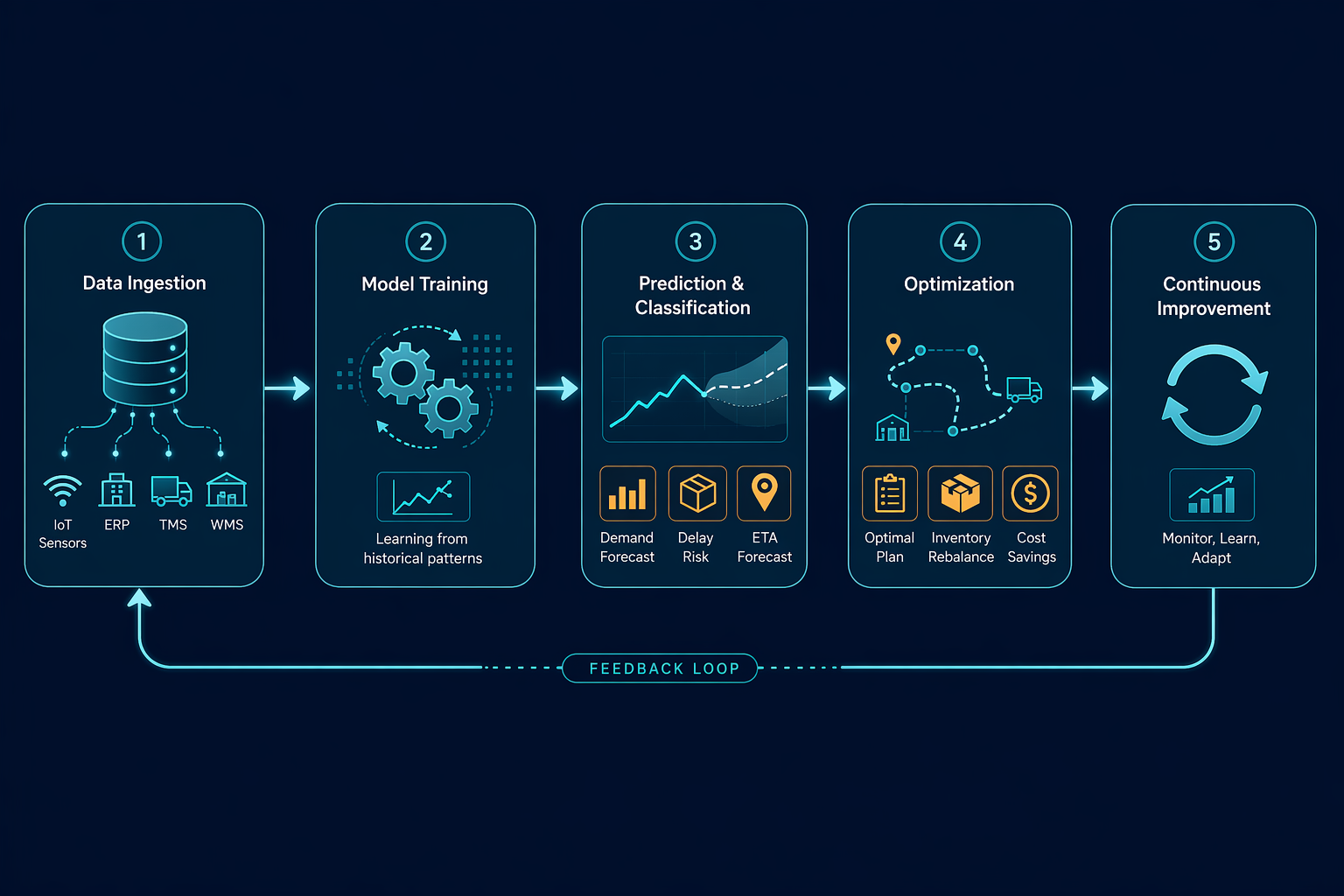
The operational ML pipeline in a supply chain context follows five sequential stages, each with distinct data requirements and technical considerations. Understanding this pipeline helps practitioners diagnose where their organization's data infrastructure supports ML deployment and where gaps exist.
Cited evidence
- AI Inventory Optimization ROI: What Supply Chain Leaders Can Expect in 2026
This article provides supply chain executives with a quantified ROI framework for AI inventory optimization, including a worked example, realistic timeline expectations (the 2–4 year compounding curve), and industry-specific benchmarks to build a defensible business case.
- What Is Artificial Intelligence and Machine Learning in Supply Chain? A Practical Glossary Entry
A comprehensive, vendor-neutral glossary entry defining AI and ML in the supply chain context for procurement leaders, operations managers, and business executives. It explains the core techniques—ML forecasting, NLP, computer vision, reinforcement learning, and agentic AI—maps them to specific supply chain functions, and grounds every claim in sourced statistics.
- AI Use Case Library: The 10 Highest-Impact AI Applications in Supply Chain Management
A structured, filterable guide to the 10 highest-impact AI use cases across planning, procurement, logistics, and warehouse operations — with source-attributed ROI ranges, deployment patterns, and implementation risks for supply chain leaders evaluating AI investments.
Spotted something inaccurate or incomplete in this entry? ChainSignal reviews corrections and additional evidence before publishing an update — this is not a public comment thread.
Flag an inaccuracy / submit evidence for this entry →