
Intel's Server CPU Supply Crunch Reshapes AI Procurement
Intel's server CPUs are sold out through 2026, with distributors fulfilling only ~40% of orders, creating a structural bottleneck for enterprises building AI data centers. This analysis covers the procurement strategies—forward-buying, BOM flexibility, and alternative CPU qualification—that supply chain leaders need to adopt now.
For a buyer planning 2026 AI infrastructure, Intel server CPUs are no longer a normal spot-buy component. The useful question is not whether Intel’s stock reaction to AI chip demand and supply-chain strain looks dramatic on a trading screen. It is whether a rack design approved in July can still be built, priced, and delivered on the dates operations already promised.
The constraint cluster is now too dated and too specific to treat as ordinary quarter-end noise. A procurement-industry post citing Fusion Worldwide said Intel server CPU capacity was sold out for all of 2026 as of January, with distributors fulfilling only about 40% of annual order volumes; the original Fusion Worldwide page was access-restricted and could not be independently verified, so that figure should be treated as a secondary distributor signal rather than a primary Intel disclosure.[1] The same source put Xeon 4th and 5th generation lead times above six months in the first half of 2026 and described server CPU average selling prices as rising 10% to 15%.[1]
Public market reaction made the supply issue visible outside sourcing teams. Intel shares fell about 14% on January 23, 2026, after the company’s first-quarter forecast missed estimates and management pointed to supply-chain snarls as a drag on its turnaround.[2] Domain-b reported the same warning as a 13% slide tied to a weak Q1 2026 forecast and an AI chip supply crunch.[3] The exact stock move matters less than what it exposed: the shortage was large enough to affect guidance, not just distributor behavior.

Demand Is Up, But That Does Not Mean Capacity Is Flexible
Intel’s Data Center and AI group revenue rose 9% year over year to $4.7 billion in Q4 2025, while the company still forecast breakeven EPS for Q1 2026.[2][3] That is the mismatch procurement should care about. A supplier can have demand, a backlog, and a strategic growth market, yet still be unable to convert those conditions into reliable allocation, margin, and delivery schedules.
The pressure is not isolated to data center CPUs. Intel’s Client Computing revenue fell 7% year over year to $8.2 billion, a sign that capacity and mix decisions are being made under constraint rather than abundance.[2][3] For enterprise buyers, that makes supplier reassurances harder to use. If a vendor is moving capacity among businesses while protecting strategic AI demand, the purchase order that arrives late does not become safer just because the end market is attractive.
US News framed Intel’s April 2026 results as a test of whether supply-chain issues were dimming its AI ambitions, which is the right investor question but only a partial procurement question.[4] Buyers do not need to decide whether Intel’s turnaround story works. They need to decide whether a single-source Xeon design can survive a six-month-plus lead-time environment, repriced quotes, and allocation priority rules that may change faster than internal approval cycles.
The AI Rack Is Pulling More CPU Into The Critical Path
The cleanest version of the shortage story says AI servers are moving from roughly one CPU for eight GPUs toward a one-to-one CPU-to-GPU ratio.[1] That number is useful, but it should not be repeated as confirmed hyperscaler doctrine. The source is a single procurement-industry post, not a primary disclosure from a cloud operator, OEM, or silicon vendor. It is better read as an emerging procurement signal: some AI server designs are asking for more host CPU capacity per deployed GPU than older accelerator-heavy assumptions implied.
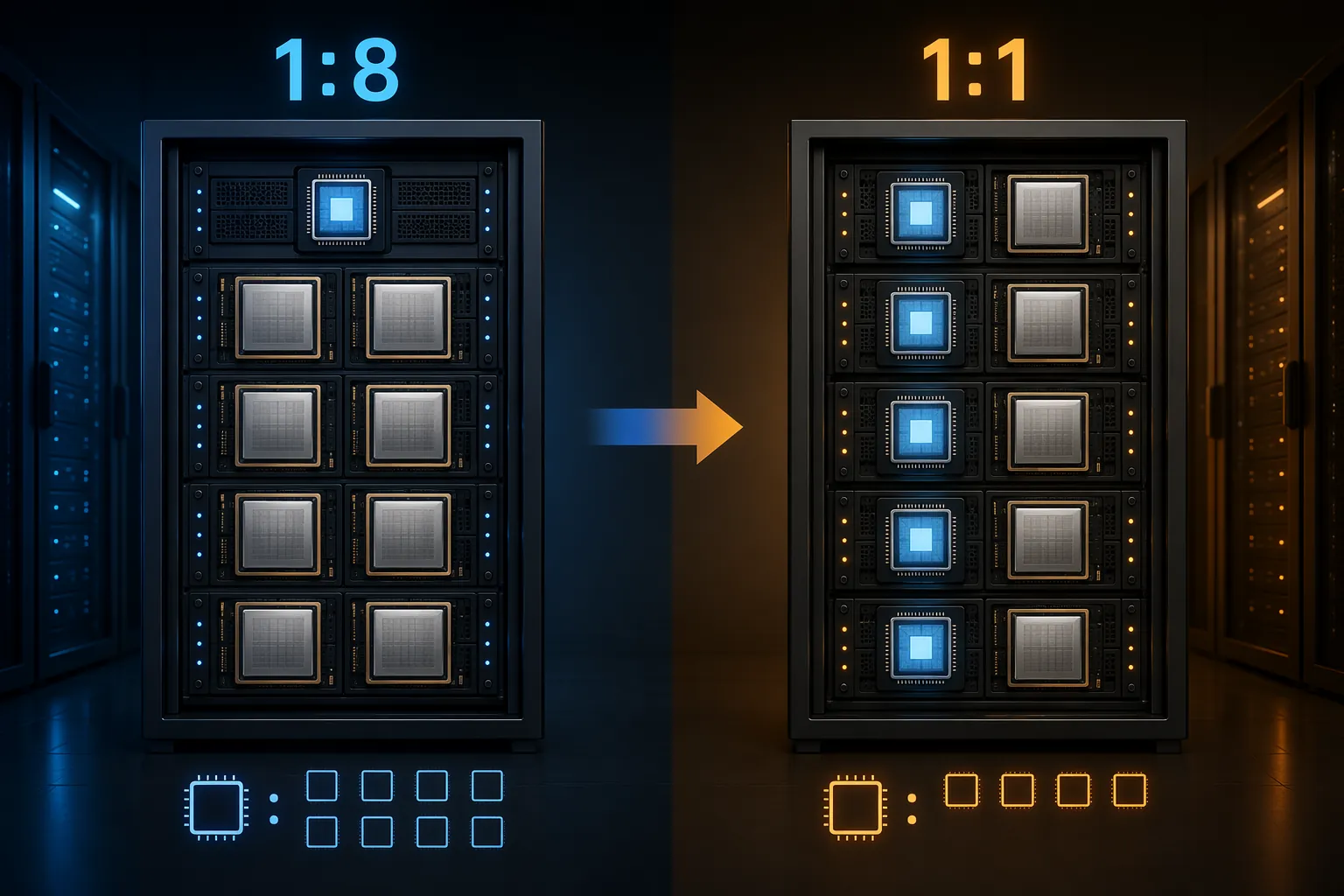
Even as an emerging signal, it changes the sourcing calendar. A GPU delay is already expected in AI infrastructure planning; a CPU delay is more dangerous because it often arrives later in the conversation. Architects approve a platform, finance approves a budget, the deployment date gets promised, and only then does sourcing discover that the host CPU is on allocation. At that point, substitution is no longer a purchasing exercise. It is a qualification project.
The AMD data point reinforces the same conclusion without making this an Intel-only story. The Win Source post said certain AMD EPYC SKUs exceeded 30-week waits, which suggests industry-wide tightening in server CPUs rather than a simple migration path from Intel to AMD.[1] That does not eliminate AMD as an alternative. It does eliminate the fantasy that an unqualified alternative can be sourced at the last minute with normal lead times.
What Changes In The Procurement Plan
The old behavior is to lock the preferred server architecture, issue RFQs close to the build window, and treat allocation as a supplier-performance problem. That behavior does not fit a sold-out-through-2026 environment, even with the verification caveat on the distributor signal. The plan has to move from quote collection to allocation defense.
| Procurement behavior | What it must answer |
|---|---|
| Forward-buying | Which CPUs need allocation commitments before final deployment dates are fully firm? |
| BOM flexibility | Which server configurations can move across Intel, AMD EPYC, or Arm-based CPUs without a full redesign? |
| Dynamic lead-time monitoring | Which weekly or monthly signals trigger a sourcing decision before the shortage reaches the program schedule? |
| Approved vendor list expansion | Which alternates are already qualified before urgency turns them into exceptions? |
Forward-buying is an allocation negotiation, not just an early purchase
Forward-buying in this market means pre-committing demand early enough to matter to the supplier’s allocation process. The procurement team is not simply placing orders sooner. It is trading forecast visibility, payment terms, cancellation discipline, and executive commitment for a better claim on scarce server CPU supply.
That requires more internal work than many AI infrastructure teams expect. Finance has to approve cash exposure before every rack-level detail is final. Infrastructure owners have to separate truly fixed configuration requirements from preferences. Operations has to accept that some inventory may arrive ahead of the build sequence because waiting for perfect timing can mean losing allocation entirely.
The practical output should be a dated allocation map: committed CPUs by platform, supplier, quarter, site, and deployment wave. A purchase order that says “server CPUs” is too vague when distributors are reportedly fulfilling only about 40% of annual order volumes.[1] The buyer needs to know which SKU is protected, which deployment depends on it, and what breaks if that allocation slips.
BOM flexibility has to be designed before it is needed
Naming AMD EPYC or Arm-based options in a sourcing slide does not create flexibility. Real flexibility means the server design, firmware stack, thermal envelope, memory configuration, operating system image, accelerator pairing, management tooling, support model, and warranty path have already been checked far enough that substitution does not reopen the whole architecture decision.
For Intel-dependent AI infrastructure, the minimum useful exercise is to identify where Xeon specificity is genuine and where it is inherited. Genuine dependencies might include validated software stacks, performance tuning, fleet-management tooling, or support obligations with an OEM. Inherited dependencies are different: templates copied from older server builds, benchmark assumptions no one has refreshed, or finance models that priced only one platform because procurement was asked too late.
A substitute CPU also changes the surrounding bill of materials. An EPYC configuration may alter motherboard selection, memory population, BIOS settings, validation work, and OEM lead times. An Arm-based option such as NVIDIA Grace or Ampere can require deeper software and operations review. Those are not reasons to avoid alternatives. They are reasons to qualify them before the preferred SKU becomes unavailable.
The useful procurement question is not “Can we buy another CPU?” It is “Can we ship the same service level on an already approved alternate configuration without a full rework?” If the answer is no, the alternate is a talking point, not a supply-chain hedge.
Lead-time monitoring should trigger decisions, not reports
Lead-time dashboards are only useful if they are tied to authority. In a six-month-plus Xeon environment, a quarterly review is too slow for programs with fixed deployment windows.[1] Procurement needs thresholds that automatically move a decision: when distributor availability falls below an agreed level, when the OEM stops holding quoted terms, when an alternate SKU crosses a lead-time ceiling, or when a deployment wave can no longer absorb a slip.
The monitoring should combine Intel disclosures, OEM quote validity, distributor availability, cancellation behavior, and observed ship dates. Supplier strategy language belongs in the file, but it should not outrank lead-time behavior. A supplier that says capacity is improving while refusing to hold delivery dates is giving procurement the more important signal in the refusal.

The Capacity Question Runs Through 18A, But 18A Is Not A Procurement Date
Intel’s process roadmap matters because server CPU supply is ultimately a capacity and yield problem, not only a demand-forecasting problem. But procurement teams should be careful with yield figures. Intel does not publish official 18A yield percentages. KeyBanc analyst estimates, discussed in a SemiWiki forum post dated January 13, 2026, put Intel 18A yields at about 55% in mid-2025, improving roughly 7% to 8% per month to more than 60% by early 2026; the same estimate put TSMC 2nm at 70% to 80% at launch and Samsung SF2 below 40%.[5]
Those numbers are not Intel metrics. They are analyst estimates. They are still useful because they give buyers a way to think about why demand can be visible while supply remains constrained. Better yields increase usable output from a given wafer start. Weak or immature yields turn capacity plans into allocation fights, especially when strategic products compete for the same scarce manufacturing path.
CEO Lip-Bu Tan’s January 2026 earnings-call language belongs in the same category: useful, directional, but not sufficient for a sourcing promise. He said yields were “in line with internal plans” and “still below what I want them to be.”[6] That is not a delivery commitment for a particular Xeon SKU, and it should not be treated as one. It tells buyers the company sees progress and dissatisfaction at the same time.
The earliest relief signals worth watching are therefore specific. Intel Q2 2026 earnings may provide supply-improvement commentary. Future 18A updates may show whether internal progress is becoming external availability. External foundry customer announcements from companies such as Microsoft, AWS, or Apple would matter because customer tape-outs can validate process readiness. TSMC allocation decisions also matter because advanced-node capacity can favor AI GPUs over server CPUs, tightening CPU options even when accelerator supply improves.
Single-Source Intel Dependency Is Unsafe Through Early 2027
The conservative procurement position is to assume that single-source Intel dependency remains unsafe through at least Q1 2027. That does not mean every enterprise should abandon Intel platforms. It means Intel-only planning should carry an explicit delivery risk, a named mitigation owner, and an approved substitution path where the workload permits one.
Some workloads will stay on Xeon because the switching cost is real. That is acceptable if the business knows it is paying for that dependency with earlier commitments, less pricing leverage, and tighter deployment sequencing. What is not acceptable is approving a single CPU path in architecture review and discovering the lead-time consequence only after the deployment window is politically fixed.
The approval process needs to move upstream. Architecture should state whether Intel is required or preferred. Procurement should attach current lead-time and allocation evidence to that decision. Finance should see the working-capital impact of forward buys and the cost of delayed capacity. Operations should know which sites or clusters are exposed if a CPU allocation slips.
The uncomfortable work is political as much as technical. Multi-architecture BOMs complicate support models, benchmarking, fleet operations, and vendor management. They also prevent a bad habit: treating procurement as the department that can manufacture flexibility after everyone else has designed it out.
The Decision To Make Now
A 2026 AI infrastructure plan should now separate CPU demand into three buckets: protected Intel allocation, qualified non-Intel substitution, and unresolved exposure. The third bucket is the one that needs executive attention. It contains the builds that still depend on normal market availability even though the market is no longer behaving normally.
Procurement does not need a perfect forecast to act. The Fusion-linked fulfillment figure is secondary and access-restricted, the CPU-to-GPU ratio shift is an emerging signal, and the 18A yield numbers are analyst estimates rather than official Intel disclosures.[1][5] Those caveats narrow the conclusion; they do not erase the lead-time problem. When multiple imperfect signals point toward constrained server CPU availability, the safe response is to build plans that survive uncertainty.
Relief will be visible first in lead-time disclosures, stable OEM quote validity, distributor fulfillment behavior, credible 18A readiness signals, external foundry customer validation, and advanced-node allocation choices across the broader market. Until those signals improve together, waiting for a clean capacity normalization date is not a sourcing strategy.
References
- Win Source post citing Fusion Worldwide server CPU allocation and lead-time data
- Intel shares tumble as supply chain snarls hamper turnaround, Reuters, January 23, 2026
- Intel warns of AI chip supply crunch; shares slide 13% on weak Q1 2026 forecast, domain-b
- Intel Results to Show if Supply Chain Issues Are Dimming Its AI Ambitions, US News, April 21, 2026
- KeyBanc’s TSMC Intel Samsung Yield Benchmark 1/13/2026, SemiWiki forum, January 13, 2026
- Intel Q4 2025 earnings call transcript, Intel, January 2026
Cited evidence
- Intel's AI Data Center Growth Strains CPU Supply Chain
Intel's 22% DCAI revenue jump to $5.1B has created a CPU shortage with lead times up to 22 weeks and allocation fulfillment around 40%. This article analyzes how enterprise procurement leaders should navigate allocation risk, pricing, and product prioritization through Q3 2026.
- Oracle's $7B Pentagon Contract Reshapes Defense Supply Chain Procurement
The July 2026 Oracle Enterprise Software Initiative gives DoD agencies a standardized vehicle to acquire Oracle Fusion Cloud SCM modules, potentially shifting procurement dynamics. But defense leaders must weigh the streamlined acquisition against unresolved risks—including the DCHRMS failure—before committing to Oracle over multi-vendor planning ecosystems.
- How AI Chip Supply Chain Shapes Intel's Stock Outlook
Evaluates Intel's stock forecast through the lens of AI chip supply chain constraints, examining whether its position as the sole U.S. advanced-node foundry alternative can drive a sustained re-rating given TSMC's capacity limits, confirmed customer engagements, and ongoing execution challenges.
Ready to check your own team's readiness for this pattern?
See the procurement readiness checklist →Spotted something inaccurate or incomplete in this entry? ChainSignal reviews corrections and additional evidence before publishing an update — this is not a public comment thread.
Flag an inaccuracy / submit evidence for this entry →