
Intel's AI Data Center Growth Strains CPU Supply Chain
Intel's 22% DCAI revenue jump to $5.1B has created a CPU shortage with lead times up to 22 weeks and allocation fulfillment around 40%. This article analyzes how enterprise procurement leaders should navigate allocation risk, pricing, and product prioritization through Q3 2026.
Intel's AI data center revenue growth is no longer just an earnings story. For enterprise buyers, it has become a supply chain planning problem: a Xeon order that looked routine in a server refresh model can now collide with AI-driven data center demand, allocation rules, and lead times that stretch beyond a single deployment quarter.
The practical contradiction is simple. Intel is selling more into data center and AI workloads, but that success is absorbing server CPU capacity faster than normal procurement calendars expected. In Q1 2026, Intel reported Data Center and AI revenue of $5.1 billion, up 22% year over year.[1] CRN separately reported CFO David Zinsner's comment that the unmet demand figure "starts with a B," meaning at least $1 billion of demand Intel could not satisfy.[2] For a buyer trying to lock a Q3 deployment, that is not color commentary. It is a warning that purchase orders may be competing with demand Intel already knows it cannot fully serve.

| Signal | What It Means For Procurement | Source Context |
|---|---|---|
| DCAI revenue reached $5.1B in Q1 2026, up 22% YoY | Server and AI demand is strong enough to change Intel's product mix and capacity priorities. | Intel financial results.[1] |
| Unmet demand is at least $1B | Demand is not just delayed by channel noise; Intel's CFO publicly framed the gap in billion-dollar terms. | CRN coverage of Zinsner's conference comments.[2] |
| Allocation fulfillment reported around 40% | Buyers should not treat supplier acceptance of a request as evidence that the full quantity will ship. | Fusion Worldwide; figure was visible in search-snippet-accessible material from a page behind human verification, so it should be treated as distributor intelligence with a visible source limitation.[3] |
| Domestic lead times reported at 8-22 weeks; international lead times at 6-8 months | Q3 deployment timing depends heavily on geography, OEM position, and SKU tier. | Fusion Worldwide and CRN channel reporting.[3][4] |
Those signals do not prove that every Intel CPU is unavailable. Shortages rarely work that cleanly. They usually mean the right customer, the right SKU, and the right delivery quarter matter more than the headline inventory picture. A large buyer with committed forecasts for mid-to-high-end Xeons may still get priority. A smaller buyer waiting on entry-level parts, international routing, or late-quarter changes may discover that "available" means available after the project window has already moved.
The Shortage Is A Mix Problem, Not Just A Volume Problem
The pressure starts with a familiar AI infrastructure pattern: GPUs draw the attention, but servers still need CPUs, memory, boards, power components, networking, and integration capacity. When AI clusters expand, CPU demand does not disappear; it shifts toward the server platforms that support training, inference, storage, and orchestration workloads.
That is why Intel's DCAI result matters operationally. The $5.1 billion Q1 2026 number measures revenue already recognized, not the full order book. Zinsner's "starts with a B" comment points to demand Intel had not converted into shipments.[2] The procurement implication is that revenue growth and backlog can coexist. Buyers should not read a strong DCAI quarter as proof that supply is catching up; it may also show that Intel is prioritizing the highest-value server demand first.
CRN's channel coverage gives the shortage a wider shape. Intel global channel chief Trevor Guzzi said "Everyone is impacted" when discussing the CPU shortage, while also noting that CPU price increases were "relatively small" compared with memory.[4] That distinction is useful. Pricing matters, especially for multi-quarter budget locks, but availability is the harder constraint. A modest CPU price move can be negotiated or absorbed; a missed deployment slot can cascade into idle racks, delayed migrations, extended maintenance on older systems, and revised revenue assumptions for internal IT services.
The channel data also explains why a single global lead-time assumption is dangerous. Fusion Worldwide's 2026 server CPU shortage note reports domestic lead times of 8 to 22 weeks and international timelines of 6 to 8 months.[3] Even if those ranges improve, they are long enough to make Q3 2026 planning uncomfortable. An enterprise buyer placing or revising orders in late July is no longer operating with a clean quarter-ahead buffer.
What Intel Appears To Be Protecting
The clearest product-level signal is that Intel is favoring Xeons over lower-priority client segments. The Register reported in January 2026 that Intel was prioritizing Xeons over client chips to meet AI demand, with Chromebook orders facing delays of up to 12 months.[5] Intel has not publicly disclosed exact allocation ratios by segment, so this should not be read as a precise map of every fab or product line. But it does show the direction of sacrifice: server CPUs tied to AI and data center demand sit higher in the queue than entry-level client-adjacent products.
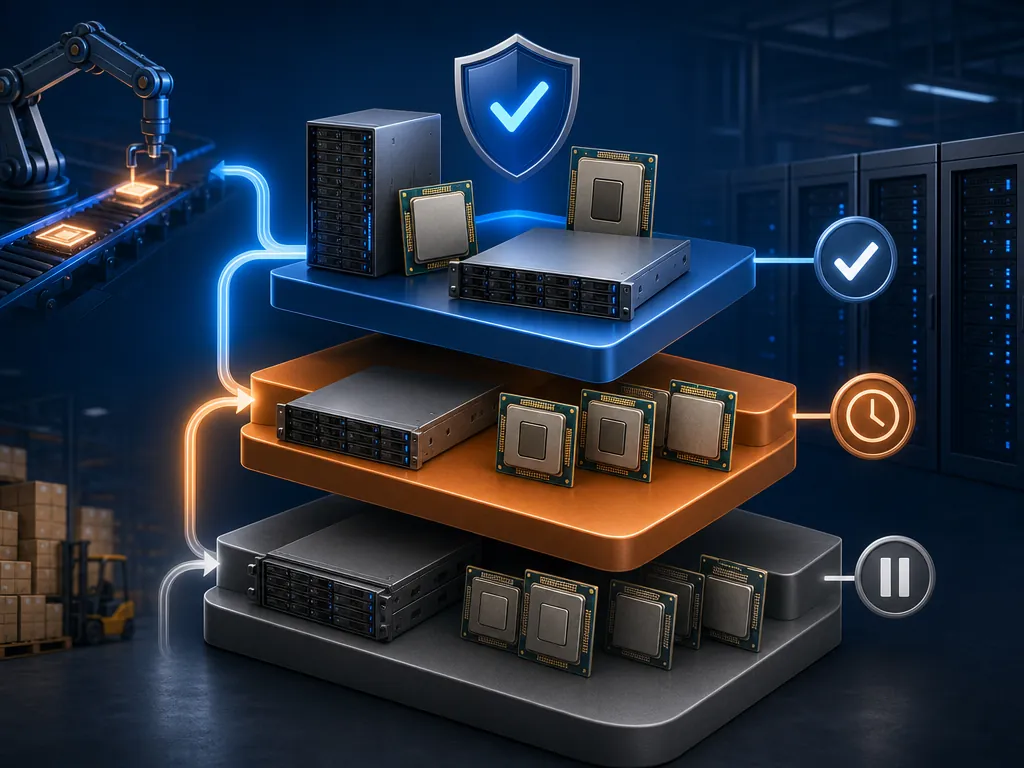
That matters because enterprise hardware refresh plans often bundle assumptions across product classes. A company may be buying servers, endpoints, edge systems, and low-cost devices through overlapping OEM and distribution relationships. In a normal cycle, buyers can let some lower-cost items float and focus attention on high-value platforms. In this cycle, the float is part of the risk. If Intel and its partners are protecting mid-to-high-end Xeon supply first, then lower-priority CPU categories can become the shock absorber.
For server procurement, the useful question is not whether Intel is "out" of CPUs. It is whether the exact CPUs attached to a Q3 rack plan are in the protected lane. Mid-to-high-end Xeon demand linked to data center and AI platforms appears more defensible. Entry-level server options, client-adjacent assumptions, and late substitutions deserve more skepticism. A buyer who treats all Intel CPU demand as one pool will miss the allocation hierarchy that suppliers are already living with.
Guidance Says Easing; Channel Evidence Says Do Not Normalize Q3
Intel has indicated that the shortage should peak before April and ease from Q2 2026 onward as AI-driven server chip demand works through the system.[6] That guidance should not be ignored. Procurement teams should update assumptions when lead times actually compress, especially where OEMs can show confirmed ship dates rather than soft allocation language.
But "easing" is not the same as normalized. KeyBanc's April 2026 upgrade, reported by Yahoo Finance, described server CPUs as "mostly sold out for the year."[7] That reading sits awkwardly beside any buyer hope that Q3 will behave like a standard fulfillment quarter. It suggests the market can improve at the margin while still leaving late or lower-priority demand exposed.
The Next Platform's analysis of Intel's Q1 2026 earnings call adds another layer: it estimated that AI-driven businesses represented 60% of Intel revenue and grew 40% year over year.[8] That is a broader analytical cut, not the same as Intel's official DCAI revenue line. Still, it supports the operational reading that AI-related demand is not a small pocket inside Intel's business. It is large enough to shape what Intel builds, ships, and defers.
This is where executive optimism and channel friction need to be kept separate. Intel can be correct that supply improves after the peak. Distributors can also be correct that buyers remain constrained. The two statements can coexist when supply gets better first for priority SKUs, strategic accounts, and committed forecasts, while weaker positions still see partial fills.
How Q3 Buyers Should Change The Order Conversation
The procurement response should start with allocation, not price. Guzzi's comment that CPU price increases are relatively small compared with memory keeps pricing in the model, but it should not be the first control point.[4] A buyer that wins a small discount on a CPU that ships two quarters late has not improved the deployment plan.
The first move is to split Intel CPU demand by priority and substitution tolerance. Mid-to-high-end Xeon configurations tied to Q3 data center deployments should be separated from refreshes that can tolerate slippage. The protected list should include the exact processor family, OEM platform, memory configuration, region, requested ship date, and business consequence of delay. Vague demand signals are easy to ration. Specific, committed, consequence-backed demand is harder to push aside.
- Ask OEMs and distributors for allocation status by SKU, not just order acceptance or quoted lead time.
- Confirm whether the quoted date is tied to allocated supply, expected inbound supply, or an unconstrained planning system.
- Protect mid-to-high-end Xeon orders first when they support Q3 data center cutovers, AI infrastructure, or migration deadlines.
- Treat entry-level, client-adjacent, and internationally routed orders as higher delay risks unless suppliers can show committed allocation.
- Build a substitution ladder before escalation starts: alternate CPU bins, alternate server platforms, split shipments, or phased deployment.
The second move is to pull commitment windows forward. Domestic lead times of 8 to 22 weeks already span much of a quarter.[3] International timelines of 6 to 8 months can push delivery into a different planning half.[3] Buyers waiting for final internal approvals before opening allocation conversations are effectively donating queue position to competitors with earlier forecasts.
The third move is to avoid false comfort from partial coverage. If the Fusion allocation figure is directionally right, a request may be only partly filled even when the supplier relationship is healthy.[3] That does not mean every buyer will receive 40% of requested volume; allocation rarely spreads evenly. It means procurement should ask what percentage of the planned deployment is actually protected, which serial release dates are firm, and which locations will wait if Intel or the OEM cuts the schedule.
A hypothetical example makes the difference clear. If an enterprise needs a server refresh for two data center halls, the allocation conversation should not stop at "the order is in." The buyer needs to know whether both halls are covered, whether the same CPU bins are assigned to both, whether international delivery legs change the timing, and whether the OEM can support a phased acceptance plan if only the first tranche ships. The operational risk lives in those details, not in the existence of a purchase order.
Competitor Context Helps, But It Does Not Remove The Constraint
Some buyers will look to AMD or alternative architectures when Intel lead times get uncomfortable. That is reasonable as a sourcing discussion, but it should not be treated as a universal escape hatch. AI infrastructure demand is stressing multiple parts of the semiconductor supply chain, from CPUs to accelerators to advanced packaging. The relevant comparison is not only processor performance; it is whether the alternative platform has available capacity, qualified OEM configurations, software support, and a ship date that beats the Intel path.
For a broader view of Intel's supply-chain position in the AI cycle, see How AI Chip Supply Chain Shapes Intel's Stock Outlook. For the parallel AMD capacity bind, The Supply Chain Bind Behind AMD's Analyst Upgrade is the more useful comparison than a simple vendor-switch argument.
The same caution applies to stock-market framing. Intel's turnaround narrative matters for investors, but procurement teams do not buy CPUs from a narrative. They buy against lead times, allocation priority, OEM commitments, and internal deployment deadlines. A better share-price story does not automatically create more Q3 supply for a buyer sitting outside the protected lane.
The Q3 Operating Assumption
The most defensible Q3 2026 assumption is constrained improvement. Intel supply may be better than it was at the peak, and some priority Xeon demand may flow cleanly. But the evidence does not support treating Intel server CPU supply as normalized. DCAI revenue growth, billion-dollar unmet demand, distributor lead-time ranges, channel comments, and reported product prioritization all point in the same direction: buyers should plan as if allocation still governs outcomes.
That means protecting mid-to-high-end Xeon orders first, forcing explicit allocation conversations with OEMs and distributors, and treating lower-priority Intel CPU segments as exposed until confirmed otherwise. The companies that move earliest will not eliminate the shortage. They will at least know which deployments are real, which are delayed, and which need to be redesigned before Q3 closes.
References
- Intel Reports First-Quarter 2026 Financial Results — Intel, 2026.
- Intel's Data Center Revenue Grows 22 Percent Amid Pent-Up AI Demand — CRN, 2026.
- Server CPU Supply and Pricing in 2026 — Fusion Worldwide.
- Intel Global Channel Chief On CPU Shortage: Everyone Is Impacted — CRN, 2026.
- Intel prioritizes Xeons over client chips to meet AI demand — The Register, January 2026.
- Intel Expects CPU Shortage To Peak Before April As AI Boom Drives Server Chip Demand — CRN, 2026.
- Intel shares tumble as supply chain snarls hamper turnaround — Yahoo Finance.
- AI-Driven CPU Shortage Saves Intel's Financial Cookies — The Next Platform, April 27, 2026.
Cited evidence
- How AI data center electricity costs change supply chain planning
As AI data centers drive structural electricity price increases, supply chain planners must treat electricity as a variable cost in S&OP, network design, and total-landed-cost models. This analysis provides the evidence and framework for updating planning assumptions.
- Intel's Server CPU Supply Crunch Reshapes AI Procurement
Intel's server CPUs are sold out through 2026, with distributors fulfilling only ~40% of orders, creating a structural bottleneck for enterprises building AI data centers. This analysis covers the procurement strategies—forward-buying, BOM flexibility, and alternative CPU qualification—that supply chain leaders need to adopt now.
- What Trump's Ratepayer Pledge Means for AI Data Center Supply Chains
The Ratepayer Protection Pledge shifts grid upgrade costs but lands on a supply chain already crippled by transformer shortages, tariff exposure, and multi-year lead times—forcing enterprise AI buyers to plan for higher costs and delays through at least 2028.
Ready to check your own team's readiness for this pattern?
See the procurement readiness checklist →Spotted something inaccurate or incomplete in this entry? ChainSignal reviews corrections and additional evidence before publishing an update — this is not a public comment thread.
Flag an inaccuracy / submit evidence for this entry →