
How AI Chip Supply Chain Shapes Intel's Stock Outlook
Evaluates Intel's stock forecast through the lens of AI chip supply chain constraints, examining whether its position as the sole U.S. advanced-node foundry alternative can drive a sustained re-rating given TSMC's capacity limits, confirmed customer engagements, and ongoing execution challenges.
The Intel stock forecast tied to the AI chip supply chain starts with a very physical problem: the most valuable AI accelerators are being designed faster than the most advanced foundry capacity can be qualified, reserved, and shipped. TSMC’s 3nm and 2nm capacity has reportedly been running above 100% utilization since late 2025 and is booked through 2028, which means the bottleneck is no longer an abstract “AI demand” story. It is a queue, and the queue is long enough to change how hyperscalers, chip designers, and procurement teams value alternatives. [1]
That is where Intel becomes more interesting than its recent income statement suggests. Intel is not merely asking investors to believe in a turnaround; it is trying to become the only U.S.-based advanced-node pressure valve for customers that cannot afford total dependence on one offshore manufacturing path. Supply Chain Digital’s analysis frames Intel as on track to control about 20% of the world’s most advanced logic capacity by late 2026, while the CHIPS Act package adds $8.9 billion in direct funding and a roughly 10% U.S. government stake as a de-risking layer around domestic capacity buildout. [2]
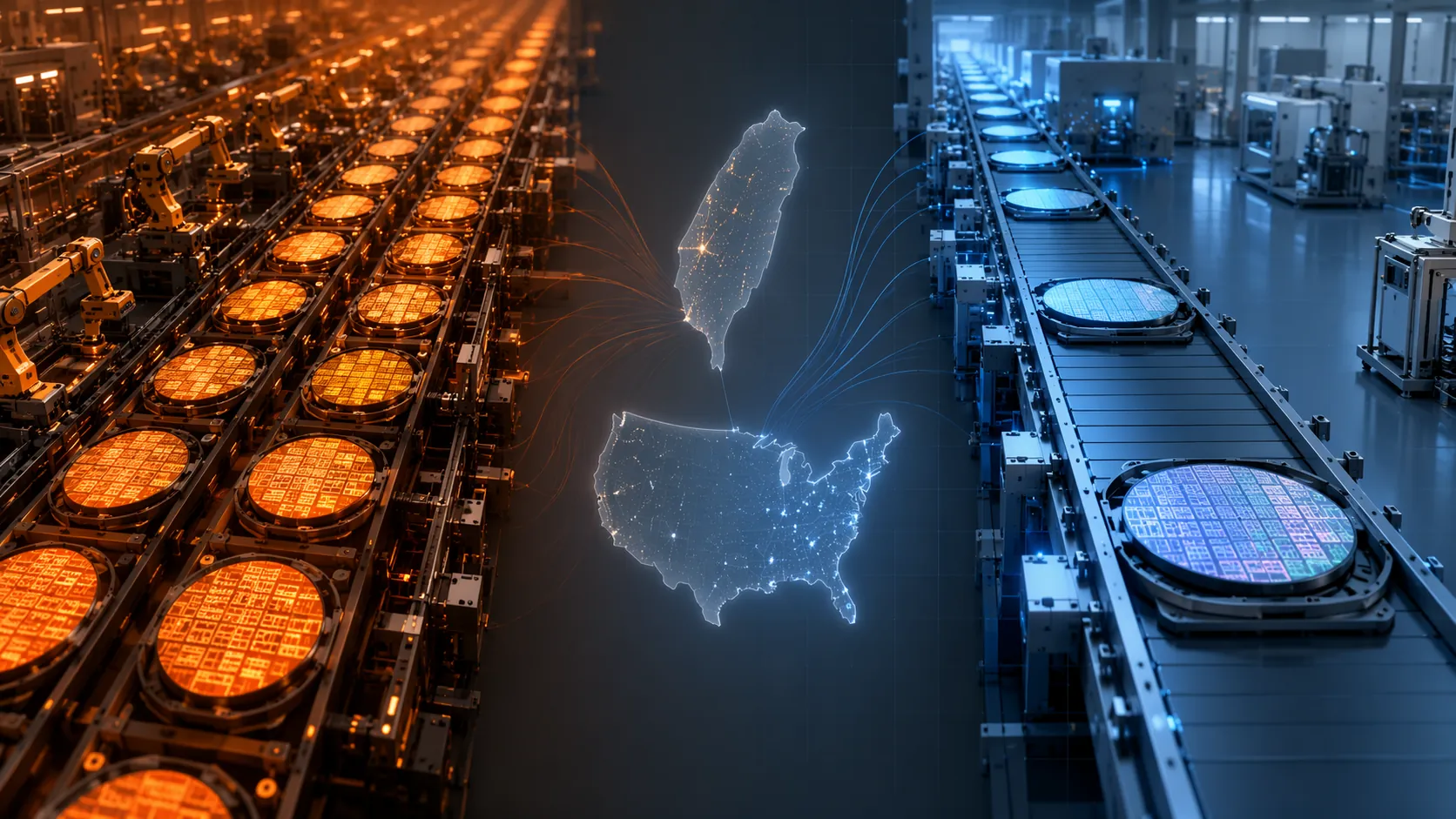
The stock question, then, is not whether Intel is suddenly a cleaner company than it was a few years ago. It is whether supply-chain pain is strong enough that customers with serious AI chip volume will accept Intel execution risk in exchange for geography, redundancy, and access to scarce leading-edge wafers. That is a narrower claim than “Intel is back,” and it is the only claim worth testing.
Capacity Scarcity Gives Intel A Real Opening
Advanced-node scarcity is different from ordinary component tightness. A buyer can dual-source many semiconductors with enough qualification time, but it cannot casually move a frontier AI accelerator from one leading-edge process to another. Physical design rules, packaging assumptions, yield learning, thermal behavior, and software-adjacent performance targets all get tied to the manufacturing route. By the time the bottleneck is visible in procurement dashboards, most of the important choices have already been locked in.
That is why TSMC’s booked-out position matters for Intel’s valuation. If leading-edge capacity is merely tight for a quarter or two, Intel’s foundry story remains a long-dated aspiration. If capacity is structurally allocated years ahead, then Intel’s domestic foundry capacity has option value before it has fully mature margins. Moody’s semiconductor supply-chain work treats the current advanced-node bottleneck as a constraint that can influence customer sourcing behavior, not just near-term chip pricing. [3]
The useful distinction is between adoption and effectiveness. Customers can adopt Intel design kits, test early flows, and issue encouraging public statements without having moved meaningful wafer volume. That still matters because no serious AI chip company starts foundry diversification at the purchase-order stage. But it should not be confused with proven production economics.
| Evidence Layer | What It Supports | What It Does Not Yet Prove |
|---|---|---|
| TSMC capacity above 100% utilization and booked through 2028 | AI chip buyers face a real advanced-node supply constraint | That buyers will shift volume to Intel at scale |
| Intel projected at about 20% of advanced logic capacity by late 2026 | Intel may become a meaningful supply-chain alternative | That capacity will be fully yieldable or margin-bearing |
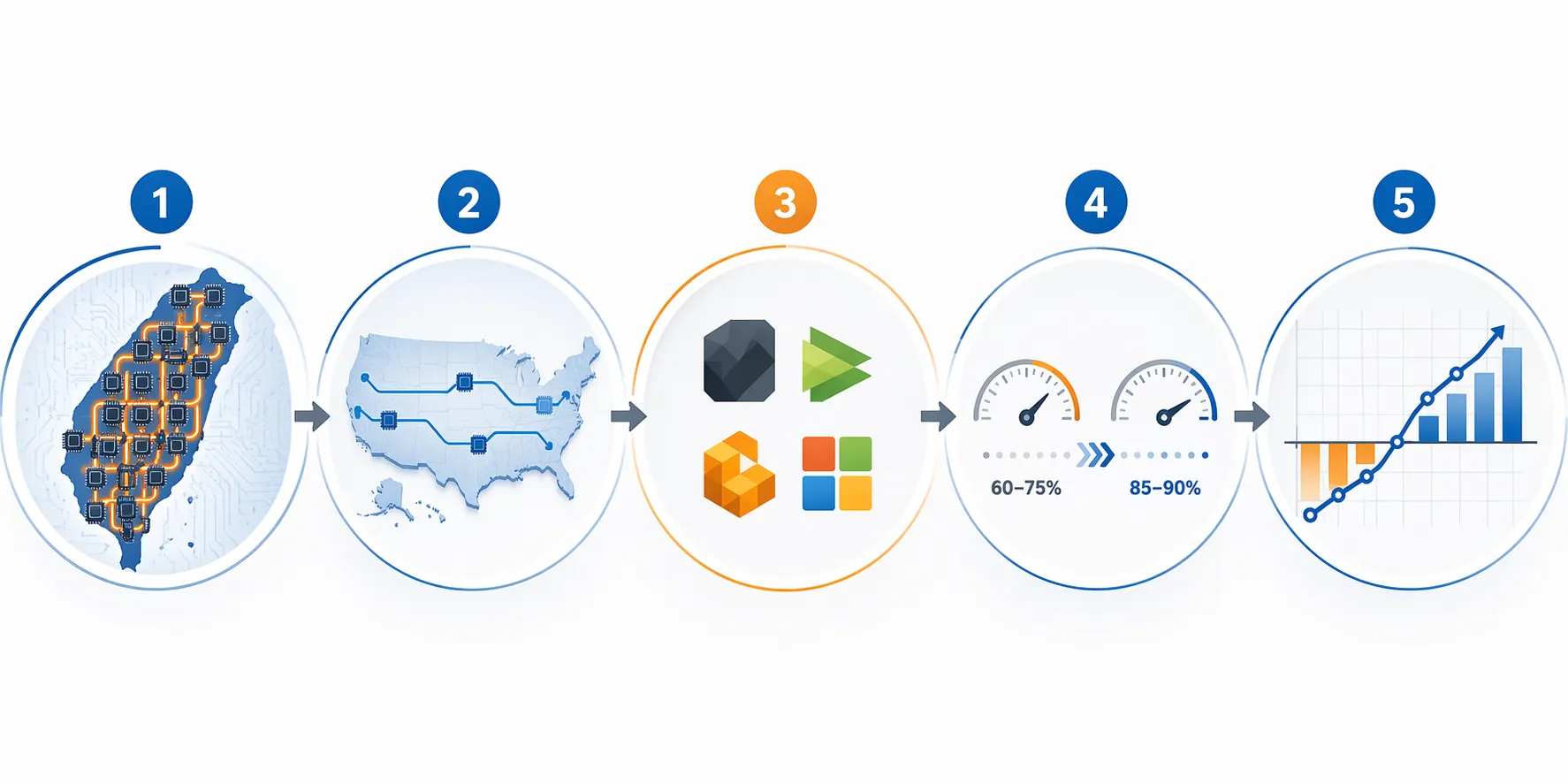
| Named engagements with Apple, NVIDIA, AWS, and Microsoft | Customer interest is not merely generic ecosystem talk | That exploratory work equals committed production volume |
| 18A yield estimates below margin thresholds | The manufacturing conversion test remains unresolved | That Intel cannot improve yields over time |
Named Customers Matter, But The Commitment Level Matters More
The strongest version of Intel’s AI chip supply chain outlook does not rest on vague interest from “the ecosystem.” It rests on named counterparties. Apple has a confirmed foundry partnership with Intel, NVIDIA has made a $5 billion equity investment, and Intel has design wins with AWS and Microsoft. Those are not minor logos for a company trying to persuade the market that external customers will use its fabs. [4]
Still, a customer name can represent very different things inside a factory plan. It can mean a design enablement relationship, PDK evaluation, test-chip activity, a narrow product engagement, or committed high-volume manufacturing. The public evidence supports the first conclusion more strongly than the last one: strategically important companies are engaging Intel because the alternative supply base is constrained. It does not yet prove that they have committed enough external wafer volume to carry the foundry segment toward profitability.
For enterprise supply-chain leaders, that distinction is familiar. A second source may appear on a sourcing strategy slide long before it is approved for the highest-volume product family. Qualification is work. The buyer has to decide how much engineering capacity to spend, how much performance variation to tolerate, and how much schedule risk to put into a new manufacturing path. Intel’s opening exists because those trade-offs are becoming more acceptable, not because they have disappeared.
The 18A Yield Test Is Where Strategy Becomes Revenue
The center of the Intel stock outlook is 18A. Not because node names themselves deserve investor fascination, but because 18A is the bridge between geopolitical relevance and commercial foundry viability. If Intel can qualify customer designs on 18A, improve yields, and ship at margins that do not consume the strategic value it is creating, the market has a reason to value Intel Foundry differently. If it cannot, the supply-chain diversification thesis remains real but financially incomplete.
The current yield evidence is not yet where it needs to be. TrendForce estimates put 18A yields in the 60% to 75% range in early 2026, below the roughly 85% to 90% level associated with strong margin performance. [5] Intel’s Q1 2026 earnings call also kept attention on yield improvement rates and supplier metrics, which is exactly where attention belongs: not on whether the node can be demonstrated, but on whether it can be repeated often enough, with enough good die, to support external customer economics. [6]
Yield shortfalls hit the stock thesis through several channels at once. They raise cost per good die. They complicate delivery commitments. They make customers more cautious about shifting their most valuable products. They also delay the point at which foundry revenue can improve segment margins rather than simply absorbing fixed cost. This is the part of the story where an investor’s patience and a manufacturing organization’s reality can diverge.
There is no need to dismiss Intel because 18A is not yet at mature margin yields. Foundry learning curves are not software adoption curves. But there is also no reason to capitalize every customer conversation as though the yield curve has already crossed the margin threshold. A cleaner forecast waits for the conversion points: qualified designs, wafer starts, yield progression, delivery performance, and external revenue that carries acceptable gross margin.
Losses And Delays Keep The Optionality From Becoming A Free Option
Intel’s foundry losses are not a footnote. Forbes/Trefis estimates that Intel’s foundry segment lost about $7 billion in 2023, with multi-billion-dollar losses continuing through 2025. [7] That level of loss matters even if one believes the infrastructure logic. A fab strategy can be strategically correct and still be punishing for shareholders if the revenue ramp arrives later than the depreciation, labor, tooling, and supplier commitments.
The Ohio delay sharpens that issue. The fab’s expected timeline has moved to 2030–2031, which caps how much near-term capacity expansion can contribute to the 2026 stock case. [7] Intel can still gain relevance through existing and nearer-term capacity, but investors should not treat every announced U.S. fab shell as immediately available advanced-node supply. Qualified capacity is the scarce asset, not concrete.
The conditional 14A decision adds another useful checkpoint. Intel’s next major node will proceed only if firm external customer commitments materialize in the second half of 2026. [7] That condition is healthy discipline, but it also makes the stock forecast milestone-dependent. If customers remain mostly in evaluation mode, Intel may preserve capital discipline while losing some of the re-rating case. If commitments arrive, the market gets a clearer signal that supply-chain concern is converting into commercial demand.
What Would Change The Stock Outlook In 2026
The useful Intel stock forecast for AI chip supply chain exposure is not built around a single price target. It is built around a sequence of operational evidence. The first sign is whether named customers move beyond early-stage engagement into firmer production commitments. The second is whether 18A yield improvement approaches the margin-relevant range. The third is whether Intel can show that external foundry revenue is growing without simply deepening losses.
- A stronger case: TSMC remains capacity-constrained, Intel reports measurable 18A yield progress, and at least some named engagements convert into committed external volume.
- A stalled case: customers continue PDK-stage or exploratory work, 18A yields improve but stay below margin thresholds, and foundry losses remain the dominant reported fact.
- A weaker case: capacity delays compound, 14A lacks firm second-half 2026 commitments, and customers keep Intel as a strategic option rather than a production source.
That framework also separates Intel from a generic AI-chip beneficiary. NVIDIA can benefit from accelerator demand immediately through products. TSMC benefits from booked advanced-node capacity. Intel benefits if bottlenecked customers decide that a second advanced-node source on U.S. soil is worth the engineering and execution risk.
For supply-chain leaders, Intel is becoming a serious contingency path. For investors, that is not the same as proof of a sustained re-rating. The 2026 stock case is strongest when Intel is valued as supply-chain diversification insurance in a capacity-constrained AI-chip market. It becomes a durable earnings case only when 18A crosses margin-relevant yield thresholds and named customer engagements turn into firm, yieldable, margin-bearing external volume.
References
- AI chip supply constraints, CNAS, link
- Intel pressure valve analysis, Supply Chain Digital, link
- Semiconductor supply chain bottleneck report, Moody’s, link
- Apple-NVIDIA partnerships, Bloomberg Intelligence, link
- 18A margin targets, TrendForce, link
- Intel Q1 2026 earnings call transcript, Intel, 2026, link
- Foundry inflection point assessment, Forbes/Trefis, link
Cited evidence
- Intel's Server CPU Supply Crunch Reshapes AI Procurement
Intel's server CPUs are sold out through 2026, with distributors fulfilling only ~40% of orders, creating a structural bottleneck for enterprises building AI data centers. This analysis covers the procurement strategies—forward-buying, BOM flexibility, and alternative CPU qualification—that supply chain leaders need to adopt now.
- How AI Capex Is Reshaping Supply Chain Software Vendor Risk
A vendor-intelligence analysis of the five major supply-chain planning platforms—Kinaxis, o9 Solutions, Blue Yonder, Anaplan, and RELEX—maps their financial health and AI deployment evidence against the $700B+ hyperscaler AI capex wave. The findings reveal that only Kinaxis offers audited financials and verifiable AI outcomes, while the other four operate under private or subsidiary ownership that obscures financial and deployment risk, making the transparency gap itself a material selection factor for enterprise buyers.
- Intel's AI Data Center Growth Strains CPU Supply Chain
Intel's 22% DCAI revenue jump to $5.1B has created a CPU shortage with lead times up to 22 weeks and allocation fulfillment around 40%. This article analyzes how enterprise procurement leaders should navigate allocation risk, pricing, and product prioritization through Q3 2026.
Ready to check your own team's readiness for this pattern?
See the procurement readiness checklist →Spotted something inaccurate or incomplete in this entry? ChainSignal reviews corrections and additional evidence before publishing an update — this is not a public comment thread.
Flag an inaccuracy / submit evidence for this entry →