What IBM's AI Software Delays Mean for Supply Chain Planning
IBM's Q2 2026 earnings miss and 25% stock drop reveal that AI software revenue delays are tied to client capex shifts, not product rejection. This article examines whether the setback is a temporary blip or a structural risk for supply chain planning buyers evaluating IBM.
If an IBM Planning Analytics renewal or AI planning evaluation is already moving through approvals in Q3 2026, the July earnings miss should change the questions asked before signature, not automatically cancel the project. The useful issue is narrower than the market reaction: whether IBM’s delayed enterprise software deals were genuinely pushed into a later quarter, or whether the delay signals weaker execution around the software roadmap buyers are counting on.
The signal stack is compact. IBM shares fell 25% on July 14, 2026, wiping out about $70 billion in market value in what Reuters described as the company’s worst single trading day in its century-long history.[1] Q2 software revenue came in at $7.76 billion, below the $7.88 billion analyst estimate, and software growth slowed to 5% after 11% growth in Q1.[2] Arvind Krishna told CNBC that “numerous large deals failed to close on the timelines we expected” because clients were redirecting capital expenditure toward AI infrastructure rather than software.[2] Then, on July 22, IBM cut its full-year 2026 revenue growth forecast from “over 5%” to “4–5%,” while Krishna said roughly one-third of the delayed deals had already closed in early Q3.[3]

That last claim is the hinge. If the early-Q3 recovery is visible in a buyer’s own IBM engagement — rescheduled approvals, updated commercial documents, named implementation capacity, and roadmap commitments that survived the miss — the event looks more like a sales-timing problem. If the recovery cannot be substantiated before a renewal deadline, it remains a vendor-risk signal for supply chain planning teams whose internal business cases depend on near-term AI planning capabilities.
What The July Timeline Actually Supports
The cleanest reading of IBM’s explanation is not that enterprise AI planning demand disappeared. Krishna’s CNBC explanation points to client budget sequencing: customers chose AI infrastructure capex first, leaving large software deals outside the expected Q2 close window.[2] That matters because a delayed purchasing sequence is different from a failed product evaluation. It does not prove the roadmap is safe, but it does prevent a responsible buyer from treating the stock drop as direct evidence that IBM’s planning software was rejected.
The problem is that software revenue is not a mood indicator. It is the line where pipeline confidence becomes signed business. Missing the software estimate by about $120 million while growth slowed from 11% to 5% gives procurement and planning leaders a concrete reason to ask whether their own IBM timeline sits inside the same slippage pattern.[2] A vendor can be strategically right about AI and still miss the quarter because customer approvals, infrastructure availability, or commercial dependencies did not line up.
The July 22 update helps, but only partly. IBM’s assertion that roughly one-third of the delayed deals had closed in early Q3 supports the “deferred, not destroyed” case if those closures were comparable to the deals that missed Q2 and if the remaining backlog has identifiable close paths.[3] The research available here does not independently audit that claim. For a buyer preparing an internal memo, that means the statement can be cited as management commentary, not treated as verified recovery.
Why Supply Chain Planning Buyers Should Care
A stock-market event becomes relevant to supply chain planning only when it can touch contract timing, implementation confidence, roadmap delivery, or approval risk. IBM’s Q2 miss clears that bar because the explanation sits directly in enterprise software buying behavior: large deals slipped, AI infrastructure consumed client capex, and the company reduced its annual revenue outlook.[2][3]
For an S&OP director, the immediate consequence is not a theoretical view on IBM’s valuation. It is the quality of the assumptions inside the planning-system business case. If the business case says an AI-enabled planning capability will support a new forecasting, scenario-planning, or replenishment process by a particular quarter, the buyer needs to know whether IBM’s own software execution and customer delivery capacity still support that date.
For IT procurement, the risk is different. A renewal can proceed even when a vendor has a weak quarter, but the contract should not preserve yesterday’s pricing, implementation promises, and roadmap dependencies while the buyer absorbs all schedule risk. If IBM wants the event treated as timing rather than deterioration, the burden should shift toward documentation: what was delayed, what has closed, what remains pending, and which roadmap commitments are contractually or commercially meaningful.
The Mainframe Detail Changes The Confidence Read
The software miss did not appear alone. IBM also reported a 42% Q2 mainframe revenue decline, which CFO James Kavanaugh said was three times worse than IBM’s internal model.[3] That does not prove a planning-software failure. It does, however, complicate the buyer’s confidence read, because hardware, infrastructure prioritization, and enterprise software commitments were all part of the same management explanation around deal timing and annual guidance.
This is where analyst distinction is useful. CFRA’s Brooks Idlet argued that IBM’s software woes more likely reflected IBM-specific hardware issues, rather than an industry-wide AI chip supply shortage.[4] For planning buyers, that cuts two ways. It avoids the lazy conclusion that enterprise AI demand broadly collapsed. It also means IBM cannot hide entirely behind a generic market explanation if the constraint was more specific to its own environment.
Three Reasonable Buyer Positions After The Miss
The wrong response is to turn a 25% stock drop into a binary platform verdict. The more useful response is to decide which buyer position the evidence supports for the specific IBM engagement in front of you.
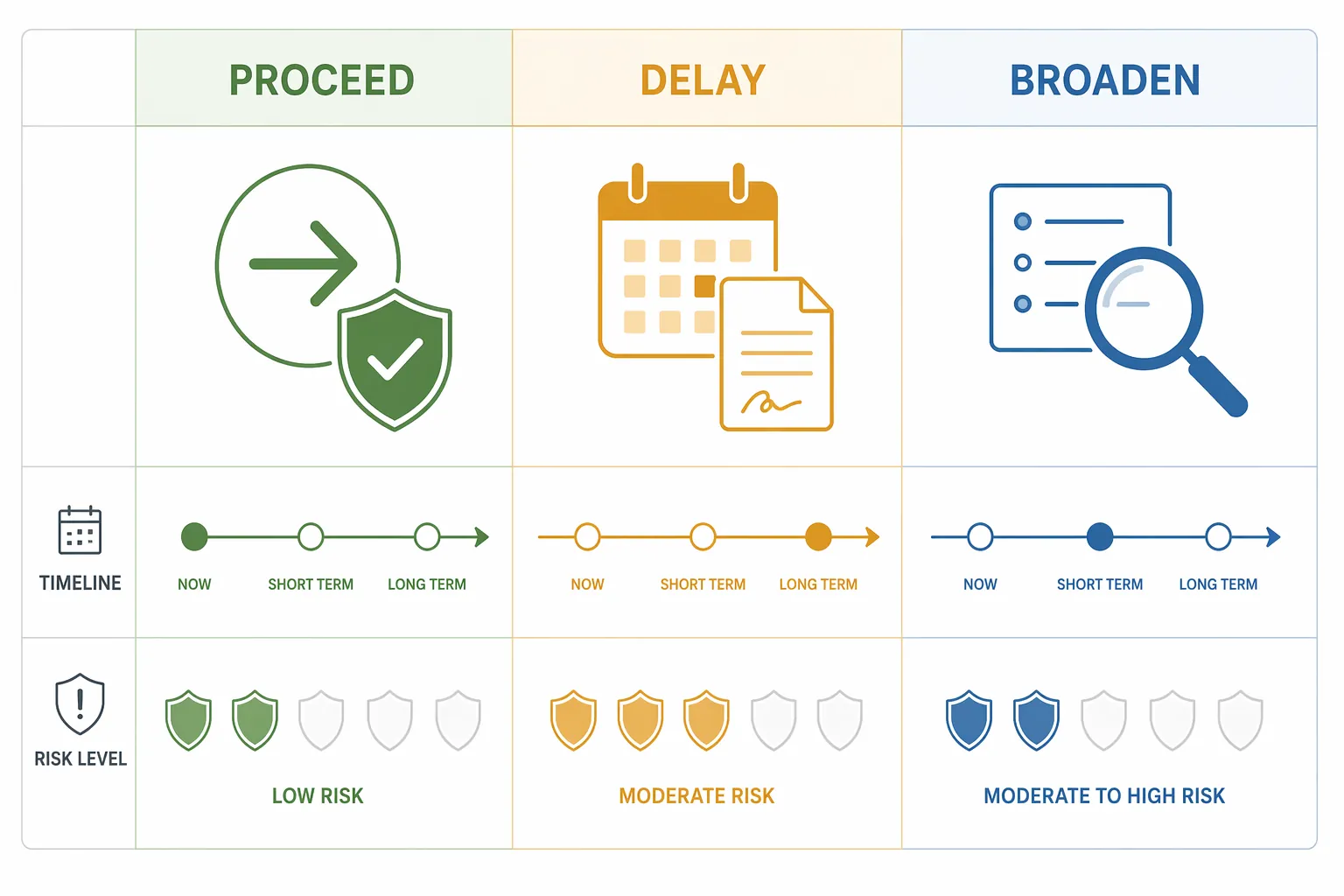
| Buyer position | When it is defensible | What to verify before approval |
|---|---|---|
| Proceed unchanged | IBM can document continuity in your own deal, implementation timeline, and roadmap dependencies. | Named milestones, delivery capacity, renewal terms, and written confirmation that the relevant AI planning commitments were not pushed out. |
| Delay or add protections | Your business case depends on near-term AI planning capabilities or integration work that would be costly to re-sequence. | Termination rights, milestone-based payments, service credits, implementation staffing, and fallback scope if roadmap items slip. |
| Broaden the shortlist | IBM cannot substantiate the early-Q3 recovery claim in a way that maps to your buying timeline. | Comparable alternatives, migration lead time, data-integration effort, and the cost of keeping IBM as incumbent while evaluating other options. |
Proceeding unchanged is reasonable only when the buyer has more than reassurance. A procurement lead should be able to point to updated IBM documents that match the post-earnings reality: the same scope, the same delivery window, and a clear explanation of whether the Q2 slippage affected the account team’s commitments. If the renewal is mostly a continuity transaction and the AI planning scope is not material to the next operating cycle, the earnings event may not justify reopening the whole sourcing process.
Delay or contract protection becomes the cleaner position when the buyer is not just renewing licenses, but anchoring a planning transformation to IBM’s near-term AI software delivery. In that case, the Q2 miss adds approval risk. Finance may ask why the organization is locking into a multi-year commitment just after IBM reported slower software growth and cut guidance. The answer cannot be a general statement that AI is strategic. It has to show what IBM will deliver, when, and what happens commercially if those milestones move.
Broadening the shortlist is not a punishment. It is a timing hedge. If IBM cannot give account-level evidence that delayed demand is returning, a planning team should not wait until the renewal deadline to discover that migration alternatives need more diligence. The useful comparison is not “IBM or no IBM.” It is whether the incumbent path still has lower execution risk than the cost and disruption of evaluating other planning platforms.
What Not To Infer From The Earnings Miss
The Q2 event does not establish that IBM’s AI supply chain planning products are failing in deployment. The cited evidence shows delayed large software deals, slower software growth, a guidance cut, and management’s explanation that customers prioritized AI infrastructure capex.[2][3] It does not show failed implementations, abandoned planning projects, or customer rejection of a specific IBM Planning Analytics roadmap item.
It also does not prove that enterprise AI software demand has weakened across the market. The analyst view in the brief points the other way: the issue may be more IBM-specific than industry-wide.[4] That distinction is important for internal risk memos. A sourcing team that overstates the case may lose credibility with finance or IT architecture reviewers who know that large enterprise software deals often slip for budget-sequencing reasons.
Adjacent credibility events should stay adjacent. A separate Red Hat npm attack in June 2026 may matter to some enterprise risk teams because Red Hat is part of IBM, but the provided research does not connect that incident causally to the Q2 earnings miss. The same caution applies to broader research on AI deployment failure rates or skepticism around autonomous planning. Those are useful background pressures when evaluating any AI planning roadmap; they are not evidence that IBM’s July software delay was caused by failed planning deployments.
Category Momentum Does Not Remove Vendor-Specific Risk
There is still spending momentum around AI-enabled supply chain software. Gartner forecasts that supply chain management software with agentic AI will grow to $53 billion in spend by 2030.[5] That helps frame why customers are still evaluating planning vendors rather than walking away from the category.
But category growth is not vendor execution. A planning buyer cannot use the Gartner forecast as reassurance that IBM’s delayed deals will close, that IBM’s roadmap commitments will arrive on the buyer’s calendar, or that a specific renewal deserves unchanged approval. The forecast supports the idea that the market remains important. It does not verify IBM’s early-Q3 recovery claim.
The Verification Work Before A Q3 Decision
The practical work is to turn IBM’s public explanation into account-level evidence. Procurement should ask IBM to identify whether the buyer’s renewal, expansion, or AI planning evaluation is connected to any of the same constraints that affected Q2 software revenue. If the answer is no, the account team should be able to document why. If the answer is yes, the buyer should know which milestone moved and who now owns the recovery path.
- Ask whether any software, implementation, infrastructure, or services dependency in your IBM plan was re-sequenced after the Q2 close.
- Request written confirmation of roadmap items that affect forecasting, scenario planning, integration, or planning automation within the renewal period.
- Separate license continuity from new AI planning commitments; each carries a different level of timing risk.
- Tie payment, expansion, or renewal protections to delivery milestones where the business case depends on near-term capability.
- Keep an alternative evaluation path warm if IBM cannot map its claimed early-Q3 recovery to credible account-level progress.
None of this requires treating IBM as distressed or assuming the platform roadmap has broken. It requires refusing to let a vendor-wide timing explanation substitute for verifiable buyer-specific evidence. For supply chain planning teams, that is the difference between absorbing normal enterprise-sales noise and underwriting a roadmap risk they did not price into the renewal.
IBM’s Q2 miss is a real vendor-signal event for buyers evaluating IBM AI enterprise software for supply chain planning. The risk level depends less on the July 14 stock chart than on whether IBM’s July 22 recovery claim can be independently supported before the buyer locks renewal timing, roadmap assumptions, or migration alternatives.
References
- IBM expects second-quarter revenue below estimates, Reuters, July 14, 2026.
- IBM warns second-quarter earnings fell short of expectations, CNBC, July 14, 2026.
- IBM trims outlook after earnings miss but says delayed customer demand is returning, Moneycontrol, July 22, 2026.
- IBM warns of weakness in large deals, supply chain, CryptoBriefing.
- Gartner Forecasts Supply Chain Management Software With Agentic AI Will Grow to $53 Billion in Spend by 2030, Gartner, April 7, 2026.
Cited evidence
- What Trump's Ratepayer Pledge Means for AI Data Center Supply Chains
The Ratepayer Protection Pledge shifts grid upgrade costs but lands on a supply chain already crippled by transformer shortages, tariff exposure, and multi-year lead times—forcing enterprise AI buyers to plan for higher costs and delays through at least 2028.
- How AI Capex Is Reshaping Supply Chain Software Vendor Risk
A vendor-intelligence analysis of the five major supply-chain planning platforms—Kinaxis, o9 Solutions, Blue Yonder, Anaplan, and RELEX—maps their financial health and AI deployment evidence against the $700B+ hyperscaler AI capex wave. The findings reveal that only Kinaxis offers audited financials and verifiable AI outcomes, while the other four operate under private or subsidiary ownership that obscures financial and deployment risk, making the transparency gap itself a material selection factor for enterprise buyers.
- How AI Supply Chain Planning Flags Tip-Over Risks Before Recalls
This analysis examines whether supply-chain AI platforms can detect and stop furniture tip-over recalls before they escalate. Drawing on CPSC injury data, the 2024 New Age restraint-kit recall, and known vendor capabilities from o9, Blue Yonder, and Kinaxis, it finds that AI can compress the defect-escape interval from months to days—but only if the industry resolves data-sharing and multi-tier traceability gaps.
Ready to check your own team's readiness for this pattern?
See the supply chain planning readiness checklist →Spotted something inaccurate or incomplete in this entry? ChainSignal reviews corrections and additional evidence before publishing an update — this is not a public comment thread.
Flag an inaccuracy / submit evidence for this entry →