How AI Supply Chain Disruption Planning Handles Texas Earthquakes
This analysis shows how AI-powered scenario planning platforms (o9, Kinaxis, Blue Yonder, Everstream) enable supply chain leaders to model and mitigate the accelerating induced seismicity risk in the Permian Basin, drawing on documented trend data, regulatory responses, and platform capabilities.
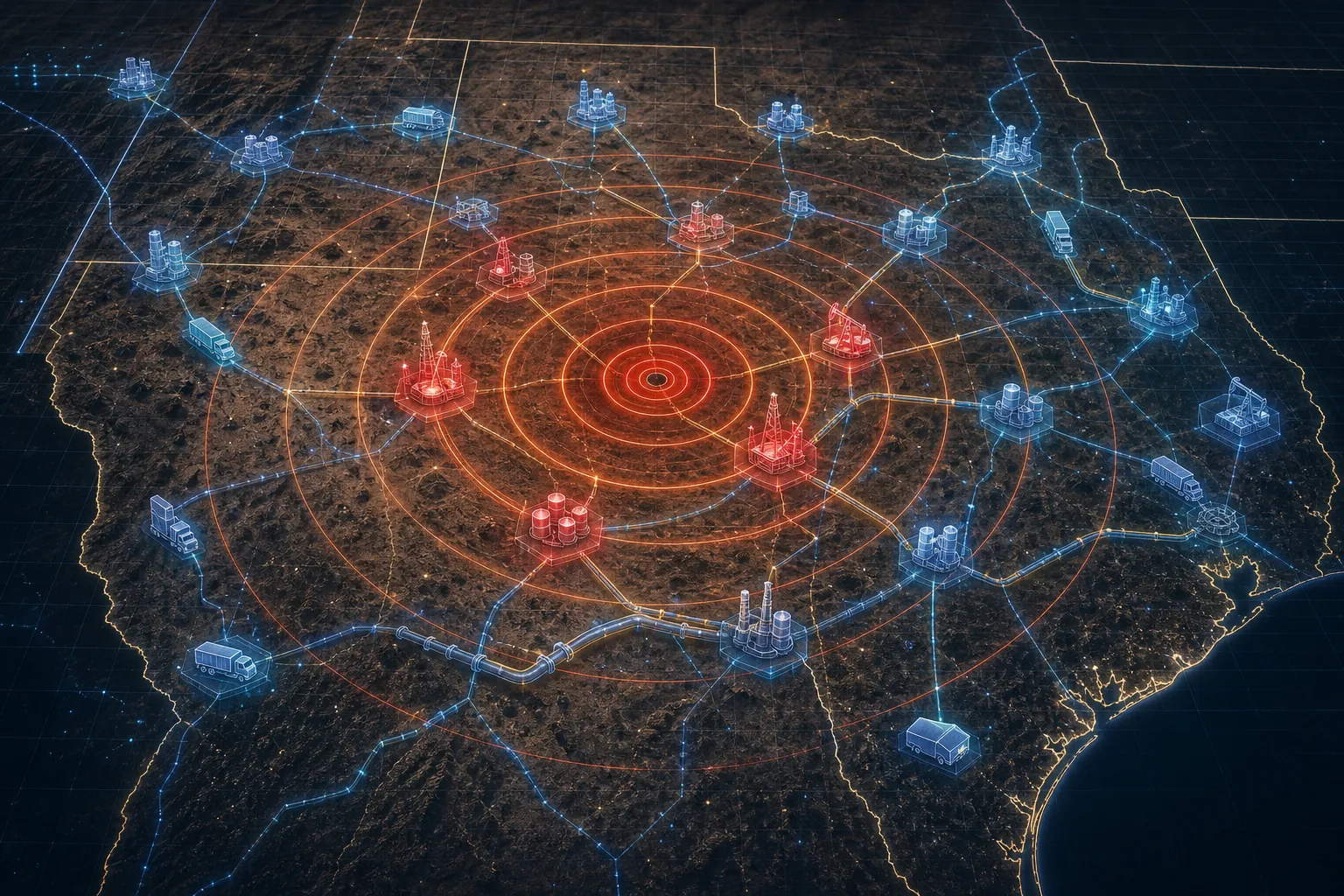
A magnitude 5.0 earthquake in West Texas is not, by itself, a supply-chain crisis. The February 2025 event struck a sparsely populated part of the Permian Basin, and the U.S. Geological Survey expected economic losses from the quake to be minimal, according to contemporaneous reporting by The Texas Tribune.[1] The planning problem starts one layer deeper: a gas pipeline ruptured and ignited after the event, and Reuters reported that the incident put renewed attention on wastewater disposal and seismicity in the oil patch.[2]
That is the point where a headline becomes a field in a model. If a manufacturer, chemical buyer, fuel distributor, water-midstream operator, or logistics provider has Permian exposure, the practical question is not whether “an earthquake happened in Texas.” It is whether the company can identify the facilities, suppliers, lanes, inventories, and capacity assumptions inside the affected radius before operations teams are already explaining misses to customers.
The February rupture was also not an isolated infrastructure concern. The Watchers described it as the third pipeline failure in Reeves County in 19 months, while Forbes framed the event against a broader rise in serious earthquakes in the region.[3][4] That still does not make every Permian earthquake a major economic disruption. It does make induced seismicity a supply-chain variable that deserves treatment somewhere between routine weather risk and catastrophic tail risk.
Why Texas seismicity is now planable
The evidence that matters for AI supply chain disruption planning is not the drama of one quake. It is the acceleration, the operating mechanism, and the regulatory response.
A 2022 University of Texas at Austin study linked most recent West Texas earthquakes to oil and gas activity and reported that magnitude 2.0 or greater earthquakes increased eightfold from 2019 to 2021, while magnitude 3.0 or greater earthquakes increased twentyfold over the same period.[5] In December 2024, UT Austin’s Jackson School of Geosciences described new research aimed at improving understanding of earthquake hazards in the Permian Basin, reinforcing that the region is being studied as an active hazard system rather than as a collection of odd local events.[6]
The likely operating link is wastewater. Oil and gas production brings up large volumes of produced water, and disposal through injection wells can affect subsurface pressure conditions. Commercial-provider estimates from Sourcenergy point to high produced-water-to-oil ratios in the Delaware and Midland basins, but those ratios should be treated as vendor data, not as peer-reviewed confirmation. For supply-chain modeling, the exact ratio is less important than the fact that produced-water handling, disposal capacity, and seismic response are now tied to operating continuity.
The Railroad Commission of Texas has already turned that relationship into constraints. Its seismicity response program identifies Seismic Response Areas, including Gardendale, Stanton, and the Northern Culberson-Reeves area, with deep-disposal injection reductions of up to 68% and 23 deep-disposal well suspensions.[7] That is the supply-chain planning hinge: seismicity does not have to damage a plant to change available capacity. A regulatory injection reduction can affect water handling, production cadence, truck demand, midstream flows, maintenance priorities, and supplier commitments.
The planning workflow starts with a geofence, not a press release
A useful earthquake scenario does not begin with “major natural disaster” as a generic risk label. It begins with coordinates, a magnitude, a radius, and a time window. From there, the planning system needs to answer a sequence of operational questions fast enough that supply, demand, and customer decisions can be made together.
| Planning action | What the model needs to see | Decision it supports |
|---|---|---|
| Identify geologic exposure | Epicenter, radius, known seismic response areas, nearby assets | Which sites, suppliers, and lanes need immediate review |
| Map multi-tier dependencies | Tier-1 and tier-2 suppliers, production inputs, water and energy dependencies | Which commitments depend on the affected geography |
| Simulate outage or constraint | Facility downtime, pipeline interruption, road delay, injection reduction | Which supply, inventory, and service assumptions break first |
| Replan concurrently | Demand priorities, available inventory, alternate sources, capacity limits | Which customers and products should be protected |
| Predefine playbooks | Approved substitutions, alternate lanes, allocation rules, escalation owners | What operations can execute without inventing governance during the event |
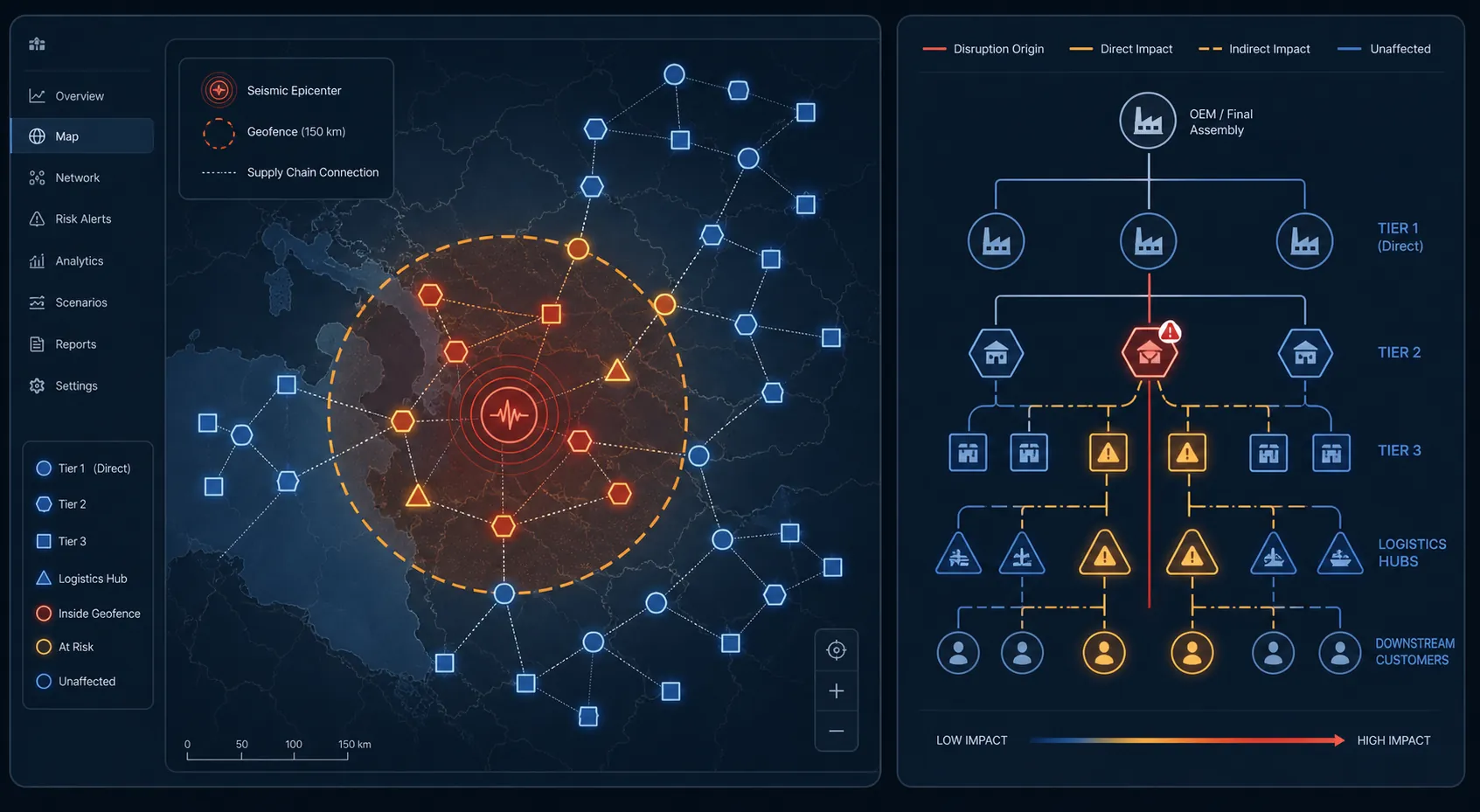
Everstream’s Scenario Builder is the cleanest fit for the first move because its published scenario-planning material describes geofencing a disruption area and identifying impacted facilities, suppliers, and logistics nodes.[8] In a Texas earthquake scenario, that means the planner draws a radius around the epicenter or around a regulatory response area and asks what sits inside it: compressor stations, disposal wells, chemical suppliers, transload points, yards, pipeline segments, contracted carriers, or customer-critical production nodes.
That map view matters because tier-one procurement data usually gives a false sense of coverage. A buyer may know the direct supplier’s headquarters, remit-to address, or primary plant. That is not the same as knowing whether the supplier’s resin, water-hauling capacity, field service crew, fuel supply, or subcontracted fabrication step depends on Reeves County, Midland Basin lanes, or a disposal-constrained area.
Dependencies have to be modeled as geography, not just vendor records
The next step is where many risk registers fail. They list “earthquake” as a hazard and “supplier disruption” as a consequence, but they do not connect the hazard to the actual dependency graph. An AI planning platform only becomes useful here if it can represent the relationship between geography, facilities, products, suppliers, and constraints.
o9’s published scenario-planning material describes an Enterprise Knowledge Graph and digital-twin approach for modeling supply planning relationships and evaluating scenarios.[9] For a Permian-exposed supply chain, the relevant use is not a generic “AI predicts disruption” claim. It is the ability to attach a geological zone or response area to nodes in the operating model: a supplier facility, a disposal dependency, a pipeline connection, a lane, an inventory position, or a customer allocation rule.
Once those links exist, the earthquake scenario can stop being a one-off email exercise. A planner can ask which finished goods depend on a feedstock sourced through the affected area, which customers consume those goods, which alternate suppliers are qualified, and which substitutions require quality, regulatory, or engineering approval. The output is not a prediction that an earthquake will happen next Tuesday. It is a dependency view that shows what would be exposed if a specific location or constraint failed.
This is also where regulatory response has to enter the model. If a Seismic Response Area reduces injection volumes, the scenario should not only remove a damaged pipeline or mark a facility offline. It should test a capacity-constrained operating mode: slower production, redirected water hauling, higher carrier demand, alternate disposal sites, or deferred output. Those are not geological abstractions. They are supply, labor, lane, and inventory assumptions.
A facility outage is only the first domino
After exposure mapping, the useful scenario becomes deliberately operational. Assume a hypothetical Permian supplier site is unavailable for several days after a seismic event. The model should not stop at flagging the supplier as disrupted. It should recalculate what that outage does to purchase orders, production schedules, inventory buffers, promised ship dates, customer priorities, and constrained alternate capacity.
Kinaxis positions Maestro around concurrent planning and real-time what-if analysis for disruption and volatility.[10] That capability matches the earthquake problem because the supply-chain impact does not arrive in one functional silo. Procurement wants to know whether the supplier can recover. Manufacturing wants to know whether to change the schedule. Sales wants to know which orders are at risk. Finance wants to know whether expediting or allocation is justified. Operations needs all of those answers before the first workaround hardens into the wrong plan.
Concurrent planning is especially important when the event is small enough to avoid a company-wide crisis label but large enough to bend assumptions. The February 2025 quake is a good example of the distinction. Reported losses from the actual event were expected to be minimal, but a pipeline rupture still occurred.[1][2] A planner does not need to declare a regional catastrophe to test what happens if a specific node is removed, a lane is delayed, or a regulatory constraint reduces throughput.
The same caution applies to Blue Yonder and other AI-enabled planning or control-tower environments. Their broader value proposition is relevant when a company needs exception detection, scenario planning, inventory visibility, and coordinated execution. But without a named Texas earthquake deployment, it is cleaner to describe the fit at the capability level rather than imply field validation for this hazard.
What the scenario should actually test
A credible Texas earthquake scenario should be narrow enough that people can act on it. “Permian disruption” is too broad. “M5.0 event near a Reeves County dependency, with one pipeline segment unavailable and a related disposal constraint in force” is closer to something a planning team can model.
- Asset exposure: which owned sites, supplier sites, logistics nodes, and pipeline-linked operations sit inside the selected earthquake radius or response area.
- Material exposure: which SKUs, feedstocks, components, fuels, chemicals, or services depend on those nodes directly or through tier-2 suppliers.
- Capacity exposure: how much volume is lost if a facility, lane, disposal well, or pipeline segment is unavailable or constrained.
- Inventory exposure: how many days of cover exist by location, product family, and customer priority before service levels change.
- Recovery exposure: which alternates are qualified, which need approval, and which mitigation actions create new bottlenecks elsewhere.
The most useful output is usually not a single risk score. It is a comparison of feasible operating choices. If the affected supplier recovers in 48 hours, hold the schedule and watch inventory. If recovery extends beyond that, shift qualified volume to an alternate source. If the alternate source consumes scarce carrier capacity, protect higher-margin or contractual customers first. If the disruption is caused by a regulatory injection constraint rather than physical damage, test whether the bottleneck lasts long enough to justify rerouting, substitution, or commercial renegotiation.
Those choices have owners. Procurement owns supplier confirmation and alternate sourcing. Planning owns the supply-demand balance. Logistics owns lanes and expediting feasibility. Commercial teams own customer communication and allocation tradeoffs. Legal, quality, and engineering own substitutions that cannot be made by planners alone. A playbook that does not name those decision rights will fail at the moment it is needed.
Natural-disaster analogues are useful, but they are not earthquake proof
There is enough adjacent evidence to believe the workflow is practical. Emerj’s case study of DHL’s Resilience360 described a risk-management platform used by more than 13,000 users and discussed how proactive modeling can shorten response time compared with reactive firefighting in events such as hurricanes.[11] Everstream’s own scenario-planning material also describes disaster-style geofencing and impact analysis across supply-chain nodes.[8]
Those examples transfer at the capability-pattern level: define an event perimeter, identify exposed nodes, simulate the operational impact, and execute a prepared response. They do not prove that a named manufacturer used o9, Kinaxis, Blue Yonder, or Everstream for a dated Texas earthquake event and published the results. That evidence gap matters because earthquakes, hurricanes, freezes, cyber events, and port closures have different warning times, asset-damage patterns, and recovery profiles.
The ROI case should be bounded in the same way. SupplyChainBrain has cited McKinsey’s finding that AI-driven forecasting can improve accuracy by 20% to 50%, which is a useful anchor for the broader value of AI planning under volatility.[12] It should not be read as a measured return from Texas earthquake planning specifically. The stronger business case is more concrete: fewer unmapped dependencies, faster scenario comparison, cleaner allocation decisions, and less executive improvisation after an event.
How to treat this in an internal business case
For a company with Permian exposure, the business case should not claim that AI will make earthquakes predictable. It should claim that induced seismicity is now visible enough to be represented in planning data. The minimum viable version is simple: load supplier and facility coordinates, tag known exposure to Permian geological and regulatory zones, connect those nodes to products and customers, and run outage or constraint scenarios before the next event.
The better version goes further. It tests tier-2 dependencies, not just direct suppliers. It models regulatory constraints alongside physical damage. It separates pipeline interruption from production slowdown, logistics delay, and water-disposal bottleneck. It records which mitigation options are already approved and which require exception governance. It makes the answer visible to S&OP, not just to the risk team.
That distinction is why the Feb. 2025 event deserves attention without being overstated. The actual quake did not produce a documented broad economic loss. But it did combine a measurable seismic trend, a physical infrastructure consequence, and a regulatory environment that can constrain operating capacity. That is enough to justify modeling.
Texas induced seismicity has moved from exotic risk to planable disruption variable. Major AI planning platforms have relevant capabilities for geofenced impact analysis, supplier dependency mapping, digital-twin simulation, and concurrent replanning. Buyers should treat the use case as high-fit and evidence-supported by adjacent capabilities, while still asking vendors for named, dated earthquake deployments before treating the category as proven.
References
- Texas west earthquake magnitude, The Texas Tribune, February 15, 2025.
- Pair of large quakes rattle Texas oil patch, putting spotlight on water disposal, Reuters, February 18, 2025.
- Permian Basin pipeline ruptures after M5.0 earthquake hits Texas, The Watchers, February 17, 2025.
- A serious earthquake in the ‘drill, baby, drill’ oilfields of Texas, Forbes, February 20, 2025.
- Oil and gas activity linked to most recent earthquakes in West Texas, The University of Texas at Austin, June 27, 2022.
- New research provides an improved understanding of earthquake hazards in the Permian Basin, Jackson School of Geosciences, The University of Texas at Austin, December 2024.
- Seismicity Response, Railroad Commission of Texas.
- Scenario Planning for Supply Chain Risk Management, Everstream Analytics.
- The Power of Scenario Planning in Supply Planning, o9 Solutions.
- Disruption and volatility supply chain, Kinaxis.
- AI for Avoiding Supply Chain Disruptions: Two Use-Cases, Emerj.
- How AI Can Turn Supply Chain Disruptions Into Bumps Rather Than Sinkholes, SupplyChainBrain.
Cited evidence
- How AI data center electricity costs change supply chain planning
As AI data centers drive structural electricity price increases, supply chain planners must treat electricity as a variable cost in S&OP, network design, and total-landed-cost models. This analysis provides the evidence and framework for updating planning assumptions.
- How AI Supply Chain Planning Flags Tip-Over Risks Before Recalls
This analysis examines whether supply-chain AI platforms can detect and stop furniture tip-over recalls before they escalate. Drawing on CPSC injury data, the 2024 New Age restraint-kit recall, and known vendor capabilities from o9, Blue Yonder, and Kinaxis, it finds that AI can compress the defect-escape interval from months to days—but only if the industry resolves data-sharing and multi-tier traceability gaps.
- How AI Capex Is Reshaping Supply Chain Software Vendor Risk
A vendor-intelligence analysis of the five major supply-chain planning platforms—Kinaxis, o9 Solutions, Blue Yonder, Anaplan, and RELEX—maps their financial health and AI deployment evidence against the $700B+ hyperscaler AI capex wave. The findings reveal that only Kinaxis offers audited financials and verifiable AI outcomes, while the other four operate under private or subsidiary ownership that obscures financial and deployment risk, making the transparency gap itself a material selection factor for enterprise buyers.
Ready to check your own team's readiness for this pattern?
See the supply chain planning readiness checklist →Spotted something inaccurate or incomplete in this entry? ChainSignal reviews corrections and additional evidence before publishing an update — this is not a public comment thread.
Flag an inaccuracy / submit evidence for this entry →