The Fruit Pouch Recall That Exposed a Traceability Gap
This case study examines the July 2026 PT Organics fruit pouch recall, where a plastic defect on one of four production lanes went undetected by the brand's quality systems. It reveals why lot-level traceability under FSMA 204 could have narrowed the recall scope and how food companies can address supplier-quality blind spots.
The important date in the PT Organics fruit pouch recall is not July 21, 2026, when the FDA posted the recall notice. It is March 6, 2026, when the packaging supplier first identified a defect during its own production-run investigation and notified PT Organics the same day. PT Organics then began its assessment, according to the FDA notice. The public record shows the supplier saw the problem first; it does not show that the brand’s finished-product controls independently detected it before that notification.[1]
That order of discovery matters. A brand can have inspection protocols, release checks, supplier approvals, and retailer requirements, and still be late to a packaging defect if the only high-resolution process data sits upstream. In this case, the defect was described as soft plastic strands emanating from the inner pouch material, occurring intermittently on one of four production lanes. The supplier also stated this was the first such defect in 20 years of operation.[1]

By the time the recall became public, the scope was no longer a small supplier-quality event. Consumer Reports put the affected volume at about 380,000 Pumpkin Tree Peter Rabbit Organics Banana & Strawberry Fruit Puree pouches. The recalled products covered six best-before dates, from March 17, 2027 through May 15, 2027, and had been distributed nationally through Kroger, Target, and Meijer.[2]
The four-month interval between supplier discovery and the FDA posting is visible in the dates. What caused that interval is not fully visible. It may have included investigation time, scope validation, customer coordination, regulatory process, or other steps not described in the notice. The public record also does not name the packaging supplier, so any serious post-mortem has to stop short of assigning supplier-specific blame. The stronger conclusion is narrower and more useful: PT Organics appears to have depended on a supplier notification to learn about a packaging defect that its own downstream controls were not positioned to see in real time.
The Recall Boundary Was a Data Problem
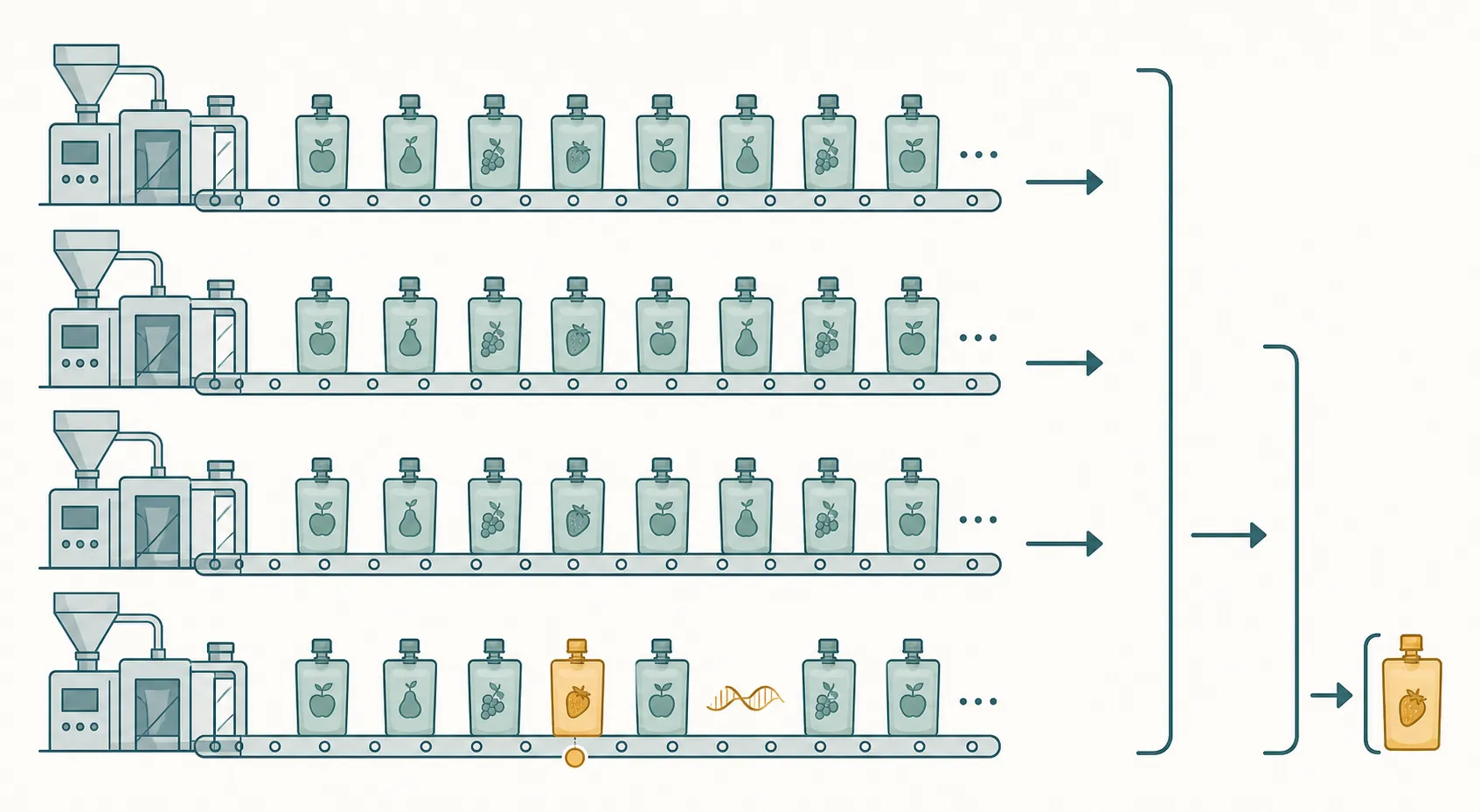
Once a supplier reports an intermittent defect on one of four lanes, the operational question changes. It is no longer simply whether plastic may be present. It is which finished units can be tied back to that lane, that run, that pouch material, and that time window.
Without that link, quality and supply-chain teams face a blunt choice. They can recall broadly enough to protect consumers, or they can try to narrow the action using incomplete evidence. The first option may remove safe product and create retailer disruption. The second option risks leaving affected product in market. Neither is a satisfying decision if the actual defect path was lane-specific.
| Question at supplier notification | Data needed to answer it | Operational consequence if missing |
|---|---|---|
| Was the defect confined to one lane? | Supplier lane ID tied to packaging material lots and finished-good lots | Recall scope may default to all lanes that produced the SKU |
| Was it confined to one production run? | Run start and stop timestamps, line-change records, and traceability lot codes | A short intermittent event can become a multi-date recall |
| Did affected pouches enter finished goods? | Packaging lot consumption records linked to brand batch records | Finished-product inspection can confirm samples but not map the universe |
| Which retailers received the exposed units? | Shipment records tied to the same traceability lot code | Retail notifications may be broader and slower than necessary |
This is where finished-product sampling is a limited control, not a useless one. If a sampled pouch shows visible plastic strands, the inspection confirms contamination. It can also help validate a supplier’s warning. But for an intermittent defect on one of four lanes, sampling is a weak instrument unless each sampled unit is tied back to the supplier lane and run that made its pouch.
The mechanics make the limitation obvious. If three lanes are running normally and one lane produces an intermittent inner-material defect, the average finished-good lot may look acceptable until a contaminated unit appears. A sampling plan that treats all pouches in a lot as interchangeable may miss the signal or confirm it only after the supplier has already isolated the process abnormality upstream.
Why Flexible Pouches Change the Inspection Burden
Rigid packaging failures often announce themselves through cracks, deformation, cap problems, or obvious foreign material. Flexible pouches have a different risk profile. The container is a laminated structure, and the failure can originate inside the material stack or around the seal area before the brand ever fills it.
Inner-layer delamination, seal-area contamination, and heat-seal parameter drift are not the same kind of defect as a dented can or a broken jar. They may appear intermittently. They may be associated with a lane, a sealing station, a roll of material, or a short process condition. If the brand only receives finished pouches as units to inspect, rather than as products with supplier-process history, the most important evidence remains outside the brand’s normal field of view.
That is the asymmetry in the PT Organics case. The supplier’s production-run investigation found the defect; PT Organics’ assessment followed the notification. The FDA notice indicates that the brand’s finished-product inspection confirmed the issue after the supplier had already identified it.[1] Confirmation is useful, but it is not the same as independent detection.
The FSMA 204 Point Is Not Paper Compliance
FSMA 204 is often discussed as a recordkeeping deadline. In this case, it is more useful as a way to ask what the recall team would have known on March 6 if the right traceability architecture had already been operating.
The FDA’s Food Traceability List includes fruits and fruit purees among foods subject to additional traceability record requirements. The rule requires records around Critical Tracking Events such as transformation, shipping, receiving, and other handling steps, with traceability lot codes used to connect product movement and transformation history.[3] Congress extended the compliance date to July 20, 2028, giving companies more time, but also lengthening the period in which many traceability systems remain uneven.[4]
For a fruit puree pouch, the practical value is not the existence of a compliance file. It is whether the traceability lot code can connect the fruit puree, the pouch material, the packaging run, the lane, the timestamp, the finished-good lot, and the outbound shipment. If those records are linked cleanly, the recall boundary can follow the process evidence. If they are not linked, the team may have to treat a lane-specific event as a broader SKU-and-date problem.
In the PT Organics recall, the public materials identify the defect as intermittent and lane-specific, but the recall covered six best-before dates and national retail distribution.[1][2] That does not prove over-recall; public notices rarely disclose enough production mapping to make that judgment from the outside. It does show the kind of question traceability should answer: did all four lanes create exposure, or did the affected universe belong to one lane and one run?
What the Brand Would Have Needed on March 6
The useful traceability record is not a static supplier certificate. It is a chain of process evidence that survives the handoff from packaging supplier to brand.
- Supplier production lane and equipment identifiers for the affected pouch run.
- Packaging material lot and roll records connected to run timestamps.
- Start-stop windows for the intermittent defect, including any holds, rework, scrap, or line clearance actions.
- Brand-side batch records showing which finished fruit puree units used those pouch materials.
- Distribution records linking finished-good lots to Kroger, Target, Meijer, or any other customer shipments.
None of those records is exotic on its own. The hard part is keeping them connected across company boundaries. Procurement may own the supplier relationship. Quality may own supplier approval and nonconformance review. Supply chain may own production planning and allocation. Regulatory may own recall execution. The defect, however, moves through all of those functions before anyone can make a defensible recall-scope decision.
This is why broad promises of end-to-end visibility are not enough. A platform claim becomes meaningful only if it can answer a specific recall question faster than the existing process: which lane, which run, which finished units, which retailer shipments, and which inventory positions are implicated? If the system cannot change that decision, it is mostly a dashboard around the same uncertainty.
Planning Systems Are Relevant, but Only After the Evidence Is Structured
Food and CPG companies evaluating o9, Blue Yonder, Kinaxis, RELEX, Anaplan, or adjacent supplier-intelligence and planning tools should be careful about the question they are asking. These platforms may be relevant to supplier risk monitoring, scenario planning, allocation, replenishment, or recall impact analysis. The public PT Organics record does not indicate that any named platform was involved in this recall, and it does not provide a basis to claim that one vendor would have prevented or shortened it.
The better evaluation criterion is operational. Can the system ingest supplier lane-level quality events before finished goods ship? Can it preserve the link between supplier run data and brand lot codes? Can it show which retailers, distribution centers, and inventory positions received units tied to the affected traceability lot? Can it support a narrower recall simulation without relying on manual spreadsheet reconstruction?
Supplier-quality monitoring also has to distinguish adoption from effectiveness. A company may collect certificates, audit scores, COAs, and periodic nonconformance reports and still lack the real-time process evidence needed for an intermittent lane defect. Conversely, a narrower data model that captures lane, run, timestamp, and material-lot relationships may be more useful in a recall than a broad supplier-risk score that cannot be tied to physical product movement.
The Business Pressure Is Real, Even If the Benchmarks Are Directional
Recall economics are often quoted too casually, as if an average cost can explain a specific incident. It cannot. The direct cost of this PT Organics recall is not disclosed in the public materials. The often-cited benchmark of about $10 million in average direct cost per food recall incident should be treated as directional business context, not as an estimate of what PT Organics spent.[5]
Consumer trust belongs in the same category. A reported 59% consumer hesitation to repurchase a recalled brand is not a forecast for Peter Rabbit Organics, and it does not measure actual lost sales in this case.[5] It does explain why quality, procurement, and supply-chain leaders cannot treat recall scope as a purely internal cost-minimization exercise. A slow or broad recall decision affects retailer confidence, parent confidence, and future purchase behavior, especially in baby and children’s food categories.
The operational pressure runs both ways. Under-recalling can leave consumers exposed. Over-recalling can remove unaffected product, strain retailer relationships, and make a supplier-quality defect look like a larger brand-control failure. Lane-level traceability does not eliminate that tension, but it gives the recall team better evidence at the moment the decision is still shapeable.
Detection Asymmetry Is the Real Test
The PT Organics case is not a clean morality play about a negligent brand or a failed supplier. The supplier identified an unusual defect and notified the brand. PT Organics began its assessment the same day, according to the FDA notice.[1] The missing piece is not effort; it is visible, connected process evidence at the handoff between packaging production and finished-food control.
That is the standard food companies should use when they evaluate traceability and supplier-quality investments. Finished-product inspection coverage matters, but it cannot be the only line of defense for an intermittent defect born inside a supplier’s packaging process. FSMA 204 readiness matters, but a traceability program that cannot narrow a lane-and-run question is not yet doing the operational work the rule points toward.
The lesson from this recall is specific: when the supplier sees the defect first, the brand needs enough lane-level, run-linked data to decide whether the affected universe is one production run or four lanes of product. Anything less leaves the most important recall decision to be made after the evidence has already moved out of view.
References
- PT Organics Limited Recalls Select Pumpkin Tree Peter Rabbit Organics Banana & Strawberry Fruit Puree Pouches — FDA Safety Alert
- 380,000 Pumpkin Tree Peter Rabbit Organics Baby Food Pouches Recalled Due to Potential Plastic — Consumer Reports
- FSMA Final Rule on Requirements for Additional Traceability Records for Certain Foods — FDA
- How to Create Business Value from FDA's Extended Food Traceability Timeline — Deloitte/WSJ
- Recall Readiness: Trends, Takeaways, & Predictions — Food Industry Executive
Cited evidence
- Could AI Traceability Have Prevented 2025 Fruit Puree Recalls?
An analysis of three major 2025–2026 fruit puree recalls—PT Organics, WanaBana, and Tippy Toes—shows how commercially available AI traceability tools like supplier risk scoring, N-tier visibility, and spectral screening could have cut the average contamination-to-recall lag from 23–31 days to near-real-time targeted removal, based on FDA recall data and deployment benchmarks from Walmart and Nestlé.
- Taylor Farms cyclospora exposes AI traceability gaps
An analysis of four documented traceability failures during the Taylor Farms cyclospora outbreak, evaluating which current AI technologies could have addressed them and delivering a vendor-neutral verdict for enterprise buyers evaluating food safety traceability platforms.
- Why AI Traceability Failed in the 2026 Cyclospora Outbreak
The 2026 multistate cyclosporiasis outbreak — with over 1,645 confirmed cases and a 2.5-month FDA investigation lag — exposed a stark divide: AI-powered diagnostic screening identified cases at 3-4x human sensitivity, but the produce supply chain still lacks the lot-level digital traceability needed to pinpoint contamination. This case study examines what the outbreak reveals about AI's real limits in food safety today.
Ready to check your own team's readiness for this pattern?
See the quality management readiness checklist →Spotted something inaccurate or incomplete in this entry? ChainSignal reviews corrections and additional evidence before publishing an update — this is not a public comment thread.
Flag an inaccuracy / submit evidence for this entry →