How Five AI Platforms Compare for Tariff Scenario Planning
This article audits the tariff-specific capabilities of o9, Kinaxis, Blue Yonder, Anaplan, and Coupa using published deployment data, revealing differences in deployment speed and scenario depth, and identifying the absence of verified P&L outcome studies.
The hard part of AI supply chain tariff impact planning in 2026 is no longer finding a vendor that says it can model tariffs. o9, Kinaxis, Blue Yonder, Anaplan, and Coupa all have tariff-response material in market. The harder buying question is whether the published evidence tells you anything useful before finance asks why the tariff assumption changed margin twice in the same week.
Feature checklists blur too much. A seven-day assessment is not the same operational object as an always-on enterprise graph. A spike in scenario usage is not the same as a protected gross margin. A named customer reference is stronger than a demo, but it still may stop short of a P&L result. The comparison has to start there.
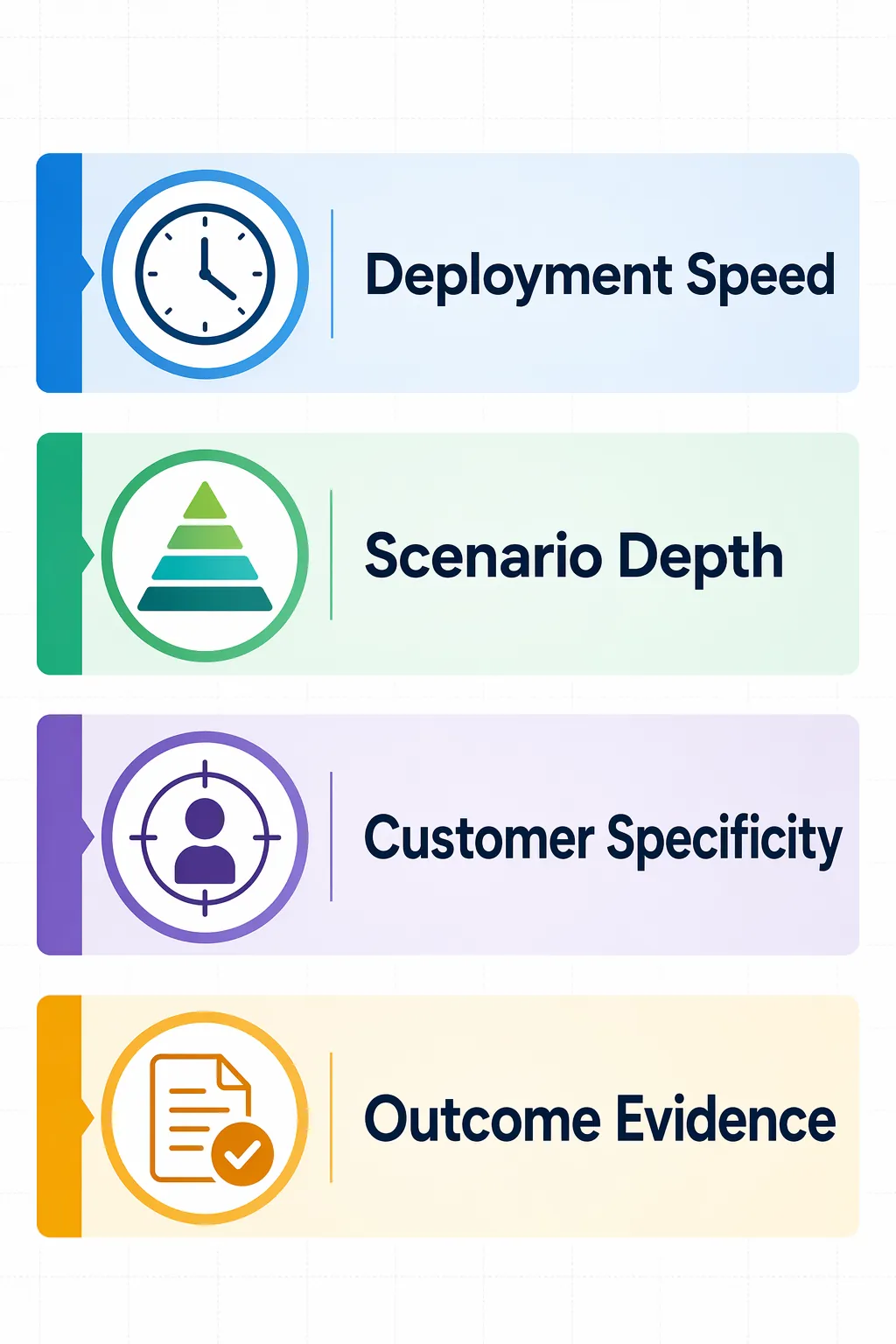
| Platform | Tariff-specific public claim | Deployment speed evidence | Scenario depth signal | Customer or usage specificity | Outcome evidence boundary |
|---|---|---|---|---|---|
| Blue Yonder | Automotive tariff risk assessment focused on rapid mitigation. | Says assessment can be enabled in as little as 7 days. | Uses a Canada-US-Mexico cross-border automotive example and includes pricing-impact math attributed to Morgan Stanley. | Industry-specific, but the cited material is an assessment offer rather than a named post-deployment client result. | No published named-client P&L post-mortem for tariff planning in the reviewed material. [1] |
| Kinaxis | Tariff Response offering for rapid scenario planning under tariff volatility. | Says Tariff Response can go live in 21 days. | Public metrics emphasize scenario volume and activity rather than full supplier-tier exposure mapping. | Cites MillerKnoll by name; also reports a 124% scenario-usage spike after a presidential debate, 4.5x auto-sector daily activity, and a 24% quarter-over-quarter scenario-planning increase. | Usage and named-customer evidence exist, but no quantified tariff-specific P&L impact is published. [2] |
| o9 | AI-powered scenario planning with Enterprise Knowledge Graph support. | No comparable rapid-deployment clock is provided in the reviewed tariff materials; public claims appear strongest for customers already operating on the platform. | Shows tier-2 supplier visibility, supplier-side PO acceptance collaboration, and a demo with a $500M-plus projected cost exposure across three scenarios. | The $500M-plus example is a vendor demonstration, not a named-client outcome. | Strong architecture-level claim, but no verified named-client tariff P&L post-mortem. [3] |
| Anaplan | Supply Chain Analyst AI agent applied to retail pricing optimization under tariffs. | No tariff-specific deployment time is provided in the reviewed material. | Most relevant where tariff exposure flows into pricing, margin, and retail planning decisions. | Public material is capability-oriented, with less tariff-specific named deployment detail in the reviewed evidence. | No named-client tariff-planning P&L outcome is published in the reviewed material. [4] |
| Coupa | Tariff impact planning resources covering sourcing, scenario models, and tariff-optimized network design. | No specific tariff deployment clock is provided in the reviewed material. | Signals strength in sourcing events, scenario modeling, and network design rather than integrated end-to-end planning depth. | Reports a 32% global increase in sourcing events and 43% more scenario models year over year. | Activity indicators are useful, but they do not prove financial outcomes from tariff planning. [5] |
The first split is speed versus depth
Blue Yonder and Kinaxis make the clearest public speed claims. Blue Yonder’s automotive material says tariff risk mitigation can be enabled in as little as 7 days, while Kinaxis says its Tariff Response offering can go live in 21 days.[1][2] Those are not minor claims for teams working inside tariff windows that move faster than annual operating plans.
Speed matters because tariff planning often starts as a messy exception process. Procurement wants to know which supplier lanes are exposed. Demand planning wants to know whether inventory positioning still makes sense. Finance wants a margin bridge. Commercial teams want to know whether price increases are defendable. If a tool takes a quarter to stand up, the first decision cycle may already be gone.
But speed is only one planning tier. o9’s public material is less compelling as a quick-start promise and more compelling as a depth claim: its Enterprise Knowledge Graph is presented as a way to connect tariff exposure beyond the immediate tier-1 view, including tier-2 supplier visibility and supplier-side purchase-order acceptance collaboration.[3] For a buyer trying to understand where tariff exposure is hiding several nodes away from the finished-good plan, that is a different question than whether a rapid assessment can be launched next week.
That is why the buying decision should not be framed as one platform category called scenario planning. A fast tariff assessment, a concurrent planning deployment, an enterprise knowledge graph, a retail pricing agent, and a sourcing-event model all sit in different places in the operating cycle.
Kinaxis: the strongest public usage trail, with the usual usage caveat
Kinaxis has the richest public usage story among the five vendors in this brief. Its Tariff Response release combines a 21-day go-live claim with named customer reference material and several activity metrics: a 124% spike in scenarios after a presidential debate, 4.5x daily activity in the auto sector, and a 24% quarter-over-quarter increase in scenario planning.[2]
For an S&OP director defending a planning-platform expansion, those numbers are useful in a narrow way. They suggest customers reached for the system when tariff uncertainty increased. That is better than a generic statement that the platform supports what-if analysis. It indicates the tool is close enough to the planning process that users can model more scenarios when a policy shock arrives.
The limit is just as important. Scenario volume measures behavior, not effectiveness. It does not say whether the modeled scenarios were the right ones, whether procurement acted on them, whether pricing changed in time, or whether gross margin came in better than it would have under spreadsheet planning. The MillerKnoll reference gives Kinaxis more customer specificity than a pure demo claim, but the reviewed public evidence still does not publish a tariff-specific P&L result for that customer.[2]
That distinction is not pedantry. In a planning-cycle review, finance will not accept “we ran more scenarios” as the same claim as “we avoided X dollars of tariff cost.” Kinaxis has evidence that customers used the capability under pressure. It has not, in the reviewed material, closed the loop to verified financial impact.
Blue Yonder: a useful rapid-assessment shape, especially for automotive
Blue Yonder’s tariff material is narrower, and that is partly why it is credible. The company describes an automotive-focused tariff risk assessment that can be enabled in as little as 7 days, using a Canada-US-Mexico cross-border example and pricing-impact math attributed to Morgan Stanley.[1]
That shape fits a real tariff problem: automotive networks are cross-border, parts-heavy, and timing-sensitive. A rapid assessment can help a team isolate where exposure sits before it tries to rebuild a full network design or renegotiate supplier terms. It is not the same as a complete operating model, but it may be exactly the first artifact a procurement or planning leader needs before walking into a finance review.
The evidence boundary is that the public claim is still an enablement and assessment claim. It does not name a client that completed the assessment, acted on recommended changes, and later reported measured P&L protection. In other words, Blue Yonder has one of the clearest speed claims in the group; it does not have the strongest outcome evidence.
o9: the deepest public modeling claim, not a client result
o9’s strongest public tariff-planning argument is not deployment speed. It is model structure. The company’s AI-powered scenario planning material presents an Enterprise Knowledge Graph that can support tier-2 supplier visibility, supplier-side PO acceptance collaboration, and fast scenario comparison.[3]
That matters because tariff exposure is often misread when the model stops at the first supplier record in the ERP. A tier-1 supplier may look domestic, while critical components, subassemblies, or capacity dependencies sit elsewhere. If the planning graph can represent those upstream relationships with enough freshness and governance, it gives the planning team a better chance of seeing exposure before it arrives as a cost variance.
The public demo also cuts both ways. o9 shows an AI agent projecting more than $500M in cost exposure in seconds and returning three scenario outcomes.[3] That is a useful illustration of interaction speed and executive-facing workflow. It is not evidence that a named customer found $500M of exposure, made the right operating decision, and realized a measured financial result.
For buyers already on o9, the relevant diligence question is whether the tariff model can be connected to the planning tiers that matter: supplier tiers, purchase orders, supply allocations, pricing assumptions, and margin review. For buyers not already on o9, the public material does not support treating it as a rapid tariff-response deployment in the same way Blue Yonder and Kinaxis frame their offers.
Anaplan and Coupa sit closer to decision edges
Anaplan’s reviewed tariff material is most relevant where tariff planning flows into commercial decisions. Its Supply Chain Analyst AI agent is described in the context of retail pricing optimization under tariffs.[4] That is a narrower public claim than end-to-end supplier-tier modeling, but it sits near a painful decision edge: when cost changes need to become price, margin, or assortment decisions.
For retail and consumer-facing businesses, that connection can matter as much as upstream modeling depth. A tariff scenario that never reaches pricing governance can stay academically correct and operationally useless. The public evidence in this brief, however, gives less named deployment detail for Anaplan’s tariff-specific use than it gives for Kinaxis, Blue Yonder, or o9.
Coupa’s material points in a different direction: sourcing events, scenario models, tariff-optimized network design, and what it calls an “antifragile” ecosystem. The company reports a 32% global increase in sourcing events and 43% more scenario models year over year.[5] Those signals are useful for procurement leaders because tariff response often turns into supplier-event design, lane changes, and network tradeoffs.
Again, activity is not impact. More sourcing events may mean teams are reacting to tariff pressure. More scenario models may mean they are testing alternatives. Neither metric, by itself, proves that awarded events, lane redesign, or supplier changes reduced tariff cost or protected margin.
Market pressure explains adoption, not platform effectiveness
The pressure behind these launches is real. A RELEX and Researchscape survey of 579 respondents found that 60% were overhauling supply chains, 86% of leaders said they were impacted, 51% were raising prices, and 24% were shifting sourcing.[6] Those numbers help explain why tariff-specific planning modules moved quickly from roadmap language into product marketing.
They should not be read as proof that any one platform works. The survey is market context, and it is vendor-commissioned. It tells buyers that peers are changing supply-chain and pricing behavior under tariff pressure. It does not tell them whether o9, Kinaxis, Blue Yonder, Anaplan, or Coupa produced better decisions than the incumbent mix of spreadsheets, consultants, ERP extracts, and planning tools.
For a broader primer on the capabilities vendors are packaging into these tools, see ChainSignal’s guide to AI planning tools for tariff volatility. This comparison is narrower: it is about what the five named platforms have publicly supported with tariff-specific evidence.
The outcome evidence is still thin
The closest quantified tariff-result reference in this evidence set is not from one of the five platforms. Gray Group International describes a case in which tariff costs fell 74%, from $4.2M to $1.1M, through restructuring that combined nearshoring, foreign-trade zone usage, and reclassification.[7]
That is a useful outcome because it shows what a tariff program can eventually be measured against: actual cost before and after operating changes. It also shows why the platform evidence gap matters. The case does not isolate the contribution of an AI planning platform, and it combines several tax, trade, sourcing, and network actions. It cannot be used to claim that any of the five vendors delivered a comparable result.
A proper vendor post-mortem would need more than a launch announcement. It would name the customer, date the deployment, describe the tariff-planning workflow, identify which decisions changed, and report a measured financial outcome with enough context to distinguish avoided tariff cost, price recovery, working-capital movement, and ordinary demand variance.
| Buyer question | Evidence that helps | Evidence that does not answer it |
|---|---|---|
| Can the tool be deployed quickly enough for the next tariff cycle? | A dated go-live claim, deployment scope, required data inputs, and user group. | A general AI roadmap or undated scenario-planning demo. |
| Can it see enough of the exposure chain? | Supplier-tier modeling, purchase-order linkage, sourcing lane data, pricing assumptions, and network constraints. | A dashboard that only models finished-good cost at a high level. |
| Did it improve financial outcomes? | Named-client post-mortem with measured cost, margin, or price-recovery impact. | Scenario-count growth, login activity, or a simulated executive demo. |
Data readiness can break the clean demo
The weakest part of many tariff-planning conversations is not the algorithm. It is the handoff from messy enterprise data into a model that executives trust. C3 AI and Dataiku both point to fragmented ERP data as a primary barrier to effective tariff scenario modeling.[8][9]
That constraint lands across all five vendors. A scenario engine can look fast in a demo if item masters, supplier hierarchies, country-of-origin data, purchase orders, landed-cost assumptions, and price lists are already clean. In production, those fields often belong to different owners, refresh on different calendars, and contradict one another at exactly the moment a tariff model is supposed to become a margin explanation.
This is also where model-refresh discipline matters. When tariff assumptions change after a policy update, the planning team has to know which demand plans, sourcing assumptions, and margin bridges were built on stale inputs. ChainSignal’s analysis of AI supply-chain lead-time assumption recalibration after the US-China Phase 2 tariff deal covers that planning-cycle problem in more detail.
What the evidence supports in Q3 2026
Blue Yonder and Kinaxis have the clearest public speed claims: 7 days for Blue Yonder’s automotive tariff risk assessment and 21 days for Kinaxis Tariff Response.[1][2] o9 has the strongest public claim for deeper supplier-tier modeling through its Enterprise Knowledge Graph, although its most vivid cost-exposure example is a simulated demo rather than a client result.[3] Coupa shows tariff-aware sourcing and network-design activity, while Anaplan is relevant where tariff planning needs to connect into retail pricing optimization.[4][5]
That is enough to shortlist differently by operating problem. A procurement-led tariff response may look harder at Coupa and the sourcing side of Kinaxis or Blue Yonder. A planning transformation team already invested in enterprise graph modeling may press o9 on tier-2 visibility and data governance. A retailer trying to translate tariff exposure into pricing actions may ask Anaplan for proof closer to margin and commercial workflow.
It is not enough to name a universal winner. The missing proof is the one that matters most: none of the five vendors, in the reviewed public evidence, has published a verified named-client tariff-planning post-mortem with actual P&L impact. Until that appears, buyers should treat tariff AI planning as operationally promising, unevenly evidenced, and still financially unproven in public.

References
- Just in Time for Automotive: Enabling Tariff Risk Mitigation in as Little as 7 Days, Blue Yonder.
- Kinaxis Tariff Response press release, Kinaxis.
- Building Resilience With AI-Powered Scenario Planning, o9 Solutions.
- Tariffs and Trade Disputes: Retail and Supply Chain Guidance, Anaplan.
- Tariff Impact Planning Software & Resources, Coupa.
- RELEX/Researchscape survey on tariff impacts, RELEX Solutions.
- Gray Group International tariff cost reduction case study, Gray Group International.
- C3 AI blog on tariff scenario modeling and fragmented ERP data, C3 AI.
- Dataiku blog on tariff scenario modeling and fragmented ERP data, Dataiku.
Cited evidence
- Are Forced Labor and Tariff Compliance One AI Planning Problem?
Forced-labor enforcement (UFLPA) and tariff volatility are structurally converging, yet most AI planning platforms still treat them as separate problems. This use-case analysis examines how Kinaxis, o9, Blue Yonder, Resilinc, and Interos handle dual-risk optimization and where the gaps remain for procurement decisions.
- How AI Supply Chain Planning Flags Tip-Over Risks Before Recalls
This analysis examines whether supply-chain AI platforms can detect and stop furniture tip-over recalls before they escalate. Drawing on CPSC injury data, the 2024 New Age restraint-kit recall, and known vendor capabilities from o9, Blue Yonder, and Kinaxis, it finds that AI can compress the defect-escape interval from months to days—but only if the industry resolves data-sharing and multi-tier traceability gaps.
- How AI data center electricity costs change supply chain planning
As AI data centers drive structural electricity price increases, supply chain planners must treat electricity as a variable cost in S&OP, network design, and total-landed-cost models. This analysis provides the evidence and framework for updating planning assumptions.
Ready to check your own team's readiness for this pattern?
See the procurement readiness checklist →Spotted something inaccurate or incomplete in this entry? ChainSignal reviews corrections and additional evidence before publishing an update — this is not a public comment thread.
Flag an inaccuracy / submit evidence for this entry →