
From Reactive to Proactive: A Maturity Model for Combining Demand Forecasting and Demand Sensing
A staged roadmap for supply chain executives and planning directors, mapping the progression from traditional forecasting through AI-enhanced forecasting and demand sensing to autonomous planning, with accuracy benchmarks, infrastructure requirements, and ROI timelines.
The Reactive-to-Proactive Journey
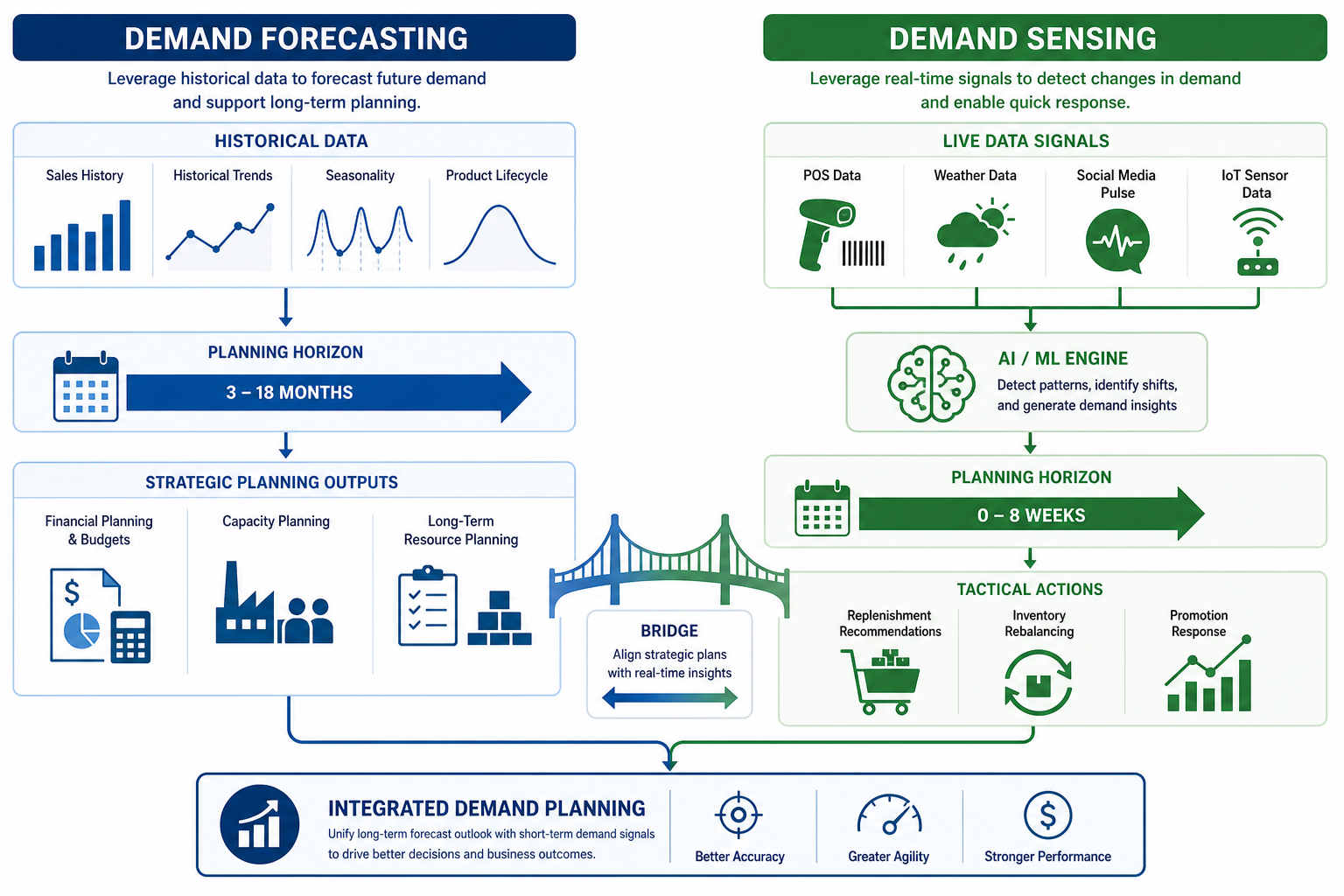
For years, the supply chain planning conversation has been trapped in a static binary: demand sensing versus demand forecasting. Executives treat them as two competing methods, when in reality they represent sequential rungs on a ladder from reactive to proactive demand intelligence. The question is not which one to pick, but how to move through the stages that build from one to the next.
This article lays out a four-stage maturity model — from traditional forecasting through AI-enhanced forecasting, demand sensing integration, and finally autonomous planning — so that supply chain leaders can locate their organization’s current position and chart a practical path forward. Each stage demands distinct data infrastructure, process design, and organizational readiness. Skipping stages is possible, but the risks compound.
Cited evidence
- Demand Sensing vs. Demand Forecasting: Definition and Disambiguation
A precise disambiguation of demand sensing and demand forecasting as used in AI-enabled supply chain planning — covering definitions, time horizons, data inputs, and when each term applies operationally.
- IBP vs S&OP: Definitions, Differences, and How AI Fits Into Each
A precise disambiguation of Integrated Business Planning (IBP) and Sales & Operations Planning (S&OP) as they apply to AI-augmented supply chain environments, covering definitional boundaries, process scope, and where AI tools attach to each framework.
- Predictive Analytics in Supply Chain Management: Definition, Techniques, and Implementation Roadmap
A definitive glossary entry for supply chain leaders and practitioners. Defines predictive analytics, explains the analytics maturity continuum (descriptive → predictive → prescriptive), details key techniques with a decision framework, provides source-attributed ROI data from enterprise deployments, and outlines implementation challenges, tooling costs, and emerging trends.
Spotted something inaccurate or incomplete in this entry? ChainSignal reviews corrections and additional evidence before publishing an update — this is not a public comment thread.
Flag an inaccuracy / submit evidence for this entry →