Why AI Traceability Failed in the 2026 Cyclospora Outbreak
The 2026 multistate cyclosporiasis outbreak — with over 1,645 confirmed cases and a 2.5-month FDA investigation lag — exposed a stark divide: AI-powered diagnostic screening identified cases at 3-4x human sensitivity, but the produce supply chain still lacks the lot-level digital traceability needed to pinpoint contamination. This case study examines what the outbreak reveals about AI's real limits in food safety today.
By the public numbers available in late July, the 2026 cyclosporiasis outbreak was already large enough to strain both epidemiology and patience. CDC surveillance listed 1,645 laboratory-confirmed domestically acquired cases as of July 13, with illnesses beginning May 1 and reports spanning 34 states; CNBC reported on July 23 that more than 5,100 additional cases still required further analysis and that 141 people had been hospitalized.[1][2] The FDA public notice arrived July 16, roughly two and a half months after the first reported illnesses began.[2]
That timeline is where this outbreak becomes useful as a traceability case study, but not in the usual way. The interesting failure is not that every “AI” tool underperformed. One of the better-documented AI systems in this outbreak did exactly the kind of narrow, labor-saving job food-safety teams should want: it helped a clinical lab screen for a difficult parasite during a testing surge. The failure sat upstream, where produce records still had to answer older, less glamorous questions: which lettuce lot, from which supplier, shipped through which channel, to which customer, with what confidence.
The AI Was at the Diagnostic Endpoint
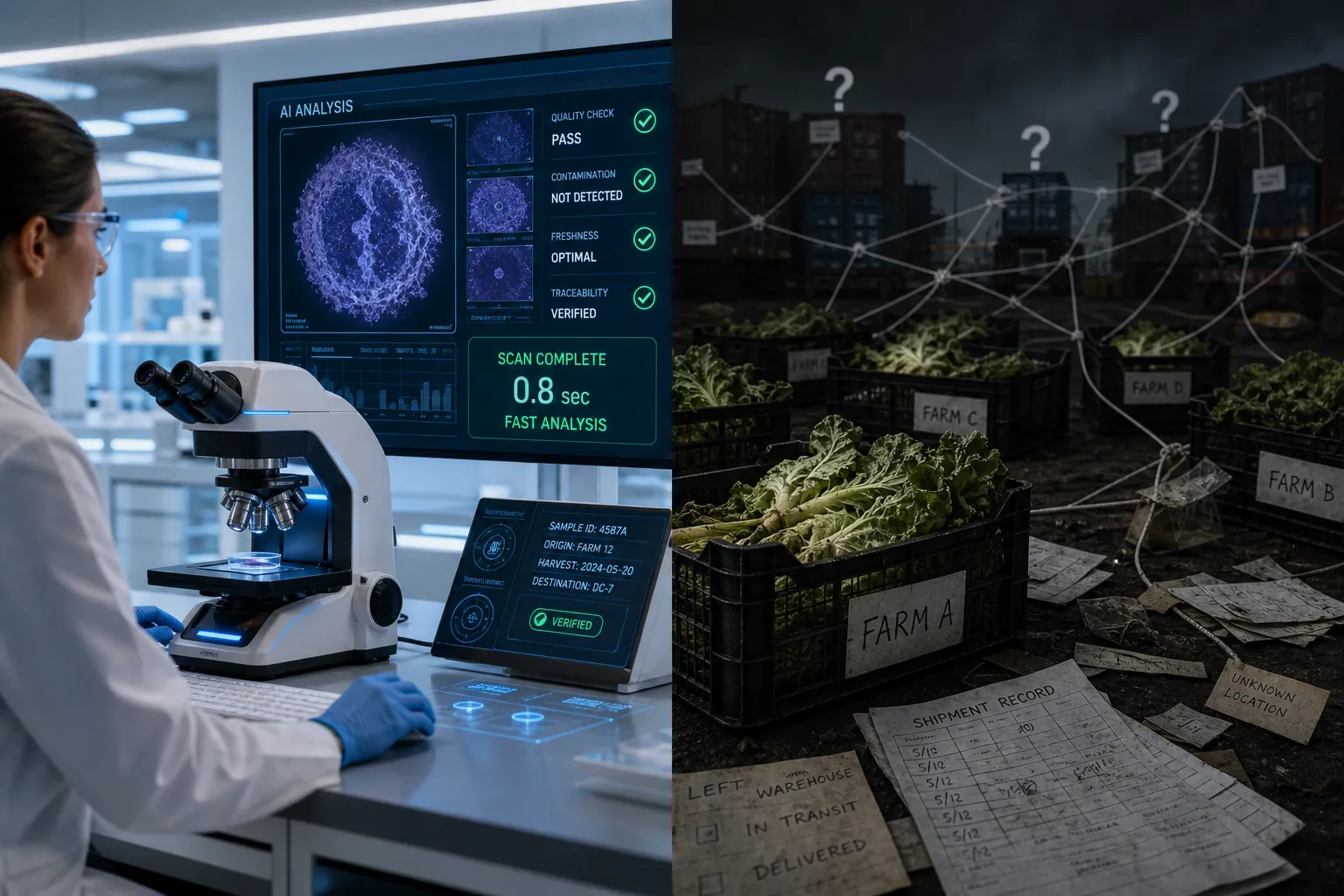
ARUP Laboratories’ use of Techcyte’s AI-augmented ova and parasite screening system is not a traceability platform. It does not know which farm block produced a head of lettuce, which distributor handled a pallet, or which restaurant received a case. It reads microscope images and flags possible parasites for expert review. During the 2026 outbreak, that distinction mattered.
ARUP described the system as first deployed in 2019 for AI-augmented ova and parasite screening, later expanded by March 2025 to full ova and parasite screening using both trichrome and wet-mount preparations.[3][4] In a July 17 interview, ARUP’s Ryan Jensen said the lab had seen roughly a 200% increase in testing volume during the outbreak and was identifying about 50 Cyclospora-positive cases per day; he also said each AI scan took about two minutes, compared with manual review that can take hours.[3]
The performance claims were not just marketing copy. Techcyte and ARUP reported peer-reviewed findings in the Journal of Clinical Microbiology showing 98.88% agreement with conventional microscopy, a five-fold increase in limit of detection, and three to four times higher sensitivity than human screening for the evaluated ova and parasite detection task.[5] ARUP also said its positivity rate for Cyclospora nearly doubled after introducing the AI-assisted workflow.[4]
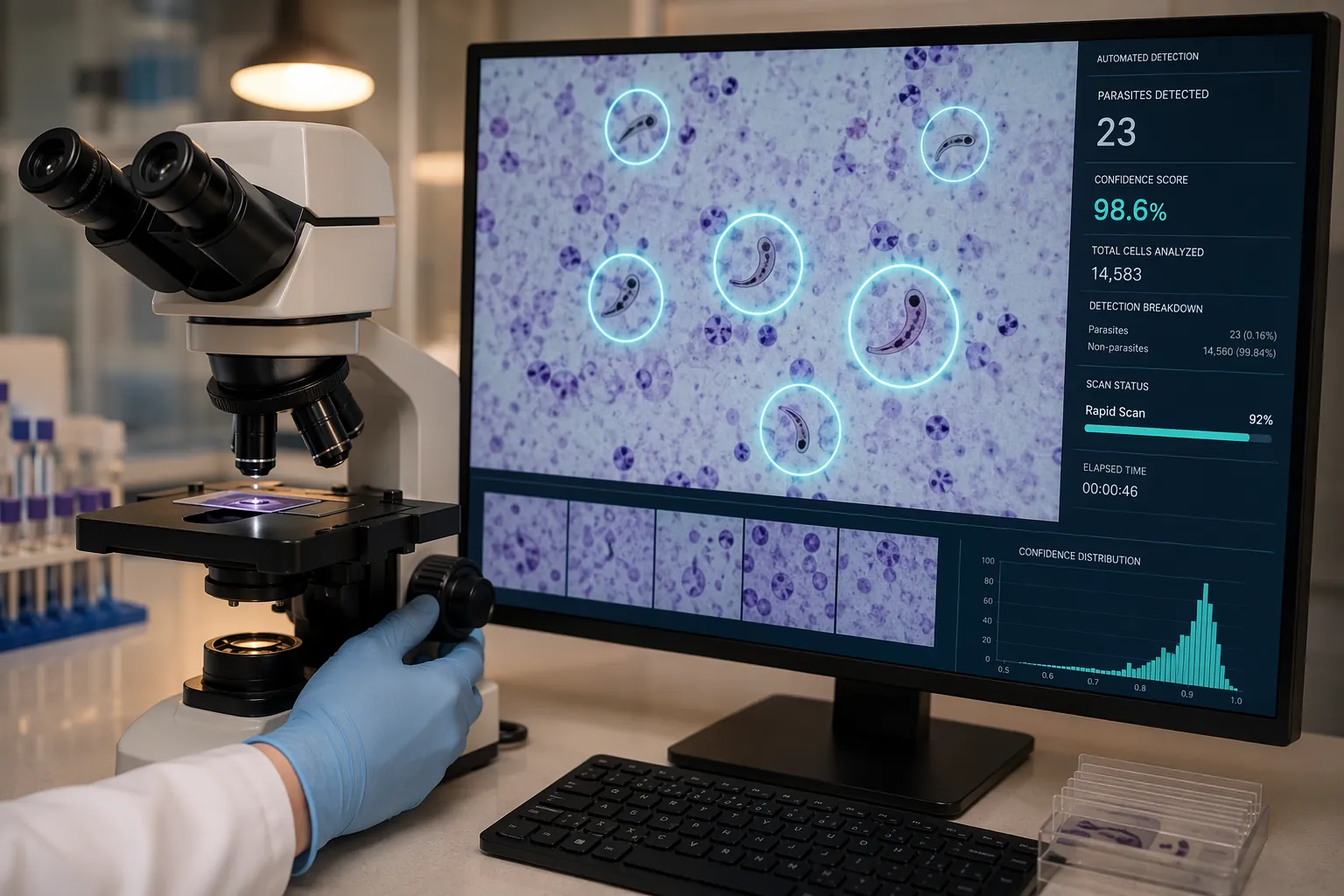
That is a real operational gain. A parasitology lab does not have a spare bench of expert microscopists waiting for a multistate outbreak. If a screening system can push more suspicious images to trained reviewers faster, catch lower-burden positives, and absorb a volume spike without simply stretching human review thinner, it changes the diagnostic bottleneck. More infected patients get recognized. More case reports enter the surveillance system. Investigators get more signals.
But a better case signal is not the same as source attribution. The lab can help establish that a patient has cyclosporiasis. It cannot, by itself, reconstruct the path of contaminated produce through growers, coolers, processors, distributors, restaurants, and retailers. Once the positive result leaves the lab layer, the next system has to match illnesses against food histories and product movement records. That is where the outbreak still looked stubbornly analog.
Detection Increased Before Traceability Caught Up
The most generous reading of the outbreak is also the most uncomfortable one for produce supply chains: diagnostic AI may have improved the front end of case detection while the upstream traceback process still depended on incomplete or slow-to-reconcile records. That does not make the AI irrelevant. It makes the system uneven.
In a bacterial outbreak, investigators may be able to combine epidemiology with genetic relatedness from whole genome sequencing. Cyclospora is harder. Stanford’s July 2026 outbreak explainer noted that the parasite’s biology complicates detection and investigation, including the absence of the same kind of routine whole-genome-sequencing equivalent that supports many bacterial outbreak investigations.[6] ASTHO also emphasized the parasite’s 7- to 15-day incubation period, which leaves patients trying to remember fresh produce exposures from one to two weeks earlier.[7]
That lag matters in the real work. By the time a patient tests positive, the lettuce is gone, the receipt may be missing, the restaurant order was shared, and the distributor’s shipment records have to be lined up against a menu item that may have changed suppliers during the exposure window. A stronger lab signal adds confidence that the illness is real. It does not automatically shorten the distance between a patient interview and a specific lot code.
This is why broad claims about “AI-powered outbreak response” need to be handled carefully. AI can help detect contamination signals, triage records, flag anomalies, and accelerate recall workflows when the underlying data exists. But in this outbreak, the documented AI success was clinical screening, not a produce genealogy system operating across the implicated supply chain. There is no evidence in the available materials that an AI supply-chain traceability platform was actively resolving lot-level movement during this specific investigation.
The Taylor Farms Episode Showed the Cost of Ambiguity
The confusion around Taylor Farms lettuce is the part of the case that supply-chain leaders should sit with, because it shows how quickly a single positive signal can become a business and public-health problem when the surrounding record context is not decisive.
Forbes reported that a positive Taylor Farms lettuce result was reclassified as a false positive around July 19-20, after earlier public attention had connected the result to the outbreak.[8] Trustwell described the episode as a roughly 48-hour confusion event and used it to argue that lot-linked traceability is necessary to confirm or refute a suspected product link quickly.[9]
It would be too neat to call that episode proof of one company’s failure. The available public record supports a narrower conclusion: a lab signal, standing without immediately persuasive lot-level genealogy, can create expensive uncertainty. A QA leader facing that situation is not debating AI philosophy. They are deciding whether to hold product, whether to notify customers, how to answer executives, and how to preserve credibility if the signal is reversed two days later.
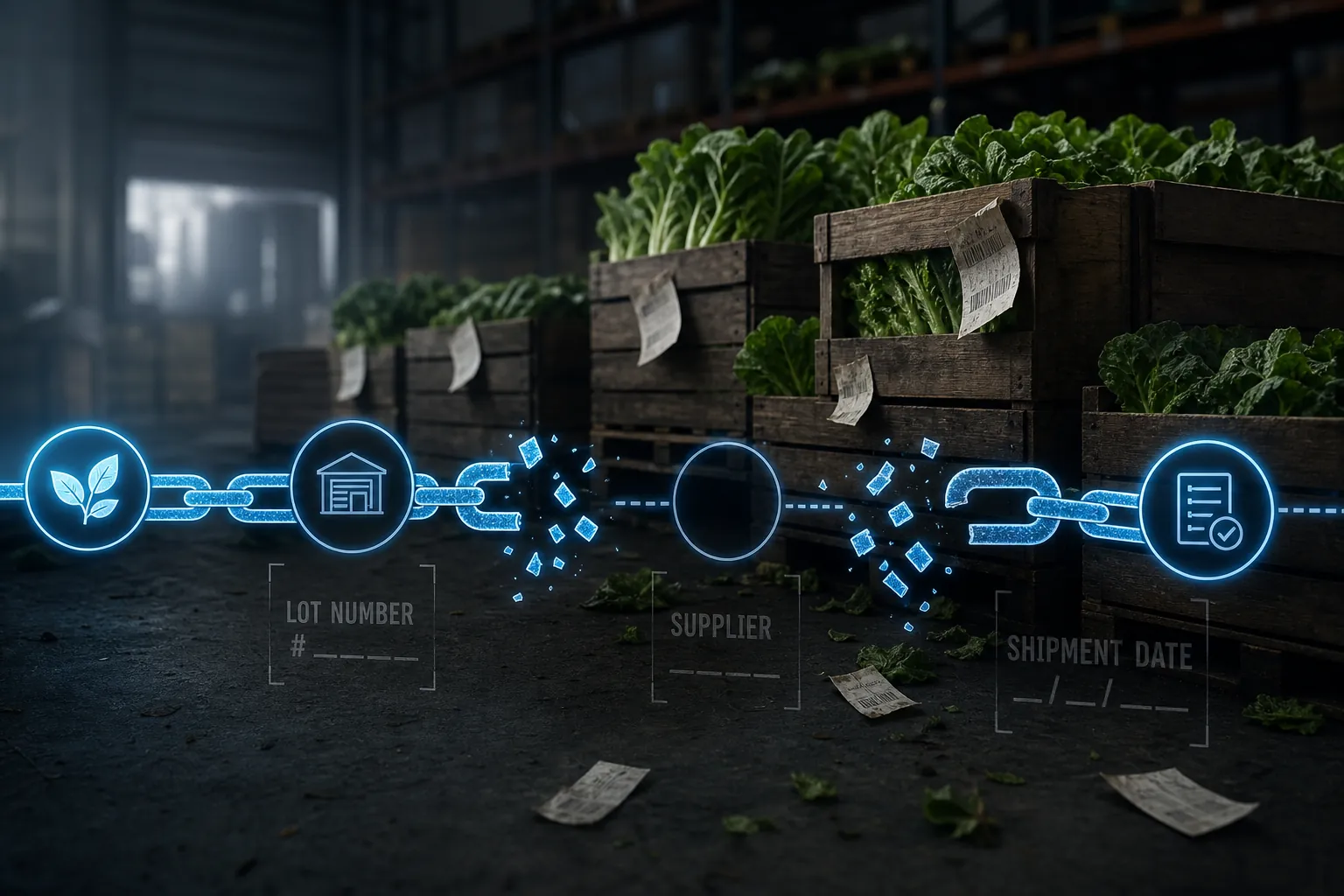
A mature traceability layer would not make every ambiguous test result disappear. It would narrow the blast radius. If a positive result is tied to a lot, and that lot is tied to harvest, processing, shipment, customer, and inventory records in a usable format, the organization can test the signal against genealogy instead of treating it as a loose alarm. Which customers received the lot? Which adjacent lots shared equipment, water, labor, or shipping? Which product is still in commerce? Which implicated records are missing? Those are the questions that determine whether an outbreak response becomes targeted action or a broad defensive scramble.
Cyclospora Makes the Data Problem Harder, Not Optional
Cyclospora is a poor pathogen for simplistic technology lessons. It is not E. coli with a clean genomic fingerprint waiting to be matched across isolates. The parasite is biologically complex, investigation often starts after a long incubation period, and microscopy can produce false-positive concerns that need expert adjudication.[6][7][9]
Those constraints explain some of the delay. They do not excuse avoidable record gaps. In fact, they raise the value of good produce genealogy. When biology gives investigators fewer clean molecular breadcrumbs, the burden shifts harder onto exposure histories, purchase data, shipping records, receiving logs, lot codes, supplier links, and harvest information. Weak traceability does not merely slow a neat investigation; it removes one of the few tools that can compensate for a pathogen that does not give investigators the same shortcuts as better-characterized bacterial outbreaks.
| Layer | What AI Could Help With | What It Cannot Do Without Lot-Level Records |
|---|---|---|
| Clinical lab screening | Flag parasite images faster, absorb testing surges, increase screening sensitivity | Identify the contaminated produce lot or shipment |
| Epidemiology | Organize case signals and exposure patterns when data is available | Recover accurate food histories when patients cannot remember exposures |
| Produce traceability | Search, reconcile, and narrow affected product scope if records are digital and linked | Infer reliable supply-chain genealogy from missing, inconsistent, or paper-bound records |
| Recall execution | Prioritize holds, customer notifications, and inventory checks | Prove which product is safe to release when lot identity is ambiguous |
This is the practical boundary that should govern AI traceability investments. The model can only reason over the product identity it receives. If the system sees a shipment as a vague case of “shredded lettuce” instead of a lot-linked unit with supplier, production, date, customer, and transformation history, the output will inherit that vagueness. The dashboard may look modern while the investigation remains stuck in phone calls, spreadsheets, PDF certificates, and mismatched item descriptions.
FSMA 204 Is the Policy Hinge
The Food Traceability Rule under FSMA 204 was designed to push higher-risk foods toward more standardized traceability records. Its compliance date has been delayed to July 2028, and Bloomberg Law reported that former FDA officials cited the 2026 cyclospora outbreak as evidence that the delay increased health risks.[10] Bloomberg Law also reported industry survey findings that fewer than 40% of affected companies were prepared.[10]
That delay matters because FSMA 204 is not just a paperwork deadline. For a product like leafy greens, the rule’s operational promise is that key data elements and critical tracking events become available in a form investigators can use under pressure. The useful question is not whether a company owns traceability software. It is whether records can connect a suspect food to the lot-level movement history fast enough to support a hold, release, recall, or reclassification decision.
Vendor-reported metrics suggest what that kind of infrastructure can change, though they should not be mistaken for independent evidence from this outbreak. FoodReady has reported that its platform is deployed in hundreds of facilities, including Dole, and that customers have compressed mock recalls from 4-8 hours to 10-30 minutes while reducing data-entry errors by 85-95%.[11] A BusinessWire release described one processor using AI-enabled traceability to limit affected product scope to 2% of inventory rather than roughly 40% under the prior manual system.[12]
Those numbers are directional, not a verdict. They show the kind of outcome buyers are being sold: faster mock recalls, fewer manual entry errors, smaller affected inventory populations. What they do not show is that a comparable AI traceability platform operated across the lettuce supply chain in the 2026 cyclosporiasis investigation. The case therefore should not be used to say “AI traceability failed” if no AI traceability layer had the necessary data and mandate in the first place.
What This Case Actually Says About AI Traceability
The cleanest lesson from the outbreak is layered. At the diagnostic endpoint, AI-assisted screening appears to have helped a strained lab find more Cyclospora cases faster during a surge. Upstream, the produce investigation still had to fight the older problem of source attribution in a fragmented fresh-food network. The extra diagnostic signal increased the flow of confirmed or suspected cases into a system that still needed lot-level records to turn those cases into a confident source determination.
For supply-chain and food-safety leaders, that distinction should shape purchasing decisions. A traceability platform is not valuable because it says “AI” on the slide. It is valuable if it can answer specific outbreak questions quickly: which lots are implicated, which lots are adjacent, which shipments carried them, which customers received them, which inventory remains, and which records are too weak to support a release decision.
The 2026 cyclospora outbreak does not prove that AI has no place in food safety. It proves that AI placed at one layer cannot repair missing infrastructure at another. Diagnostic AI can improve detection. Without lot-level digital traceability, it mostly increases the speed and volume of signals entering an upstream system that still cannot resolve source attribution fast enough.
References
- Surveillance of Cyclosporiasis page and outbreak page, CDC
- Cyclospora outbreak tests CDC, RFK Jr. response, CNBC, July 23, 2026
- AI Takes On the Cyclospora Outbreak, BankInfoSecurity, July 17, 2026
- The Biggest Advancement in Parasite Screening Since the Microscope, ARUP Laboratories
- ARUP, Techcyte Publish Study On AI-based Ova And Parasite Detection Tool, Techcyte
- What to know about the cyclosporiasis outbreak, Stanford Report, July 2026
- Tracking Cyclosporiasis: Understanding the Current Outbreak, ASTHO, 2026
- Here's Where The Cyclosporiasis Outbreak Stands After Taylor Farms' False Positive, Forbes, July 20, 2026
- What a Cyclospora False Positive Teaches Us About Food Traceability, Trustwell
- Cyclospora Hunt Highlights Need for Delayed Food-Tracing Rule, Bloomberg Law
- FoodReady blog, FoodReady
- BusinessWire release, BusinessWire
Cited evidence
- Taylor Farms cyclospora exposes AI traceability gaps
An analysis of four documented traceability failures during the Taylor Farms cyclospora outbreak, evaluating which current AI technologies could have addressed them and delivering a vendor-neutral verdict for enterprise buyers evaluating food safety traceability platforms.
- What the 2026 Oil Crisis Revealed About AI Planning
An analysis of how o9, Kinaxis, and Blue Yonder AI planning platforms performed during the 2026 Hormuz oil price shock, based on vendor-reported data and public evidence, revealing that while concurrent planning enabled rapid scenario re-evaluation, data integration gaps limited broader effectiveness.
- Could AI Traceability Have Prevented 2025 Fruit Puree Recalls?
An analysis of three major 2025–2026 fruit puree recalls—PT Organics, WanaBana, and Tippy Toes—shows how commercially available AI traceability tools like supplier risk scoring, N-tier visibility, and spectral screening could have cut the average contamination-to-recall lag from 23–31 days to near-real-time targeted removal, based on FDA recall data and deployment benchmarks from Walmart and Nestlé.
Ready to check your own team's readiness for this pattern?
See the procurement readiness checklist →Spotted something inaccurate or incomplete in this entry? ChainSignal reviews corrections and additional evidence before publishing an update — this is not a public comment thread.
Flag an inaccuracy / submit evidence for this entry →