
How AI computer vision detects spoilage to prevent food recalls
This analysis of four computer vision deployments at Tyson Foods, Walmart, Kraft Heinz, and Nestlé shows that AI-powered inspection catches defect classes that manual methods miss, with clear recall-prevention implications. But the impact depends on upstream placement and is limited to visible-surface defects.
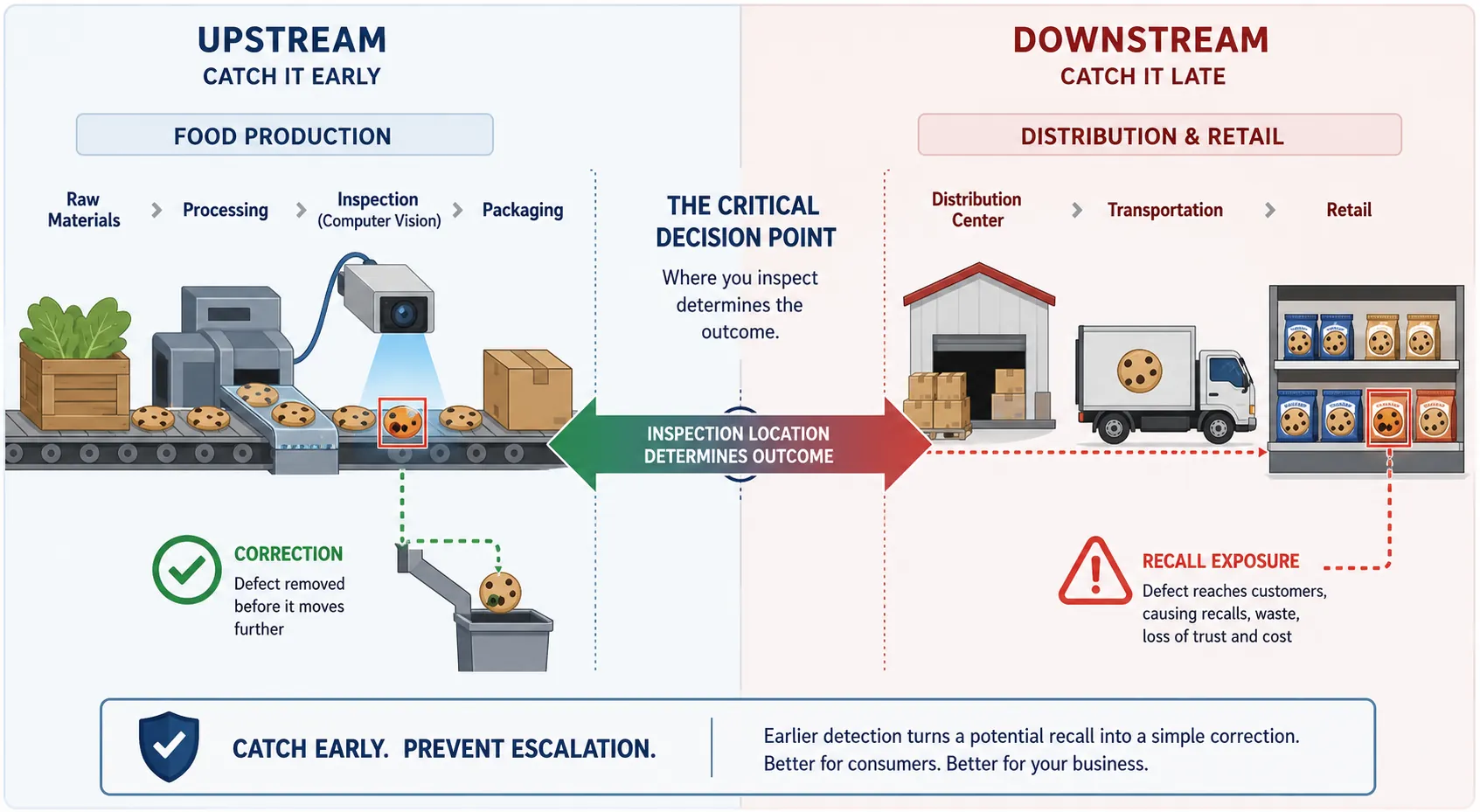
The recall-prevention value of AI computer vision is decided less by the camera than by where the camera sits. A short-counted tray, a damaged wrapper, or a blemished produce case caught on the line can become a correction or a hold. The same defect found after it has moved through distribution becomes a DC sort, a store withdrawal, or part of a public recall exposure. That is the useful way to read an AI supply chain recall and spoilage detection case study: not as a claim that AI “sees defects,” but as evidence that a specific missed defect class became interceptable at a cheaper point in the workflow.
The stakes are not theoretical. FDA food and beverage recalls exceeded 740 in 2024, more than double the 313 reported for 2023, according to recall-cost analysis cited by Lumafield. The same source cites an average direct recall cost of $10 million per event, while noting that total economic impact can run 3 to 5 times higher when business interruption, which it estimates at 49% of total cost, is included.[1] Those figures should not be stretched into a formula for every food plant. They are enough, however, to explain why inspection location has become a board-level issue rather than a narrow automation upgrade.
The useful question is which defect moves upstream
Computer vision is strongest when the defect is visible, repeatable, and tied to a decision the operation can still act on. That is a narrower claim than many AI inspection pitches make, but it is also the claim that matters most to QA and receiving teams. A model that flags tray count variance before palletization changes the next production adjustment. A model that grades produce at the DC can redirect, discount, or reject inventory before store-level shrink accumulates. A model that sees a wrapper-integrity problem before cases leave the plant gives QA a containable lot problem instead of a market problem.
The four deployments below are useful because they sit at different points in the food supply chain and report different kinds of evidence. Tyson offers the cleanest technical performance number. Walmart offers the strongest placement story and the weakest recent verification. Kraft Heinz and Nestlé add examples of visible quality and packaging inspection, though the evidence comes through a case-study aggregator rather than primary company reporting.
| Deployment | What the system saw | Where it sat | Reported outcome | Evidence strength |
|---|---|---|---|---|
| Tyson Foods | Chicken tray counts tied to over- and under-packaging | Production line / packaging feedback loop | mAP 0.91 detection accuracy in an AWS Panorama and SageMaker deployment | Specific technical metric from a vendor-published engineering case |
| Walmart Eden | Produce defects and shelf-life signals | Distribution centers before store replenishment | $85M saved in early deployment; $2B projected over five years | Large-scale announced figures from 2018, without later independent audit in the available material |
| Kraft Heinz Claussen pickles | Cucumber quality inspection | Production quality-control process | 12% production efficiency increase | Case-study aggregator, not primary company reporting |
| Nestlé chocolate | Wrapper-integrity inspection | Packaging quality checks | 80% reduction in manual quality checks and increased production speed | Case-study aggregator, not primary company reporting |
Tyson: a narrow metric that is useful because it stays narrow
Tyson Foods’ AWS case is not a pathogen-detection story. It is a production-control story, and that is why the evidence is worth keeping in its proper box. In a computer vision deployment using AWS Panorama and Amazon SageMaker, Tyson applied vision to chicken tray counting in an operation described as processing 45 million head per week. The reported detection performance was mAP 0.91, with real-time production feedback intended to reduce over- and under-packaging.[2]
For recall prevention, tray counting matters only in a bounded way. It can help catch a packaging execution problem before it becomes a mislabeled, underfilled, or otherwise nonconforming lot moving downstream. It does not tell a QA director that the product is microbiologically safe. It does not replace sanitation verification, temperature control, allergen controls, or hold-and-release logic. The operational value is that a visible, countable defect class becomes measurable during production instead of being discovered later by inventory reconciliation, customer complaint, or a downstream audit.
That distinction is not a caveat added to weaken the case. It is the case. A packaging feedback loop that reliably reduces count variance can prevent avoidable nonconformance from traveling. It just should not be sold as comprehensive food safety infrastructure.
Walmart Eden: the best placement story, with old numbers
Walmart’s Eden system is more directly relevant to spoilage interception because it was described as an AI-based produce quality and freshness platform deployed across 43 distribution centers. Food Logistics reported that Eden had saved Walmart $85 million in an early deployment and was projected to save $2 billion over five years by helping determine produce freshness and likely spoilage timing.[3]
The placement is the important part. A produce defect found at a store is already fragmented across labor, markdowns, customer experience, and local waste. A defect found at the DC can still affect inbound vendor decisions, allocation, routing, store replenishment, and whether product should move at all. Eden’s value, as reported, was not merely that it classified produce. It put that judgment at a point where the supply chain could still change the fate of inventory before poor shelf life multiplied across stores.
The weak point is verification. The $85 million and $2 billion figures come from a 2018 report, and the available material does not provide an independent later audit or current public performance record.[3] That does not make the deployment irrelevant. It means the figures should be used as announced business-case numbers, not as independently confirmed savings. For a QA or supply chain leader building an internal case, Eden is strongest as evidence that a major retailer saw enough value to place AI spoilage detection at DC scale. It is weaker as proof of sustained savings through 2026.
Kraft Heinz and Nestlé show the same pattern in faster-moving inspection tasks
The Kraft Heinz Claussen pickles case is a cucumber-quality example. Enterprise AI Case Studies reports that AI vision inspection helped improve cucumber quality control and produced a 12% production efficiency increase.[4] That is not the same as a documented reduction in recalls. It is still relevant because cucumber grading is exactly the kind of visual judgment that can drift under throughput pressure: size, surface condition, shape, and visible quality attributes must be assessed quickly enough to keep production moving.
Nestlé’s chocolate wrapper inspection case, reported in the same case-study source, is a packaging-integrity example. The source reports an 80% reduction in manual quality checks and increased production speed.[4] Wrapper integrity is closer to the recall-prevention lane than a generic productivity metric might suggest. A compromised wrapper can create downstream quality complaints, labeling exposure, contamination risk at the package level, and rework that becomes more expensive after cases leave the plant.
These two cases should be treated as corroborating evidence, not as audited proof. They show that AI vision has been applied to recognizable food-manufacturing inspection problems with reported efficiency gains. They do not, on their own, establish that recalls fell, that defect escape rates changed by a measured amount, or that the companies’ full quality systems were transformed.
Where interception changes the cost curve
The common thread across the four cases is not a single AI capability. It is the movement of inspection earlier than the point of expensive discovery. Tyson’s tray-counting feedback belongs close to production because the corrective action is still a line adjustment. Kraft Heinz’s cucumber inspection belongs before poor-quality inputs become finished product. Nestlé’s wrapper inspection belongs before packaging defects are case-packed and shipped. Walmart’s Eden belongs at receiving and distribution because produce shelf life is already decaying while the network decides where inventory should go.
That placement logic is why computer vision can have recall-prevention implications even when the reported metric is not “recalls reduced.” A caught defect can trigger a hold, rework, supplier conversation, lot segregation, routing change, or production correction. A missed defect leaves those options behind one by one. By the time QA is writing the corrective-action report after field discovery, the expensive part is often not identifying what went wrong. It is finding where the product went, who touched it, and how much must be withdrawn to protect customers and the brand.
Lumafield’s discussion of a detection gap uses FDA medical device recall root-cause data, including a finding that 26% of medical device recalls came from supplier or component failures that conventional inspection missed.[1] That figure should not be presented as food-sector proof. The useful analogy is narrower: supplier inputs and packaging components can carry defects that conventional checks miss, and visual inspection only helps if it is placed where those defects are still isolatable.
What computer vision still does not see
The first limitation is physical. Computer vision can classify what the camera can observe: count, shape, color, surface blemish, label presence, fill appearance, seal condition, wrapper damage, and similar attributes. It does not see embedded contamination, pathogen presence, chemical residue, or internal spoilage unless those conditions create visible cues and the model has been trained to recognize them. A clean-looking product can still be unsafe.
The second limitation is data. A model trained on clean examples, obvious defects, and stable lighting may perform well in a pilot and degrade when product variety, packaging artwork, condensation, camera angle, seasonal variation, or line speed changes. The labeled-image burden is not a procurement footnote. It is part of the quality system. Someone must define defect classes, label borderline examples, review false positives and false negatives, and decide when a model update requires validation before release.
The third limitation is evidence. The available public record is mostly vendor-published, journalistic, or aggregator-based. Tyson’s mAP 0.91 is a concrete technical result, but it covers tray counting.[2] Walmart’s Eden scale is notable, but the public savings figures are old and unaudited in the available material.[3] Kraft Heinz and Nestlé have useful reported outcomes, but not primary-company or third-party recall post-mortems.[4] A stronger evidence base would connect deployment dates, defect escape rates, hold decisions, customer complaints, and recall or withdrawal outcomes over time.
How to read the business case without overstating it
A credible business case for AI visual inspection should name the defect class before naming the AI platform. “Computer vision for packaging integrity on high-speed confectionery lines” is testable. “AI for food safety” is too broad to validate. The same discipline applies to spoilage: visual produce grading at DC receiving is a different control from predictive cold-chain monitoring during transit, and both are different from microbial testing.
The practical questions are straightforward:
- Which visible defect class is escaping today?
- Where is that defect first observable with enough consistency to train a model?
- What action is still available at that inspection point: hold, rework, reject, reroute, markdown, or line correction?
- Which metric will prove improvement: defect escape rate, manual-check reduction, complaint rate, spoilage loss, rework hours, or recall/withdrawal count?
- Who owns false negatives and false positives when the model disagrees with operators?
Those questions keep the evaluation tied to operational consequence. A high model score is useful only if the workflow around it is ready to act. A DC receiving team that flags short-shelf-life produce but lacks routing authority still inherits waste. A plant QA team that receives model alerts without lot-level traceability still struggles to contain the issue. A line operator who cannot distinguish nuisance alarms from real nonconformance will eventually work around the system.
The conditional answer
The evidence supports a careful yes. AI computer vision can function as recall-prevention infrastructure for visible-surface, count, package, and produce-quality defects when it is deployed early enough for the business to act before field scale. Tyson shows a measurable production-line inspection result. Walmart shows why distribution-center placement matters for spoilage and shelf-life decisions. Kraft Heinz and Nestlé show adjacent manufacturing and packaging inspection uses with reported efficiency gains.
The evidence does not support a broader claim that computer vision solves food safety. It does not detect embedded contamination by itself, it depends on labeled training data and validation discipline, and the public record still lacks the independent post-mortem trail that would connect specific deployments to fewer recalls over time.
For spoilage prevention, the strongest architecture is not vision alone. It is visual inspection at production and receiving combined with upstream environmental monitoring, supplier controls, and cold-chain prediction. ChainSignal’s analysis of AI-driven food safety optimization for the cold chain and predictive AI sensors for cold chain monitoring covers the earlier environmental layer. Computer vision becomes more valuable when it is one interception point in that chain, not the whole control plan.
References
- The Real Cost of a Product Recall and How to Prevent One, Lumafield
- Industrial automation at Tyson with computer vision, AWS Panorama, and Amazon SageMaker, AWS Machine Learning Blog
- Walmart is Developing a Machine that Knows When Produce Will Spoil, Food Logistics
- Food and beverage production quality control (Kraft Heinz case), Enterprise AI Case Studies
Cited evidence
- How AI Recall Management Improves Food Safety Outcomes
This article examines measurable outcomes from AI-driven recall management deployments, including trace-speed reductions, recall-scope compression, and cost avoidance, while distinguishing verified claims from marketing assertions. It provides evidence to help supply-chain leaders evaluate AI investments for food safety.
- How AI Supply Chain Planning Flags Tip-Over Risks Before Recalls
This analysis examines whether supply-chain AI platforms can detect and stop furniture tip-over recalls before they escalate. Drawing on CPSC injury data, the 2024 New Age restraint-kit recall, and known vendor capabilities from o9, Blue Yonder, and Kinaxis, it finds that AI can compress the defect-escape interval from months to days—but only if the industry resolves data-sharing and multi-tier traceability gaps.
- How Five AI Platforms Compare for Tariff Scenario Planning
This article audits the tariff-specific capabilities of o9, Kinaxis, Blue Yonder, Anaplan, and Coupa using published deployment data, revealing differences in deployment speed and scenario depth, and identifying the absence of verified P&L outcome studies.
Ready to check your own team's readiness for this pattern?
See the warehouse management readiness checklist →Spotted something inaccurate or incomplete in this entry? ChainSignal reviews corrections and additional evidence before publishing an update — this is not a public comment thread.
Flag an inaccuracy / submit evidence for this entry →