The AI ROI Playbook for Transportation and Logistics: Where the Money Actually Is
A portfolio-level ROI analysis for CFOs, COOs, and supply chain VPs building a business case for AI in transportation and logistics. Covers use-case-specific returns, hidden costs, risk-adjusted payback timelines, and the compounding network effects that make logistics AI investments unique.
The ROI Landscape: Why Logistics AI Is Different
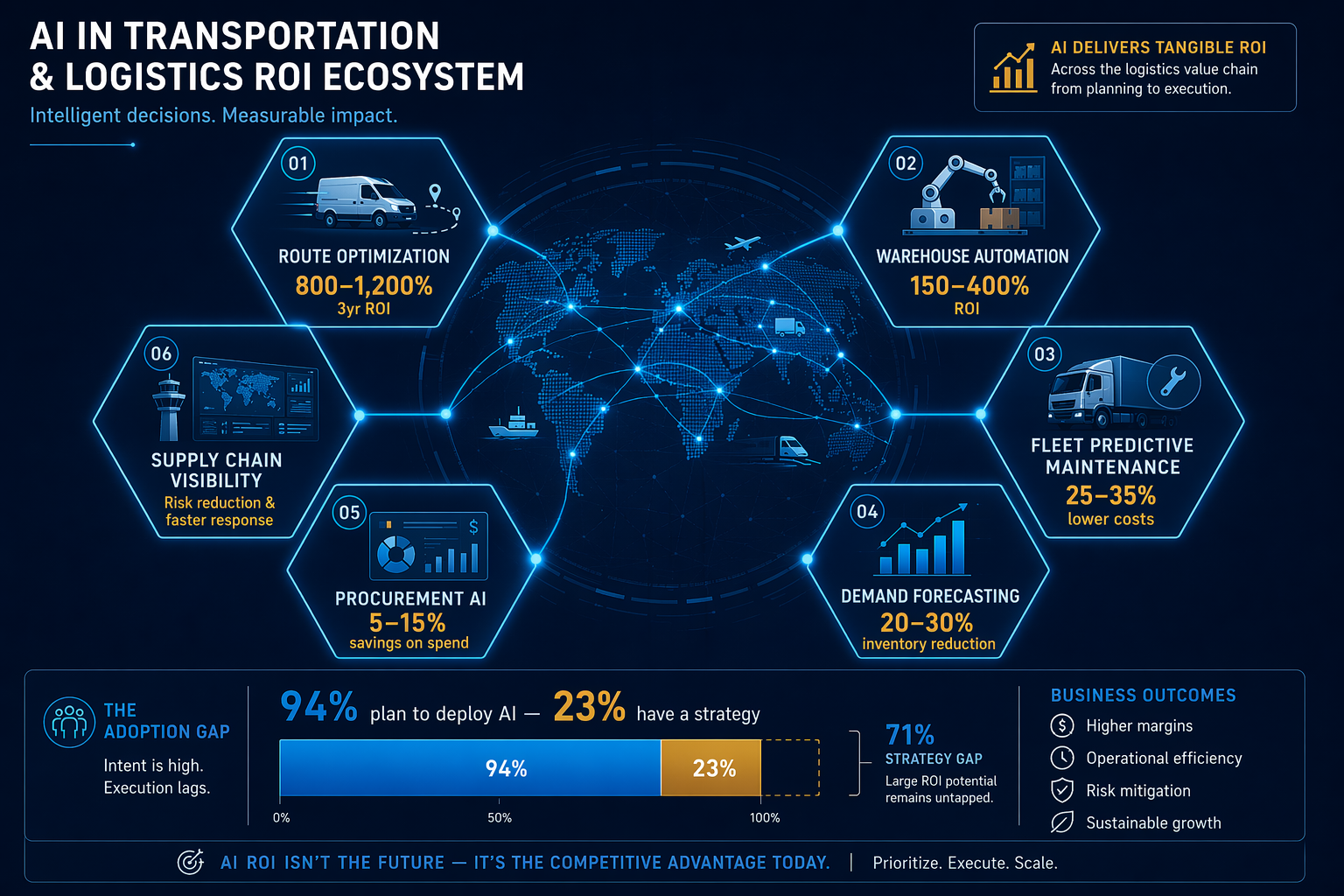
Every supply chain function can benefit from AI, but transportation and logistics occupy a distinct position on the ROI curve. Unlike procurement or demand planning — where returns are real but often incremental — logistics AI investments average 190% ROI across all use case categories, according to The Thinking Company's 2025 analysis. That headline number, however, masks a wide variance: route optimization for a 500-vehicle fleet can return 800–1,200% over three years, while a standalone warehouse automation project might land at 150–250%. The difference is not just about which vendor you pick — it is structural.
Logistics AI returns compound in ways that other domains do not. A route optimization model that learns traffic patterns feeds directly into demand forecasting, which improves warehouse slotting, which reduces last-mile complexity. Each use case generates data that makes the next one more accurate. That network effect is the reason portfolio-level returns are 40–60% higher than the sum of individual point solutions.
For CFOs and COOs building a business case, the key takeaway is this: logistics AI is not a single investment decision. It is a portfolio decision. The organizations that treat it as such — modeling shared infrastructure costs, sequencing use cases to maximize data reuse, and applying conservative, risk-adjusted projections — are the ones that capture the full 190% average. Those that pursue isolated point solutions leave 40–60% of potential portfolio ROI on the table.
ROI by Use Case Category: Where the Returns Concentrate
Not all logistics AI use cases are created equal. The table below organizes the major categories by three-year ROI range, typical investment size, and payback period, drawing primarily on The Thinking Company's 2025 analysis of EU-based logistics operators and cross-referenced with McKinsey's 2024 benchmarks for logistics cost reduction.
| Use Case Category | Three-Year ROI Range | Typical Investment (EUR) | Annual Savings (EUR) | Payback Period | Key Source |
|---|---|---|---|---|---|
| Route optimization (500-vehicle fleet) | 800–1,200% | 80K–150K | 1.5M–3M | 2–4 months | The Thinking Company 2025 |
| Predictive fleet maintenance | 300–500% | 60K–120K | 400K–800K | 3–6 months | The Thinking Company 2025; Intangles 2026 |
| Last-mile optimization | 250–400% | 40K–100K | 200K–600K | 4–8 months | The Thinking Company 2025 |
| Warehouse AI (directed picking) | 250–400% | 100K–300K | 300K–1M | 6–12 months | The Thinking Company 2025 |
| Warehouse AI (computer vision sorting) | 200–350% | 150K–400K | 250K–800K | 8–14 months | The Thinking Company 2025 |
| Demand sensing / forecasting | 200–350% | 50K–200K | 150K–500K | 6–12 months | The Thinking Company 2025; McKinsey 2024 |
| Supply chain risk monitoring | 150–400% | 30K–100K | 50K–200K | 6–12 months | The Thinking Company 2025 |
| Inventory positioning (warehouse) | 150–250% | 50K–150K | 100K–300K | 8–14 months | The Thinking Company 2025 |
Cited evidence
- From Reactive to Predictive: Building the Data Foundation for Logistics Analytics
A practical, phased implementation roadmap for supply chain technology leaders and analytics teams. This guide explains why most predictive analytics initiatives fail due to weak data foundations, then provides a 30/60/90-day plan covering data readiness, use case selection, team roles, hidden costs, and success metrics.
- AI Logistics Companies in Action: 10 Real-World Deployments With Measured Outcomes
This article presents 10 documented AI deployments across transport, warehouse, and supply chain orchestration layers, with quantified outcomes from DHL, Uber Freight, InPost, Ocado, Kuehne+Nagel, FourKites, and FedEx. Written for operations directors and supply chain VPs building internal business cases.
- What AI for Cruise Logistics Route Planning Actually Delivers
AI-powered route planning for cruise logistics combines real-time weather, ocean current, port congestion, and fuel consumption data to reduce fuel costs by 5–15% and improve itinerary reliability. This use-case entry covers how it works, documented outcomes from major operators, and key implementation risks.
Spotted something inaccurate or incomplete in this entry? ChainSignal reviews corrections and additional evidence before publishing an update — this is not a public comment thread.
Flag an inaccuracy / submit evidence for this entry →