Could AI Traceability Have Prevented 2025 Fruit Puree Recalls?
An analysis of three major 2025–2026 fruit puree recalls—PT Organics, WanaBana, and Tippy Toes—shows how commercially available AI traceability tools like supplier risk scoring, N-tier visibility, and spectral screening could have cut the average contamination-to-recall lag from 23–31 days to near-real-time targeted removal, based on FDA recall data and deployment benchmarks from Walmart and Nestlé.
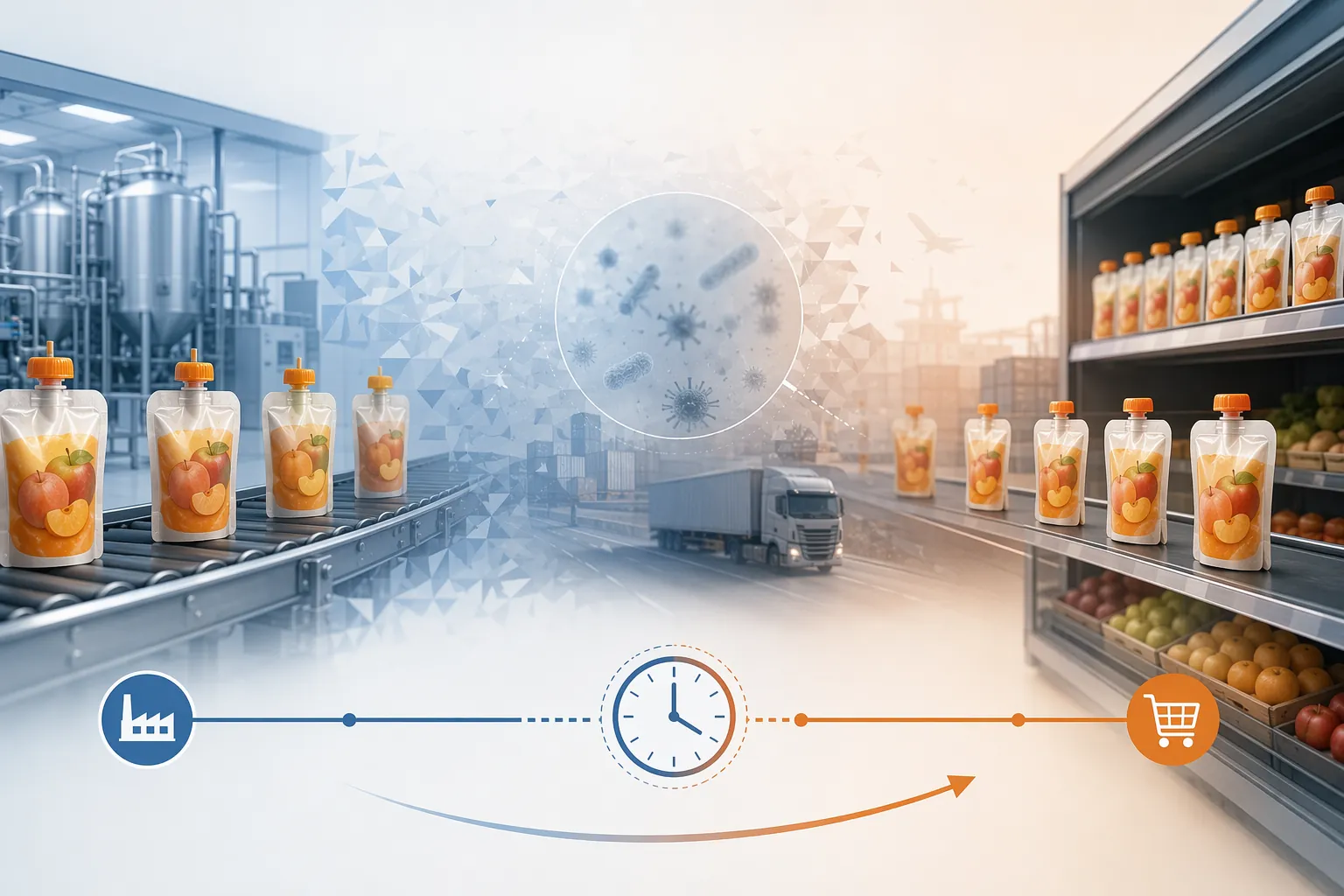
The uncomfortable number behind the fruit puree recall traceability question is not a market forecast. It is the time between a contaminated or defective product entering commerce and the recall catching up. Mergen AI’s 2025 review of 1,576 FDA recall entries found an average contamination-to-recall lag of 23 to 31 days, with the caveat that its dataset included food and cosmetics and had a small duplicate-entry issue.[1] Even treated directionally, that is long enough for pouches to move from plants to distribution centers, retail shelves, pantries, day-care bags, and toddlers’ hands.
That lag is where AI traceability either earns its place or becomes another vendor slide. The useful question is not whether an algorithm could have made contamination impossible. It is whether commercially available systems could have surfaced the missing upstream signal earlier, narrowed the affected lots faster, and changed the recall from a broad emergency search into a targeted removal.
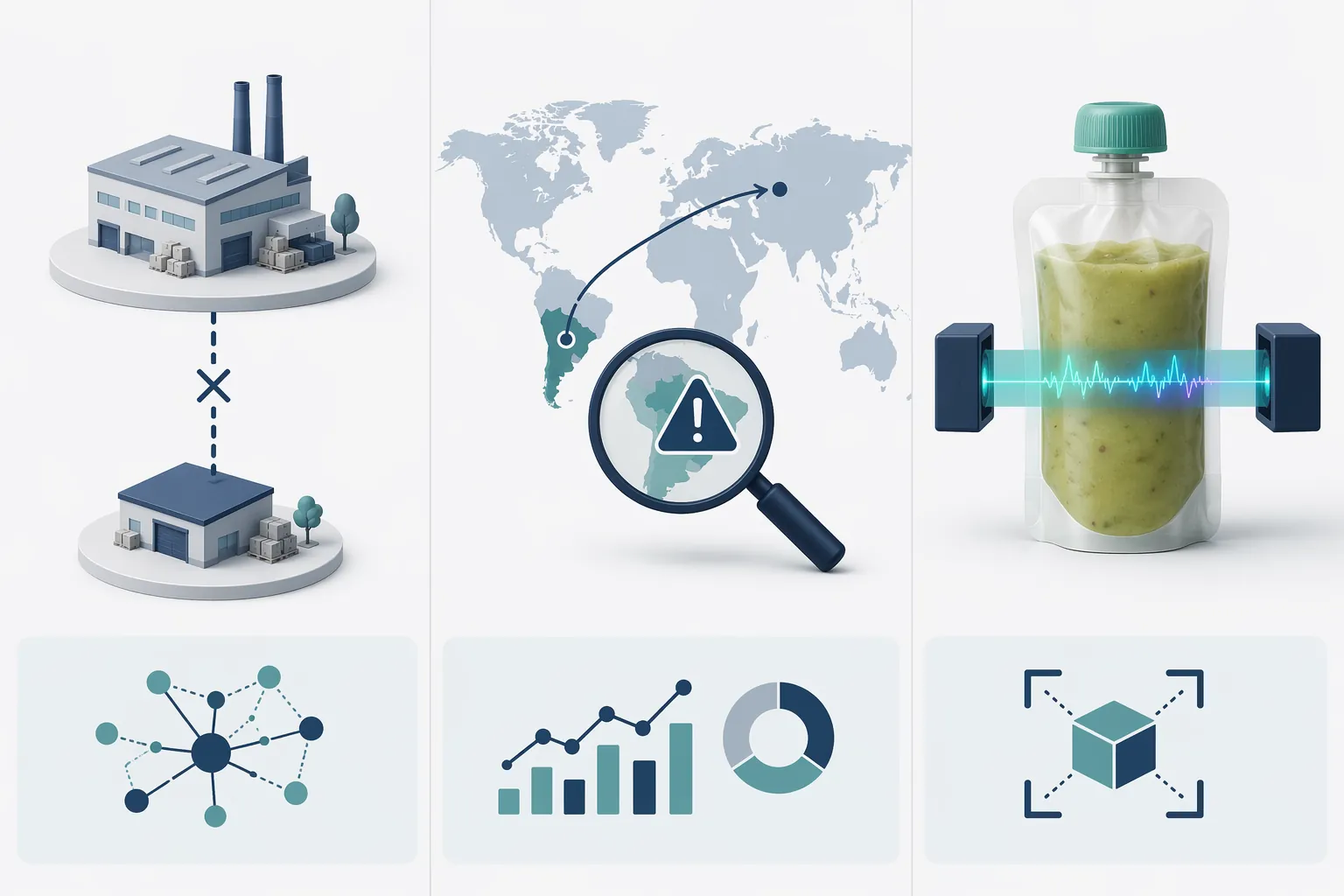
The three recalls that matter here do not show one generic “supply-chain problem.” They show three different places where the chain went dim: packaging supplier visibility, ingredient-source risk, and finished-product toxin detection. Those are different control points. They require different data. They also produce different counterfactuals.
Three Recalls, Three Failure Modes
| Recall | What Failed Operationally | Where AI Traceability Would Sit | What Could Plausibly Change |
|---|---|---|---|
| PT Organics / Pumpkin Tree and Peter Rabbit Organics fruit puree, July 2026 | Finished-product recall followed the packaging supplier’s proactive recall of defective pouches, leaving the brand dependent on downstream notification rather than full upstream visibility.[2] | N-tier supplier mapping, supplier-alert ingestion, packaging-lot linkage to finished goods | Earlier identification of affected pouch lots and faster retailer-specific withdrawal before the supplier notice became the trigger |
| WanaBana cinnamon applesauce and related puree products, event originating October 2023 with later investigation and expanded relevance into 2025 | Lead contamination traced to cinnamon from a third-country ingredient supply chain, making it a supplier-risk and ingredient-anomaly problem rather than a simple finished-goods logistics problem.[4] | Supplier risk scoring, ingredient price and quality-history anomaly detection, country and vendor risk monitoring | Earlier escalation of suspect ingredient lots and tighter hold-and-release decisions, not a guarantee that adulteration would be prevented |
| Tippy Toes fruit puree baby food, 2025 | Patulin mold toxin risk was tied to puree product safety, putting the control point at incoming fruit material, puree processing, or finished-product screening.[5] | Spectral analysis, computer-vision screening, toxin-risk models connected to lot disposition | Shorter exposure window if suspect lots were flagged before shipment or during release testing |
The table is the center of the matter because “AI traceability” is not one capability. A supplier graph does not test for patulin. A spectral scanner does not discover a hidden packaging sub-supplier. A supplier risk model may raise suspicion about an ingredient stream, but it still needs purchasing records, certificates, receiving data, and quality history to have anything meaningful to process.
PT Organics: The Supplier Alert Should Not Be the First Real Map
The PT Organics recall is irritating in a very specific way. The FDA notice says PT Organics Limited recalled select Pumpkin Tree Peter Rabbit Organics Banana Strawberry fruit puree because of a packaging defect, and that the action followed a proactive recall by the packaging supplier.[2] USA Today reported the recalled products were sold at Kroger, Target, and Meijer.[3] That is not a finished-product owner discovering a risk through its own upstream control tower. It is a supplier’s action becoming the decisive signal.
A practical N-tier traceability setup would have treated the pouch as more than a purchased component with a vendor name attached. It would have linked packaging production lots to puree manufacturing lots, distribution shipments, and customer destinations. It would also have watched supplier alerts, quality events, nonconformance trends, and material substitutions across the packaging network. The point is not to admire a network graph. The point is to know which finished goods are sitting on which defective pouch lots before a retail notice becomes the operating system.
In the counterfactual, the packaging supplier’s defect signal still matters. AI does not remove the need for supplier disclosure. What changes is the dependency chain after the signal appears. Instead of quality and procurement teams calling, emailing, and reconciling spreadsheets to answer “Which finished lots used this material?”, the system should already hold the packaging-lot-to-finished-lot relationship. If a supplier event hits at 9 a.m., the first response should be a scoped list of affected lots, plants, shipment destinations, and open inventory—not a meeting to discover whether those records exist.
The benchmark that makes this credible is not a promise that every company can click once and trace everything in seconds. Walmart and IBM’s Food Trust work is often cited for reducing mango traceback from 7 days to 2.2 seconds; the benchmark is old and directional, but it proves that integrated lot-level traceback can collapse the search portion of a recall when the data exists in usable form. Nestlé has also reported an 80% reduction in manual checks from a traceability system, which is the kind of workload reduction that matters when the recall clock is already running.
WanaBana: Ingredient Risk Is Not the Same as Retail Traceback
WanaBana needs more care than many 2025 recall summaries give it. The lead-contaminated cinnamon applesauce event began in October 2023; its relevance to a 2025–2026 analysis comes from continued investigation and expanded supply-chain actions, not because the original contamination event neatly began in 2025.[4] That distinction matters. If the calendar is wrong, the failure mode usually gets blurred too.
This was not primarily a “find the pallet in the store” problem. By the time a finished pouch is in retail distribution, the dangerous ingredient has already passed multiple gates. The sharper counterfactual sits earlier: supplier approval, ingredient purchasing, receiving, certificates of analysis, historical nonconformance records, country-of-origin monitoring, and price or quality anomalies.
AI supplier risk scoring would not magically detect lead by reading an invoice. It could, however, force an earlier review when several weak signals combine: a higher-risk ingredient category, a third-country supply chain, unusual pricing, supplier quality drift, inconsistent documentation, or a mismatch between ingredient risk and test frequency. Journey Foods’ 2026 analysis characterizes AI fraud detection accuracy as ranging from 81% to 100%, which is a wide claim and should be read as a capability range across methods and contexts, not as a guaranteed performance level for any single cinnamon supplier.[4]
The operational change would have been a tighter hold-and-release posture for suspect ingredient lots. If the risk model flagged the cinnamon stream before formulation, quality teams could have required additional testing, delayed release, or segmented production using that ingredient. If the signal appeared after production but before broad distribution, traceability would need to connect ingredient lots to finished puree lots quickly enough to quarantine inventory rather than reconstruct the history after children were exposed.
That is a narrower and stronger claim than “AI would have prevented WanaBana.” Adulteration and contamination can still beat a control plan. The defensible claim is that supplier-risk analytics could have increased the chance that the risky ingredient stream was escalated earlier and that lot genealogy could have shortened the time between suspicion and action.
Tippy Toes: Screening Belongs Where the Toxin Enters the Decision
The Tippy Toes case is the easiest one to picture because the product category is child-facing and the hazard is concrete. Delish reported a 2025 recall involving Tippy Toes puree baby food over patulin risk, a mold toxin concern in fruit-based products.[5] That pushes the analysis away from supplier-graph elegance and into material control.
Spectral analysis and computer-vision systems belong at the point where fruit condition, puree composition, or finished-product release is being judged. Depending on the process, that may mean incoming fruit inspection, in-process puree monitoring, finished-pouch screening, or a risk-based test plan that uses AI to decide which lots deserve heavier scrutiny. The control point should be chosen by where the hazard can still be acted on. A beautiful detection signal after nationwide shipment is still late.
Here the counterfactual is not supplier visibility. It is release discipline. If a screening system identifies a suspect lot before it leaves the plant, the consequence is a hold, confirmatory testing, disposal, rework if permitted, or a narrowed distribution block. If it identifies risk after some shipments have left, traceability still matters because the affected-lot list has to be precise enough for retailers and distributors to remove the right product without turning the event into a blanket withdrawal.
Spectral screening should not be sold as a guarantee. Detection systems reduce exposure windows when they are validated, maintained, connected to disposition decisions, and backed by confirmatory testing where required. If the system raises an alert that no one has authority to act on, it becomes another dashboard that looked impressive before the recall.
What Weeks-to-Hours Actually Requires
The 23-to-31-day lag is the load-bearing timing frame, but it should not be abused. It does not mean every recall can be cut by exactly a month. It means that, across the analyzed recall entries, the gap between contamination and recall was large enough that the search, escalation, and decision layers deserve scrutiny.[1] Mergen AI also identified 89 recalls with “microbial + supply chain” co-occurrence patterns indicating inadequate incoming ingredient testing, which reinforces the point that traceability and quality testing fail together often enough to be operationally relevant.[1]
The realistic timing gain comes from removing specific pieces of latency:
- Supplier-event latency: the time between an upstream defect or hazard signal and the finished-product owner knowing which internal lots are affected.
- Genealogy latency: the time spent reconciling purchase orders, receiving records, batch records, and shipment histories.
- Risk-escalation latency: the time a weak ingredient or supplier signal sits below the threshold for human review.
- Release-decision latency: the time between a test, scan, or anomaly alert and a hold, quarantine, or retailer notice.
AI helps only if it is attached to those steps. A forecasting platform that never touches supplier qualification will not fix WanaBana-type ingredient risk. A blockchain ledger without current batch and shipment data will not fix PT Organics-type packaging dependency. A spectral model that is not tied to lot release will not fix Tippy Toes-type toxin exposure. Capability has to sit inside the workflow that owns the consequence.
The broader recall environment explains why this matters without making fruit puree carry the whole food system. Mergen AI’s Bedner Growers cucumber example described 258 downstream recalls from one contaminated supplier, a useful scale comparison for N-tier cascade visibility.[1] PIRG’s 2026 Food for Thought report counted 31 cascade recalls in 2025 and found that, among 28 foodborne outbreaks, no recall was announced for 17.[6] CRC Group reported that units affected surged 232% in Q1 2025 to more than 70 million units even as recall event counts declined 3.8%.[7] Those figures do not prove that fruit puree recalls are becoming more frequent. They do show why affected-unit scope and downstream visibility matter as much as the initial recall count.
The Compliance Date Moved; the Traceability Logic Did Not
It is tempting to treat the FSMA 204 enforcement extension to July 2028 as a reason to slow down traceability work. That would be a procurement mistake. The enforcement timing moved, but the underlying logic of key data elements and critical tracking events remains the same: if a company cannot connect supplier lots, transformation events, and shipments quickly under pressure, the recall team will rebuild the chain manually when time is most expensive.
The market is certainly responding. Supply Change Capital estimated the food traceability AI market at $4.2 billion in 2025, growing to $18.6 billion by 2033 at an 18.5% CAGR, while traceability software represented only about 7% of total supply-chain software spend.[8] That says adoption is still uneven. It does not say the tools work automatically, or that buying a platform fixes master data, supplier onboarding, or plant-floor release authority.
For enterprise buyers, the useful vendor question is not “Do you have AI traceability?” It is much more specific:
- Can the system map packaging, ingredient, and finished-product lots across more than one supplier tier?
- Can supplier quality events and external alerts automatically identify affected internal lots?
- Can ingredient risk models combine vendor history, origin, pricing, documentation, and test frequency without pretending correlation is proof?
- Can screening outputs trigger holds, quarantines, or release blocks inside the manufacturing workflow?
- Can the company produce a retailer-ready affected-lot list in hours without assembling a war room around spreadsheets?
Could AI Traceability Have Prevented the Recalls?
Prevented is too absolute. PT Organics still depended on a packaging defect being detected and disclosed. WanaBana still involved an ingredient contamination pathway that supplier scoring could flag only if the right signals were available and weighted correctly. Tippy Toes still required validated screening and release controls capable of acting before shipment. Food safety does not become clean because software is present.
But the weaker claim would also be wrong. These recalls map cleanly to commercially deployed capabilities: N-tier supplier visibility for packaging defects, supplier and ingredient risk analytics for third-country contamination risk, and spectral or computer-vision screening for toxin detection. When those capabilities are embedded before the emergency—in supplier qualification, material receiving, production genealogy, release testing, and retailer shipment mapping—they can plausibly shorten discovery, narrow affected-lot identification, and support targeted removal well before a typical 23-to-31-day lag runs its course.
For readers working through implementation rather than theory, the next question is usually how to bring smaller tier suppliers into the data loop without turning compliance into an unfunded mandate. ChainSignal’s analysis of AI supply-chain compliance for small businesses is the natural continuation. The same failure-mode logic also appears outside food in the Boeing supplier visibility counterfactual and the Panasonic toaster oven recall analysis, where the product category changes but the traceability question stays the same: which node stayed invisible too long, and what would have had to be known earlier?
References
- FDA Recalls Story Final, Mergen AI, 2025.
- PT Organics Limited Recalls Select Pumpkin Tree Peter Rabbit Organics Banana Strawberry Fruit Puree, U.S. Food and Drug Administration.
- Fruit puree pouches recalled at Kroger, Meijer, Target, USA Today, July 22, 2026.
- Journey Foods 2026 analysis.
- Baby Food Recall: Tippy Toes Puree Patulin Risk, Delish.
- Food for Thought 2026, PIRG Education Fund, 2026.
- Beyond the Label: What 2025’s Product Recall Trends Reveal About Emerging Risk, CRC Group.
- AI-Enabled Traceability: The Next, Supply Change Capital.
Cited evidence
- Why AI Traceability Failed in the 2026 Cyclospora Outbreak
The 2026 multistate cyclosporiasis outbreak — with over 1,645 confirmed cases and a 2.5-month FDA investigation lag — exposed a stark divide: AI-powered diagnostic screening identified cases at 3-4x human sensitivity, but the produce supply chain still lacks the lot-level digital traceability needed to pinpoint contamination. This case study examines what the outbreak reveals about AI's real limits in food safety today.
- How AI computer vision detects spoilage to prevent food recalls
This analysis of four computer vision deployments at Tyson Foods, Walmart, Kraft Heinz, and Nestlé shows that AI-powered inspection catches defect classes that manual methods miss, with clear recall-prevention implications. But the impact depends on upstream placement and is limited to visible-surface defects.
- What the 2026 Oil Crisis Revealed About AI Planning
An analysis of how o9, Kinaxis, and Blue Yonder AI planning platforms performed during the 2026 Hormuz oil price shock, based on vendor-reported data and public evidence, revealing that while concurrent planning enabled rapid scenario re-evaluation, data integration gaps limited broader effectiveness.
Ready to check your own team's readiness for this pattern?
See the food safety readiness checklist →Spotted something inaccurate or incomplete in this entry? ChainSignal reviews corrections and additional evidence before publishing an update — this is not a public comment thread.
Flag an inaccuracy / submit evidence for this entry →