How AI Supply Chain Planning Flags Tip-Over Risks Before Recalls
This analysis examines whether supply-chain AI platforms can detect and stop furniture tip-over recalls before they escalate. Drawing on CPSC injury data, the 2024 New Age restraint-kit recall, and known vendor capabilities from o9, Blue Yonder, and Kinaxis, it finds that AI can compress the defect-escape interval from months to days—but only if the industry resolves data-sharing and multi-tier traceability gaps.
The strongest test of AI supply-chain planning for product-safety recall risk is not whether a dashboard can predict “recall exposure” in the abstract. It is whether the system would have noticed a cheap plastic component failing before millions of furniture restraint kits moved through purchasing, inbound inspection, assembly, distribution, retail, and finally into homes.
That is why the 2024 New Age restraint-kit recall is the useful case. The CPSC recall covered millions of plastic furniture tip-over restraint kits sold by 33 furniture companies. The defect was not mysterious: the plastic zip-ties could become brittle and break, leaving the furniture unsecured. The affected zip-ties came from a single manufacturer in Vietnam, and the problem went undetected for two years across the downstream companies that used the kits with their furniture products. [1]
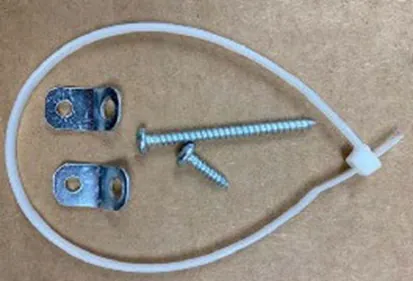
For a product-safety team, the uncomfortable part is not only that the component failed. Components fail. The uncomfortable part is that the defect had a clean operational shape: one material-level issue, one supplier origin, many finished-goods brands, and a long escape interval. If an AI planning platform is going to earn a place in recall prevention, this is the kind of case it has to compress from years into days.
Why Tip-Over Risk Belongs In The Planning Room
Tip-over risk is sometimes treated as a compliance or instruction-labeling problem, but the injury record makes it a product-safety control problem. A NEISS-based study estimated that 560,203 children were treated in U.S. emergency departments for furniture and television tip-over injuries from 1990 through 2019. For clothing storage unit injuries, 82.5% involved children under 6. [2]
The regulatory floor also changed. The CPSC’s final mandatory standard for clothing storage units, adopted under the STURDY Act and effective in September 2023, includes a 60-pound stability test, testing on carpet, and testing with loaded drawers. The agency cited 234 fatalities from clothing storage unit tip-overs from 2000 through April 2022. [3]
Those facts explain why the category matters. They do not, by themselves, explain where AI should intervene. A planning platform cannot make a dresser stable by noticing an incident trend after shipment. It can only help if the signal arrives while the company can still change a supplier decision, quarantine a batch, hold replenishment, or stop kits from being paired with finished goods.
The Defect-Escape Interval In The New Age Recall
The New Age case is best read as a missed-detection path. A plastic zip-tie with a brittleness problem entered the supply base. It was packaged into restraint kits. Those kits were supplied across a network of furniture companies. The kits accompanied products that were sold to consumers. Only later did the industry face a broad recall. [1]
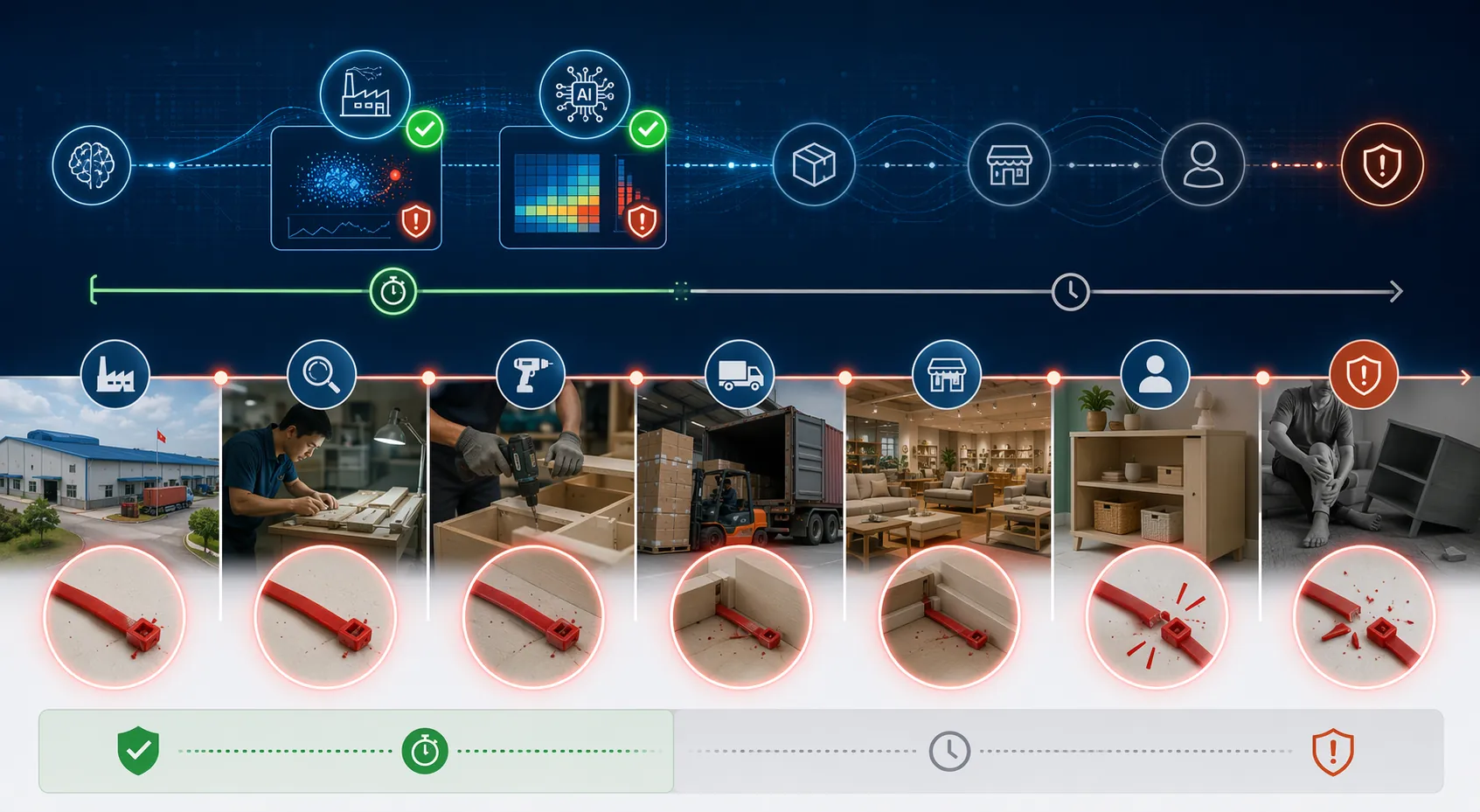
Several gates should have had a chance to catch it. Supplier qualification should have known which manufacturer produced the restraint-kit plastic components. Incoming inspection should have had a sampling plan sensitive to material brittleness, not only package completeness. Assembly or kitting should have retained enough lot identity to connect a failed zip-tie back to a manufacturing source. Distribution should have known which finished goods carried which restraint-kit batches. Retail and customer-service signals should have been able to flow backward into the same map.
The failure was not necessarily that nobody had any data. Furniture companies routinely know enough to forecast demand, replenish inventory, allocate stock, and invoice customers. The safety gap is more specific: many companies do not maintain component-level lineage in a form that lets a quality manager ask, “Which finished goods contain restraint kits using zip-ties from this supplier and date range, and where are they now?”
That question is the hinge. Without it, AI can produce alerts but not containment. With it, a supplier-quality anomaly can become an inventory action before the recall perimeter expands.
What An AI System Would Have Needed To See
A credible AI recall-prevention workflow for tip-over risk would not start with a generic “risk score.” It would start with a weak but traceable signal tied to the component that can defeat the safety function.
| Missed Gate | Useful Signal | Planning Action If Traceability Exists |
|---|---|---|
| Supplier quality | Abnormal brittleness, breakage, failed pull test, or complaint pattern for zip-ties from one source | Raise supplier risk score; block new receipts; require requalification or alternate source |
| Inbound inspection | Inspection failures clustered by component lot, supplier, resin batch, or manufacturing date | Hold receipts; prevent kits from entering assembly or kitting |
| Finished-goods association | Known link between restraint-kit batch and furniture SKUs | Identify affected finished goods before shipment |
| Distribution and retail | Inventory locations containing suspect kit batches | Quarantine warehouses, stop replenishment, and notify retail partners |
| Field feedback | Early complaints or returns mentioning broken ties or unsecured furniture | Expand containment only to related lots instead of defaulting to broad uncertainty |
The important distinction is between detection and execution. A machine-learning model may detect that one supplier’s zip-ties are generating an abnormal failure pattern. That is useful, but incomplete. The recall-prevention value appears when that signal is connected to open purchase orders, in-transit shipments, warehouse inventory, finished-goods bills of material, retail allocations, and replenishment plans.
In the New Age pattern, the first useful intervention would have been supplier-quality anomaly detection: brittleness or breakage clustered around a particular manufacturer, date range, material batch, or production line. The second would have been multi-tier bill-of-material visibility: not just “this dresser shipped with a restraint kit,” but “this dresser shipped with a restraint kit that used this zip-tie source.” The third would have been concurrent planning: while quality investigates, planning stops new exposure instead of continuing to move goods through the network.
Where o9, Blue Yonder, Kinaxis, And Quality Tools Fit
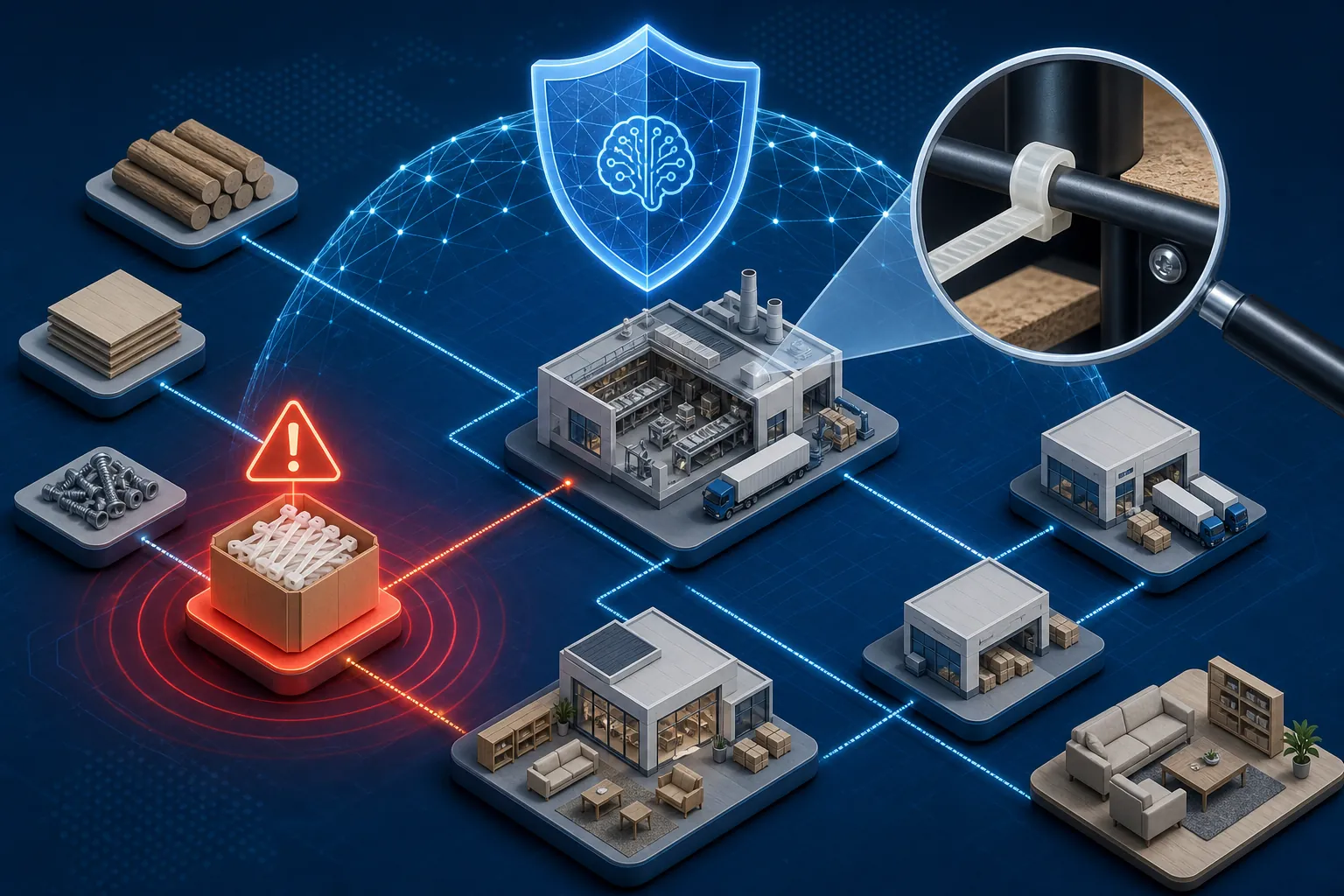
The major supply-chain planning platforms are not product-safety systems by default. Their relevance comes from the mechanics they already emphasize: connected planning data, supplier visibility, anomaly detection, scenario planning, and rapid replanning when a constraint changes.
o9’s planning architecture is commonly discussed around enterprise knowledge graphs and multi-tier visibility concepts. In this use case, that matters only if the graph can represent the restraint-kit component, its supplier, the affected lots or batches, and the finished goods that consumed it. A supplier score that cannot be traced into inventory is only a warning light.
Blue Yonder’s Luminate platform is relevant where disruption prediction and anomaly capabilities can be connected to operational decisions. For tip-over prevention, the anomaly is not a port delay or demand swing. It is a supplier-quality pattern that should change what the company receives, ships, replenishes, and promises.
Kinaxis Maestro is relevant because concurrent planning reduces the lag between a new constraint and a network response. If quality blocks a restraint-kit batch, supply planning should immediately show which customer orders, DCs, production schedules, and retail allocations are affected. The purpose is not a better report; it is a faster containment decision.
Adjacent production-quality systems fill a different gap. QualityLine describes AI-powered recall-prediction technology that uses production and quality data to identify anomaly patterns and specific unit or batch risk. That is closer to the quality signal itself than to the planning response. [5]
Recall-monitoring tools also show the direction of travel: they pull product-safety, recall, and compliance signals into a more structured monitoring workflow. TrackVision, for example, positions recall monitoring around automated surveillance and alerts. That kind of monitoring can help companies notice external recall activity faster, but it is not the same as proving that a supplier-origin furniture component defect was stopped before shipment. [6]
The combined workflow is plausible: production-quality anomaly detection raises the signal; the planning platform maps the signal to suppliers, components, lots, and finished goods; concurrent planning executes quarantine, alternate sourcing, allocation changes, and replenishment stops. The claim becomes weak only when vendors imply that the AI layer alone solves the recall problem. It does not. The layer underneath has to know where the suspect component went.
The Economics Are Clearer Than The Data Readiness
Finance teams usually understand recall exposure once the numbers are put in their language. Lumafield cites Grocery Manufacturers Association data that direct recall costs average $10 million per event, and notes that total economic impact can be three to five times higher when business interruption and related costs are included. Its cited pharma-recall analysis attributes 49% of total cost to business interruption. [4]
Quality teams often use the 1:10:100 defect-cost rule to make the same point operationally: a defect found at design or supplier qualification is far cheaper than one found at final assembly, and far cheaper still than one found after shipment. The precise multiplier will vary by company and product category, but the direction is not controversial. Once a suspect restraint kit is spread across warehouses, retailers, and homes, the cost curve has already moved against the manufacturer.
That is why “months to days” is the right operational target. The promise is not that AI removes all recalls. The promise is that a supplier-origin defect does not have to wait for broad field evidence before someone can identify affected lots and stop additional exposure.
A Conditional Workflow, Not A Proven Furniture Deployment
The honest limitation is important: there is no public record showing o9, Blue Yonder, or Kinaxis preventing a furniture tip-over recall end to end. The technical ingredients exist in adjacent forms, and traceability-led industries such as pharma and food have pushed further on lot control and supplier visibility. But carrying that logic into furniture is an extrapolation, not a documented benchmark.
A furniture manufacturer evaluating these platforms should therefore test the use case backward from containment, not forward from software features. Start with the New Age scenario and ask what the company would know on day one of a brittle zip-tie signal.
- Can the system identify every finished-goods SKU that used the suspect restraint-kit component?
- Can it distinguish supplier, factory, lot, batch, and date range rather than treating the restraint kit as a generic accessory?
- Can quality data from inbound inspection, supplier audits, test failures, returns, and complaints be linked to planning objects?
- Can planners quarantine inventory, block replenishment, simulate alternate sourcing, and notify affected channels from the same risk view?
- Can legal, supplier quality, product safety, and planning teams see the same affected population without rebuilding it manually in spreadsheets?
If the answer is no, the platform may still be useful for planning, but the recall-prevention claim is premature. A model cannot infer component lineage that the company never captured. It cannot quarantine inventory that is not associated with the suspect batch. It cannot shorten an investigation if the supplier contract does not require timely lot-level disclosure.
What Would Have Changed In The New Age Pattern
A stronger system would not have needed to predict a national recall. It would have needed to make a smaller, earlier decision: stop trusting a restraint-kit component until the brittle zip-tie signal was resolved.
In practical terms, that could mean an inbound inspection failure triggers a supplier-quality alert. The alert raises the risk score for the Vietnamese zip-tie source. The planning graph identifies furniture SKUs using kits from that source. Warehouses with affected inventory receive quarantine instructions. Open purchase orders are held. Retail replenishment is paused for affected goods. Alternate kits are evaluated. Product safety and legal see the same exposure population while the failure mode is still under investigation.
That workflow would not prove that every shipped unit is dangerous. It would give the company a disciplined way to prevent additional exposure while the evidence is still narrow. That distinction matters. Overbroad holds are expensive and can desensitize the organization. Underbroad holds leave unsafe products moving. The value of component-level AI planning is the ability to make the hold neither theatrical nor blind.
The New Age recall shows what happens when the affected population is discovered late: the industry has to work across many brands and downstream channels after the product has already escaped. [1] AI supply-chain planning is most useful before that moment, when the question is still operational enough to answer: which lots, which kits, which finished goods, which locations, which orders, and which supplier decision changes today?
The Judgment
AI-driven supply chain planning can plausibly flag tip-over risks before recalls when three conditions are met: supplier-quality anomalies are detected early, component-level traceability connects the signal to affected finished goods, and planning execution can quarantine or reroute inventory immediately.
For furniture and adjacent consumer-goods manufacturers, that makes the use case technically credible but operationally conditional. The platforms can help compress the defect-escape interval from months to days. The industry has not yet shown, in public furniture tip-over deployments, that it consistently has the multi-tier supplier data, batch discipline, and cross-functional workflow needed to make the confident version of the claim true.
References
- Alliance4Safety and 33 Furniture Companies Recall Millions of Plastic New Age Furniture Tip-over Restraint Kits, CPSC.gov
- Furniture and Television Tip-Over Injuries to Children Treated in United States Emergency Departments, PMC
- CPSC Adopts Final Consumer Product Safety Standard to Prevent Tip-overs of Dressers and Other Clothing Storage Units, CPSC.gov
- The Real Cost of a Product Recall and How to Prevent One, Lumafield
- Enhancing Product Quality: QualityLine’s AI-Powered Recall Prediction Technology, QualityLine
- Recall Monitoring, TrackVision
Cited evidence
- How AI Capex Is Reshaping Supply Chain Software Vendor Risk
A vendor-intelligence analysis of the five major supply-chain planning platforms—Kinaxis, o9 Solutions, Blue Yonder, Anaplan, and RELEX—maps their financial health and AI deployment evidence against the $700B+ hyperscaler AI capex wave. The findings reveal that only Kinaxis offers audited financials and verifiable AI outcomes, while the other four operate under private or subsidiary ownership that obscures financial and deployment risk, making the transparency gap itself a material selection factor for enterprise buyers.
- How AI data center electricity costs change supply chain planning
As AI data centers drive structural electricity price increases, supply chain planners must treat electricity as a variable cost in S&OP, network design, and total-landed-cost models. This analysis provides the evidence and framework for updating planning assumptions.
- What IBM's AI Software Delays Mean for Supply Chain Planning
IBM's Q2 2026 earnings miss and 25% stock drop reveal that AI software revenue delays are tied to client capex shifts, not product rejection. This article examines whether the setback is a temporary blip or a structural risk for supply chain planning buyers evaluating IBM.
Ready to check your own team's readiness for this pattern?
See the supplier quality readiness checklist →Spotted something inaccurate or incomplete in this entry? ChainSignal reviews corrections and additional evidence before publishing an update — this is not a public comment thread.
Flag an inaccuracy / submit evidence for this entry →