AI-powered IBP let pharma quantify tariff risk in 48 hours
How fast should a pharma company quantify tariff exposure? This post-mortem of Amgen, J&J, Pfizer, Merck, and Eli Lilly shows that AI-powered integrated business planning (IBP) enabled 6–15× faster response, and what infrastructure separates the 48-hour responders from the 30-day laggards.
The useful clock started on April 1, 2025. Within 48 hours of the Section 232 pharmaceutical tariff announcement, Amgen had put a number in front of investors: $0.23 per share of tariff exposure, framed on its Q1 earnings call rather than left as an internal sensitivity case. Johnson & Johnson took about two weeks to disclose a $400 million exposure, then cut that estimate to $200 million within three months as assumptions changed. Merck disclosed a roughly $200 million hit after about three weeks. Pfizer took about one month to quantify a $150 million burden, including that 12% of its API imports faced 25% duties.[1][2][3][4]
That spread is the part worth examining. A 48-hour response and a one-month response are not merely different communications styles. In AI-enabled drug supply chain tariff planning, elapsed time often reveals how much reconciliation had to happen after the shock: supplier location data, import classifications, inventory positions, factory schedules, duty assumptions, tax treatment, margin translation, and investor-relations language all had to converge before anyone could safely say the number out loud.
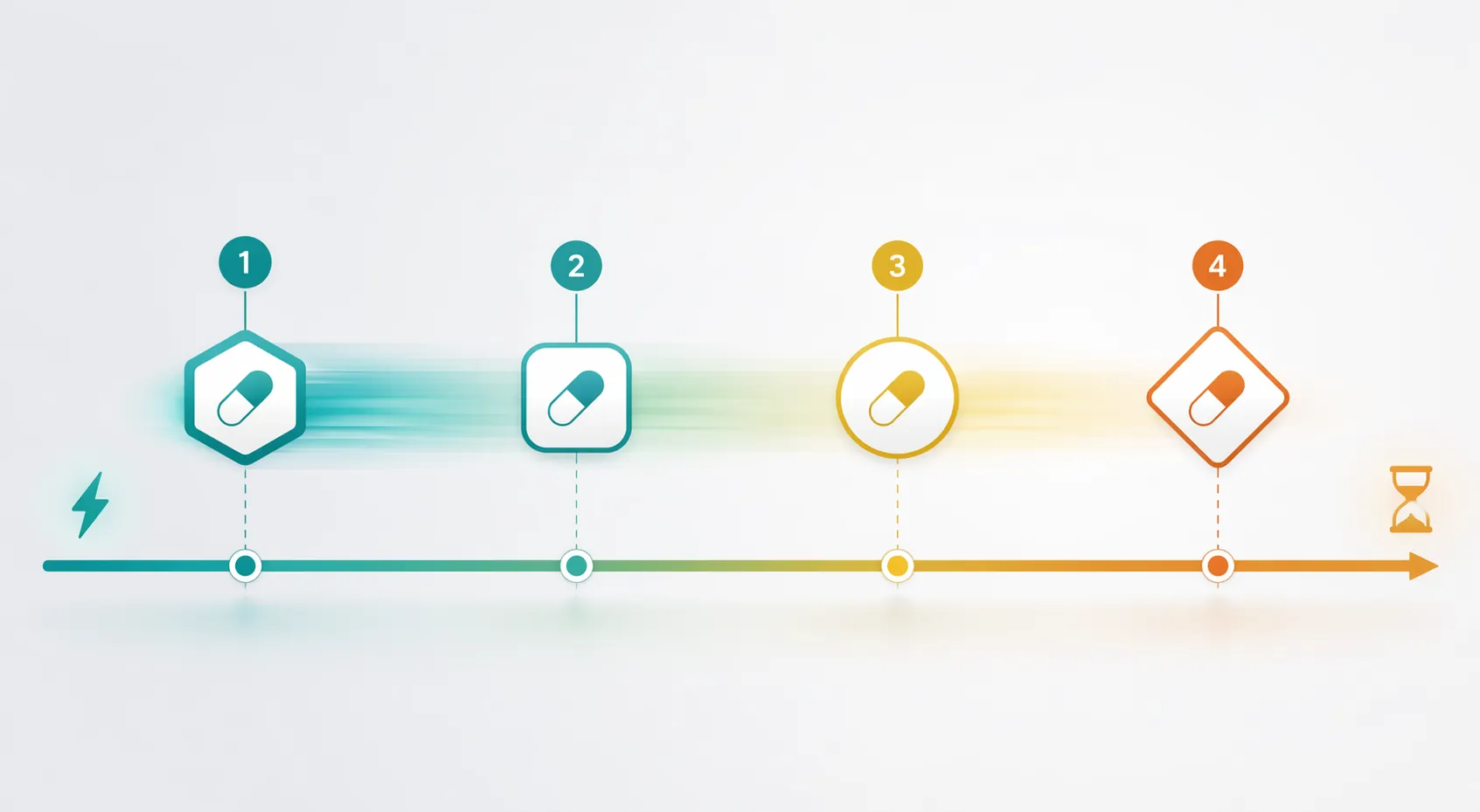
The benchmark is not that every company must publish a perfect answer in two days. Tariff policy was moving, exemptions were uncertain, and earnings-call numbers can later be revised. The benchmark is whether a board-usable exposure range can be produced inside days, and whether that range can be refreshed without rebuilding the analysis from scratch. By that standard, Amgen and J&J sit on the faster end of the operating tempo. Pfizer and Merck show the slower end of the same peer set, without proving that either company was poorly run.
The Speed Gap Was 6-15x, Not A Rounding Error
Amgen’s 48-hour disclosure is the cleanest case because it combined three things that usually live in different rooms: a financial impact expressed as EPS, an operational tariff exposure estimate, and strategic positioning around domestic manufacturing. The same disclosure cycle also highlighted a $900 million Ohio facility investment as a hedge against tariff and supply-chain exposure.[1]
That does not prove a particular software platform produced the answer. It does suggest that supply chain, finance, tax, manufacturing network strategy, and investor relations were close enough to the same version of reality for the company to quantify exposure before most peers had finished public assessment. The impressive part is not the existence of a model. It is the apparent lack of weeks-long spreadsheet lineage debate before the number reached the earnings script.
J&J’s first response was slower than Amgen’s but, operationally, almost as interesting. A $400 million exposure estimate within two weeks gave investors a first read. The later reduction to $200 million within three months showed a different capability: revision agility.[2] A one-time estimate can be assembled by a hard-working crisis team. A halved estimate, produced as policy and mitigation assumptions shift, points toward a scenario environment that can be reopened, challenged, and recalculated.
| Company | Initial public quantification | Reported exposure | What the timing suggests |
|---|---|---|---|
| Amgen | 48 hours | $0.23/share | Fastest first answer; financial, operational, and strategic framing appeared tightly connected |
| Johnson & Johnson | About two weeks | $400M, later revised to $200M within three months | Strong first response plus unusually visible revision agility |
| Merck | About three weeks | Roughly $200M | Slower disclosure tempo, still within the same earnings-cycle window |
| Pfizer | About one month | $150M; 12% of API imports facing 25% duties | More extended cross-functional assessment before public quantification |
| Eli Lilly | No comparable quantified timing in the provided materials | Not benchmarked here | Insufficient public evidence in this source set for the same response-speed comparison |
The resulting response-time spread is roughly 6x from Amgen to J&J’s two-week disclosure and about 15x from Amgen to Pfizer’s one-month assessment. The point is not to assign virtue by stopwatch. It is to notice that tariff response speed is one of the few AI-planning claims that can be checked against dated, named disclosures.
ZS’s policy-response framework is useful here because it separates broad resilience language from the planning behaviors that matter under policy shock. Its analysis describes delayed quantification and siloed responses as common pharma problems, while pointing to AI-driven integrated business planning as a way to connect strategic, operational, and financial planning for faster scenario analysis.[5]
Why The Shock Mattered, Without Turning This Into A Tariff Primer
The policy backdrop matters only because it explains why a rough internal estimate was not enough. Brookings examined whether pharmaceutical tariffs would achieve their stated goals and raised the problem of generic drug supply implications, where cost increases can hit products with thinner economic cushions.[6] ZS, citing Cognitive Market Research, noted generic API cost increases of 12-20% for amoxicillin, acetaminophen, and metformin in its tariff-policy discussion.[5]
Logistics Viewpoints later framed pharmaceutical tariffs as part of a broader restructuring pressure on global drug supply chains.[7] That is the operating problem pharma planners were handed: not just “what is the duty rate,” but which supplier, site, inventory bucket, shipment lane, product family, and earnings line absorbs the consequence.
There is also a legal caveat that should stay attached to any 2025 tariff post-mortem written in Q3 2026. The Feb. 20, 2026 Supreme Court ruling striking down IEEPA-based reciprocal tariffs created legal uncertainty around some tariff measures described in earlier sources, so current tariff tiers and authority should be verified before applying these numbers to a live exposure model.[7]
What Had To Exist Before April 1
A company does not wake up on announcement day and suddenly connect import data, supplier geographies, inventory, production schedules, and financial guidance. The 48-hour version of the work has to be mostly pre-wired. The model may run after the announcement, but the data relationships have to exist before it.

The infrastructure behind fast tariff quantification is less glamorous than most AI demos. It starts with real-time cost modeling: landed cost by SKU or product family, supplier location, tariff classification, API source, and import share. It then needs multi-scenario simulation: duty rates, exemptions, inventory drawdown, alternate supplier availability, transfer pricing assumptions, logistics routing, and manufacturing network constraints.
The hard part is translation. Supply-chain exposure is not yet an investor-ready number. Someone has to convert it into gross cost, mitigation-adjusted exposure, margin impact, EPS effect, or cash-flow timing. The format chosen tells you which teams were connected. Amgen’s EPS framing implies a different level of finance integration than a raw import-duty estimate, while Pfizer’s API import-share disclosure gives a more operational view of the exposure base.[1][4]
This is where integrated business planning earns its keep. Strategic planning asks whether domestic capacity, alternate sourcing, or portfolio choices change the exposure. Operational planning asks which factory, batch, supplier, and shipment decisions can move. Financial planning asks what can be defended in guidance and what must remain a sensitivity range. AI helps when it shortens the time between those questions instead of producing a polished answer from disconnected inputs.
A control-tower layer is usually part of the prerequisite, because the model needs visibility into where inventory is, which orders are committed, and which flows are exposed. That is the same visibility problem discussed in which supply chain control tower model fits your bottleneck, only with a tariff clock attached. A weak visibility layer forces planners to spend the first days proving what is already in transit or already committed.
The cloud layer matters for a less visible reason: scenario work is bursty. Tariff planning asks teams to run many combinations quickly, then discard most of them. The infrastructure issues covered in what cloud infrastructure does AI supply chain planning actually need become practical when a company has to compare tariff tiers, exemptions, supplier switches, logistics alternatives, and financial sensitivities before the next executive meeting.
The Difference Between A First Answer And A Refreshable Model
J&J’s revision from $400 million to $200 million deserves as much attention as Amgen’s 48-hour first answer because it tests a second capability. Initial speed can come from executive urgency, a strong war room, or a well-rehearsed crisis playbook. Revision speed requires the assumptions to remain live.
A refreshable tariff model has to preserve the link between the assumption and the consequence. If an exemption changes, the model should show which products move. If a supplier-location assumption changes, the model should show which import flows and factory schedules are affected. If inventory can bridge a window, the model should show whether the benefit is a timing deferral or a true cost reduction.
This is also why the vendor story should be handled carefully. Kinaxis has described life-sciences customers using Maestro for multi-scenario tariff comparison across supplier locations, inventory, factory schedules, logistics costs, and customer commitments.[8] That is a credible example of the workflow category. It is not evidence, from the provided materials, that Amgen, J&J, Pfizer, or Merck used that exact platform for these disclosures.
FreightWaves described AI moving from planning toward execution as manufacturers confronted tariff uncertainty, which fits the broader pattern: companies wanted systems that could do more than generate planning slides.[9] Pharmaceutical Technology made a related resilience argument for drug makers and distributors facing tariffs, uncertainty, and disruption.[10] The practical distinction is whether the system lets teams change an assumption and see the operational and financial consequences quickly enough to matter.
What The Slower Cases Do And Do Not Prove
Pfizer’s one-month assessment and Merck’s roughly three-week disclosure should not be read as evidence of incompetence. Large pharma networks are messy for legitimate reasons: regulated sites, validated suppliers, complex tax structures, product-specific quality constraints, and public-company disclosure discipline. A slower number can reflect a higher threshold for public certainty as much as slower planning mechanics.
Still, the timing difference is too large to dismiss. Pfizer’s assessment included a $150 million burden and a specific operational detail that 12% of API imports faced 25% duties.[4] Merck’s disclosure of a roughly $200 million hit arrived after about three weeks.[3] Those are usable numbers, but they arrived on a slower operating tempo than Amgen’s and J&J’s.
The likely explanation is not a single missing tool. It is the amount of manual reconciliation required across functions. If trade compliance has one version of supplier exposure, manufacturing has another version of feasible sourcing, finance has a different cost bridge, and investor relations is waiting for an approved range, the calendar fills quickly. The work may be diligent and still slow.
There is a fair counterweight. C-suite alignment, existing crisis playbooks, regulatory readiness, and plain executive discipline can compress response time even without best-in-class AI architecture. The pattern supports a link between integrated planning maturity and speed; it does not experimentally prove that AI infrastructure caused every hour of the gap.
A Practical Q3 2026 Benchmark
By Q3 2026, a serious pharma IBP environment should be judged against a practical tariff-response standard: produce a defensible first exposure range within 48 hours to two weeks, then revise it as policy, exemptions, sourcing, inventory, logistics, and financial assumptions change. The first number does not have to be final. It does have to be traceable.
That standard gives transformation owners a better business case than generic AI maturity language. The question is not whether the company has forecasting AI, a control tower, or an IBP program by name. The question is whether the next policy shock can move through the planning stack without waiting for every function to rebuild its own answer.
The adjacent pharma readiness pattern is familiar from recall response: the companies that move fastest are rarely improvising every connection during the incident. They already know where the data lives, who can approve the decision, and how operational facts become defensible external action. That same organizational muscle appears in how AI transforms pharma recall response from reactive to predictive. Tariffs are a different trigger, but the readiness test is similar.
For companies comparing tariff-AI programs across industries, the US-Canada tariff volatility case discussed in how AI supply chain planning tackles US-Canada tariff volatility offers a useful parallel. Pharma adds regulatory, quality, and product-access constraints, but the planning requirement is the same: compare scenarios while the commercial and legal facts are still moving.
The caveats matter. The company exposure figures cited here came from earnings-call disclosures and may have been revised. Generics exemptions remain provisional and subject to annual review. Legal uncertainty after the Feb. 20, 2026 Supreme Court ruling means live tariff authority should be checked before any current planning decision. Within those limits, the operational lesson is narrow and useful: fast disclosure came from connected planning infrastructure already in place; slower disclosure suggests more manual reconciliation across functions before the company could defend the number.
References
- Amgen Q1 earnings call disclosure
- Johnson & Johnson tariff exposure earnings-call disclosures
- Merck tariff exposure earnings-call disclosure
- Pfizer tariff exposure earnings-call disclosure
- Adapting to dynamic U.S. pharma policy: Strategies to future-proof your supply chain, ZS, 2025
- Will pharmaceutical tariffs achieve their goals?, Brookings, 2025-03
- Pharmaceutical Tariffs and the Restructuring of Global Drug Supply Chains, Logistics Viewpoints, 2026-04-10
- Kinaxis Maestro life sciences tariff scenario comparison comments, Kinaxis
- AI shifts from planning to execution as manufacturers confront tariff uncertainty, FreightWaves, 2026
- Tariffs, uncertainty and disruption: how drug makers and distributors can build operational supply chain resilience, Pharmaceutical Technology, 2025/2026
Cited evidence
- How Supply Chain AI Fared Under the Red Sea Chokepoint
The Red Sea crisis tested supply-chain AI platforms like no other event since the category matured. This analysis compares how Kinaxis, Blue Yonder, o9, RELEX, and Anaplan handled the disruption, revealing where real usage data exists and where vendors rely on marketing claims.
- AI Supply Chain Risk Management in the 2026 Oil Price Spike
This analysis maps how AI planning platforms from o9, Kinaxis, C3 AI, and Resilinc performed during the three phases of the 2026 Strait of Hormuz oil crisis, and identifies which capabilities mattered most—and which gaps remained.
- How AI Supply Chain Disruption Planning Handles Texas Earthquakes
This analysis shows how AI-powered scenario planning platforms (o9, Kinaxis, Blue Yonder, Everstream) enable supply chain leaders to model and mitigate the accelerating induced seismicity risk in the Permian Basin, drawing on documented trend data, regulatory responses, and platform capabilities.
Ready to check your own team's readiness for this pattern?
See the integrated business planning readiness checklist →Spotted something inaccurate or incomplete in this entry? ChainSignal reviews corrections and additional evidence before publishing an update — this is not a public comment thread.
Flag an inaccuracy / submit evidence for this entry →