How AI Enables Precision Recall Management in Food Supply Chains
Food recalls cost millions and often fail traceability requirements. This article examines how AI-powered traceability and scope prediction cut recall response time by over 80% while reducing unnecessary product waste by up to 95%.
When a contamination signal becomes real, the first question is not how to write the report. It is which lots get held, which shipments stay moving, and which clean product can still be defended while quality, supply chain, customer service, legal, and plant teams compare notes.
The cost of getting that wrong is still large enough to change behavior. iFactory cites 1,590 FDA food recalls in FY2025, and the older GMA benchmark still puts average recall cost around $10 million as a directional reference; Lumafield notes that 52% of recalls exceed that level and 1 in 20 surpass $100 million [1][2].
The manual baseline is slower than most dashboards imply. Using iFactory's GMA-cited traceability data, 68% of facilities miss the FDA's 4-hour one-up, one-back requirement; a single-batch manual trace averages 8.2 hours, and a multi-batch trace averages 18.7 hours [1].
What Changes After The Trigger
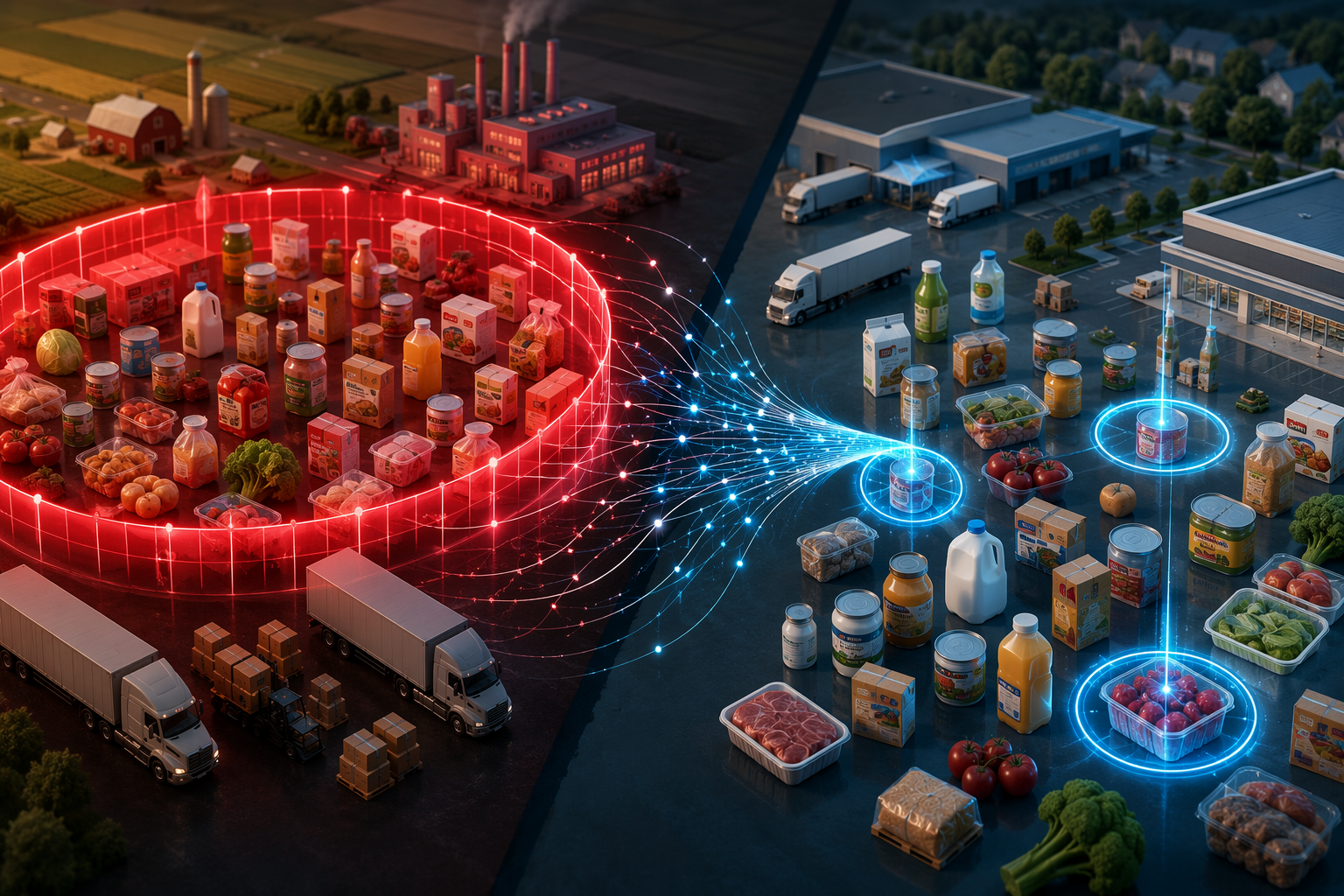
AI only matters here when it has enough of the operation connected to make a defensible boundary. That means lot-level records tied across ERP, MES, WMS, supplier data, customer records, and any live process signals the plant actually keeps. Once those pieces form a digital thread, the model is no longer guessing from a single transaction line; it is predicting scope across the path the product actually took.
That is why the best claims are about scope, not about compliance theater. iFactory says AI-based scope prediction can identify affected lots, shipments, and customers within 90 seconds at 95%+ accuracy, which shifts recall management from broad batch retrieval toward targeted containment [1].
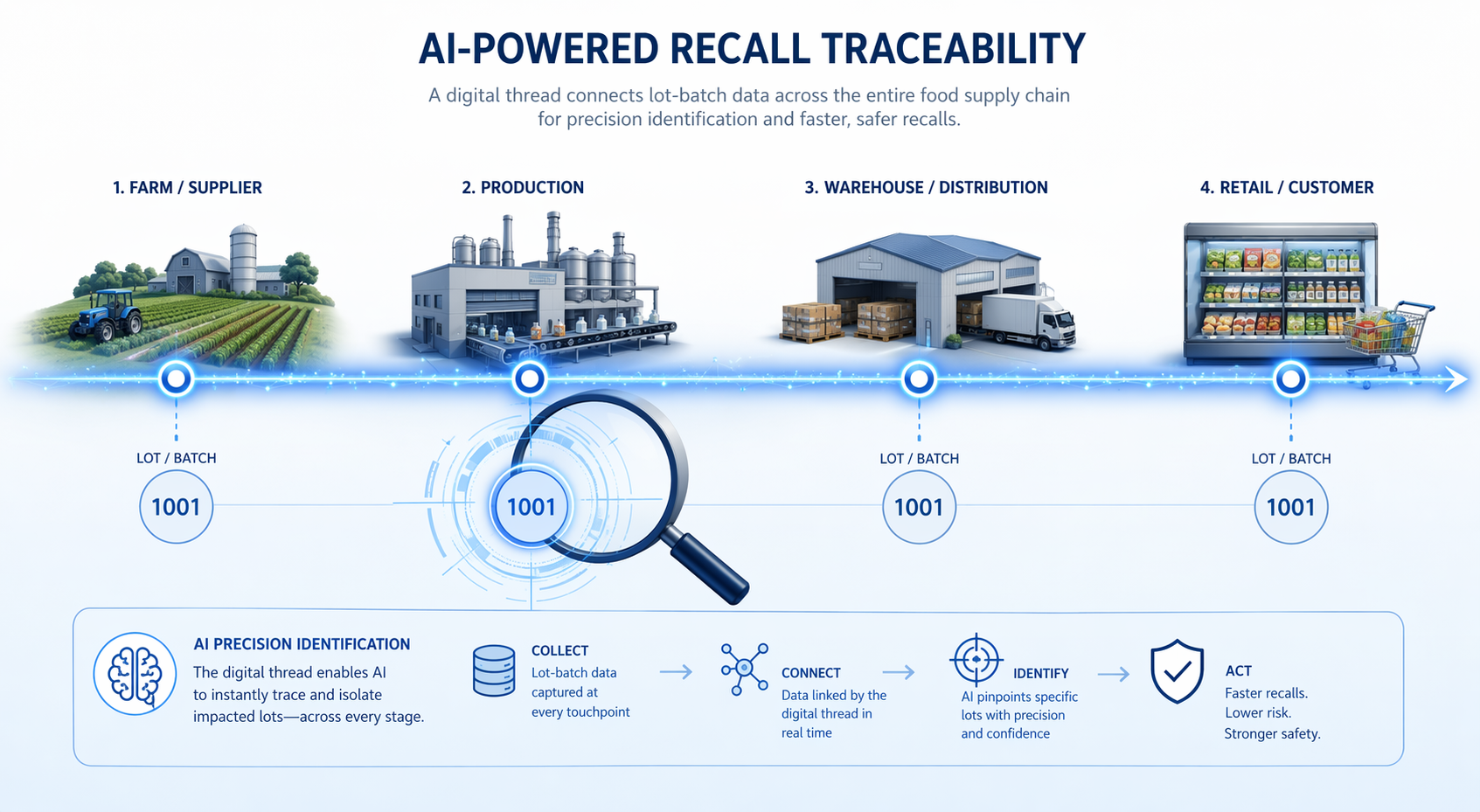
The practical gain is not just speed. It is the ability to hold what is actually implicated without freezing the rest of the warehouse, the retailer allocation, or the clean finished goods sitting next to the suspect run. That is where precision recall management starts to look different from ordinary traceability paperwork.
The recognizable milestone is still the Walmart/IBM Food Trust lettuce trace, which FoodSafetyTech says reduced origin tracing from 7 days to 2.2 seconds [3]. It is an old example now, but it remains useful because it shows what happens when the chain is already instrumented enough for the search to become near-instant.
Where The Gains Show Up
Once the digital thread is in place, the gains show up in the work teams already do under pressure. iFactory reports an 86% reduction in recall response time, full traceability in under 4 hours, and automated mock recall exercises compressed from 2-3 days to under 2 hours [1].
FoodReady reports a similar operational pattern from a different deployment context: mock recalls cut from 4-8 hours to 10-30 minutes, data-entry errors reduced by 85-95%, and first-time audit pass rates above 90% [5]. Those numbers matter because they describe the part of recall management that usually burns time before anyone even debates the final scope.
Why Adoption Still Lags
The adoption gap is the real question, not the promise. BCC Research's 2025 figures, as reported by IFT, put AI use in food safety and quality control below 30% globally even as the market is projected to grow from $2.7 billion in 2024 to $13.7 billion by 2030 at a 30.9% CAGR [4]. That is a fast market, but it is not yet the same thing as a ready plant network.
The reasons are mostly operational. Records are fragmented, lot discipline is uneven, legacy systems do not talk cleanly to each other, and recall workflows are often rehearsed as a paperwork exercise rather than as a live decision path. If the upstream and downstream records do not agree, the model has nothing credible to tighten.
That is also why automated mock recalls and real-time readiness dashboards matter even when they are not the headline feature. They expose gaps in the digital thread before an actual event does, when a wrong lot assignment is merely an embarrassing drill result instead of a frozen shipment and a customer call list.
AI does not make recalls disappear, and it does not replace food safety accountability. It changes the recall boundary from "everything that might be implicated" to the lots, shipments, customers, and locations the data can defensibly identify. The companion article on the 23-day blind spot covers the detection side; this one starts once the recall has already been triggered and asks how precision containment is actually executed.
References
- iFactory — Product Recall Management Traceability & AI Mock Recall Exercise Optimization
- Lumafield — The Real Cost of a Product Recall and How to Prevent One
- FoodSafetyTech — Harnessing AI Can Help to Ensure Safe Food for Consumers Across the US and Beyond
- BCC Research via IFT — AI Revolutionizes Food Safety and Quality Control Market
- FoodReady — Transforming Food Safety With AI-Native Traceability
Cited evidence
- How Supply Chain AI Makes Food Recalls Preventable
Supply chain and food safety leaders evaluating AI for recall management will find evidence that AI detection systems can identify contamination signals before quality thresholds are crossed, compress root-cause analysis from days to under 20 minutes, and reduce affected product volume by 60–80%.
- How AI Enables Proactive Supply Chain Risk Management
Learn how AI can shift your supply chain risk management from reactive to proactive, with a five-step framework and quantified outcome metrics from real deployments that help build a business case for leadership.
- AI-driven supply chain risk management for food recalls
Learn how AI-powered predictive risk detection can help food manufacturers and retailers catch contamination earlier, compress detection latency from weeks to hours, and shift from reactive recall response to proactive prevention — supported by 2025 FDA recall data and documented AI capabilities.
Spotted something inaccurate or incomplete in this entry? ChainSignal reviews corrections and additional evidence before publishing an update — this is not a public comment thread.
Flag an inaccuracy / submit evidence for this entry →